
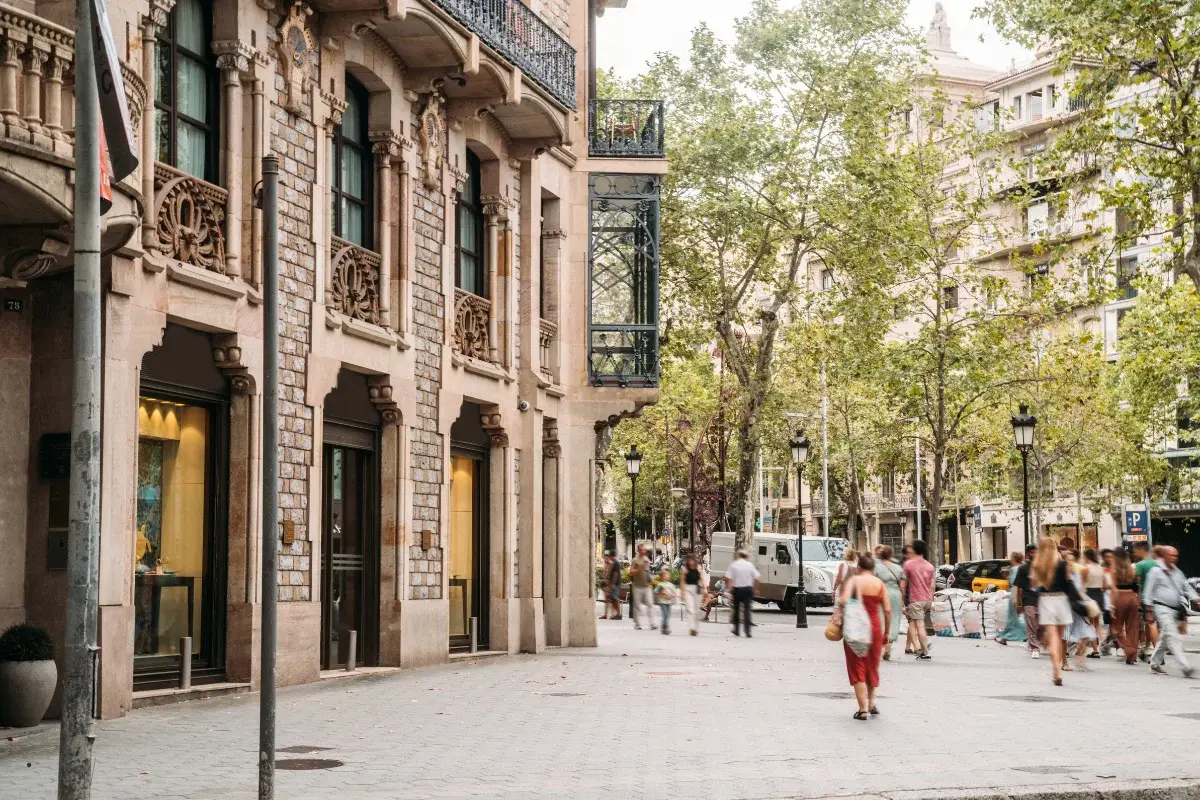

The best streets in Barcelona are not where most travel guides send you. After walking this city daily for years, I can tell you the single biggest mistake visitors make is spending their whole trip on Las Ramblas — a street that, despite its fame, delivers the worst version of Barcelona.
This guide works differently. Instead of ranking streets arbitrarily, I have organised them by what kind of traveller you are, because the perfect street for an architecture lover is completely wrong for someone who hates crowds.
Which streets are actually worth walking? For architecture, walk Passeig de Gràcia. For local life, choose Enric Granados. For medieval atmosphere, Carrer del Bisbe or Carrer de Montcada. For something genuinely off the tourist map, Passatge de Tubella in Les Corts. All are free to walk, reachable by metro, and most are within walking distance of each other.
Every street here is free to walk and reachable by metro. I have included honest photography timing, the best part of day for each, and the mistakes that ruin most visits.
What Makes a Barcelona Street Worth Your Time
Barcelona has over 1,200 named streets, and most are forgettable. The ones worth seeking out share three qualities: architectural layering (you can read centuries of history in a single block), human scale (built for walking, not cars), and what locals call caràcter — roughly, the feeling that this street could exist nowhere else. The streets in this guide all have it. What varies is the type, which is why the guide is sorted by traveller rather than by ranking.
For the wider picture of how these streets connect into a trip, the guide to the best things to see in Barcelona maps them against the major sights.
The Eixample, Barcelona’s Grand Stage
The Eixample grid, designed by Ildefons Cerdà in 1860, was the most ambitious urban planning project in 19th-century Europe. Each block measures exactly 113 metres per side, with 45-degree chamfered corners that create the octagonal intersections you see in every aerial photo. But not all Eixample streets are equal — two have evolved into something the plan never anticipated.
Passeig de Gràcia, the World’s Greatest Architecture Walk
This 1.2-kilometre boulevard between Gran Via and Diagonal is the non-negotiable starting point for any Barcelona walking itinerary. Within a single block — the Manzana de la Discordia — stand three masterpieces by direct rivals: Casa Batlló (Gaudí, 1906), Casa Amatller (Puig i Cadafalch, 1900) and Casa Lleó Morera (Domènech i Montaner, 1906).
Look at your feet. The hexagonal sidewalk tiles, designed by Gaudí in 1904 for the interior of La Pedrera, were later adapted for outdoor use with an inverted relief so they do not turn slippery in rain. The design depicts marine fossils — a jellyfish, a starfish and an ammonite — imagery linked to naturalist Ernst Haeckel, whose illustrated atlas of sea creatures influenced Gaudí directly.
Passeig de Gràcia vs Rambla de Catalunya: these two run parallel, two blocks apart. Passeig de Gràcia gives you the landmark architecture and the famous pavement. Rambla de Catalunya gives you shade, terraces and a pace that does not require constant sidesteps around tour groups. On a hot summer afternoon, Rambla de Catalunya wins.
Best photography time: 07:00–09:00 (oblique light, near-empty sidewalks) or 19:00–21:00 (golden hour on the stone reliefs). Avoid 11:00–16:00 in July and August — harsh light, serious heat, four tour groups per block.
Cost: free to walk. Casa Batlló entry from ~€29; La Pedrera from ~€25. Book in advance — same-day tickets regularly sell out. The full Casa Batlló visitor guide covers which ticket tier actually includes the rooftop.
Enric Granados, How Barcelona Actually Lives
Converted from a car-heavy road to a semi-pedestrianised boulevard in 2012, Enric Granados is the best Eixample street for understanding local daily life. It runs with a slight downhill gradient from Diagonal toward Gran Via — minor on paper, but it means you walk it downhill without realising, stopping at gallery windows and terrace cafés.
On weekend evenings after 20:00, this is where residents do el tardeo — a long, unhurried late-afternoon gathering with no real English equivalent. The detail that tells you everything: unlike Las Ramblas, the terraces here face each other rather than the street. The social architecture is oriented inward, toward conversation, not spectacle.
Best for: travellers who feel uncomfortable in obviously touristy spaces, and photographers after candid, lit street scenes once it gets dark.
Passeig de Sant Joan, Barcelona’s Most Underrated Boulevard
Time Out once named this the best street in the world to live on — a judgment that surprises most visitors, who cross it briefly on the way to the Arc de Triomf and move on. The central tree-lined promenade runs 2 kilometres from the Eixample to Gràcia, flanked by buildings that would be national monuments in most cities. Palau del Baró de Quadras (Puig i Cadafalch, 1904, at number 108) has a facade of such ornate Gothic-Renaissance detail you can spend twenty minutes on the entrance alone.
What sets it apart from Passeig de Gràcia is neighbourhood character. Locals actually use it — for cycling, morning coffee, the weekend market. Walk it northward toward Gràcia: the architecture concentrates and you end at the district boundary, worth exploring in itself through the Gràcia neighbourhood guide.
The Old City, History in Layers
Barcelona’s centre històric contains three very different zones — the Gothic Quarter, El Born and El Raval — each with its own street logic and walking approach.
Carrer del Bisbe, the Gothic Quarter’s Most Photographed Lie
Here is the honest version: Carrer del Bisbe is not medieval. The neo-Gothic bridge that dominates every photo — the Pont del Bisbe, with its arches and gargoyles — was completed in 1928. The architect, Joan Rubió i Bellver, a disciple of Gaudí, designed it to look 600 years old. He succeeded.
Look at the keystone of the central arch: a carved skull with a dagger through it. No documentation has ever explained why. Local legend says the bridge will collapse if Catalonia’s government ever falls; it has not. The street itself, however, is ancient — the paving follows the exact line of the Roman Via Augusta, the main road through Barcino in the 1st century AD.
Photography tip: shoot from directly below, looking up, before 11:00. After that, someone is in every frame. For the wider district, the Gothic Quarter guide separates the genuinely old from the 20th-century reconstruction.
Carrer de Montcada, 15th-Century Palaces, Actually
Running parallel to the Passeig del Born, this narrow street holds the best surviving collection of Gothic civil architecture in Barcelona. The palaces were built by the mercantile aristocracy between the 14th and 16th centuries, when this was the city’s most prestigious address. Five interconnected medieval mansions — the Palau Aguilar, Palau del Baró de Castellet, Palau Meca and others — now house the Museu Picasso (general admission €14, free the first Sunday of each month).
The structural detail worth knowing: the large arched openings at street level were not decorative. They were load-bearing relief arches that let the buildings’ massive ground floors open up for the passage of carts and goods. Medieval logistics in stone. Visit before 09:30 or after 18:00 — at midday in summer this is one of the most crowded streets in the city.
Carrer del Rec, the Street That Used to Be a Canal
In El Born, the curved trajectory of Carrer del Rec is completely anomalous — the only street in the neighbourhood that does not form right angles with its parallels. The reason: it follows the exact course of the medieval canal that carried water from the River Besòs to the Jewish quarter and the Gothic Quarter, in use from the 13th to the 19th century. The stone arcades along parts of the street were originally built to protect the canal from contamination. Walk it slowly and watch the gentle curve — it is the ghost of a 600-year-old waterway.
Carrer de Petritxol, Six Centuries of Hot Chocolate
This pedestrian street, barely 4 metres wide, has connected Plaça del Pi to Carrer de Portaferrissa since the 15th century. It holds an improbable concentration of granges — traditional Catalan chocolate houses — serving thick drinking chocolate with melindros (sponge fingers) for generations. La Pallaresa and Granja Dulcinea have operated in the same spots for decades; a cup runs €4–6. It is most enjoyable from October to March, when hot chocolate makes climatic sense and the summer crowds have thinned.
The Passatges, Barcelona’s Secret Street Type
Most visitors never discover that Barcelona contains dozens of passatges — semi-private or fully private lanes that do not appear on tourist maps or metro signage. Some date from the 19th century, others from 1920s housing developments. All feel like stepping through a door in the city’s fabric. They are also, as the hidden places guide argues, the single most overlooked street type in the city.
Passatge de Tubella, the Closest Thing to Notting Hill in Barcelona
In Les Corts — a neighbourhood with almost zero travel content — Passatge de Tubella is a single row of colourful two-storey detached houses with front gardens, built in 1925. The facades are ochre, terracotta and pale yellow. It sits 200 metres from the Diagonal, one of the busiest roads in the city. The contrast is complete.
How to find it: metro line 5 to Entença, walk north on Carrer de Numància, turn right onto Carrer de Berlín. The entrance is on your left. There is no sign. Morning light before 10:00 hits the facades directly.
Passatge de Permanyer, a Fragment of England in the Eixample
Built in 1864 — the same year as Cerdà’s grid plan — Passatge de Permanyer is a private lane of English-style terraced houses with small front gardens, enclosed by an iron gate left open during the day. Walking in requires a conscious adjustment: the scale drops, the noise disappears, and the architectural language shifts to something that belongs in South Kensington. Visit midweek mornings; weekends now draw some tour groups.
Passatge d’Ibèria, the Street Barcelona Voted Most Beautiful
In a Time Out Barcelona survey asking residents — not tourists — to name the most beautiful street in the city, Passatge d’Ibèria in Sants came first. It beat Passeig de Gràcia. Once you see it the result makes sense: a row of low houses with ochre facades, iron balconies and window boxes, a fragment of rural village architecture absorbed when Sants was annexed by Barcelona in 1897. Metro line 3 or 5 to Sants Estació, five minutes north.
Passatge Camil Oliveras, Gràcia’s Green Secret
Narrower and more overgrown than the others, this Gràcia passatge between Carrer de l’Encarnació and Carrer de Francisco Giner is barely wide enough for two people. The facades are covered in climbing plants, there are cats, and residents have decorated the lane with small ceramic pieces. It has not appeared in any major travel publication, and the residents would prefer to keep it that way — visit briefly, photograph quietly, do not linger in groups.
Beyond the Centre, Streets That Feel Like Other Cities
Carrer d’Aiguafreda, the Village Street Barcelona Swallowed
In the Horta neighbourhood — reachable by metro but feeling genuinely remote — this cobbled lane descends between low stone houses with staircases, classic streetlamps and no cars. When Horta was an independent municipality, this was a normal street; Barcelona annexed it in 1904 and the street never updated. Combine it with the Parc del Laberint d’Horta ten minutes away for a half-day unlike anything in standard Barcelona tourism — but see the cost section below for an important closure note. Metro line 3, stop Mundet.
Carrer de Campoamor, the Jacaranda Tunnel
In spring, typically late April to May, the jacaranda trees lining this Horta street form a continuous violet canopy over 19th-century bourgeois houses. During the two weeks of peak bloom it is one of the most photographed natural spectacles in the city — and one of the least visited by non-residents, because you have to know it exists. Outside flowering season it is a pleasant but unremarkable residential street, so time the visit.
Carrer dels Tallers, Las Ramblas Without the Traps
Parallel to Las Ramblas but free of the tourist density that makes that boulevard exhausting, Carrer dels Tallers has kept the same street plan for nearly 700 years. Pedestrianised, cobbled, with structural buttresses projecting from the facades — not decorative, but supporting walls of buildings that predate deep foundations. Today it holds independent record shops, second-hand bookshops and a screen-printing workshop running in the same space since the 1980s. It is what Las Ramblas was before it became what it is. The vinyl record shops guide maps the music stores along it.
Two Complete Walking Routes
Route A, the Essential Barcelona Walk (3–4 hours)
- 08:00 — Passeig de Gràcia at Gran Via. Walk north, stop at the Manzana de la Discordia, check the hexagonal floor tiles, continue to La Pedrera at number 92.
- 09:30 — Gothic Quarter. Enter via Plaça de Catalunya, walk Carrer del Bisbe, photograph the bridge before tour groups arrive.
- 10:30 — El Born. Walk Carrer de Montcada slowly, look into the courtyard of the Palau Aguilar, continue to Carrer del Rec and notice the curve.
- 12:00 — Passeig del Born for coffee. Return via Carrer dels Tallers for the antithesis of Las Ramblas.
Cost: free unless you enter Casa Batlló or La Pedrera. Add €5–€12 for coffee and breakfast.
Route B, the Local Barcelona Walk (4–5 hours)
For return visitors and anyone who dislikes crowds. Start 09:00 at Passeig de Sant Joan by the Arc de Triomf and walk north. Enter Gràcia, find Passatge Camil Oliveras, cross Plaça del Sol and Plaça de la Vila de Gràcia. Head to Les Corts for Passatge de Tubella and Passatge de Permanyer. End around 15:00 on Enric Granados for late lunch — or arrive after 19:00 to catch the street at its best. Lines 3 and 5 cover the whole route if your legs give out.
The Four Mistakes That Ruin Most Barcelona Street Walks
- Treating Las Ramblas as a destination. It is a corridor, not a destination. The Boqueria, the Palau de la Virreina and the Canaletes fountain are worth seeing, but walking the boulevard at tourist-season density is unpleasant. Cross it, do not walk it.
- Assuming the Gothic Quarter is medieval. Most of what looks Gothic was built or heavily reconstructed between 1910 and 1940, including the Pont del Bisbe (1928). The genuine medieval fabric is on Carrer de Montcada and in the Roman ruins beneath the MUHBA on Plaça del Rei.
- Skipping the passatges. Tubella, Permanyer, Camil Oliveras and d’Ibèria are nearly absent from major travel publications, and they are the most surprising and photogenic streets in the city.
- Walking Passeig de Gràcia at midday. The architecture is extraordinary at any hour, but at midday in July it is 34°C, the light kills the stone reliefs, and tourist density peaks. The same street at 07:30 belongs to the city, not to you.
Cost Breakdown, Walking Barcelona for Free
| Street / Experience | Cost |
|---|---|
| Walking any street | Free |
| Passeig de Gràcia floor tiles | Free |
| Carrer del Bisbe bridge | Free |
| All four passatges | Free |
| Parc del Laberint d’Horta garden | €2.23 general / €1.42 reduced — free Wed & Sun |
| Casa Batlló | from ~€29 (book online) |
| La Pedrera | from ~€25 (book online) |
| Museu Picasso (Carrer de Montcada) | €14–15 — free first Sunday monthly |
| Coffee on Enric Granados terrace | €2–4 |
| Hot chocolate at Petritxol | €4–6 |
One important note on the Laberint d’Horta: the maze hedge itself is closed for restoration from early 2025 until early 2027 (cypress replacement, irrigation and sculpture works). The rest of the garden stays open and free on Wednesdays and Sundays, but the famous maze you may have seen in photos is not walkable right now.
Best Time of Year to Walk Barcelona’s Streets
| Season | Best for | Avoid |
|---|---|---|
| March–May | Jacarandas in bloom (Campoamor), mild temperatures, low crowds | Easter week — crowds spike |
| June–August | Long evenings, Enric Granados after 20:00 | Midday anywhere; August in the Gothic Quarter |
| September–November | Perfect temperatures, autumn light on stone | First weekend of October (La Mercè crowds) |
| December–February | Petritxol hot chocolate weather, near-empty passatges | Heavy rain makes cobblestones treacherous |
Frequently Asked Questions
What is the most beautiful street in Barcelona according to locals?
Time Out Barcelona surveyed residents, not tourists, and the winner was Passatge d’Ibèria in Sants, ahead of Passeig de Gràcia. Second place went to Enric Granados, third to Arc de Sant Agustí. None of the top three appear on standard tourist itineraries, which is exactly why they stay pleasant to walk.
Is Carrer del Bisbe really Gothic?
No. The iconic bridge, the Pont del Bisbe, was built in 1928 by architect Joan Rubió i Bellver, a disciple of Gaudí. The street itself follows a 2,000-year-old Roman road alignment, the Via Augusta, but the dramatic neo-Gothic bridge everyone photographs is barely a century old.
What are the Gaudí tiles on Passeig de Gràcia?
Hexagonal pavement tiles Gaudí designed in 1904 for the interior of La Pedrera, later adapted for outdoor use with an inverted relief so they do not turn slippery in rain. The design depicts marine forms — a jellyfish, a starfish and a fossil cephalopod — linked to naturalist Ernst Haeckel.
Where exactly is Passatge de Tubella?
In the Les Corts neighbourhood, between Carrer de Berlín and Carrer de Numància. Take metro line 5 to Entença, then walk about five minutes north. There is no tourist signage — look for the narrow entrance between two ordinary apartment buildings. A row of 1925 garden houses sits 200 metres from the Diagonal.
Is it worth going to Horta just for the streets?
Yes, if you combine Carrer d’Aiguafreda with the Parc del Laberint d’Horta ten minutes away. Note that the maze hedge itself is closed for restoration until early 2027, though the rest of the garden stays open. The pairing gives a half-day that feels nothing like standard Barcelona tourism.
What time should I photograph Passeig de Gràcia?
Between 07:00 and 09:00 for oblique morning light that reveals the facade relief, or 19:00 to 21:00 for warm golden-hour tones. The architecture photographs worst from 10:00 to 16:00, when direct overhead light flattens the stone carving and tour-group density peaks.
The streets nobody told you about are the ones that stay with you: a silent row of painted houses in Les Corts, a cobbled lane in Horta the city forgot to modernise, a curve in El Born that traces a vanished canal. Those are the streets that make people come back.