

Before you arrive: the suspension bridge of Rupit is not medieval. It was built in 1945 by four local craftsmen — the blacksmiths Francisco and Pere Rovira, mason Salvi Vila and innkeeper Joaquim Marsal. The 10-person capacity limit isn’t a tourist management policy; it exists because the cable and wood structure wasn’t engineered for oscillation under load, and the restriction prevents stress on the anchors. Don’t try to make it swing. This is the most useful thing to know before crossing it.
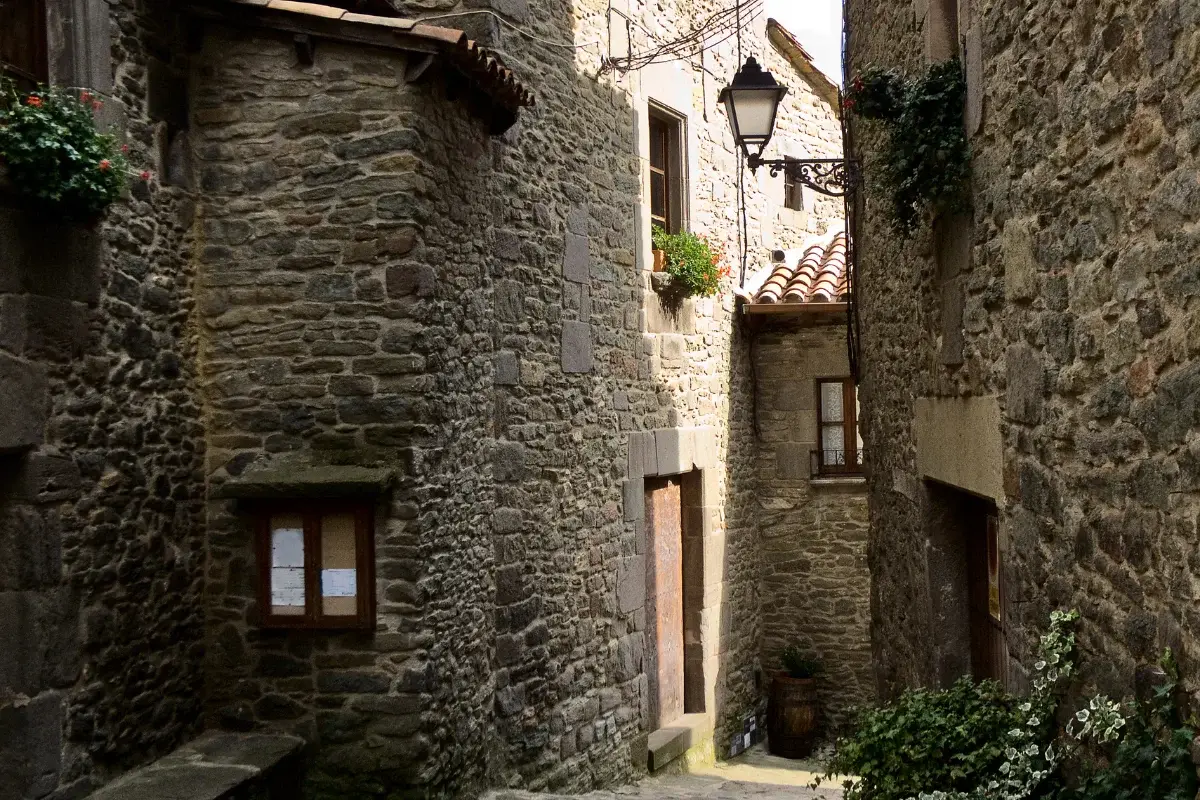
Rupit itself dates from the 16th and 17th centuries, at 822 meters altitude in the Collsacabra massif. The village name comes from the Latin rupes — rock — because the buildings aren’t constructed on rock so much as they’re part of it: in several places, the stone of the floor and the stone of the wall are the same geological formation. The house lintels carry their construction dates in carved stone; some exceed 400 years. It’s 98km from Barcelona, about 1h20 by car. There is no practical public transport option.
Practical Before You Start
Parking: The historic center is blocked to visitor vehicles with retractable bollards. The municipal car park at the entrance, next to the Tourist Office, costs €5 per day for cars and is free for motorcycles. On summer weekends it fills by 10:00 — arrive before that or after 17:00 to find a space.
Access without a car: Technically possible — R3 train to Vic (1 hour) then Sagalés line 464 bus to Rupit. Total journey: 3–4 hours each way. The bus has very few departures. Verify the schedule before attempting it.
The free audio guide “Rupes” covers the historic center with information on each building — available as a free download from the town hall website or at the Tourist Office.
The Bridge, the Village Entrance and the Best Photograph
The bridge was built to give direct access to the historic center across the riera (stream) without having to loop around the valley. It was fully restored in 1994. The crossing takes about 90 seconds. The two rules — maximum 10 people, no deliberate swaying — are structural, not ceremonial.
The classic Rupit photograph is taken from the opposite bank to the village entrance, with the bridge in the foreground and the stone houses rising behind it. It works best in the early morning before people are crossing, when the light comes from the east and the stone catches it directly.
Once you’re across, the village opens in front of you as a navigational puzzle. There are no main streets — there are the Carrer del Fossar going steeply upward, the Carrer Barbacana running horizontal, and a series of connecting passages between them. The correct approach is to walk every path before deciding which to photograph.
Reading the Architecture as You Walk
Every house lintel in Rupit has something to say. The construction date carved in stone is the most visible, but the inscriptions also carry religious declarations — “JHS” (Jesus Hominum Salvator) above doorways was simultaneously a statement of faith and a protective charm for the household. Walk with your eyes at lintel level and the village becomes a document.
Key buildings and what they tell you:
The Carrer del Fossar is the steepest street and the most photographed. The name comes from the old cemetery that stood behind the church. The steps are cut directly into limestone, and the houses have original wooden balconies. It leads to the Plaça dels Cavallers, the highest point of the historic center, with rooftop views.
The Notaria Soler on Carrer del Palau has a 1608 Baroque shield with a sun — the Soler family symbol — carved above the door. It occupies a 14th-century palace. The old forge (antiga herreria) preserves its original carved portal and windows. It was so well conserved that it served as the model for a replica built at the Poble Espanyol in Barcelona — a useful comparison to make if you’ve seen that open-air museum.
The Ca l’Apotecari (now Cal Mestre) was the village pharmacy. In a medieval settlement, the apothecary was a protected professional — their absence was a survival problem, not an inconvenience. The building’s function explains its central location.
The Church and the Climb to the Bell Tower
The Església de Sant Miquel has roots in the 10th century, though the current building reflects Baroque expansions over several centuries. The Greek cross plan with lateral chapels and an elliptical dome creates central top-lighting that distinguishes the interior from the typical single-nave village church. The 17th-century Baroque altarpiece occupies the main apse.
The octagonal bell tower was built between 1786 and 1869 — the latest architectural addition to the complex and the most visible element from outside the village. On weekends and public holidays it’s possible to climb for €2. The view from the top is the only aerial perspective of the historic center available to visitors — rooftops, streets and the riera in a single frame.
Twenty minutes on foot from the center: the Romanesque church of Sant Joan de Fàbregues, 11th century, single nave with three trefoil-arranged apses and an octagonal lantern tower. The 1976 restoration returned the interior to its original austerity. Rarely visited, genuinely beautiful, and the starting point for the route to the waterfall.
The Salt de Sallent: Europe’s Tallest Waterfall in This Area — When It Has Water
The Salt de Sallent drops 100–115 meters (the measurement varies depending on which reference point is used) and is the tallest waterfall in Catalonia. It forms where the riera de Rupit falls off the Casadevall escarpment.
The information that determines whether the visit is worth planning around: the flow is entirely seasonal. In a dry summer, the waterfall can reduce to a trickle or disappear completely. In autumn, after the first rains, and in spring after snowmelt, it reaches its most powerful state. Check recent rainfall before making the waterfall your primary objective for the trip.
The most common route starts from below the suspension bridge, follows the riera downstream and reaches the viewpoint in approximately 3km. The viewpoint has a metal railing and gives a frontal view of the water curtain and the Agullola — a limestone needle separated from the main cliff by differential erosion, visible from the same position.
Along the path: ruins of the water mills that the riera powered before the 1940 flood. The Molí Rodó and the Salt de Sabaters have sluices and water channels cut into the rock that are visible from the trail.
The Hidden Medieval Graves
In the Bassis plateau, near Sant Joan de Fàbregues, there’s a small Early Medieval necropolis that most visitors to Rupit never find: anthropomorphic rock-cut graves carved directly into the limestone bedrock, with the characteristic head-and-shoulder shape of Early Medieval burial practice. They date from the 9th–11th centuries and represent the first Christian settlers of the area.
They’re often filled with rainwater. They’re unmarked on most tourist maps. They blend into the rocky landscape unless you know to look for them. If you’re walking the Bassis–Sallent circular route (12.5km, 4 hours), they’re on the path between Sant Joan de Fàbregues and the waterfall area.
This is the element of a Rupit visit that most clearly distinguishes someone who came with information from someone who came with a map.
Hiking Routes by Time and Effort
| Route | Distance | Elevation | Time | Character |
|---|---|---|---|---|
| Rupit → Salt de Sallent (linear) | 6km | Minimal | 2h | River, mills, waterfall, Agullola |
| Bassis–Sallent circular | 12.5km | 400m | 4h | Medieval graves, Sant Joan de Fàbregues |
| Rupit → Pruit | 7km | Moderate | 2h | Meadows, Pruit architecture |
| Rupit → Roques Encantades | 10km | 500m | 4h40 | Beech forest, rock formations |
The Roques Encantades route rewards autumn visitors especially — the beech forest changes color in October and the rock formations that give the route its name (Enchanted Rocks) are most atmospheric in low-fog conditions that the Collsacabra produces regularly in that season.
Food: What to Eat and Where
Rupit’s cooking is mountain and seasonal, with products from the Osona region. The fuet and longanissa de Vic here are the real article — Osona is the historical territory of Catalan fuet, and the quality difference from industrial versions is clear at any bar counter in the village.
Seasonal dishes: lamb on the grill, rabbit with wild mushrooms (moixernons in spring), winter escudella stew, Osona mountain beef. The coca de l’àvia is the village sweet — served at breakfast and tea time in the traditional fondas.
- Hostal Estrella (Pl. Bisbe Font) — Catalan cooking with a tasting menu, Michelin Guide recommended
- Fonda Marsal (C/ del Manyà) — seasonal home cooking, the most traditional format
- Restaurant Albert (Sant Joan Fàbregues) — views of the Santa Magdalena hermitage, classic cooking
- Braseria El Coll (Carretera Vic-Olot) — lamb and grilled meats, the outdoor option
The Living Nativity and Dark Sky Certification
The Pessebre Vivent (Living Nativity) on December 27–28 is one of the most famous in Catalonia: over 100 local performers recreating the nativity and medieval crafts — blacksmiths, bakers, weavers — in the actual corners of the village. Admission: €5 adults, free under 9. Tickets at the Tourist Office on the day from 10:00–18:30. Maximum 1,300 people per session. The municipal car park is free if you show your ticket at the exit.
In 2020, Rupit received the Quality Night Sky certification — light pollution is low enough to see the Milky Way with the naked eye on clear nights. Autumn and winter evenings are most favorable. If you’re staying overnight, the orientation of the Collsacabra plateau makes it one of the better dark-sky locations within 100km of Barcelona.
Best Strategy
3–4 hours (quick visit): Bridge crossing and photographs → Carrer del Fossar → Church with bell tower climb (€2) → Plaça dels Cavallers. Skip the waterfall route — you need more time.
Full day: Morning circuit of the village → lunch at Hostal Estrella or Fonda Marsal → afternoon route to Salt de Sallent (return by 18:00) → verify waterfall conditions before committing.
Weekend with surroundings: Saturday in Rupit with the waterfall route → Sunday in Tavertet (15 minutes by car, village on a cliff above the Sau reservoir) + Pantà de Sau (where the medieval church tower emerges from the water in low-water years).
Mistakes to Avoid
- Planning the waterfall as the main objective without checking recent rainfall — a dry summer visit to see the Salt de Sallent can result in a trickle. The walk along the riera is worth doing regardless, but be clear about expectations.
- Arriving by car after 10:00 on a summer weekend without a backup — the car park fills, the center is bollarded, and you’ll spend time you planned for the village circling for parking.
- Rushing the church — the bell tower climb is €2 and gives the only aerial view of the historic center. This is consistently skipped and consistently regretted.
- Taking the transport-free route without verifying the bus schedule — the Vic–Rupit bus has very few departures and the R3 train currently has work-related disruptions. Check current Renfe and Sagalés schedules before attempting by public transport.
- Visiting in the dry season for the waterfall and the wet season for the village photographs — the best combination is spring or early autumn, when the riera has water and the foliage provides visual context.
Further east, Peratallada takes its name from the Latin for cut stone: its defensive moat is excavated straight into the limestone the houses sit on, as the Peratallada medieval village guide describes.
Final Insight
The Collsacabra is one of those landscapes that shifts completely by season: the beech forests of the Roques Encantades in October, the waterfall at full flow in April, the village under snow in January, the dark sky in December with the Living Nativity crowd gone by 20:00. Most visitors to Rupit see one version of it. The place rewards returning at a different time of year — the stone doesn’t change, but everything around it does.
For more on day trips in the Catalan interior, the Penedès day trip from Barcelona covers the wine region in the opposite direction, and the hiking near Barcelona guide organizes the wider network of routes accessible from the city without a long drive.