

Barcelona has more genuinely free content than is usually documented properly. The problem isn’t finding what to do without paying — it’s not knowing the exact hours, which options require advance booking even when free, and which “free” attractions carry conditions most visitors miss. The single detail that trips up the most people: free entry does not always mean walk-in. Most major Barcelona museums require advance online booking even during their free windows, and arriving without one can mean being turned away from a free Sunday afternoon. The specific data is below, and you can build a full day around it without spending more than the daily travel budget needed for transport and food.
Free Viewpoints, the Best and the Most Overlooked
The strongest free experience in Barcelona is a view, and the best of them cost nothing at all. The essential sights worth planning around include several paid viewpoints, but the free ones often beat them on both panorama and crowd levels.
Bunkers del Carmel, the Non-Negotiable
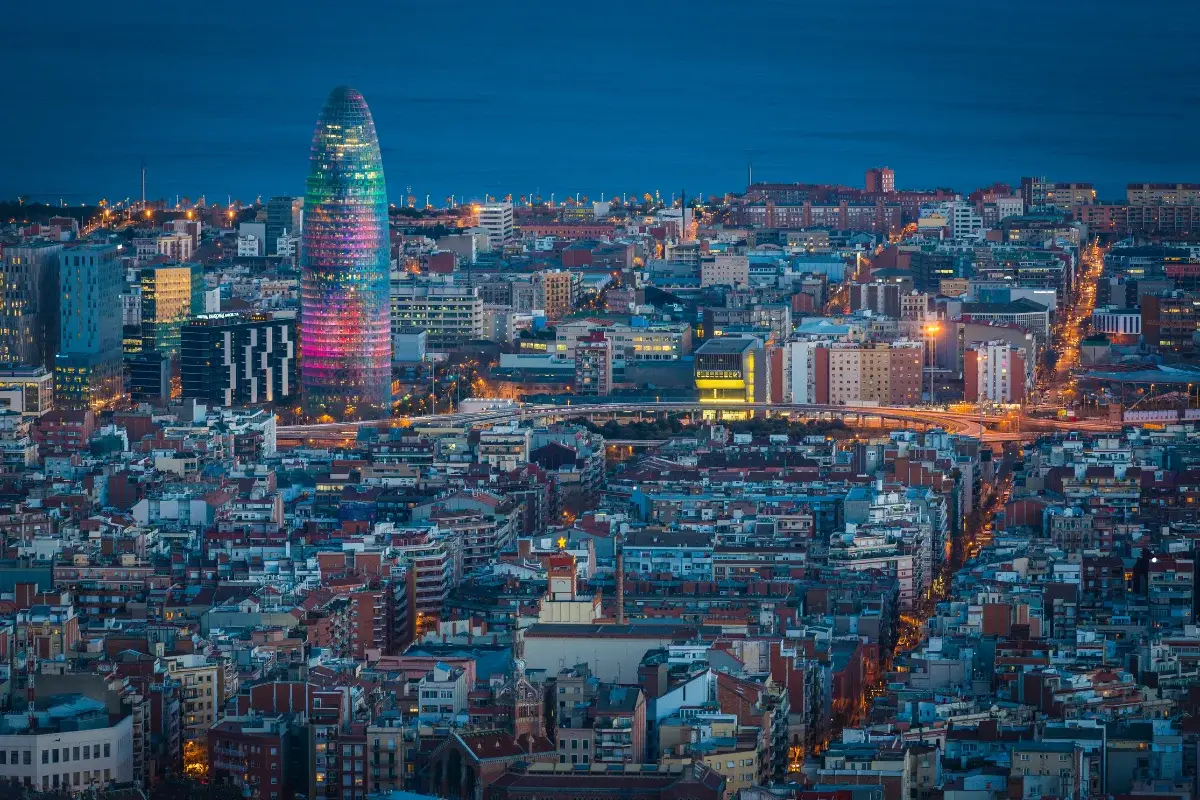
The Turó de la Rovira anti-aircraft battery offers a 360-degree panorama at 262 metres: Sagrada Família, Tibidabo, the port and sea, the full Eixample grid, and the Pyrenees on clear days. Free always, within seasonal hours — roughly 9am to 7:30pm in summer, 9am to 5:30pm in winter — with an enforced closing time. No booking required.
Getting there: bus V17 from Alfons X (metro L4), or metro to El Carmel (L5) and 15 minutes uphill. The final stretch is steep and exposed, so bring water and sun protection in summer. Best light for photographs is 40 to 50 minutes before sunset on a weekday, when attendance is far lower than weekends.
MNAC Terrace, City Panorama Without the Museum Ticket
The exterior terrace of the Palau Nacional, the MNAC building on Montjuïc, looks over Plaça d’Espanya, the Eixample grid and the sea. Access is free regardless of whether you hold a museum ticket — request it at the entrance control and staff direct you to the terrace without charge. It is one of the least-known free viewpoints in the city and the best one reachable without a long climb.
Mirador del Migdia, Montjuïc South Face
On the south face of Montjuïc, away from the standard circuit, the Mirador del Migdia has sea views toward the Llobregat delta with almost no crowds. The bar here is a neighbourhood spot rather than a tourist service. Free and always accessible.
Park Güell Forest Zone, Free Section of a Paid Park
The monumental zone of Park Güell — dragon staircase, Hypostyle Hall, mosaic terrace — costs 18 euros and requires advance booking, after an 80 percent price rise in early 2026. The surrounding forest park covers roughly 95 percent of the total park area and is always free and open. The Three Crosses viewpoint at the summit, 183 metres, sits in the free zone and gives a panorama comparable to the paid terrace without the crowds. Walk up from Metro Lesseps (L3) or Vallcarca (L3), 10 to 15 minutes to the free entrance. For timing the visit to dodge peak crowds, the best time to visit Barcelona breaks down the months and hours that matter.
Museum Free Windows, the Exact Schedule
Most Barcelona museums apply two free-access patterns: the first Sunday of every month all day, and every other Sunday from 3pm. The booking note is critical: most require online advance reservation even during free windows. Book 2 to 3 days ahead in low season, a week ahead in high season.
| Museum | Free, first Sunday | Free, other windows | Booking when free |
|---|---|---|---|
| Museu Picasso | All day (9am–7pm) | Thursday afternoons | Yes, mandatory |
| MNAC | Morning (10am–3pm) | Saturdays from 3pm | Recommended |
| MACBA | n/a | Saturdays 4pm–8pm | Recommended |
| CCCB | All day | Sundays from 3pm | Yes |
| Montjuïc Castle | All day | Sundays from 3pm | No |
| MUHBA (Plaça del Rei) | All day | Sundays from 3pm | Recommended |
| Museu Marítim | All day | Sundays from 3pm | Recommended |
| Museu de la Música | All day | Sundays from 3pm | Recommended |
| Born CCM | All day | Tue–Sun (site) | No |
Note the two traps in that table: the MNAC first-Sunday window is morning only and closes at 3pm, and MACBA is not free on Sundays at all — its free slot is Saturday evening.
Always-Free Museums, No Conditions
These run free every day without restriction and rarely appear in free-activity lists:
La Virreina Centre de la Imatge (Las Ramblas 99) — photography and visual culture exhibitions in an 18th-century palace, with one of the strongest free programmes in the city. No booking.
Arts Santa Mònica (Las Ramblas 7) — contemporary art centre at the end of Las Ramblas. Exhibitions, workshops, festivals, free always.
Palau Robert (Passeig de Gràcia 107) — cultural and photography exhibitions from the Generalitat de Catalunya. Free always.
Born CCM (Plaça Comercial 12) — the medieval archaeological site of 1714 Barcelona, visible from walkways above. The site is always free; the interpretation centre has set hours.
Fabra i Coats (Sant Andreu) — contemporary art in a former factory. Free permanent access.
Free Architecture, the Modernista Circuit That Costs Nothing
The Eixample holds the highest density of Modernista architecture in the world, and most of it is visible from the street without an entry fee.
The Block of Discord (Passeig de Gràcia, between Carrer d’Aragó and Carrer del Consell de Cent) — Casa Batlló (around 33 euros to enter), Casa Amatller and Casa Lleó Morera. The façades from the pavement are extraordinary and free. Entering costs money; the buildings’ most striking architectural elements — the organic ceramic work, the stepped gable, the floral glass — read clearly from outside.
Hospital de Sant Pau (Carrer de Sant Antoni Maria Claret 167) — the largest Modernista complex in Europe, UNESCO-listed, Domènech i Montaner, 1902 to 1930. The exterior, gardens and courtyards are free to enter and walk through. The paid visit, around 16 euros, covers the pavilion interiors. The exterior alone justifies half an hour; the scale is fully legible from the gardens.
Palau de la Música Catalana (Carrer de Sant Francesc de Paula 2) — another Domènech i Montaner UNESCO site. The exterior and exterior vestibule are free; interior guided tours are paid. The façade is one of the most elaborate pieces of Modernista stone and ceramic in the city.
Avinguda de Gaudí — designed by Gaudí, this axis connects Sant Pau to the Sagrada Família in a straight line. Walking it with the Sagrada Família towers at the far end gives the clearest free sense of the scale of Barcelona’s Modernista ambition.
Free Green Spaces and Beaches
Parc de la Ciutadella — the largest park in the historic centre. Ornamental lake with rowing boats for hire (optional), the Cascada Monumental, lawns and sculpture. Always free. 10 minutes from El Born, 15 from the Gothic Quarter.
Montjuïc gardens — the mountain has several free gardens: Jardins de Laribal, Jardins de Joan Brossa, and the Jardí Botànic Històric. Hilltop points give city views without cost.
Parc del Laberint d’Horta — the oldest garden in Barcelona, 18th-century neoclassical with a cypress hedge labyrinth. Entry is 2.23 euros standard and free on Wednesdays and Sundays, no booking required. Metro Mundet (L3). One caveat for 2026: the cypress maze itself is closed for restoration until early 2027, though the rest of the gardens stay open.
Urban beaches — 4.5 kilometres of free beach from Barceloneta to the Fòrum. Nova Icària, Bogatell, Mar Bella and Nova Mar Bella are less saturated than Barceloneta and connected by a flat, car-free seafront path.
Free Street Art and Public Space
El Raval, Keith Haring mural (Carrer dels Àngels, facing MACBA) — a faithful reproduction of the mural Haring painted here in 1989, one of the few works by an artist of that stature in free public space in Europe.
Poblenou, Wall Spot (Carrer de Pere IV) — the most extensive legal street art wall in Barcelona, renewed regularly, functioning as an ongoing document of the city’s scene.
Gothic Quarter public art — “El Beso” by Joan Fontcuberta in Plaça de George Orwell is among the most cited public artworks in the city. The shrapnel craters on the walls of Plaça de Sant Felip Neri, from a 1938 bombing, are the most significant piece of historic public evidence in the quarter. Both free, both always accessible.
Free Markets
Mercat dels Encants (Plaça de les Glòries) — Europe’s oldest flea market under a mirrored canopy designed by Fermín Vázquez in 2013. The architecture is as interesting as the trade. Free entry, open Monday, Wednesday, Friday and Saturday.
Mercat de Sant Antoni (Carrer del Comte d’Urgell 1) — fresh food market, free to enter Monday to Saturday. Sunday morning brings a second-hand book and magazine market in the exterior arcades, one of the most active literary markets in the city. The best markets in Barcelona guide covers the full circuit.
Mercat de Santa Caterina (Avinguda de Francesc Cambó 16) — Enric Miralles’ undulating mosaic roof is architecture as much as market cover. Free entry always.
A Complete Free Day in Barcelona
This itinerary groups by geography to avoid cross-city transit, and pairs naturally with the route logic in the first-time visitor guide:
Morning, Old City
- Gothic Quarter walk before 9am: Cathedral cloister, Plaça de Sant Felip Neri craters, Pont del Bisbe
- Temple of Augustus, Carrer del Paradís 10 (free, opens 10am)
- Born CCM archaeological site (free)
- Parc de la Ciutadella for a rest (free)
Afternoon, cultural institutions (Sundays from 3pm)
- CCCB in El Raval (free, booking required)
- La Virreina Centre de la Imatge on Las Ramblas (free always)
Sunset, viewpoint
- Bunkers del Carmel (free, within seasonal hours) — metro plus 15-minute walk
- Or, if staying central, the MNAC terrace on Montjuïc (free, funicular from Paral·lel)
Total transport: one T-Casual journey at 1.30 euros from a 10-trip card. Entry fees: zero.
Free does not always mean walk in
A museum listed as free without its booking rule leaves visitors at the gate while staff explain the slots are full. Park Güell gets labelled free in full, when only the forest zone is — the monumental zone costs 18 euros and books out. And they ignore the MNAC terrace, one of the best free viewpoints in the city, inside a UNESCO building. Knowing the conditions matters as much as knowing the places, the same way the neighborhood safety guide matters more than a generic warning to “stay alert.”
Mistakes to Avoid
- Going to a free museum Sunday without booking — most require advance reservation even when free; without it you can be turned away regardless of queue.
- Assuming all of Park Güell is free — only the forest zone. The monumental zone costs 18 euros and requires advance booking.
- Treating the MNAC first Sunday as all-day — it’s morning only, closing at 3pm. Confusing it with the afternoon pattern of other museums leaves you at a locked door.
- Going to the Bunkers in July at 7pm on a Saturday — it works, but you share it with several hundred people. Weekday late afternoon is far better.
- Treating La Boqueria as a free market experience — free to enter, but priced for tourist traffic. For the real market, Sant Antoni or Santa Caterina.
One of the cheapest is the Frederic Marès at 4.40 euros, free every Sunday from 3 pm, though no audio guide is lent on free days: the detail is in the Frederic Marès guide.
Frequently Asked Questions
Which museums are free on Sundays in Barcelona?
The first Sunday of every month, MNAC, Museu Picasso, MUHBA, Museu Marítim and others are free. Every other Sunday most municipal museums are free from 3pm. MACBA is the exception, free Saturdays 4pm to 8pm, not Sundays. Almost all require advance online booking even when free.
Do the Bunkers del Carmel have an entry fee?
No, the Bunkers del Carmel are always free. They have seasonal opening hours, roughly 9am to 7:30pm in summer and 9am to 5:30pm in winter, with an enforced closing time. Access to the climb and the viewpoint is free within those hours. No booking required.
Is the Park Güell forest zone really free?
Yes. The monumental zone with the dragon staircase and mosaic terrace costs 18 euros and requires booking. The surrounding forest park covers about 95 percent of the total area and is always free. The Three Crosses summit at 183 metres sits inside the free zone.
Do you need to book free museum slots in Barcelona?
For most major museums, yes. MNAC, Museu Picasso and CCCB require advance online booking even during free windows. Without a booking you can be denied entry despite no visible queue. Book 2 to 3 days ahead in low season and a week ahead in high season.
What is the best free viewpoint in Barcelona?
The Bunkers del Carmel offer a 360-degree panorama at 262 metres, free always, with few crowds on weekday mornings. The MNAC terrace on Montjuïc is the best free viewpoint reachable without a long climb. Both beat any paid viewpoint in the city on value.
Is Hospital de Sant Pau free to visit?
The exterior, gardens and courtyards are free to walk through at any time. The paid visit, around 16 euros, covers the interior of the pavilions. The exterior alone is worth 30 minutes, since the scale of Europe’s largest Modernista complex is fully legible from the gardens.
The real cost of a day in Barcelona is rarely the entry fees — it’s the time spent not knowing which door is open and when.