

This guide is based on real visits across Barcelona’s 39 municipal markets — including checking what’s actually sold at each, when the locals go, and which ones are genuinely worth your time versus which ones have become something else entirely.
Barcelona has 39 municipal markets, one for each neighbourhood in theory. Between them there is an enormous difference: the ones everyone visits, the ones Barcelonese residents actually use for daily shopping, and the ones that contain experiences that appear in no standard guide. The most important thing to understand before visiting any of them: La Boquería and the neighbourhood markets are not the same product. They serve different functions, attract different people, and deliver completely different experiences.
Quick Answer: Best Markets in Barcelona Most famous (but visit before 10am): La Boquería, Las Ramblas (300 stalls, food bars worth the trip). Best neighbourhood market: Sant Antoni (three personalities: food, clothing, Sunday collectibles). Best architecture + archaeology: Santa Caterina, Born (Miralles roof, free medieval excavation underneath). Best for chefs and serious food: El Ninot, Eixample. Best antiques + live auction: Els Encants, Glòries (only public auction market in Europe). Least touristy: Mercat de Galvany (Sarrià), Mercat de la Llibertat (Gràcia).
Quick Picks
- Best food market experience → El Ninot (Eixample, where local chefs shop, low tourist pressure)
- Best market for architecture → Santa Caterina (Miralles ceramic roof, free archaeology below)
- Best market bar → Bar Pinotxo, La Boquería (before 10am, Catalan breakfast with tripe and chickpeas)
- Most unique market in Europe → Els Encants (live public auction Mon/Wed/Fri before 9am)
- Best Sunday market → Sant Antoni (collectibles, comics, vinyl — not food on Sundays)
- Best flowers, 24 hours → Mercat de la Concepció, Eixample (only 24-hour florist in Barcelona)
Quick Decision: Which Barcelona Market Is Right for You?
- Want the iconic market experience → La Boquería, but go before 10:00 to avoid the tour groups
- Want the market where locals actually shop → El Ninot (Eixample) or Mercat de la Llibertat (Gràcia)
- Want architecture + food + archaeology → Santa Caterina, Born (all three in one visit, free)
- Want Sunday collectibles, comics, retro → Sant Antoni Sunday market (not food — see below)
- Want antiques, vintage, live auction → Els Encants, Glòries (Mon/Wed/Fri/Sat, free entry)
- Want flowers at midnight → Mercat de la Concepció, Eixample (only 24-hour flower market)
- Want the most upscale market → Mercat de Galvany, Sarrià (game, charcuterie, imported cheese, zero tourists)
Who Is This For?
- First-time visitors → La Boquería (before 10am) + Santa Caterina (architecture) as a single morning route — both old city, 15 minutes apart
- Food-focused travellers → El Ninot for serious produce; Bar Pinotxo at La Boquería for breakfast; Cuines Santa Caterina for lunch
- Architecture interested → Santa Caterina (Enric Miralles + Benedetta Tagliabue); Mercat de Sant Antoni (Rovira i Trias, 1882); Mercat de Galvany (1927, Art Nouveau dome and stained glass)
- Collectors and culture hunters → Sant Antoni Sunday market (comics, retro gaming, stamps); Els Encants live auction
- Locals-only experience → Mercat de la Llibertat (Gràcia), Mercat del Ninot (Eixample), Mercat de Galvany (Sarrià)
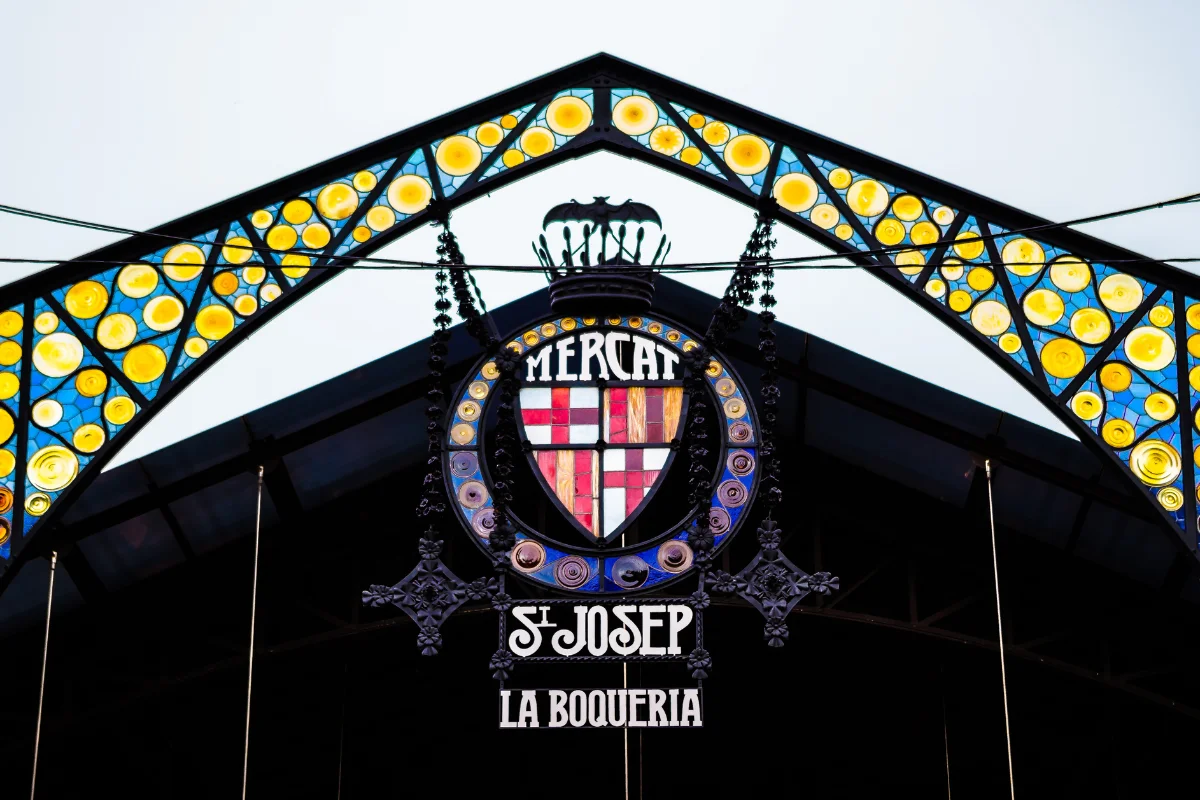
La Boquería — The Most Famous Market and Its Two Realities
Nobody visits Barcelona without passing through La Boquería. Nobody who knows the city well uses it for daily shopping. That tension is what defines the most famous market in the city.
The real facts: Mercat de Sant Josep de la Boqueria sits on La Rambla 91, with the entrance on the promenade and side street access. Over 300 stalls. Up to 40,000 visitors on peak season days. Founded in 1217 as a straw and meat market at the city gate — the Modernista metal canopy that defines it today was completed in 1914. Open Monday to Saturday 8:00–20:30.
The issue: tourist pressure led to a gradual substitution of fresh traditional produce for immediate consumption — fruit cups, juices, snacks. The city council intervened, requiring that at least 50% of each stall’s offering remain within the traditional market scope (unprocessed meat, fish, legumes, raw fruit). That regulation is active and has slowed the drift — but La Boquería remains more tourist-oriented than any other municipal market.
The honest strategy: go between 8:00 and 10:00. At that hour, restaurant chefs are selecting their stock, the fish and shellfish stalls are at their best, and the breakfast bars have seats. After 11:00, the flow of organised tour groups makes movement difficult.
What to Eat at La Boquería
Bar Pinotxo (stall near the main entrance, on the right) has been serving esmorzars de forquilla — fork breakfasts — for decades. Chickpeas with black pudding, cap i pota, tripe. Stew-pot cooking from early morning, no tourist menu.
El Quim de la Boqueria is the reference for fried eggs with baby squid — the dish most photographed by visitors and most repeated by locals. Also pickled sardines and garlic prawns with egg.
Kiosko Universal works grilled fresh fish with product-first simplicity: cuttlefish, prawns, mussels, monkfish. The bar opens directly onto the open kitchen.
For the wider Boquería food context, the best paella in Barcelona guide covers the restaurants that source from this market.
Sant Antoni — The Market with Three Personalities
Mercat de Sant Antoni is the favourite of Barcelonese residents who know the city’s markets. Not for nostalgia — for what it delivers in practice.
Built in 1882, designed by Antoni Rovira i Trias with a Greek cross floor plan and an octagonal central dome. It occupies an entire Eixample block. The comprehensive renovation completed in 2018 produced an unexpected archaeological discovery: during construction, intact sections of the medieval city wall and the 16th-century Sant Antoni bastion appeared. Rather than covering them, they were integrated into the basement levels — visitors walk literally over the city’s history when entering the car park or the market’s service areas.
Three modes of use depending on the day:
Monday to Saturday: the food market — meat, fish, fruit, vegetables, cured meats. Less touristy than La Boquería, more reasonable prices, more direct vendor interaction. The exterior perimeter stalls have the Encants de Sant Antoni — clothing, footwear, household items — on Mondays, Wednesdays, Fridays, and Saturdays.
Sunday is when Sant Antoni has its most distinctive personality: the books, comics, postcards, trading cards, coins, and collectibles market that fills the exterior canopy area. It is the largest Sunday collectibles market in Europe by vendor volume and material variety. Families have been coming for decades for trading card swaps. Specialist booksellers from across Europe search here for out-of-print editions.
Note for first-time visitors: the food market is closed on Sundays. If you come on Sunday, you get collectibles. If you want fresh produce, come Monday to Saturday.
Where to eat near Sant Antoni: Bar Casa Blanca has classic tapas inside the market. For vermut, the Carrer del Parlament — two minutes on foot — is the highest-density neighbourhood bar strip in the area: Bar Calders, Bar Seco, Bodega Sepúlveda. The best tapas in Barcelona guide covers these bars in detail.
Santa Caterina — The Market Over a Medieval Convent
Mercat de Santa Caterina has the most photographed roof of any market in Barcelona — and the least-told story of any of them.
The history of the site: Santa Caterina was Barcelona’s first covered market, opened in 1848 on the site of the former Dominican convent of Santa Caterina de Siena, demolished during the desamortisation. During the 2005 renovation, the convent’s foundations and earlier medieval occupation remains were discovered. The MUHBA — Museu d’Història de Barcelona — manages a free-access space inside the market where these archaeological remains are visible. It is one of the few markets in the world where the visit includes, at no extra cost, an active archaeological excavation.
The Miralles-Tagliabue roof: Enric Miralles died in 2000 before seeing the project completed. Benedetta Tagliabue finished it. The undulating canopy is covered with 325,000 ceramic pieces in 67 distinct tones — the design represents an aerial view of a market fruit and vegetable table. Located in El Born, metres from the Picasso Museum and the Palau de la Música.
Usage profile: quieter than La Boquería, more neighbourhood-oriented, less mass tourism pressure. Wide product offering — meat, fish, vegetables, fruit — with emphasis on quality over volume.
Where to eat: Cuines Santa Caterina has an open kitchen and communal tables. The menu combines Mediterranean dishes with Asian influences — rice dishes, sushi, wok — using the day’s market produce. The most successful model of integrating quality gastronomy inside a municipal market without turning it into a tourist food hall.
Els Encants — The Only Market with a Public Auction in Europe
The Mercat dels Encants has documentation from the 14th century. The current building in Glòries dates from 2013, designed by B720 Fermín Vázquez with a reflective steel canopy that acts as a mirror of the urban surroundings — one of the most distinctive architectural elements in the Glòries area.
The public auction: Monday, Wednesday, and Friday from 07:45 to 09:00, lots from cleared homes, estates, and industrial surplus are auctioned in the central courtyard. It is the only market in Europe maintaining this system. Dealers bid for lots, break them down during the day, and sell individual pieces from their stalls. This guarantees different stock every session — it is impossible to predict what you’ll find.
Over 300 stalls with used clothing, antiques, appliances, furniture, vinyl records, analogue cameras, books, and tools. The vintage and upcycling segment has grown significantly — specialist stalls for 1980s–90s fashion, retro electronics, and period ceramics and porcelain.
Hours: Monday, Wednesday, Friday, Saturday 9:00–20:00. Metro L1 Glòries. Free entry.
For the full vintage market context, the best vintage markets in Barcelona guide covers Els Encants alongside the city’s other specialist second-hand markets.
📍 Carrer dels Castillejos 158, Sant Martí.
The Neighbourhood Markets — Where Barcelonese Actually Shop
These markets don’t appear in most tourist guides. That’s exactly what makes them interesting for anyone who wants to understand how the city actually functions.
Mercat de la Llibertat — Gràcia’s Living Room
Designed by Francesc Berenguer — a direct collaborator of Gaudí — in 1888. Wrought iron and exposed brick. Renovated in 2009 with a conservation approach: original decorative elements were preserved intact. The reference market in Gràcia: organic and local produce, genuine neighbourhood interaction, prices without tourist markup. The market that most clearly answers the question where do people in Gràcia actually buy food.
Mercat de la Concepció — Flowers at Any Hour
Also by Rovira i Trias, 1888. Known as “the flower market” for the florists on the perimeter that operate 24 hours a day. It is the only point in Barcelona where flowers can be purchased at any hour of the day or night. The three-nave metal structure allows natural light that makes the space particularly pleasant. Metro L4 Girona.
Mercat del Ninot — Where Chefs Shop
Renovated in 2015 with modular steel and glass facades. The name comes from a sculpture of a child sailor that survived a fire — the original is in the Museu Marítim, a reproduction stands at the entrance. Consistently rated for the quality of its meat and charcuterie stalls. La Taverna del Ninot is the in-market bar reference for lunch. Heavily frequented by Eixample restaurant chefs sourcing quality produce. Open Monday to Friday 8:00–21:00 and Saturday mornings.
One of the most useful markets for answering where to buy fresh food in Eixample Barcelona — the answer that doesn’t appear in most tourist content.
Mercat de Galvany — The Upscale Neighbourhood Market
Declared an Artistic Monument. Built in 1927 with an octagonal dome and Modernista stained-glass windows. The highest-end produce selection in the city — game, delicatessen, hand-carved jamón, imported cheeses. Long-term neighbourhood clientele, no tourist traffic. The best restaurants in Barcelona at this end of the city source from here.
Mercat de la Barceloneta — The Sea Market
Modern building replacing the original structure. Specialised in fresh fish and shellfish by proximity to the port. Solar panels on the roof, restaurants integrated on the upper level. The most sea-product-oriented market in the city — the natural source for anything that came out of the Mediterranean that morning.
Seasonal Markets That Only Exist at Specific Moments
Fira de Santa Llúcia — since 1786, in front of the Cathedral, during the weeks before Christmas. Where you buy the elements of Catalan Christmas decoration: the Tió de Nadal, the Caganer, hand-made pessebre figures. It predates most European Christmas markets that market themselves as “historic tradition.”
Fira de Sant Ponç — May 11 on Carrer de l’Hospital, next to El Raval. Medicinal herbs, single-flower honeys, artisan products. One of the oldest fairs in the city — documented since the Middle Ages as an herbalists’ fair.
Art Market at Plaça de Sant Josep Oriol — weekends in the Gothic Quarter. Local painters sell work directly on easels in a medieval square. No intermediaries, no galleries — the most direct format of neighbourhood art market available.
Is It Worth It?
La Boquería: Yes — but only before 10:00. After that, it’s a tourist attraction more than a market. Bar Pinotxo and El Quim are worth the visit on their own. For actual shopping, go elsewhere.
Santa Caterina: Yes, unconditionally. The Miralles roof alone justifies the visit. The free archaeology underneath makes it the most layered experience of any market in the city. Less crowded than La Boquería at almost any hour.
Sant Antoni: Yes — knowing which day you’re going. Sunday for collectibles and comics. Monday to Saturday for food. Showing up on Sunday expecting fresh produce means finding none.
Els Encants: Yes, especially for the weekday morning auction. The architecture is worth seeing regardless of whether you buy anything.
Neighbourhood markets (El Ninot, Galvany, La Llibertat): Yes — if you want to understand how Barcelona actually feeds itself rather than what it shows visitors.
Market Quick Reference
| Market | Metro | Hours | Best for | Tourist level |
|---|---|---|---|---|
| La Boquería | L3 Liceu | Mon–Sat 8:00–20:30 | Breakfast bars (before 10am) | Very high |
| Sant Antoni | L2 Sant Antoni | Mon–Sat food / Sun collectibles | Collectibles Sunday | Low |
| Santa Caterina | L4 Jaume I | Mon–Sat 7:30–15:30 (Fri 20:30) | Architecture + archaeology | Medium |
| El Ninot | L5 Hospital Clínic | Mon–Fri 8:00–21:00, Sat am | Quality produce, chef shopping | Very low |
| Els Encants | L1 Glòries | Mon/Wed/Fri/Sat 9:00–20:00 | Antiques, auction (from 7:45) | Medium |
| La Concepció | L4 Girona | Mon–Sat + flowers 24h | Flowers any hour | Low |
| La Llibertat | L3 Fontana | Mon–Sat mornings | Local Gràcia shopping | Very low |
| Galvany | L5 Hospital Clínic | Mon–Sat | Premium produce | Very low |
Note on Mondays: Fish at any market on Monday is not at its best — fishing boats don’t go out on Sundays. For seafood, Tuesday through Friday.
Mistakes to Avoid
- Going to La Boquería after 11:00 expecting an authentic market experience. After that hour, the density of organised tour groups makes movement difficult and the food bars have queues. The 8:00–10:00 window is the only time it operates as a market rather than an attraction.
- Going to Sant Antoni on Sunday expecting fresh produce. The food market is closed on Sundays. The Sunday market is collectibles, comics, and vinyl at the exterior canopy. These are two completely different visits that happen to share the same building.
- Skipping the Santa Caterina archaeology. The MUHBA-managed archaeological space in the basement is free and takes 10 minutes. It’s one of the most unusual inclusions available in any market visit globally.
- Missing the Els Encants auction by arriving at 10:00. The live auction runs 07:45–09:00 on Monday, Wednesday, and Friday. Arriving at 09:30 means the auction is over and the lots are already being broken down at the stalls.
- Buying seafood at La Boquería at tourist prices without checking El Ninot. The product quality at El Ninot is equivalent or better for significantly lower prices, with no tourist markup. Locals know this; visitors rarely do.
- Treating all markets as interchangeable. La Boquería and El Ninot are both “food markets.” One has 40,000 daily visitors and fruit cup stalls. The other is where Eixample restaurant chefs shop. The product overlap is real; the experience gap is total.
La Boqueria is the most famous, not the best
La Boquería is the most famous market, not the best one. Stopping there means missing El Ninot, Santa Caterina, Galvany, and La Llibertat — markets that deliver better produce at lower prices with less tourist friction.
They don’t mention that Sant Antoni Sunday is not a food market. This is the single most common visitor misdirection in Barcelona market content. The collectibles market and the food market are different uses of the same building on different days.
They never mention the Santa Caterina archaeology. The free MUHBA space underneath the market stalls is one of the most unusual market-visit inclusions available anywhere in Europe. It appears in almost no tourist guide.
Best Strategy by Time Available
Got 2 hours (morning): La Boquería at 8:30 (Bar Pinotxo for breakfast) → walk 15 minutes to Santa Caterina (roof + archaeology + Cuines for early lunch). Two markets, two completely different experiences, one old-city morning.
Half-day: Els Encants auction at 8:00 (Mon/Wed/Fri) → stall browsing → lunch in the Poblenou neighbourhood. The best cafes in Barcelona guide covers the Poblenou coffee scene for the post-market hour.
Full weekend: Saturday morning: Mercat de la Llibertat (Gràcia, local produce) → Sant Antoni for food. Sunday: Sant Antoni collectibles market (8:30–14:30) → Els Encants afternoon. Full picture of both market functions.
1-Day Market Plan:
- 8:30: La Boquería — Bar Pinotxo breakfast (chickpeas, tripe, or fried eggs with squid)
- 10:00: Walk to Santa Caterina — Miralles roof + free archaeology + produce browsing
- 12:00: Cuines Santa Caterina — lunch with market produce, communal tables
- 14:30: Metro to Glòries — Els Encants stall browsing (free, architecture worth seeing)
- 16:30: Neighbourhood coffee — specialty coffee Barcelona has options near Glòries
Frequently Asked Questions
Is La Boquería worth visiting in Barcelona?
Yes — before 10:00. The food bars (Bar Pinotxo, El Quim de la Boqueria) are genuinely worth the visit. After 11:00, the tourist density makes it difficult to move. For daily shopping, El Ninot or Santa Caterina deliver better value with less friction.
What does the Sant Antoni Sunday market sell?
Books, comics, postcards, trading cards, coins, vinyl records, retro video games, and collectibles. The food market is closed on Sundays. Hours: 8:30–14:30, exterior canopy of the Modernista building. Metro Sant Antoni (L2).
What is the Els Encants auction and how does it work?
Monday, Wednesday, and Friday 07:45–09:00, lots from cleared homes and estates are auctioned publicly in the central courtyard. Buyers bid in real time; the highest bidder takes the lot as-is. It is the only public auction at a market in Europe. Free to observe and participate.
Where is the archaeology under Santa Caterina market?
In the lower level of the market. The MUHBA manages the space with free access. The remains are from the 13th-century Dominican convent and earlier medieval occupation. Visitable while shopping, no extra cost.
What is the least touristy market in Barcelona?
Mercat de Galvany (Sarrià), Mercat de la Llibertat (Gràcia), and Mercat del Ninot (Eixample) have almost exclusively local clientele. Mercat de Hostafrancs in Sants is also completely neighbourhood-oriented with no tourist traffic.
Where can I eat well inside a Barcelona market?
Bar Pinotxo and El Quim at La Boquería (before 10am, Catalan breakfast). La Taverna del Ninot at El Ninot (seasonal lunch). Cuines Santa Caterina (market produce, Mediterranean-Asian menu). Bar Casa Blanca at Sant Antoni for classic tapas.
Final Insight
Barcelona’s market scene rewards the visitor who understands one thing: the food market and the tourist experience of a food market are two different products. El Ninot and La Llibertat are where people in Barcelona buy their food. La Boquería is where visitors experience what that used to look like — and at 8:30am, with a seat at Bar Pinotxo, that experience is still real. The window is narrow, but it exists.
Continue the Food Route
The markets are the base of Barcelona’s gastronomic ecosystem. The best tapas in Barcelona guide covers the bars that operate on the same daily-produce logic as the markets — La Cova Fumada in Barceloneta, El Xampanyet in the Born, Bar La Plata in the Gothic Quarter.
For the broader food picture, the Barcelona travel budget guide breaks down what market shopping costs compared to restaurant dining — useful context for planning a food-focused visit.
And if you’re combining market visits with neighbourhood exploration, the best Barcelona walking streets guide maps the routes that connect La Boquería, Santa Caterina, and Sant Antoni in a single old-city morning without backtracking.