
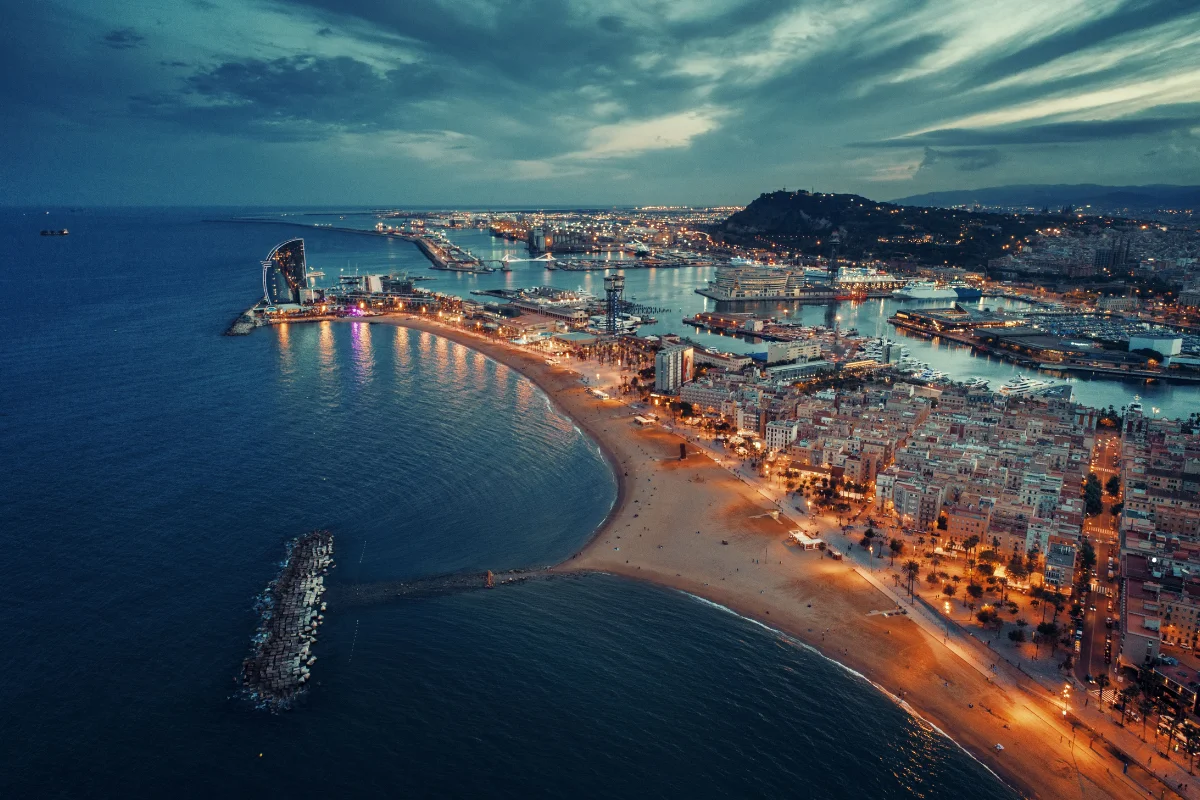

Midnight in Barcelona is not last orders on a terrace, it is the hour the terrace has to be empty of people. The by-law does not say serving stops, it says the space must be cleared, which is why staff start folding chairs well before the hour rather than at it. The two ceilings are 24.00 from Sunday to Thursday and 1.00 on Fridays and eves of public holidays, and since dinner is rarely served before 21.00 in this city, a Tuesday evening outdoors is roughly three hours long. Whether your street has a terrace at all is decided earlier, by a tape measure: a standard module needs 4.60 metres of pavement.
What time do terraces close in Barcelona? 24.00 from Sunday to Thursday and 1.00 on Fridays and eves of holidays, under article 30 of the terrace by-law. They are ceilings, not entitlements, and at that hour the terrace must be empty of customers rather than simply no longer served.
How many hours a terrace gets
| Days | Terrace hours |
|---|---|
| Sunday to Thursday | 8.00 to 24.00 |
| Friday and eves of holidays | 8.00 to 1.00 |
Two slots cover the whole city and neither changes by neighbourhood or by type of bar. The word that does the work is ceilings: if the bar itself has to close earlier, the terrace closes with it. A bar shutting at 23.00 cannot leave its terrace out until 24.00 just because the by-law would allow it.
For planning an evening, the arithmetic is simple. Dinner is served from 21.00 onwards, which leaves about three hours midweek and four on a Friday, and if you want the later end you want a Friday or the night before a public holiday, not a Saturday, which falls under the 24.00 rule unless the Sunday is a holiday.
Why some streets have none
If a street you like has no outdoor tables, the answer is usually geometry rather than licensing. A standard module is one table and four chairs occupying at least 1.50 by 1.50 metres, and the pavement has to be at least 4.60 metres wide to take one. A reduced module, one table and two chairs at 0.80 by 1.50 metres, drops the requirement to 3.40 metres and is only granted exceptionally where space is short.
The walking strip has to be half the pavement width, justifiably between 40 and 60 percent, and never under 1.80 metres, the same gap the by-law demands between two adjacent terraces. A terrace also cannot extend past the frontage of its own premises, so a narrow bar gets a narrow terrace no matter how wide the pavement is.
That last rule explains a common sight: two bars on the same street with visibly different table counts. Where the area allows a number of modules plus two thirds or more, it rounds up, but only if the shortfall is no more than 0.50 metres.
What has to be cleared away, and when
| Item | When it comes in |
|---|---|
| Tables and chairs | At 24.00, or 1.00 on Fridays |
| Parasols, blackboards, lecterns | At closing time |
| Overhead electrical fittings | At closing time, daily |
| Stacked furniture | May stay inside the terrace outline |
Tables and chairs come in daily from public space at closing time, 24.00 or 1.00 depending on the day. Where a bar has no storeroom they may be stacked inside the marked terrace outline, but not left spread across the pavement. The same applies to parasols, blackboards and lecterns, and overhead electrical fittings come down at closing too.
For anyone living above a terrace this is the most useful rule in the whole by-law, because it is visible. A photograph of tables still set out after the hour establishes a breach without any argument about decibels.
Complaining about the hour, not the noise
| Type of complaint | What it needs |
|---|---|
| Hours | Sight of occupied tables past the ceiling |
| Furniture not cleared | A photograph of tables or parasols still out |
| Noise | An acoustic measurement |
Terraces are a council matter, handled by the district office and the Guàrdia Urbana. Neither needs a specialist to act on an hours breach, which is the whole point of the distinction below.
The difference between the two routes is the reason to pick carefully. Hours are established on sight; noise needs measuring, and that is why acoustic pollution accounted for only 7.36 percent of civility reports in 2025 despite being the most common complaint. The full noise route, including the hours that apply inside a building, is in the noise rules, and what else is penalised on the street is in the street fines.
Who can extend the hours
| Reason that allows special hours |
|---|
| Specific dates of city interest |
| Specific dates of district interest |
| Locations in tourist zones |
| The summer season |
A business cannot extend its own hours or negotiate them with the district. Special hours are assigned to an area by Mayoral Decree only, and article 30.2 closes the list to those four reasons.
So a late terrace during a neighbourhood festival is covered, and a permanently late one outside those four cases is not. If you are visiting in summer, the season itself is one of the four grounds, which is why an August evening can feel later than the by-law suggests.
Where the terraces actually are
Density is uneven, which is why the same rule produces conflict on one street and none three blocks away. Ciutat Vella and the Eixample hold the highest concentration of bars and nightlife, and the narrow old-quarter pavements are also where the 4.60 metre rule bites hardest, so tables squeeze into squares rather than streets.
Further out, pavements over 4.5 metres allow the extra 1 metre of margin beyond the frontage that the centre cannot offer. The district-by-district picture is in the districts guide, and daytime pavement rhythm, including when the food markets open, is in the market hours.
Three things to remember
- Midnight means empty, so order your last drink well before it.
- Friday and the eve of a holiday are the late nights, not Saturday.
- Most terraces work first come rather than by booking, so arriving at 21.00 beats arriving at 22.00.
- If you are complaining, complain about the hour, and take the photograph.
One last practical note: tipping is not expected here, and rounding up the bill is the normal gesture on a terrace.
The tape measure decides where; the clock decides when.
Frequently asked questions about Barcelona terraces
What time do terraces close in Barcelona?
24.00 from Sunday to Thursday and 1.00 on Fridays and the eves of public holidays. Those are the ceilings set by article 30 of the terrace by-law, and a bar that has to close earlier takes its terrace in at the same time.
Does closing time mean last orders?
No, and this is the part that surprises people. At the official closing hour the terrace has to be empty of customers, not merely no longer served, so staff will start clearing well before 24.00 rather than at it.
Why does my street have no terraces at all?
Almost certainly the pavement. A terrace with a standard module needs 4.60 metres of pavement and a reduced one 3.40 metres, and the clear walking strip can never drop below 1.80 metres, which rules out a large share of streets in the old quarters.
Can a bar stay open later than 1.00 on its terrace?
Only if a Mayoral Decree covers its surroundings, and only for four listed reasons: dates of city interest, dates of district interest, locations in tourist zones and the summer season. No business can extend its own hours.
What should I do if the terrace below my flat is too loud?
Complain about the hour rather than the noise. Tables still occupied after the ceiling, or furniture not cleared away, can be established on sight, while a noise complaint needs an acoustic measurement, which is why noise was only 7.36 percent of civility reports in 2025.
Do the tables have to come in every night?
Yes. Tables, chairs, parasols, blackboards and overhead electrical fittings all have to be cleared from public space at closing time. Where the bar has no storeroom they can be stacked inside the marked terrace outline, but not left spread out.
Hours, widths and distances from Barcelona’s terrace by-law and its Operating Manual.