
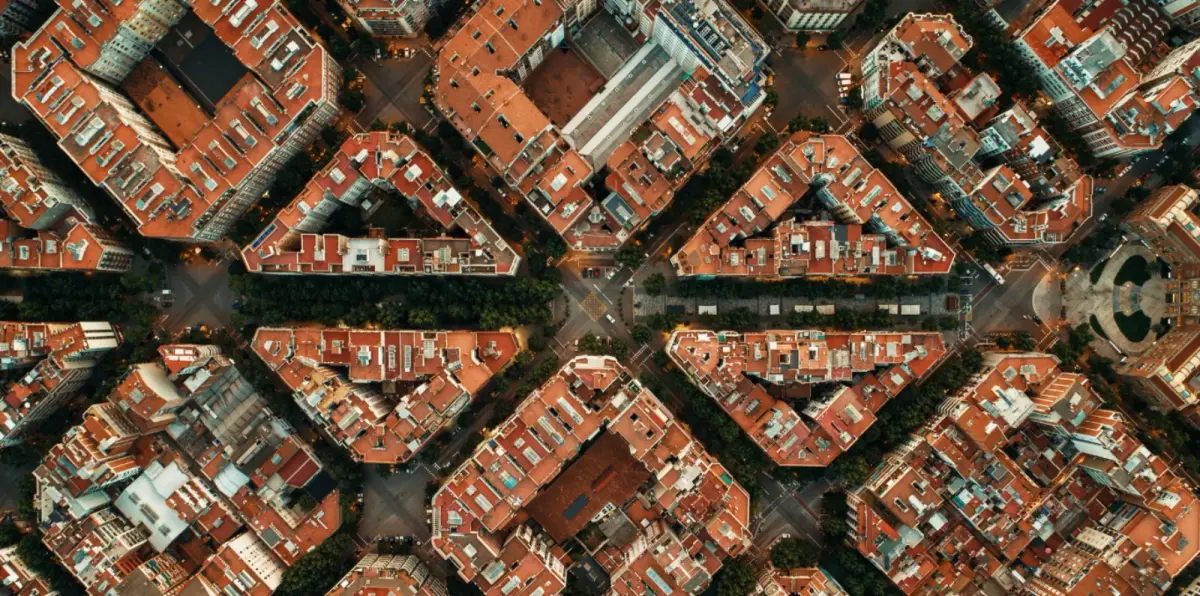

Almost everyone makes the same mistake when talking about Barcelona: they mix up districts and neighbourhoods as if they were the same thing. They are not. The city is organised into 10 districts, the large unit with an official number and management autonomy, and each groups several of the 73 neighbourhoods that exist in total. Grasping that hierarchy is what turns a confusing map into a useful mental picture for getting around, deciding where to stay or knowing what atmosphere to expect.
How many districts does Barcelona have and how are they organised? Barcelona has 10 districts grouping 73 neighbourhoods, in a division fixed four decades ago. They are numbered from 1 (Ciutat Vella) to 10 (Sant Martí). The first two are historic Barcelona; seven of the other eight were independent towns annexed just over a century ago, which explains why each keeps such a distinct character.
The 10 districts at a glance
Before the detail, here is the reference map, because a single table makes the whole city click. According to official data, the districts run by official number and each has its own population and personality, from the dense old core to the quieter northern edges.
| District | Nº | Character |
|---|---|---|
| Ciutat Vella | 1 | Historic old town, most visited |
| Eixample | 2 | Modernista grid, most populated |
| Sants-Montjuïc | 3 | Popular and industrial, plus the mountain |
| Les Corts | 4 | Well-off, Camp Nou, least populated |
| Sarrià-Sant Gervasi | 5 | Highest income, quiet uptown |
| Gràcia | 6 | Bohemian village, smallest by area |
| Horta-Guinardó | 7 | Green, hilly, village air |
| Nou Barris | 8 | Working-class, youngest district |
| Sant Andreu | 9 | Old-town feel, little tourism |
| Sant Martí | 10 | Seafront, tech 22@, second most populated |
The two central districts, Ciutat Vella and Eixample, form historic Barcelona proper: the walled medieval core and the 19th-century Cerdà expansion. The other seven of the ring were once independent towns with their own life, and Nou Barris is the exception, a young district born of working-class estates. That inheritance is why moving between neighbourhoods to visit in Barcelona feels like changing cities.
The fact that explains everything, seven districts were towns
Here is the key that makes sense of the whole city. When you walk through Gràcia or Sarrià and feel you are in a town with its own square and its own bell tower, it is because they literally were. The current division into 10 districts did not appear from nothing; it respected the historic boundaries of the former municipalities of the Pla de Barcelona, annexed by the city between the late 19th and early 20th centuries.
Only districts 1 and 2 are historic Barcelona in the strict sense. The other seven of the ring, Sants, Les Corts, Sarrià, Gràcia, Horta, Sant Andreu and Sant Martí, were independent villages, which is why each keeps such a strong identity. It is the background that makes the first-time visitor guide to Barcelona easier to read, since the character of each area comes straight from its past as a separate town.
Ciutat Vella and Eixample, the historic heart
According to official data, the two central districts hold most of what a visitor is after, so it helps to understand them first. Ciutat Vella, district 1, is the oldest core with around 105,000 inhabitants, and groups four key neighbourhoods: the Gòtic, the Raval, the Barceloneta and Sant Pere-Santa Caterina-la Ribera, home to the Born. The Cathedral, the Rambla, Plaça Reial and many icons cluster here, making it the most visited alongside the Eixample. To find your way inside, the Gothic Quarter guide helps.
The Eixample, district 2, is the most populated in the city with over 260,000 inhabitants and the heart of Modernisme. The perfect Cerdà grid holds the Sagrada Família, Casa Batlló and La Pedrera, and splits traditionally into the Dreta and the Esquerra. It is a district for walking slowly between chamfered blocks. Both districts are also the ones that call for the most care with belongings, as the best things to see in Barcelona guide notes for the busiest areas.
The seafront and the mountain, Sants-Montjuïc and Sant Martí
Two districts define the edges of the city by the sea. Sants-Montjuïc, district 3, is huge and full of contrast, with over 180,000 inhabitants: it includes the high-speed rail station, the working-class Poble-sec, the industrial Zona Franca and the whole Montjuïc mountain with the MNAC, the Miró Foundation and the Olympic ring. One fact sums it up: Carrer de Sants is one of the streets with the most shops per square metre in the world.
Sant Martí, district 10, is the second most populated with around 240,000 inhabitants and the great laboratory of urban change. Here is Poblenou, the old Catalan Manchester turned into the 22@ tech district, next to the Bogatell and Mar Bella beaches and the Torre Glòries. It is the district that best shows the Barcelona looking to the future, something the best time to visit Barcelona guide touches when weighing where to base a stay by season.
The gap between the richest and the poorest neighbourhood runs from 143,505 to 31,137 euros of gross household income, and inside a single neighbourhood it can still reach 2.9 times: the tract-by-tract table is in Barcelona neighbourhoods by income.
The uptown and Gràcia, from luxury to village
Climbing towards the mountain, three districts change the register completely. Sarrià-Sant Gervasi, district 5, has the highest income per capita, with grand streets, the Pedralbes monastery and the access to Tibidabo, keeping the calm air of a former town. Beside it, Les Corts, district 4 and the least populated with around 82,000 inhabitants, holds the Camp Nou, the university zone and the L’Illa shopping centre.
Gràcia, district 6, is the smallest by area but one of the densest and with the most personality. A former independent town until the late 19th century, it keeps a bohemian village feel with pedestrian squares, workshops and an intense neighbourhood life that explodes in its famous August street festival. It is the favourite district for anyone after local character, and pairs with the wider view in the best neighbourhoods to stay guide.
The districts tourism ignores, and why they earn a visit
Three northern districts barely appear in the guides, and part of their charm is there. Horta-Guinardó, district 7, covers almost 12 per cent of the city’s area and keeps the air of an agricultural village with Modernista summer houses, slopes and the Carmel bunkers, one of the best viewpoints. Nou Barris, district 8, is the most humble and youngest, with the large Central Park of almost 18 hectares and a strong neighbourhood identity.
Sant Andreu, district 9, keeps the historic core of the former town of Sant Andreu de Palomar, which at 59,330 residents is the largest neighbourhood in Barcelona, with its everyday feel and little tourism. These three districts are the Barcelona that locals live far from the usual circuit, and seeing them completes the mental map of the city. For anyone planning a stay, understanding this division is the base on which to decide where to stay by neighbourhood. For anyone staying on, the division matters less than it looks administratively: the thirteen citizen advice offices have no catchment areas, so any of them will do. Nou Barris has two precisely because of the hill between Torre Baró and la Guineueta.
Frequently asked questions about Barcelona’s districts
How many districts and neighbourhoods does Barcelona have?
Barcelona has 10 districts subdivided into 73 neighbourhoods (barrios). The current division into districts was approved in 1984, and the map of the 73 neighbourhoods was fixed in 2006. Districts are administrative units with some autonomy of management, numbered from 1 (Ciutat Vella) to 10 (Sant Martí), over a total area of 101 square kilometres.
What are the 10 districts of Barcelona?
By their official number they are Ciutat Vella (1), Eixample (2), Sants-Montjuïc (3), Les Corts (4), Sarrià-Sant Gervasi (5), Gràcia (6), Horta-Guinardó (7), Nou Barris (8), Sant Andreu (9) and Sant Martí (10). The first two form historic Barcelona, and most of the rest correspond to former independent towns annexed by the city.
Which is the most populated district in Barcelona?
The Eixample is the most populated district, with over 260,000 inhabitants, followed by Sant Martí, with around 240,000. The least populated is Les Corts, with about 82,000. Gràcia is the smallest district by area, but one of the densest. Sarrià-Sant Gervasi has the highest income per capita in the city.
What is the difference between a district and a neighbourhood in Barcelona?
The district is the largest administrative unit, with management autonomy and an official number from 1 to 10. The neighbourhood is the smallest subdivision within each district, and there are 73 in total. For example, the Ciutat Vella district groups the neighbourhoods of the Gòtic, the Raval, the Barceloneta and Sant Pere-Santa Caterina-la Ribera.
In Barcelona, understanding that seven of its ten districts were towns explains why each one feels like a different city.