
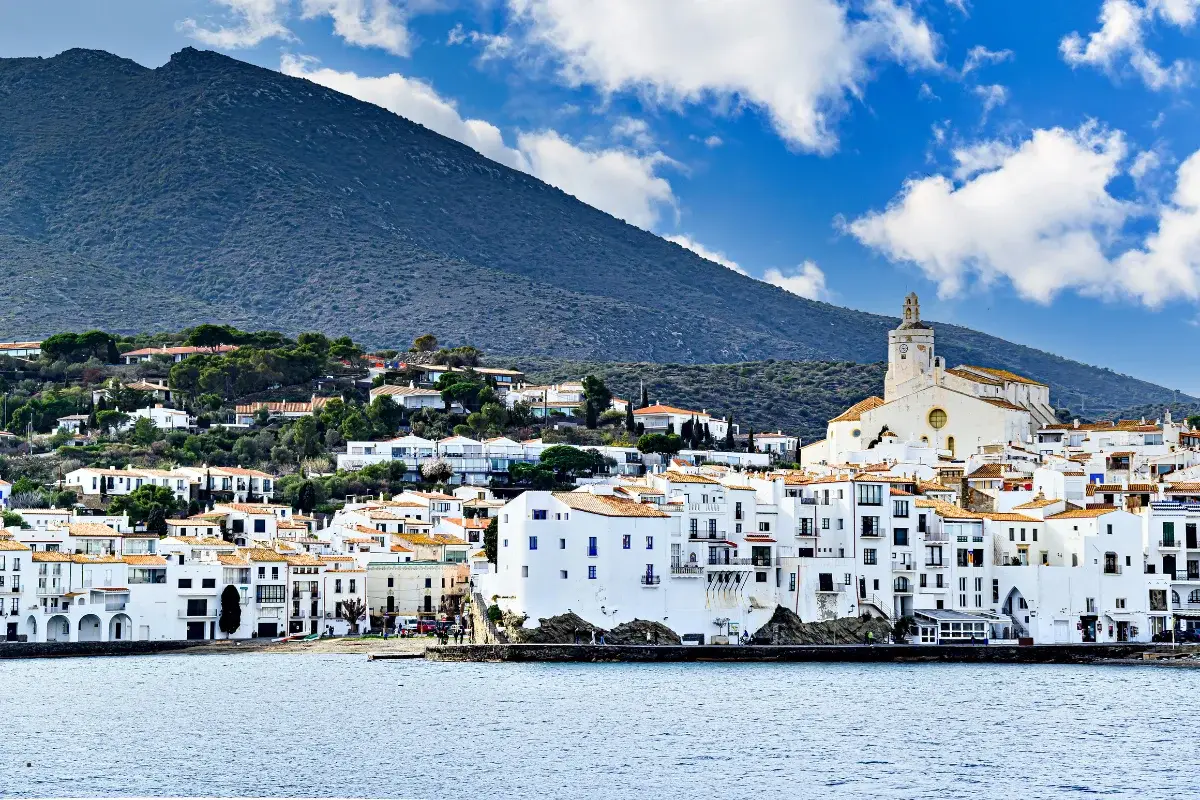

Cadaqués is separated from the rest of the Costa Brava by 13 kilometres of tight mountain curves that the village itself refused to improve for decades. That deliberate resistance to accessibility is the most important fact about the place. It explains the whitewashed architecture, the working artists’ colony, the Dalí connection, and why the old town looks the way it does while nearby villages have spent fifty years being converted into tourist infrastructure.
The curves are not an obstacle. They’re the preservation mechanism.
The Essential Facts Before You Go
Is Cadaqués worth visiting?
Yes — but only if you plan it correctly. Three things will ruin the trip if you don’t address them in advance: not booking the Dalí house at Portlligat (no walk-in entry, ever), trying to drive to Cap de Creus between June and September (restricted access, shuttle bus required), and expecting sandy beaches (Cadaqués has cobblestone and rock). Address those three and the visit is genuinely exceptional.
Quick Decision
- Main cultural priority → Casa-Museo Dalí at Portlligat — book at Salvador Dalí Foundation website, minimum 2 days ahead (often more in summer)
- Best landscape → Cap de Creus at dawn — take the shuttle bus June–September, arrive before crowds
- Best swim spot → Sa Conca — 10-minute walk from centre, pebbles, crystal water, manageable crowds
- Best architecture detail → Rastrell pavement on Carrer des Call — 16th-century engineering technique, sea-rounded stones set sideways for grip
- Best cultural backup if Dalí is sold out → Expo Dalí Cadaqués (town centre) — 300 original graphic works, no booking needed, opens mid-April
- Best time to arrive → Before 10am or after 7pm in July–August if driving — parking reaches saturation otherwise
The Old Town: Designed to Confuse Pirates, Preserved by the Same Logic
Cadaqués’ irregular street plan is not picturesque by accident — it’s a defence system. Narrow lanes, steep gradients, and a labyrinthine layout were passive security mechanisms against maritime raids. In 1543, the corsair Barbarossa burned the village to the ground and destroyed the original church. The town that exists today was rebuilt on top of that trauma.
The Rastrell: A Technique Nobody Else Kept
The most architecturally significant element of the old town is a pavement. The rastrell — found in best condition on Carrer des Call — uses stones extracted from the shoreline, rounded and shaped by wave action, set transversally in a herringbone pattern to provide grip on steep slopes during rain or sea spray. The technique dates to the 16th century. No other Costa Brava village maintains it at this level of integrity. Walking over it without knowing what it is means walking over one of the only surviving examples of vernacular coastal engineering from that period in Catalonia.
The entrance to the historic district is through Es Portal, the arch marking the boundary of the former walled town. Of the original medieval circuit, only one bastion survives — integrated into the Ayuntamiento building at Punta des Baluard.
The Dalí–Duchamp Bar You Can Still Drink In
The Bar Melitón on Passeig de Cadaqués is where Marcel Duchamp played chess with Gala during the long seasons he spent in the village. The atmosphere has been maintained without being turned into an attraction. It’s a bar where you sit down.
The Casa Serinyana (locally called Casa Blaua) — completed between 1913 and 1915 — has a turquoise glazed ceramic façade and a polygonal tower-mirador with vegetable motifs, financed by a family wealthy from Cuban trade. The same capital that transformed Sitges built this house in Cadaqués.
Santa María Church: The Fishermen Who Built Their Own Cathedral
After Barbarossa burned the original church in 1543, the reconstruction was financed and physically executed by the village’s own fishermen, who dedicated their rest days to construction work. The late Gothic building took decades to complete because of this. That fact alone changes how you look at the interior.
Two things justify the visit regardless of your interest in religious art.
The baroque altarpiece dedicated to the Virgin of Hope stands 23 metres tall — disproportionate to the building in a way that surprises even frequent church visitors. It was the work of Pau Costa and Joan Torras under a design by Jacint Moretó. The salomonic columns and gilded mouldings are the definitive reference point for Ampurdan Baroque.
The organ, built by Josep Boscà between 1689 and 1691, is considered one of the oldest and best-preserved in Catalonia. It’s used in the International Music Festival from April to August — the calendar of performances is the best reason to look up before visiting, not after.
From outside the church, the view integrates the islet of Es Cucurucuc into the bay — the element that appears in almost every aerial photograph of Cadaqués.
Casa-Museo Dalí at Portlligat: What You Need to Know Before Booking
Portlligat is 15 minutes on foot from Cadaqués centre. The Casa-Museo was Dalí’s primary residence from 1930 until Gala’s death in 1982, after which he moved to Púbol Castle. Over those fifty years, he systematically bought adjacent fishermen’s huts and connected them into what he called a “biological structure” — each new room a cell added to the organism.
The Booking Rules Are Absolute
Advance booking is mandatory. There is no walk-in option. Without a reservation, you cannot enter — not in July, not in November, not on a quiet Tuesday. Groups are capped at 8–10 people and access in 10-minute intervals. Tickets must be collected 30 minutes before your assigned time; failure to collect cancels the reservation automatically. The museum is closed on Mondays. Standard price: €15.50 online, €17.50 in July and August. Children under 14 are free but still require a reservation.
The building has no wheelchair access — the labyrinthine original structure with narrow original staircases cannot be modified.
Three Spaces Inside
The intimate spaces include the Sala dels Secrets — an oval room designed with acoustic properties for confidential conversation. The studio preserves the mechanical easels and work objects under the cape’s natural light. The exterior spaces — the olive grove and pool area — were the setting for Dalí’s public life and for installations including the giant eggs on the roof.
If Portlligat Is Sold Out
The Expo Dalí Cadaqués in the village centre shows 300 original graphic works — woodcuts, engravings, and lithographs from Dalí’s less-exhibited output. It opens from mid-April after the winter closure. No booking required.
Cap de Creus: The Landscape That Built Surrealism
The Cap de Creus Natural Park is the first marine-terrestrial park in Catalonia and the point where the Pyrenees enter the Mediterranean. The landscape is the product of geological processes begun 300 million years ago: materials compressed at depths of 11–14 kilometres under temperatures reaching 650°C. The result is the grey schists and clear pegmatite veins that form the zoomorphic silhouettes Dalí incorporated into his iconography — the Gran Masturbador has its direct origin in the Roca Cavallera at the cape.
Car access is restricted June–September between 9:30am and 9:30pm, and also during Easter week and on weekends in April, May, and October. A shuttle bus runs from the Corral d’en Morell car park to the lighthouse and the Paratge de Tudela. Return ticket approximately €7 for adults, €5 for under-14s and over-65s.
The Paratge de Tudela was the site of a Club Med holiday complex — 400 apartments demolished between 2007 and 2010 to restore the original landscape. A 5.6km trail passes rocks with animal forms that Dalí described in his correspondence.
The Faro del Cap de Creus, built in 1853, has the Cap de Creus Space with information about the park’s biodiversity. The Cova de s’Infern — a sea cave accessible from the lighthouse — produces red reflections at dawn that have nothing to do with its name.
Beaches: Pebbles and Rock, and Why That’s the Right Answer
Cadaqués has 26 beaches and 11 coves. None are sandy in the conventional sense. The cobblestone and rock composition is directly responsible for the water transparency — no sand particles in suspension. Adjust expectations accordingly; the payoff is real.
| Beach | Access | Surface | Best for |
|---|---|---|---|
| Platja Gran | Town centre | Pebbles + coarse sand | Families, services |
| Sa Conca | 10 min walk | Pebbles | Clean water, less crowded |
| Port d’Alguer | Town centre | Pebbles | Local atmosphere |
| Cala Jugadora | Shuttle + 20 min walk | Pure rock | Snorkelling, hikers |
| Sa Sabolla | Slate staircase | Rock | Crystal water, views |
The Camí de Ronda from the village to Cala Nans lighthouse (6km return) passes several unnamed coves that don’t appear on tourist maps and are consistently less crowded than the named beaches.
For diving: the waters around the cape contain Greek, Roman, and Phoenician shipwrecks, along with posidonia meadows. Diving Portlligat and Cadaqués Divers both organise guided dives.
Picasso Was Here First — and It Mattered
Pablo Picasso spent the summer of 1910 in Cadaqués — a period art historians identify as critical for the development of analytical Cubism. The verified locations from his stay include the Hostal Trompet in Plaza de Missa and the Santa Bàrbara mountain. The influence of the cape’s fractured geological forms on Cubist fragmentation is documented in his correspondence from that summer.
Marcel Duchamp’s long residences in the village left traces in the Bar Melitón and in the social fabric of the artist community that made Cadaqués a reference point for European avant-garde through the mid-20th century. This was not Dalí’s village that other artists happened to visit — it was an established artistic circuit that Dalí entered.
The village’s gallery network — including Galeria Cadaqués-Huc Malla for contemporary art — is dense relative to the municipal population and remains active. The Mini Print Internacional de Cadaqués at Taller Galeria Fort runs from late June to September (46th edition in 2026).
Dalí is one of five reasons to come, not the reason
Dalí is usually presented as the reason to visit. He is one of five distinct reasons to visit Cadaqués: the old town architecture, the geological landscape of Cap de Creus, the Picasso connection, the music festival, and the Dalí house. Treating Portlligat as the sole attraction creates unrealistic expectations when it’s sold out and misses most of what makes the village interesting.
They don’t explain the rastrell. The pavement of Carrer des Call appears in hundreds of photographs as “charming cobblestones.” Describing it as a 16th-century engineering technique for coastal slope management changes the category of observation from aesthetic to historical.
They describe the beaches as “pebbly” as if it were a limitation. The pebble-and-rock composition is why the water is that colour. This is not a consolation prize for the absence of sand.
Mistakes to Avoid
- Not booking the Dalí museum in advance — the most common single mistake. The Salvador Dalí Foundation website is the only booking channel. In peak season, two weeks ahead is often insufficient.
- Not collecting your Portlligat ticket 30 minutes before entry — the reservation cancels automatically. This detail is on the booking confirmation but most people miss it.
- Driving to Cap de Creus in summer — the restriction is enforced with fines. The shuttle from Corral d’en Morell is the only option June–September during restricted hours.
- Arriving in July or August after 10am without parking sorted — saturation is real. Before 10am or after 7pm are the workable windows.
- Assuming the beaches have sand — they don’t. Bring water shoes if you prefer not to walk on rocks.
- Not checking the International Music Festival calendar — concerts in the Santa María church using the 1689 organ are one of the strongest cultural experiences available in Cadaqués, and they’re easy to miss by not looking before you go.
Best Strategy
-
Day trip from Barcelona → Leave before 8am, park at P1 or P3 near the centre, visit Sant María church first, walk to Portlligat for your booked slot, swim at Sa Conca on the way back, drive up for Cap de Creus shuttle in the afternoon. Leave before 7pm.
-
Weekend visit → First evening: arrive, walk the old town including Carrer des Call rastrell, dinner at Casa Anita (no reservations, arrive early or wait). Day 2: Portlligat morning (booked), Cap de Creus afternoon by shuttle, swim at Cala Jugadora near the lighthouse.
-
Extended stay (3+ days) → Add the Camí de Ronda to Cala Nans (6km return), a full Cap de Creus hiking day via the GR-92, and the Expo Dalí Cadaqués for the graphic works. Consider the day trip to Girona (one hour inland) for the medieval quarter and cathedral.
Practical Information
From Barcelona: 180km by car via AP-7 (2h 15min). The final 13km on the GI-614 are tight mountain curves — ventilation recommended for anyone prone to motion sickness. By bus: Moventis Sarfa from Estació del Nord (2h 45min). From Figueres AVE/TGV station: 1h 10min by bus from Figueres bus station.
Parking: Parking de la Riera (free except Mondays — market day; avoid in heavy rain due to flood risk). P1 and P3 (paid, central). July–August: arrive before 10am or after 7pm.
Casa-Museo Dalí Portlligat: Closed Mondays. Book at fundaciodalí.org. Tickets: €15.50 standard, €17.50 July–August. Under-14 free with reservation.
Cap de Creus shuttle: From Corral d’en Morell car park, approximately €7 return. Restricted hours June–September: 9:30am–9:30pm.
Frequently Asked Questions
Do you need to book the Dalí museum in Cadaqués in advance?
Yes — mandatory. There is no walk-in entry under any circumstances. Groups of 8–10 with 10-minute access intervals. Book at fundaciodalí.org. Tickets must be collected 30 minutes before entry or the reservation is automatically cancelled. Closed Mondays. €15.50 standard, €17.50 in July–August.
Can you drive to Cap de Creus?
Not June–September between 9:30am and 9:30pm (also Easter and some spring weekends). A shuttle bus from the Corral d’en Morell car park costs approximately €7 return. Outside restricted hours, driving is permitted but parking at the cape is limited.
Does Cadaqués have sandy beaches?
No. Beaches are pebble and rock. The Platja Gran has some coarse sand mixed with pebbles. Coves near Cap de Creus are pure rock. The absence of sand is directly responsible for the water transparency — no particles in suspension. Water shoes make entry easier.
What is the rastrell in Cadaqués?
A 16th-century vernacular pavement technique — sea-rounded stones set transversally in a herringbone pattern to provide grip on steep wet slopes. Best preserved on Carrer des Call. No other Costa Brava village maintains this technique at this level of integrity.
When is the best time to visit Cadaqués?
May, June, and September combine warm temperatures, uncrowded coves, and most cultural events active. July–August have maximum activity but parking saturation and accommodation pressure. January is the most local month — the sea urchin season and the Feast of San Sebastián (20 January) attract residents, not tourists.
What’s the difference between the Portlligat museum and the Expo Dalí in the village?
Portlligat is Dalí’s former home — the personal spaces, studio, and olive grove — requiring advance booking. The Expo Dalí Cadaqués in the village centre shows 300 original graphic works (woodcuts, engravings, lithographs) from his less-exhibited output, opens from mid-April, and requires no booking. They’re complementary, not alternatives.