

In 1416, the master builders of Girona Cathedral faced a decision that divided the architectural community of the time. The existing Romanesque nave was being extended into Gothic. Should the new cathedral have three naves — the standard for Gothic construction of this scale — or a single nave of unprecedented width?
The debate ran for years. Multiple architects submitted reports arguing for three naves. Others argued for one. The chapter chose the single nave. The result is 22.98 meters of width — the widest Gothic nave in the world, a structural calculation that pushed the limits of 15th-century engineering and created an interior that disorients visitors who expect the divided rhythm of a traditional Gothic cathedral.
That decision is the most important thing to know before entering the building. And it’s the kind of specific, consequential detail that turns a cathedral visit from an obligation into something genuinely interesting.
Girona is 38 minutes from Barcelona by AVE, from €9. The station is under 10 minutes on foot from the historic center. Everything worth seeing is walkable. One day covers the essentials. Two days covers everything.
What should you see in Girona? The Cathedral (€7.50, includes cloister and Treasury with the 11th-century Tapestry of Creation). The Call — medieval Jewish quarter, free to walk, Museum of Jewish History €4. The colorful houses of the Onyar from the iron bridge (Eiffel company, 1876). The Passeig de la Muralla — free, 45-minute walk with Pyrenees views. The Arab Baths (€3). Train from Barcelona Sants: AVE 38 minutes from €9.
Quick Decision
- First time in Girona, one day → Cathedral + Call + Onyar bridge + Arab Baths + Muralla walls
- You’ve been before and want the food focus → El Celler de Can Roca (book months ahead) or Normal (no reservation needed) + xuixo from Can Castelló + Rocambolesc
- Visiting specifically for Game of Thrones → Cathedral staircase + Arab Baths + Sant Pere de Galligants monastery + Plaça dels Jurats — all within 15 minutes on foot
- You want to extend to the Costa Brava → Girona as base, Cadaqués or Begur 45–60 min by car
- Budget visit, skip the paid museums → Onyar bridge view, Muralla walk, Call streets, Sant Feliu basilica — all free
The Train: Which One to Take and Why It Matters
Three options exist for the Barcelona–Girona journey, and they’re not equally good for a day trip.
The AVE and AVANT trains from Barcelona Sants reach Girona in 38–41 minutes. Tickets start from €9 when booked ahead (dynamic pricing — earlier is cheaper). The Girona station is under 10 minutes on foot from the historic center. This is the correct choice for a day trip.
The Media Distancia trains take about 1h10 and depart from Sants, Passeig de Gràcia and Clot-Aragó. No advance reservation required. Price: €11–15. Useful if you’re starting from Passeig de Gràcia and don’t want to travel to Sants first.
The Regional R11 takes 1h35 and costs €8–9. Useful for flexibility; not ideal for maximizing time in the city.
| Train | Duration | Price (approx.) | Station on Arrival |
|---|---|---|---|
| AVE / AVANT | 38–41 min | €9–17 | Girona (central) |
| Media Distancia | ~1h10 | €11–15 | Girona (central) |
| Regional R11 | ~1h35 | €8–9 | Girona (central) |
All trains arrive at the same Girona station. By car: 85km on the AP-7, 60–90 minutes depending on Barcelona traffic. Free parking at Pont de Pedret (5–10 minutes on foot from the center) or the Devesa park (10–15 minutes). In high season these fill early — train avoids the problem entirely.
The Onyar Houses and the Bridge That’s Not Quite “by Eiffel”
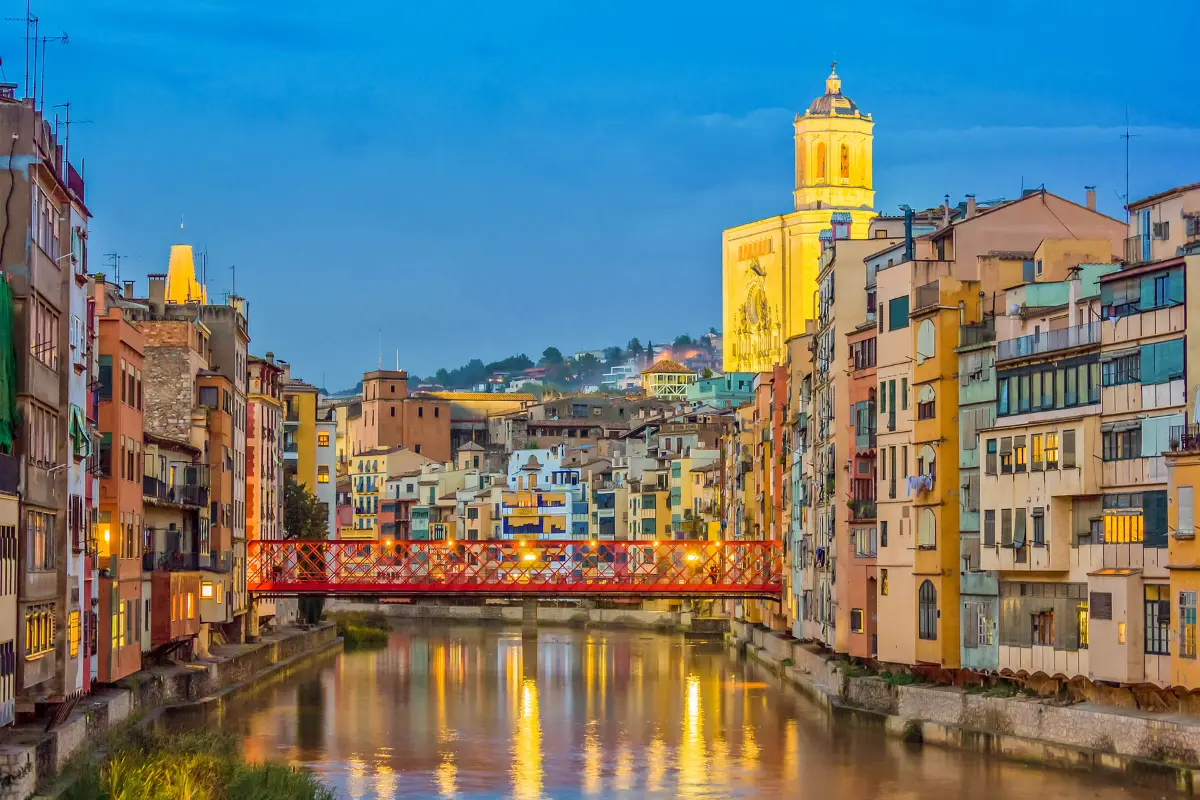
The colored facades leaning over the Onyar river are Girona’s most replicated image. The colors are not accidental — they’re governed by a palette of exactly 32 tones defined by architects Josep Fuses and Joan Maria Viader. The buildings were constructed directly over the old medieval wall, with floors and cantilevered elements added progressively through the 19th and 20th centuries onto the original defensive foundations.
The best viewpoint is the Pont de les Peixateries Velles — the red iron bridge. Built in 1876 by the Eiffel engineering company. The precision matters: it’s commonly stated that it was “designed by Eiffel.” Gustave Eiffel’s firm had an international reputation for iron structures before the Paris tower; this bridge was a project of that company, built three years before the tower that bears his name. The attribution is real but often imprecise.
From this bridge: the Onyar houses in the foreground, the Cathedral behind them, the Sant Feliu basilica to the right. The most photographed frame in the city, and justified — it shows the physical logic of Girona’s layered construction on the riverbank in a single composition.
For anyone building the full itinerary picture, the best streets walking guide for Barcelona gives the framework for understanding how medieval street networks operate — useful context for reading Girona’s Barri Vell and Call as you walk them.
The Cathedral: Understanding What You’re Actually Looking At
The single-nave decision is the organizing fact of the Cathedral of Girona. When you enter, the width is immediately disorienting — the columns are 13 meters apart, a structural span that required engineering reasoning that was genuinely at the edge of 15th-century capability. The near-equal height of the space amplifies the effect: you’re not in a divided Gothic church, you’re in an uninterrupted hall.
Construction began in the 11th century and continued until the 18th, integrating Romanesque (the cloister and Charlemagne’s Tower), Gothic and Baroque (the facade and external staircase) elements. The 90-step staircase is the Game of Thrones filming location that most visitors recognize — in season 6, it served as the entrance to the Great Sept of Baelor.
The Treasury is included in the general admission and contains two pieces that are worth the visit on their own:
The Tapestry of Creation (11th century) — a Romanesque textile representing the Genesis with a theological and chromatic complexity that makes it one of the most important surviving works of Romanesque textile art. The iconographic program covers Creation, the months, the elements and Christ in Majesty in a composition that hasn’t been fully decoded by scholars.
The Beatus of Girona (10th century) — an illuminated manuscript with Mozarabic-style miniatures commenting on the Apocalypse. The quality of the illustrations makes it an international reference for Visigothic-influenced manuscript art.
Admission: €7.50 (includes cloister and Treasury). Hours: 10:00–18:30 with seasonal variations. Closed Mondays.
The Call: What the Jewish Quarter Actually Preserves
The Call is the medieval Jewish neighborhood of Girona, centered on the Carrer de la Força. It’s one of the best-preserved Jewish quarters in Europe — not through reconstruction but because the original urban morphology of narrow streets, courtyards and passageways has survived almost intact.
The Girona Jewish community was one of the most intellectually significant in medieval Europe. The most prominent figure is Nahmanides (Bonastruc ça Porta), a 13th-century philosopher and kabbalist whose work influenced European Hebrew thought for centuries. The Museum of Jewish History is located on the site of the city’s last synagogue and holds exceptional pieces: the bronze seal of Nahmanides found in Acre (confirming his historical journey to the Holy Land after the Barcelona Disputation of 1263) and the Castelló d’Empúries Ketuba — a medieval marriage contract of significant artistic value.
The Call streets are free. The Museum of Jewish History costs €4. This is the only part of Girona where it’s worth getting deliberately lost without a map — the passageways and unexpected courtyards are the content.
The Arab Baths and the Basilica of Sant Feliu
The Arab Baths (1194) are a Romanesque construction that follows the logic of Roman thermae and Islamic hammam — not because there was Islamic occupation in Girona, but because the architectural model traveled through cultural exchange. The circuit is complete: changing room with central pool (apodyterium), cold room (frigidarium), warm room (tepidarium), hot room (caldarium). The octagonal star-shaped skylights in the vaulted ceilings are the architectural element most reproduced in photographs.
Admission: €3. Hours: 10:00–19:00 (10:00–14:00 Sundays and holidays).
The Basilica of Sant Feliu was Girona’s first cathedral before the Santa Maria complex was built at the highest point. Its interior holds eight Roman and Early Christian sarcophagi from the 3rd and 4th centuries embedded in the presbytery — one of the most significant late-antiquity funerary ensembles on the Iberian Peninsula. The truncated Gothic bell tower is the most recognizable element of the Girona skyline. Free access.
The Muralla Walk: Free, 45 Minutes, Best Views in the City
The city walls of Girona have 2,000 years of accumulated history: Roman foundations from the 1st century BC, Carolingian extensions from the 9th century, major 14th and 15th-century construction. The Passeig de la Muralla is the walkable parapet that runs for approximately 45 minutes and offers views over the rooftops of the Barri Vell, the Onyar river and — on clear days — the Pyrenees to the north and the Empordà plain to the south.
Free, always open. Best at midday or late afternoon. The exit at the north end connects directly to the Sant Pere de Galligants monastery (one of the Game of Thrones filming locations).
Game of Thrones Locations: What Was Filmed Where
In 2015 Girona was selected for Season 6 of HBO’s series to double as both Braavos and King’s Landing. The choice was driven by the integrity of the built heritage — minimal need for set dressing.
| Location | Scene in the Series |
|---|---|
| Cathedral staircase | Cersei on horseback stopping Margaery’s Walk of Shame |
| Carrer del Bisbe | Arya Stark, blind, begging and being attacked |
| Arab Baths interior | Pursuit sequences in Braavos |
| Sant Pere de Galligants | The Old Citadel Library where Samwell Tarly works |
| Plaça dels Jurats | The Braavos theater where Arya watches the Lannister parody play |
| Pujada de Sant Domènec | Arya jumping over market stalls |
All six locations are within 15 minutes on foot of each other. Free walking tours (free tours) specializing in the filming locations exist and add the historical context of each site simultaneously — worth doing even for visitors who haven’t seen the series.
What to Eat: From the Xuixo to Three Michelin Stars
The xuixo is the city’s signature pastry: a cylindrical fine-dough tube, filled with pastry cream, fried and rolled in sugar. The origin is connected to the legend of the Tarlà, a carnival figure. For the best version: Can Castelló has been making them for over 127 years and holds the Girona Excel·lent quality seal.
Rocambolesc (Carrer de Santa Clara) — artisan ice cream by Jordi Roca, the pastry brother of El Celler de Can Roca. The “Jaime Lannister’s Hand” — blood orange and strawberry sorbet in the shape of a hand — is one of the most photographed products in the city. No reservation needed. The quality is the Roca family’s.
Casa Marieta (Plaça de la Independència) — founded in 1892. Traditional Catalan cooking for a complete meal at honest prices, without the tourist premium of the more visible locations.
El Celler de Can Roca — three Michelin stars, multiple times ranked best restaurant in the world. Tasting menu around €315, wine pairing €145. Reservations open months ahead and sell out in hours. For visitors without that planning horizon: Normal — the Roca brothers’ heritage-focused restaurant with a more direct approach and accessible prices — is available without the months-ahead booking logistics.
The cooking tradition of the region is mar i muntanya — combinations of coastal seafood with mountain products from the Pyrenee foothills. This is visible in menus across the city at every price level.
Who Is This Visit For
One day, cultural focus → Cathedral + Call + Arab Baths + Muralla + Sant Feliu. Fits comfortably with morning arrival and evening return. Don’t skip the Treasury.
One day, food-driven → Xuixo breakfast at Can Castelló → Normal for lunch (book ahead) → Rocambolesc → coffee and walk through the Call and Onyar. Leave the major monuments for a return trip.
Two days with extension → Day 1 in the city. Day 2: Besalú (25km, medieval bridge and Jewish mikveh) or Costa Brava (Cadaqués or Begur, 45–60 min by car).
You’re specifically a Game of Thrones visitor → The six key locations cover a 15-minute walking circuit. Combine with the free tour for context. Still leave 2 hours for the Cathedral — the staircase is just the exterior.
Budget visit → The Onyar bridge view, the Muralla walk, the Call streets and the Sant Feliu basilica are all free. Budget approximately €15 for the Cathedral and Arab Baths combined, plus food.
Mistakes to Avoid
- Buying AVE tickets at the station on the day — dynamic pricing means same-day tickets are significantly more expensive than tickets bought a week ahead. Book in advance for the €9 starting price.
- Visiting the Cathedral without the Treasury — the Tapestry of Creation is the reason to pay the €7.50. Skipping the Treasury to “save time” is skipping the most important object in the building.
- Trying to visit El Celler de Can Roca without planning months ahead — it’s not possible without a reservation booked months in advance. Normal is the accessible Roca option and doesn’t require this lead time.
- Rushing the Call — it rewards getting deliberately lost. Schedule 45 minutes without a fixed route and let the passageways direct the movement.
- Not verifying the Cathedral closure day — it’s closed Mondays. Building a day trip around a Monday visit and discovering this on arrival is avoidable.
- Confusing the Girona stations — all Barcelona-origin trains (AVE, Regional, Media Distancia) arrive at the central Girona station. There’s no Camp de Girona equivalent like the Tarragona AVE-trap situation. All trains go to the right place.
One stop further north, the two-station mix-up costs first-timers an hour on the way to Figueres, and whether the museum deserves a full day is argued out in the Dalí Museum day trip guide.
Final Insight
Girona is the city that proves intermediate scale can produce better heritage than capital scale. The Barri Vell is more intact than anything in Barcelona. The Cathedral’s single nave is a more interesting architectural decision than most things in the country. The Call is one of the best-documented Jewish medieval neighborhoods in Europe. And the train from Barcelona takes 38 minutes. The question isn’t whether it’s worth going — the question is whether one day is enough.
For combining Girona with a broader Catalan itinerary, the Tossa de Mar guide covers the Costa Brava town 45 minutes south of Girona by car, and the Peratallada medieval village guide covers the fortified village 40km away that pairs naturally with Girona as a two-stop heritage day.