
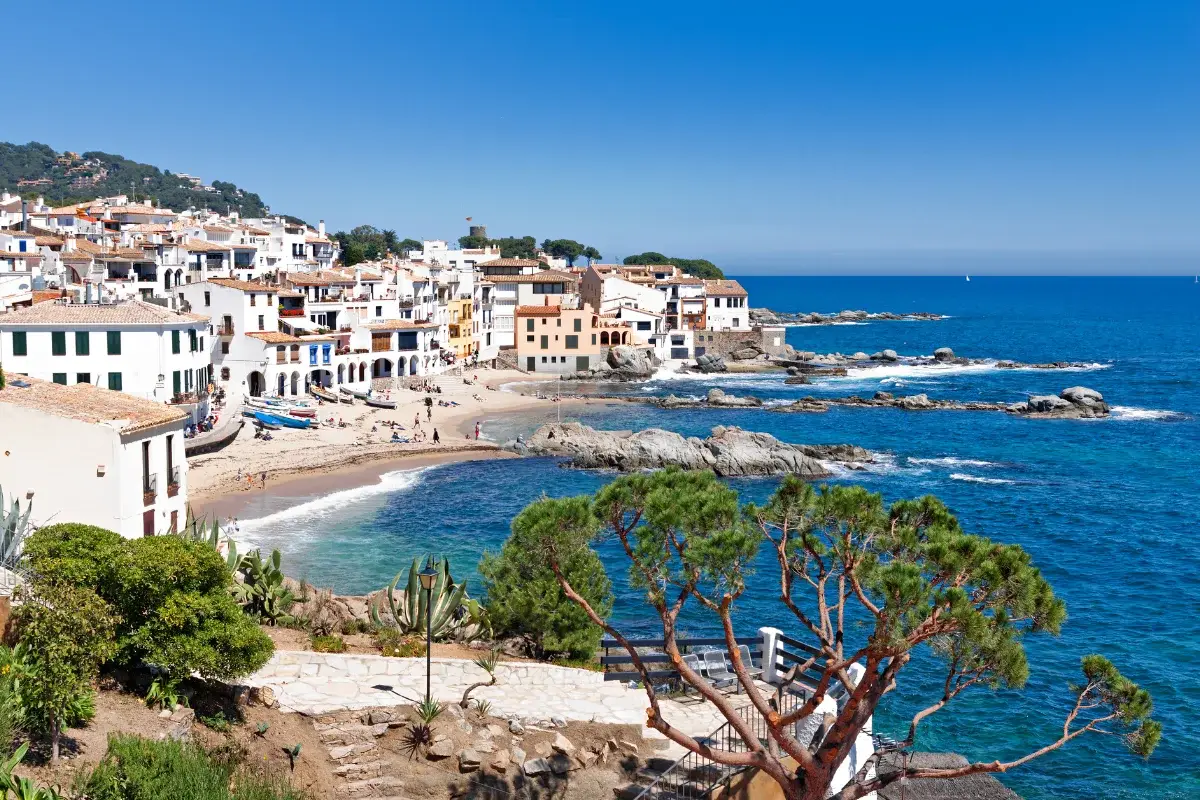

Most Costa Brava villages have a fishing quarter that’s been converted into a restaurant quarter. Calella de Palafrugell has a fishing quarter that became a restaurant quarter while keeping the original architecture intact, the original boat-building arches standing, and actual fishing boats on the beach. The distinction is not cosmetic — it’s why this particular village has a UNESCO-adjacent cultural designation while most of its neighbours do not.
Port Bo: Why the Arches Matter
What is Calella de Palafrugell known for?
Calella de Palafrugell is a Costa Brava fishing village 135km from Barcelona, known for the Port Bo harbour (National Cultural Asset, with 19th-century vaulted arches originally built as fishermen’s workshops), eight beaches and coves within walking distance, the Cap Roig Gardens (17 hectares, 800 plant species, annual music festival), and the Habaneras singing festival every first Saturday of July. It’s one of the few Costa Brava villages where the historic harbour remains structurally unchanged.
Quick Decision
- Best historic atmosphere → Port Bo at dawn or after 8pm — the boats, the arches, the white houses without crowds
- Best beach for swimming → Port Pelegrí — rockier than Canadell but cleaner water and less crowded
- Best for families → Playa del Canadell — longest beach, full services, accessible
- Most dramatic cala → Cala El Golfet — no services, red-rock cliffs, emerald water; access on foot via the Camí de Ronda
- Best panoramic viewpoint → Punta dels Burricaires — 10-minute walk, best full-arc view of the bay at sea level
- Best cultural event → Habaneras festival, first Saturday of July — stay for the final collective singing with white handkerchiefs
What Les Voltes Were Before They Were Restaurants
The vaulted arches facing Port Bo beach were built primarily in the 19th century as covered work spaces for fishermen — for repairing nets, maintaining boats out of the weather, and storing gear protected from the llevant, the northeast wind that makes this coast difficult. The transition to restaurants happened gradually across the 20th century, but the volumetry was preserved completely — no arch was demolished or structurally altered.
Urbanists call this “preservation through use”: the space survived because it remained functional, and changing function kept the form. It’s one of the cleaner examples of accidental heritage preservation on the entire Costa Brava.
The Torre de Calella, a few metres away, has the year 1599 and the monogram IHS inscribed on its upper window — the two most precise archaeological markers in the old town. It served as a corsair prison and in 1782 a cannon explosion caused five casualties. It’s the oldest visible defensive element from the beach.
The entire Port Bo ensemble is a National Cultural Asset (Bé Cultural d’Interès Nacional). The designation is rare on this coast.
Eight Beaches, Organised by What You’re Looking For
The shoreline within walking distance of the village centre covers eight distinct swimming areas. They’re not interchangeable.
Playa del Canadell is the longest (around 200 metres) and most equipped — promenade, accessibility infrastructure, showers. The indiana houses along the seafront — built by emigrants who returned wealthy from Cuba in the 19th century — include the summer residence of the family of writer Josep Pla. The rock locals call “La Trona” anchors the eastern end of the beach and has been a jumping point for generations. Best for: families, full services, the promenade walk.
Port Bo itself is the most iconic and the smallest. In high season it’s a place to photograph and eat, not to spend the day — there’s no room to spread a towel once the boats are on the beach. Best for: atmosphere, eating at Les Voltes, photography before 9am.
Port Pelegrí sits between Port Bo and La Platgeta. Rocky bottom ideal for snorkelling, original fishermen’s huts still standing at the waterline, noticeably quieter than the main beaches. Best for: snorkelling, escaping the crowds without hiking.
Cala El Golfet is the wildest option — red-rock cliffs, water that runs from turquoise to emerald depending on the time of day, no services at all. Access on foot via the Camí de Ronda (about 20 minutes from the village centre) or down stairs from the El Golfet development. In high season, driving there creates a parking problem that the walk eliminates. Best for: scenery, swimming in genuinely clean water, people who don’t need amenities.
Punta dels Burricaires is not a beach but a rocky promontory between Port Pelegrí and La Platgeta with a circular stone seat at the end. It’s the best full-arc view of the bay at sea level — from here you see the complete Calella ensemble, including Les Voltes and the Torre, in a single frame that doesn’t exist from any other sea-level point. Best for: photography, orientation, 10-minute detour.
The Camí de Ronda: Three Sections With Different Characters
The Camins de Ronda were originally coastal surveillance paths — first against pirates, later against smugglers. They’re now marked coastal walking trails connecting Calella to adjacent villages.
North to Llafranc: 1.5km, 20–30 minutes, very low difficulty. The most accessible section — wide path, landscaped stretches, short rock-cut tunnels. A stone column of books along the route honours Carles Sentís, one of Catalonia’s 20th-century war correspondents. Llafranc is less than half an hour on foot — making the Calella–Llafranc combination a viable afternoon walk with no car required.
South to Cap Roig: 3km, about 60 minutes, moderate difficulty. The most varied section — passes through the undeveloped Cala El Golfet environment, through tunnels cut directly into the rock face, with views of the Illes Formigues from the clifftops. This archipelago of four islands and twelve reefs was one of the most dangerous navigation hazards on the Costa Brava for centuries — the reason surveillance posts existed on this exact stretch of coast.
Llafranc to Tamariu via Sant Sebastià: 7km, 2–2.5 hours, moderate with real elevation. Climbs to the Sant Sebastià complex at 169 metres before descending to Tamariu. The most demanding section and the one with the best aerial views of the coastline.
Cap Roig Gardens: The Story Nobody Puts on the Signs
Nicholas Woevodsky and Dorothy Webster began building the Cap Roig Gardens in 1927 on a clifftop south of Calella. Seventeen hectares in descending terraces with over 800 plant species — from native Mediterranean flora to fully acclimatised exotic specimens. The Cap Roig Castle, in a medievalist style built by the founders themselves, crowns the complex.
The detail absent from every interpretive panel: both founders are buried in the garden alongside their pets, under plain headstones in one of the garden’s corners. The story of how a Russian Imperial Navy officer and a British writer created one of Catalonia’s most visited gardens from scratch during the interwar years — with no institutional support and on a site that required complete construction from bare rock — is not on any visible sign in the garden.
The Cap Roig Festival in July and August uses the garden’s open-air auditorium, capacity 2,100–2,440 spectators. The capacity limit is deliberate — the garden cannot absorb more public without degrading the acoustic experience and the botanical environment. Tickets for headline concerts sell out weeks in advance. Prices range from around €30 for emerging artists to over €150 for international headliners.
Garden entry (outside festival): €12 per person.
The Habaneras Festival: A Revival, Not an Ancient Tradition
The Cantada de Habaneras of Calella is one of the most photographed events on the Costa Brava. What almost no coverage mentions: it’s not a centuries-old tradition. It’s a revival that began in 1966 in the Can Batlle tavern, organised to celebrate the publication of a book about Calella and the habanera musical form. The first edition was a gathering of local singers around tables. Today the first Saturday of July event draws up to 30,000 attendees — spread across Port Bo beach, boats anchored in the bay, and the balconies of waterfront houses.
The structural moment is at the end of the night: all groups come on stage together to sing La Bella Lola and El meu avi while the audience waves white handkerchiefs. That collective closing is what gives the evening its coherence.
The cremat is inseparable from the habaneras. It’s prepared in a clay pot: dark rum flamed with sugar, coffee beans, cinnamon, and lemon peel. The burning process reduces the alcohol and concentrates the aromatics. Bars along the harbour serve it from before the first group plays.
Les Voltes were built as workshops, not as a backdrop
Les Voltes are architecture, not a restaurant backdrop. The arches are photographed constantly; what they were built for and why they survived is the part worth knowing. Understanding the 19th-century fishermen’s workshop function of the arches changes the way you look at the entire harbour ensemble.
The Habaneras’ actual origin. Describing the festival as a “traditional habanera singing” implies centuries of continuity that don’t exist. It was created in 1966. That doesn’t diminish it — a living tradition created in 1966 that now draws 30,000 people is more impressive than many “ancient” traditions that survive only as heritage tourism.
The Sant Sebastià complex as more than a viewpoint. The promontory that separates Calella from Llafranc has 2,600 years of layered history — Iberian settlement, 15th-century watchtower, 18th-century hermitage, and an 1857 lighthouse — on the same site. Standard coverage presents it as a viewpoint. It’s one of the most historically stratified single locations on the entire Costa Brava.
Mistakes to Avoid
- Driving to Cala El Golfet in August — parking at the El Golfet development reaches saturation before 10am. The 20-minute walk from the village via the Camí de Ronda is faster, free, and the approach is more interesting than the road descent.
- Visiting Port Bo in the middle of the day expecting a beach experience — it’s a tiny harbour, not a swimming beach. It’s best as an early morning or evening destination.
- Missing the Punta dels Burricaires — it’s 10 minutes from the village centre and gives the best compositional view of the bay. Almost no tourists find it because it doesn’t appear on the main tourist maps.
- Going to the Cap Roig Gardens without checking festival dates — festival nights require a separate (expensive) ticket. Regular garden entry at €12 is available year-round except during festival performances.
- Arriving during the Habaneras without knowing it’s the first Saturday of July — accommodation within 30km is full weeks before. If your travel dates fall on that Saturday, book accommodation 2–3 months out.
Best Strategy
-
Short visit (2–3 hours) → Port Bo (les Voltes, Torre de Calella) → Punta dels Burricaires viewpoint → coffee at a harbour terrace. Covers the architectural core without hiking.
-
Half day → Add Playa del Canadell walk + Camí de Ronda north to Llafranc (1.5km, return by same path or taxi). The Llafranc–Calella walk is the most accessible section and worth doing even on a half-day schedule.
-
Full day → All of the above + Camí de Ronda south to Cap Roig Gardens (3km, book garden entry) + return by same path or taxi. This is the complete coastal circuit that gives Calella its proper geographic context.
The Girona day trip guide covers the nearest major city (30 minutes inland from Palafrugell) if you’re combining the coast with an inland stop.
Practical Information
From Barcelona by car: ~135km, approximately 1h 45min via AP-7 to Palafrugell, then 5 minutes to Calella. By bus: Sarfa from Estació del Nord to Palafrugell, then local bus to Calella (runs every 30 minutes in summer). In high season, parking in Calella is severely limited — parking in Palafrugell and taking the shuttle is the practical approach.
Cap Roig Gardens: Open year-round except during festival setup. Standard entry €12. Festival tickets separate.
Camí de Ronda: Free, always open. No infrastructure on the wilder sections — bring water and sun protection.
Habaneras festival: First Saturday of July, Port Bo. Free to attend from the beach and balconies. No ticketing unless watching from the reserved terrace area.
Worth checking before booking: a different Calella sits on the Maresme coast, with its own train stop, an 1859 lighthouse and a Civil War shelter on a €3.50 combined ticket. That one is the Calella guide, more than an hour away.
Frequently Asked Questions
What are the best beaches in Calella de Palafrugell?
Port Bo for historic atmosphere and photography. Playa del Canadell for full services and promenade. Port Pelegrí for calm water and snorkelling. Cala El Golfet for wild scenery without services (access via Camí de Ronda, 20 minutes on foot). La Platgeta for local atmosphere and sheltered swimming.
How long is the Camí de Ronda from Calella to Llafranc?
1.5km, about 20–30 minutes, very low difficulty. Wide path, some tunnelled rock sections, well marked. Llafranc is reachable in under 30 minutes on foot from Calella’s centre — making the round trip a viable short walk with no car needed.
When is the Habaneras festival in Calella de Palafrugell?
First Saturday of July, Port Bo beach. Started in 1966 (not an ancient tradition). Draws up to 30,000 attendees. The festival ends with all groups singing collectively while the audience waves white handkerchiefs. The cremat — flamed rum with sugar, coffee, cinnamon, and lemon — is served throughout the night.
How much does it cost to enter the Cap Roig Gardens?
€12 per person for standard garden entry. Festival concert tickets are separate and range from ~€30 to over €150 depending on the artist. Festival capacity is limited to 2,100–2,440 per concert. Headline shows sell out weeks in advance.
What is Les Voltes in Calella de Palafrugell?
The 19th-century vaulted arches facing Port Bo beach, built as covered workspaces for fishermen — for net repair, boat maintenance, and gear storage protected from the northeast wind. They now contain restaurants but the original architecture is fully intact. The Port Bo ensemble including Les Voltes is a National Cultural Asset.
How do you get from Barcelona to Calella de Palafrugell?
By car via AP-7, approximately 135km, about 1h 45min. By bus: Sarfa from Estació del Nord to Palafrugell, then local shuttle to Calella (every 30 minutes in summer). In high season, park in Palafrugell and use the shuttle — parking in Calella itself becomes impossible by mid-morning.