
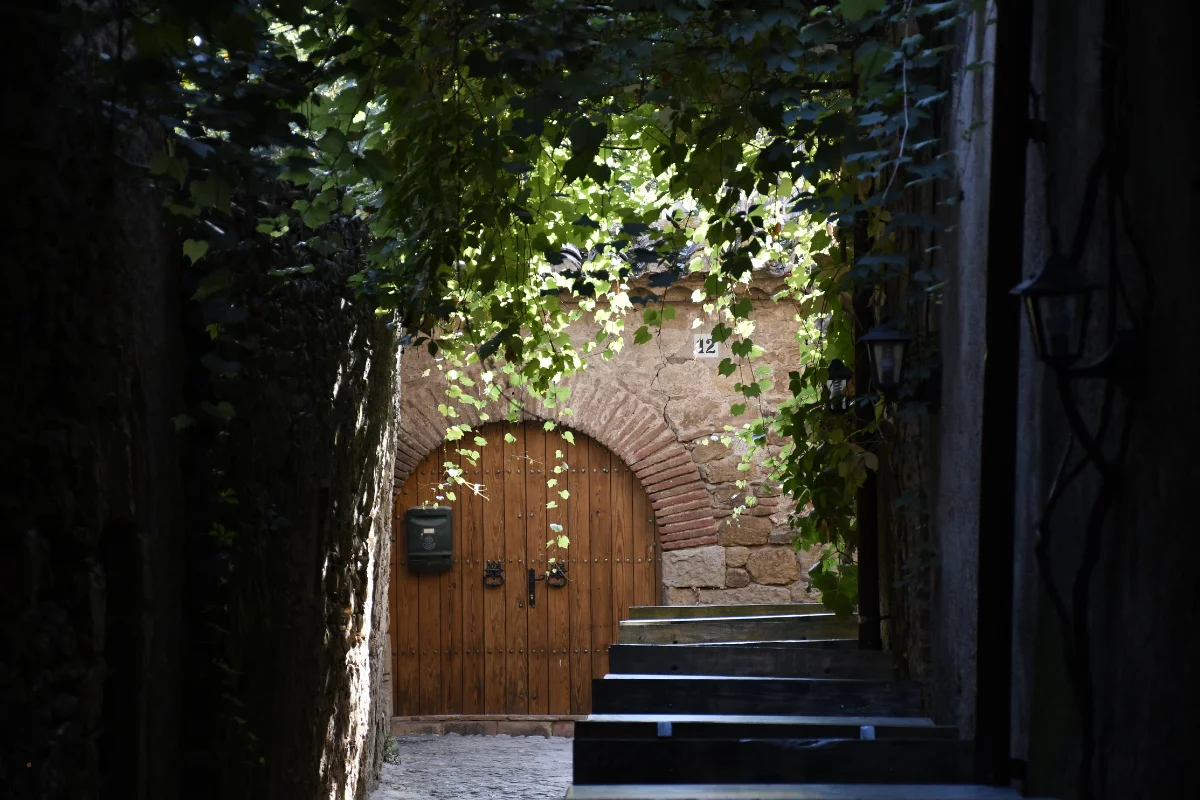

The name contains the building manual. Peratallada comes from the Latin Petra Taiata — cut stone. The moat that surrounds the historic center is not built of stone; it’s cut into the limestone bedrock that the village stands on. The buildings themselves are constructed from that same rock. The foundation and the walls are the same geological formation. The visual coherence that makes the village look like a single object — everything the same tone, the same texture — comes from this: the village and its site are made of the same material.
This isn’t a metaphor. In several places, the stone of the floor and the stone of the wall are continuous. That’s what Petra Taiata means, and it’s what the moat confirms at up to 7 meters depth in its deepest sections.
Peratallada is in the Baix Empordà, Girona province, 135km from Barcelona and 40km from Girona. It has approximately 200 inhabitants, takes two hours to walk completely and has been a Bé Cultural d’Interès Nacional (National Cultural Heritage asset) since the 1930s.
What should you see in Peratallada? The castle (documented from 1065, privately owned, courtyard accessible). The moat excavated directly in limestone — up to 7 meters deep. The Torre de les Hores (free climb, aerial view of the village). The Plaça de les Voltes with medieval arcades. The Romanesque church of Sant Esteve built outside the walls (11th–13th century). The first weekend of October Medieval Fair. No direct public transport — AVE to Girona (35 minutes) plus car rental is the practical route.
Sant Esteve sits outside the walls, and that is deliberate
Beyond the castle, the medieval streets and the Plaça de les Voltes, the detail that explains the layout is that the church of Sant Esteve is built outside the walls, and this is architecturally significant.
In most medieval fortified settlements, the church is the most protected building — it’s inside the walls, often at the highest point, sometimes incorporated into the defensive system. Peratallada’s church is outside. The reason is practical: Sant Esteve served not just the village population within the walls but also the rural farmers and workers living in the surrounding agricultural territory who weren’t inside the fortified nucleus. A church inside the walls would require those people to pass through the gate system every time they needed religious services. Building it outside removed that friction.
The placement is the architect’s answer to a social question: who is this building for? The answer was everyone in the territory, not just the protected residents.
The Defensive System: Moat, Walls and Four Towers
The castle of Peratallada is documented from 1065. It sits on a natural limestone base 5 meters above the surrounding terrain — the site had defensive height before a single wall was raised. The keep is rectangular, 10 meters tall, with original square crenellations. The 14th-century manor house attached to it has a Gothic facade that contrasts with the military austerity of the keep.
The castle is privately owned. The courtyard is accessible, the interior is not. The best exterior views are from the Plaça dels Esquiladors — named for the sheep shearers who gathered there — and from the Carrer de la Roca, where the keep appears above the roofline.
The moat reaches its maximum depth of 7 meters near the Portal de la Verge (Gate of the Virgin), the main fortified entrance. The gate had a drawbridge — the stone anchors for the chains are still visible in the arch. Inside the arch, a niche holds an image of the Virgin known as “she of the good death,” named for being the last image seen by condemned prisoners leaving for execution through this gate.
The four towers and their functions:
The Torre del Homenatge (Keep Tower) is the tallest and visible from every angle of the village — the military center of gravity.
The Torre de les Hores (Hours Tower) was the public clock, regulating communal life and watch rotations. Free to climb. From the top: the only aerial view of the full historic nucleus available to visitors.
The Torre Circular del Nord (North Circular Tower) is integrated into the most accessible stretch of curtain wall, showing the transition between the natural rock base and the built masonry above.
The Torre de l’Oest (West Tower) is the only one preserved in its original medieval state without later modifications — the most architecturally “pure” element of the defensive system.
The Plazas: Each One With a Specific Logic
Plaça de les Voltes
The social center since the Middle Ages. Medieval arcades on the north and east sides — now occupied by restaurant terraces — have been in use since the 14th century. The best starting point for a visit: buy a coffee, orient yourself to the geometry of the village and plan the rest of the circuit before moving.
Plaça dels Esquiladors
The most photogenic plaza in the complex. Named for the sheep shearers. Houses with ivy-covered facades surround the space; in autumn the ivy changes color to amber and red. The passage between Carrer de la Roca and Carrer de l’Hospital at this point produces the most reproduced image of the village — and it’s genuinely as good as the photographs suggest.
Plaça del Oli
Smaller and quieter than the others. The medieval trullos (olive oil presses) that processed the region’s olive production operated here. The buildings around it carry architectural details that most visitors pass without stopping — corbels, window surrounds and doorway proportions that reflect the specific wealth and period of each household.
The Streets Between
Carrer de la Roca is the narrowest and most photographed street, with the limestone bedrock visible at the base of some buildings — literally the geological floor that gives the village its name appearing between the houses.
Casa-pont construction appears throughout — buildings that extend over the public passage without closing it, preserving pedestrian movement under the structure while expanding the living area above. A specifically medieval urban solution to the problem of growth within a fixed defensive perimeter.
The Church of Sant Esteve: Built for Everyone Outside the Walls
The church was built between the late 12th and early 13th centuries in the Romanesque-transitional style. The espadanya (bell gable) facade with four arches is visible from the main car park approach. Inside: the 14th-century Gothic tomb of Gilabert de Cruïlles, first baron of the lineage that unified the feudal territory, lies in the right lateral chapel.
The Cruïlles family connection to Peratallada links the village to the broader political history of medieval Catalonia — the family’s role in consolidating the Empordà territory made Peratallada an administrative and judicial center as well as a fortified residence. The tomb is the physical record of that status.
For the context of Catalan Romanesque — how the Empordà churches connect to the broader tradition visible in the Pyrenees and in Barcelona’s hidden churches — the architectural continuity across these sites becomes clear when you’ve seen several examples.
Is It Worth Going?
Yes — unreservedly if you have any interest in medieval architecture as a functional system rather than a decorative object. Peratallada is one of the few places in Catalonia where the fortified village logic — moat, towers, gate, curtain wall, church placement — is complete and legible. You can walk the system and understand how each element functioned in relation to the others.
When it’s not the right choice: if you need substantial services, restaurant variety or activities beyond the historic center and the immediate surroundings. Peratallada has excellent restaurants in the medieval plazas, but the supply of everything else is limited to what 200 residents require.
The specific best-case scenario: arriving before 10:00 in May or September, walking the entire circuit before the restaurant terraces open, climbing the Torre de les Hores, and staying for lunch at the Plaça de les Voltes. Leaving by 15:00 to continue to Ullastret (7km) or Pals (8km).
Gastronomy: The Empordà on a Plate
The restaurant density in Peratallada’s medieval plazas is unusually high for a 200-person village — the tourism infrastructure has built around the architecture. The cooking is market-driven and seasonal, with the specific products of the Baix Empordà: Pals rice (a short-grain variety grown in the area since the 15th century), recuit de drap (a fresh cloth-drained cheese served with honey), snails on the grill and the full range of cuina empordanesa.
- Can Bonay — traditional seasonal cooking, local product
- La Cort — dinner-oriented, stone interior, good for couples
- L’Eixida Restaurant Gastronòmic — more developed Empordà proposal
- Can Nau — snails and grilled meats, direct Empordà cooking
Gelat Artesà — one of the few establishments in Catalonia with a line of savory ice creams: gazpacho, vermouth with olives, anchovies from L’Escala. Not a novelty act — it has its own queue in high season.
When to Go
May and June: best balance of temperature, crowds and restaurant availability. The village is active without being saturated.
September: lower crowds than July–August, excellent light for photography, local visitor profile.
October first weekend: the Fira Medieval — medieval fair with jugglers, comedy performers, jousting tournaments, period market stalls and workshops. The event transforms the village; the walled enclosure functions as its own stage. Arrive before 10:00 to park and access before peak attendance.
Winter: the village is practically empty. The light at 16:00 on a clear January day on the stone facades is the best photography window of the year and the least crowded moment of any.
Access and Practical
From Barcelona: No direct public transport. Best option: AVE to Girona (35 minutes, €12–25) + car rental from Girona station. Peratallada is 40km from Girona on the C-66, approximately 35 minutes.
By car from Barcelona: A-2 and AP-7, approximately 1h40–2h depending on traffic.
Parking: Three free municipal car parks — near Sant Esteve church, near Torre de les Hores, and at the Camí de Sant Feliu de Boada. All free. They fill from 11:00 in summer — arrive before then or after 17:00.
Within the village: pedestrian throughout. The historic center is cobblestoned; not practical for wheelchairs on most routes due to the gradient and original paving.
Villages to Combine in the Same Day
The Baix Empordà concentrates medieval heritage, Roman archaeology and Costa Brava coast within 15km:
- Ullastret (7km) — Iberian ruins with 4th-century BC walls and an on-site archaeological museum
- Pals (8km) — another well-preserved medieval nucleus, with beach access at Platja de Pals
- Monells (5km) — smaller, quieter, filmed for Ocho apellidos catalanes, almost no tourist infrastructure
- Canapost (5 minutes by car) — Early Medieval necropolis, virtually unknown, minimal tourism
- Sant Miquel de Cruïlles (10km) — 10th-century Romanesque monastery with cloister
The standard circuit: Peratallada + Ullastret + Pals in a single day covers three completely different heritage typologies: fortified medieval village, Iron Age Iberian settlement and medieval town with beach access.
Can you enter the Peratallada castle?
The castle is privately owned. The courtyard is accessible to visitors; the interior rooms are not. The full exterior and the keep silhouette are best seen from the Plaça dels Esquiladors and the Carrer de la Roca. The Torre del Homenatge is visible from every angle of the village.
How long does a visit to Peratallada take?
The walled historic center takes 1.5–2 hours at a reasonable pace. Adding lunch in one of the plaza restaurants extends the visit to 3–4 hours. Combining with Ullastret or Pals requires a full day.
Is there free parking in Peratallada?
Yes — three free municipal car parks (near Sant Esteve church, Torre de les Hores and Camí de Sant Feliu de Boada). All free. They fill from 11:00 in July and August — arrive early or plan arrival after 17:00.
When is the Peratallada Medieval Fair?
First weekend of October. Medieval market, jugglers, jousting, period workshops and gastronomy. Arrive before 10:00 to access before peak crowds. The historic enclosure functions as its own stage for the event.
How do you get to Peratallada from Barcelona without a car?
No direct public transport. Most practical route: AVE to Girona (35 minutes) and car rental from Girona station — Peratallada is 40km from Girona on the C-66 (35 minutes). Taxi from Girona is also possible (approximately €50–60 one way).
Is Peratallada accessible for visitors with reduced mobility?
The original cobblestone paving and steep gradients make most of the historic center difficult for standard wheelchairs. The Plaça de les Voltes and Plaça dels Esquiladors are relatively flat. Heritage protection restrictions limit permanent accessibility modifications.
Inland, Rupit’s suspension bridge was built in 1945 by four local craftsmen rather than in the Middle Ages, and its 10-person limit is structural — the detail the Rupit village guide opens with.
Final Insight
Peratallada survives because the geology made it inconvenient to demolish. The limestone that the moat is cut from, the same rock that forms the building foundations, the same material visible in the Carrer de la Roca — it all functions as passive preservation. The development economics that transformed Lloret de Mar or Roses simply didn’t apply here: the rock is too hard, the village too small, the access too inconvenient. What protected Peratallada wasn’t cultural policy. It was the stubbornness of the stone it’s made of.
For the wider Empordà region — the coast, the Dalí Triangle and the northern Costa Brava — the Barcelona festivals calendar covers the seasonal events that make specific dates worth planning around when combining Peratallada with other stops in the region.