
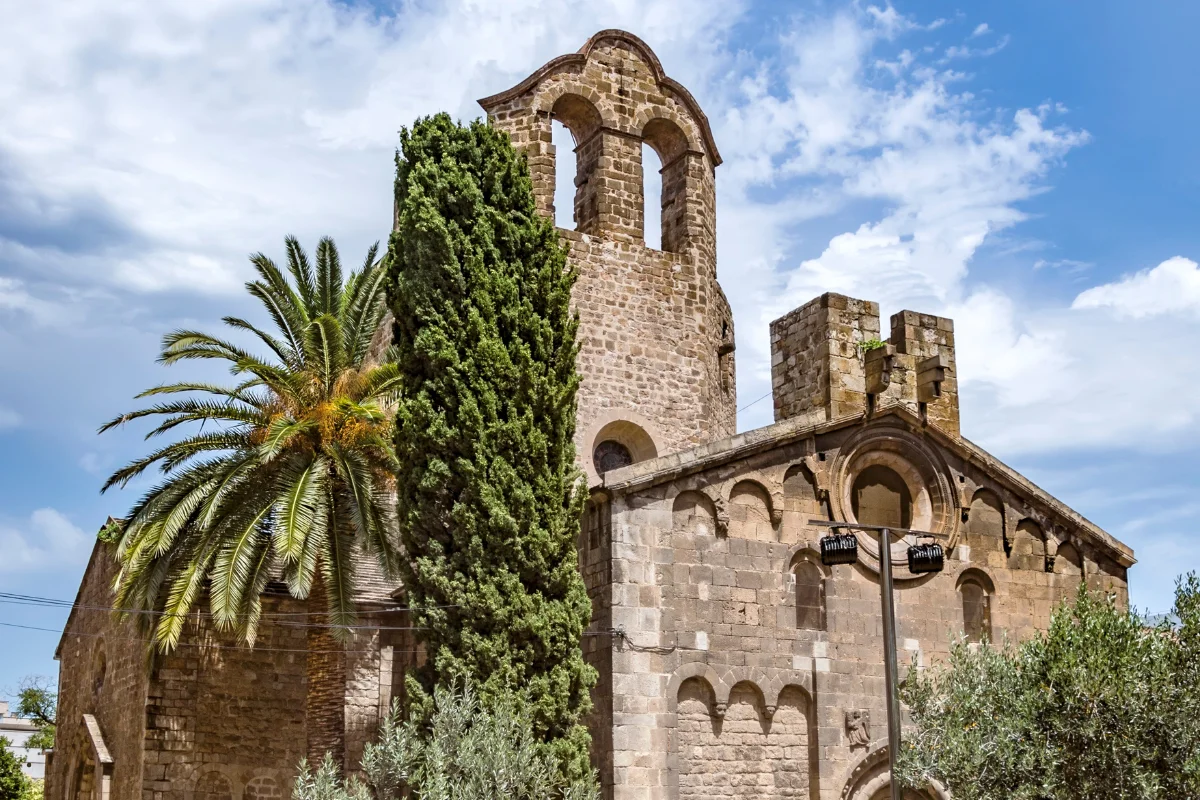

Barcelona has close to 200 churches. Most visitors see three: Sagrada Família, the Cathedral, Santa Maria del Mar. Behind those three is a catalogue of religious architecture that runs from a 9th-century Romanesque monastery to a neoclassical chapel housing one of Europe’s most powerful supercomputers — both open to visitors, both almost completely unknown.
This guide covers nine hidden churches in Barcelona with the single fact that makes each one worth a detour. Not architectural style in the abstract — the specific detail that doesn’t exist anywhere else.
Quick answer: The nine hidden churches worth visiting in Barcelona are Sant Pau del Camp (unique Romanesque cloister technique, €6), Sant Felip Neri (1938 bombing craters, free), Monasterio de Pedralbes (three-story Gothic cloister, ticketed), Capella de Marcús (1166, appointment only), Sant Just i Pastor (free, Gothic fountain outside), Torre Girona chapel (supercomputer inside, free with booking), Santa Madrona (opens once a year), Sant Pere de les Puel·les (bell tower, last Saturday of the month, €5), and Sant Andreu del Palomar (the heart of what was once an independent town).
Quick Picks
- Most architecturally unique → Sant Pau del Camp (construction technique found nowhere else in the world)
- Most historically charged → Sant Felip Neri (1938 civilian bombing, 42 dead, craters still visible)
- Best for a half-day → Monasterio de Pedralbes (Gothic cloister + royal tomb, full museum)
- Most unusual combination → Torre Girona chapel (supercomputer inside a 19th-century neoclassical nave)
- Hardest to access → Santa Madrona (opens one day per year, no exceptions)
- Best free visit → Sant Felip Neri square (open at any hour, no ticket, full historical weight)
- Best for photography → Sant Pau del Camp cloister (morning light, almost never crowded)
Which Option Should You Choose?
- Want Romanesque architecture → Sant Pau del Camp, El Raval — the oldest standing monastery in the city
- Interested in Civil War history → Sant Felip Neri — the bombing craters are the most visible mark of the war in the Gothic Quarter
- Have a half-day and want a complete visit → Monasterio de Pedralbes — cloister, museum, royal tomb, functioning convent
- Want something nobody else has seen → Torre Girona chapel with MareNostrum supercomputer — book weeks ahead
- Walking the old city anyway → Chain Sant Felip Neri + Capella de Marcús + Sant Just i Pastor in one morning on foot
- Repeat visitor looking beyond the circuit → Sant Pere de les Puel·les bell tower (last Saturday of month) or Sant Andreu del Palomar (genuine neighbourhood, no tourists)
Sant Pau del Camp: The Cloister Technique Found Nowhere Else
On Carrer de Sant Pau 101 in El Raval, the monastery of Sant Pau del Camp is the oldest Romanesque building in Barcelona — first documented around 977 AD, with the current structure built between the 11th and 12th centuries. The name tells you everything: del Camp because when it was built, the site sat surrounded by fields outside the city walls.
The Moorish influence on the cloister’s lobed arches — three-lobed and five-lobed forms drawn from Caliphate architecture — is the part everyone notices. The construction anomaly is the part that is not: the craftsmen who built these arches used horizontal stone courses rather than radial voussoirs to form the lobes. In traditional Islamic arches, the wedge-shaped stones are placed radially, converging toward the centre. At Sant Pau del Camp they were laid horizontally, producing the same visual result through a completely different structural logic. No other documented Romanesque cloister in the world uses this technique.
The monastery was Benedictine, survived the 19th-century disentailment, served as a barracks, and was rescued by popular mobilisation. It was declared a National Monument in 1879. The interior’s lack of ornamentation — a consequence of the 1909 fire during the Tragic Week — allows you to read the stone structure directly, without later additions. No other church in the city centre offers this kind of architectural clarity.
Price: €6. Weekend guided visits at €9–10. Hours: Monday–Saturday 10:00–18:00.
📍 Carrer de Sant Pau 101, El Raval. The full context of the neighbourhood is in the El Raval Barcelona guide.
Sant Felip Neri: The Wall That Records a Bombing, Not an Execution
The Plaça de Sant Felip Neri is one of the most intimate squares in the Gothic Quarter — cobblestones, a central fountain, the Baroque church facade, and the walls of the surrounding buildings covered in deep pockmarks.
A persistent myth in many Barcelona guides labels these marks as execution bullet holes. They are not. They are the shrapnel craters from a bomb dropped by Italian Fascist aircraft on 30 January 1938. The attack killed 42 people who had taken shelter in the square — most of them children from a nearby school. The distinction matters: this is not a site of political repression but an involuntary monument to the aerial bombardment of civilians during the Civil War. The two events — execution and bombardment — have different histories, different perpetrators, and different meanings for the city.
The church itself is one of the few examples of Barcelonian Baroque — built between 1721 and 1752. The interior holds Baroque and 19th-century Neoclassical altarpieces and two paintings by Joan Llimona. The regular Baroque music cycles held here are one of the most coherent ways to experience the space: the music and architecture answer to the same era.
Access: free. The square is open at any hour.
📍 Plaça de Sant Felip Neri 5, Gothic Quarter.
Monasterio de Pedralbes: The Queen in Two Versions
Founded in 1326 by Queen Elisenda de Moncada using her personal inheritance, the Monasterio de Pedralbes is one of the most complete examples of Catalan Gothic in the city. Its three-storey cloister is unusual by European standards — most Gothic cloisters have one or two levels. The gardens maintain the scale and quiet of a rural monastery within the residential and diplomatic district of Pedralbes.
The most remarkable element is the queen’s tomb, built into the wall separating the cloister from the church. It holds two sculptures of Elisenda on a single funerary structure: from the cloister side, the queen appears wearing the austere Franciscan habit of the Poor Clares who inhabited the monastery; from inside the church, the same queen appears crowned, in full royal regalia, with polychrome marble sculptures. Two versions of the same person in the same stone — the queen who chose to retire to a convent, and the queen who ruled.
The Poor Clares still live in a non-public section of the complex. This is not only a museum but an active religious community — one of the details that makes Pedralbes feel different from every other historic site in the city.
Price: museum ticket, check current rates. Hours: Tuesday–Sunday.
📍 Baixada del Monestir 9, Pedralbes. Metro Reina Elisenda (FGC).
Capella de Marcús: The Last Stop Before the Road to France
On Carrer dels Carders in El Born, a Romanesque chapel from 1166 stands almost entirely invisible — fully integrated into the street’s building line, with nothing on the exterior to signal it as a historic temple.
The Capella de Marcús was built by the merchant Bernat Marcús as part of a hostel-hospital positioned alongside the ancient road that left Barcelona northward toward France. It was the last stop for prayer and rest before the long journey. Travellers arriving from that road also paused here before entering the city. The chapel is dedicated to the Virgin of the Guide — patron of travellers — which explains its function precisely.
Today the community of Sant’Egidio manages it. Visits require an appointment and access is limited, which preserves a genuine silence in the middle of El Born — a neighbourhood that otherwise runs at high volume.
📍 Carrer dels Carders, El Born.
Torre Girona: A Supercomputer Inside a Neoclassical Chapel
The neoclassical chapel of Torre Girona on the UPC campus in Pedralbes houses the MareNostrum 5 — the most powerful supercomputer in Spain, capable of 200 petaflops (200 quadrillion operations per second). It processes data for personalised genomics, climate modelling, and international scientific simulations.
The supercomputer sits inside a transparent glass cube in the central nave of the 19th-century chapel. The neoclassical ceiling, columns and arches surround the infrastructure directly. There is no partition, no separate room — the technology sits inside the religious architecture as a single unified space.
It is the most extreme anachronism available inside any religious building in Europe, and it is open to visitors.
Access: free, mandatory booking through the Barcelona Supercomputing Center website (bsc.es). Groups of maximum 30, sessions of 40 minutes. Book several weeks ahead — slots fill consistently.
📍 Campus Nord UPC, Jordi Girona 29, Les Corts.
Santa Madrona: The Church That Opens Once a Year
The hermitage of Santa Madrona on Montjuïc is the only survivor of the many chapels that dotted the hillside during the medieval period. It is documented from 1403. It sits on the Montanyans slope, surrounded by the kind of legend that accumulates around patron saints over six centuries.
The most unusual access condition in this guide: it opens to the public once a year, on the fourth Sunday after Easter. That day, a neighbourhood procession carries residents up to the hermitage for mass, communal lunch and a tombola. It is a neighbourhood festival that has survived centuries and remains primarily for local residents, not tourists.
For the other 364 days, the door is closed. If you’re planning your visit to Barcelona around the Montjuïc castle and hillside, note the date.
Sant Pere de les Puel·les: The Octagonal Bell Tower, Last Saturday Only
The first documented female convent in Barcelona, founded in 945 as a Benedictine monastery. It has survived Al-Mansur’s raid in 985, the War of Succession, 19th-century disentailment, the 1909 Tragic Week fire, and the Civil War.
The octagonal bell tower — a rarity in the city’s Romanesque architecture — can be visited by prior booking via email: santpere164@arqbcn.cat. Visits run on the last Saturday of each month only. The view from the tower over the medieval Sant Pere neighbourhood, with its streets and rooftops directly below, is one of the most unusual vertical perspectives available in the historic centre.
Price: €5.
📍 Carrer de Lluís el Piadós 1, Sant Pere.
Sant Just i Pastor: The Fountain and the Disputed Legend
The Basílica dels Sants Just i Pastor sits on the Plaça de Sant Just, less than 100 metres from Barcelona’s City Hall, but passes almost completely unnoticed in the Gothic Quarter tourist circuit.
It is one of the city’s oldest continuously active temples — the current structure dates from the 14th century, but documentation places a church on this site much earlier. The 15th-century Gothic fountain in front of the facade is one of the oldest preserved in the city.
The most interesting legend circulating among neighbourhood residents: the original image of the Virgin of Montserrat is said to be here. According to this tradition, the image arrived from Jerusalem, was hidden in Montserrat during the Arab occupation, and when recovered, the original remained at Sant Just while a copy went to the monastery. No historical documentation confirms it — but the legend says more about the neighbourhood’s emotional connection to this building than any architectural fact.
The bell tower can be climbed, offering an unusual view over the Gothic Quarter’s rooftops.
Access: free. Variable parish hours — verify directly.
📍 Plaça de Sant Just 5, Gothic Quarter.
Sant Andreu del Palomar: The Heart of the Town That Was
The church of Sant Andreu del Palomar in the Sant Andreu neighbourhood anchors a district that was an independent municipality until its annexation to Barcelona in 1897. The square in front of the church still functions as the neighbourhood’s centre of gravity — market, community events, the barri’s November festival.
Barcelona’s historic centre is full of churches that once served villages absorbed by urban growth. Sant Andreu is the clearest surviving example: the square, the church, the market and the November festivities still operate as the hub of a neighbourhood with its own identity, entirely disconnected from the tourist circuit.
For anyone interested in the Barcelona that exists independently of tourism — and functions at a completely different pace — Sant Andreu is the most honest example available. It pairs naturally with the best streets walking guide for building a route through the less-visited north of the city.
📍 Plaça de l’Ajuntament, Sant Andreu. Metro Sant Andreu (L1).
Access at a Glance
| Church | Neighbourhood | Price | Access restriction |
|---|---|---|---|
| Sant Pau del Camp | El Raval | €6 | Mon–Sat 10:00–18:00 |
| Sant Felip Neri | Gothic Quarter | Free | Square always open |
| Monasterio de Pedralbes | Pedralbes | Museum ticket | Tue–Sun |
| Capella de Marcús | El Born | Free | Appointment required |
| Sant Just i Pastor | Gothic Quarter | Free | Variable parish hours |
| Torre Girona (MareNostrum) | Les Corts | Free | Web booking, max 30 people |
| Santa Madrona | Montjuïc | Free | One day per year |
| Sant Pere de les Puel·les | Sant Pere | €5 (tower) | Last Saturday of month, email |
| Sant Andreu del Palomar | Sant Andreu | Free | Parish hours |
Is It Worth It?
Yes — if you’re willing to plan two or three of them in advance.
The free visits (Sant Felip Neri, Sant Just i Pastor, Sant Andreu) require no planning and can be added to any walk through the Gothic Quarter or the old city. The three that require advance action — Torre Girona (web booking), Sant Pere de les Puel·les (email + specific date), Santa Madrona (one day per year) — are worth the planning precisely because almost no one else does it.
When it’s less worth it: if you arrive in Barcelona without having booked Torre Girona. The slots genuinely fill up weeks ahead and there’s no walk-in option. It’s the most unusual interior available in the city, and it costs nothing — the only barrier is the booking.
Best Strategy
- 2 hours in the Gothic Quarter → Sant Felip Neri (15 min) + Sant Just i Pastor (20 min) + walk to Capella de Marcús in El Born (20 min). All free, all walkable, covers three completely different periods.
- Half day with Pedralbes → Morning at Monasterio de Pedralbes (2 hours minimum for cloister + museum) + walk through the Pedralbes neighbourhood to Torre Girona chapel (book in advance).
- Full hidden Barcelona day → Morning at Sant Pau del Camp (El Raval) + afternoon Gothic Quarter chain + evening walk to Sant Pere de les Puel·les (if last Saturday of month). Add Sant Andreu del Palomar as a separate half-day trip.
- Planning around a specific date → If the fourth Sunday after Easter aligns with your trip, Santa Madrona in Montjuïc is a genuinely rare experience. Combine with the Montjuïc castle visit for a full hill day.
Older does not mean more interesting
Age and interest are not the same thing. The Cathedral is older than Sant Felip Neri — it is also far more visited, far less specific and, at 16 € a ticket outside Mass times, the only one of the two that charges. The bombing craters on the Plaça de Sant Felip Neri wall tell a more precise story about 20th-century Barcelona than any decorative element inside the Cathedral.
They describe style instead of detail. “Romanesque with Moorish influence” applies to half a dozen churches in Catalonia. The horizontal stone coursing in Sant Pau del Camp’s cloister applies to one building on earth. The detail is what makes the visit worth making.
They ignore access conditions. Every guide mentions the Monasterio de Pedralbes. Almost none mention that the Torre Girona chapel is free and bookable and contains one of Europe’s most powerful supercomputers. The access conditions are part of the content — and they’re often the most interesting part.
For the broader picture of Barcelona’s architectural landscape, the Casa Batlló visit guide and the Casa Vicens guide cover the Modernisme side of the city’s religious and civic architecture in the same level of detail.
Mistakes to Avoid
-
Going to Torre Girona without booking. There is no walk-in access. The Barcelona Supercomputing Center website (bsc.es) is the only booking channel. Slots fill weeks ahead, especially on weekdays. This is the most unusual free visit in the city — don’t skip the booking step.
-
Visiting Sant Pau del Camp on Sunday. The monastery is closed on Sundays. Monday–Saturday 10:00–18:00 only. A surprisingly common mistake given that Sunday is when most visitors have free time.
-
Confusing the shrapnel marks at Sant Felip Neri for execution holes. The distinction matters historically and changes how you read the space. 42 people killed by a bomb, not a firing squad. Many guided tours in the Gothic Quarter still get this wrong.
-
Trying to visit Capella de Marcús without an appointment. The door is closed outside scheduled visits. Contact the Sant’Egidio community in advance — the space is worth the extra step.
-
Visiting Pedralbes without allowing enough time. The monastery is a full museum visit, not a quick stop. The cloister alone deserves 45 minutes. Budget at least 90 minutes for the complete visit including the royal tomb and the museum collections.
-
Scheduling Sant Pere de les Puel·les bell tower on the wrong Saturday. It is the last Saturday of the month, not any Saturday. Confirm the date by email before making the trip — the neighbourhood is not in the tourist circuit and there’s nothing else specific to do there if the tower is closed.
Who Is This For?
- Architecture enthusiasts → Start with Sant Pau del Camp (unique cloister technique) and Monasterio de Pedralbes (three-storey Gothic cloister). Both have the depth to hold a serious visit.
- History and Civil War interest → Sant Felip Neri is essential. The bombing context is one of the most tangible marks of the 1936–1939 war visible in public space in the city.
- Technology and design → Torre Girona chapel with the MareNostrum supercomputer. Book in advance, bring your camera, expect to spend 45 minutes inside.
- Repeat visitors and off-circuit travellers → Sant Andreu del Palomar and Sant Pere de les Puel·les bell tower. Neither appears in standard tourist guides. Both require a deliberate detour and deliver a completely different Barcelona.
- Visitors with limited time → Sant Felip Neri square + Sant Just i Pastor + walk to Capella de Marcús. Two hours, all free, no booking needed, covers the Gothic Quarter and El Born in one loop. Pairs directly with the Barcelona complete travel guide for a full day in the old city.
The oldest layer of that catalogue has its own itinerary, from the 9th-century monastery onwards, in the Romanesque Barcelona guide.
Frequently Asked Questions
What is the oldest church in Barcelona?
Sant Pau del Camp in El Raval, with documentation from around 977 AD and a current structure from the 11th–12th centuries. The monastery of Sant Pere de les Puel·les has documentation from 945. Sant Just i Pastor has continuous activity since the 14th century on a much earlier foundation.
What are the holes in the walls at Sant Felip Neri?
Shrapnel craters from a bomb dropped by Italian Fascist aircraft on 30 January 1938. The attack killed 42 people, most of them children sheltering in the square. They are not execution bullet holes — that is a persistent myth in many tour guides.
How do I visit the MareNostrum supercomputer in Torre Girona chapel?
Free visit, mandatory advance booking through the Barcelona Supercomputing Center website (bsc.es). Groups of maximum 30 people, sessions of around 40 minutes. Book several weeks ahead — slots fill consistently. The 19th-century neoclassical chapel houses the supercomputer inside a glass cube in the central nave.
Can you visit Monasterio de Pedralbes?
Yes — it functions as a museum open Tuesday to Sunday. A private section remains occupied by the Poor Clare nuns. The three-storey Gothic cloister and the double royal tomb of Queen Elisenda de Moncada are the key elements. Budget at least 90 minutes.
When does the Santa Madrona hermitage in Montjuïc open?
Once a year: the fourth Sunday after Easter. A neighbourhood procession, mass, communal lunch and tombola mark the day. For the other 364 days, the hermitage is closed to the public.
How do I visit the Sant Pere de les Puel·les bell tower?
Last Saturday of each month only, with prior booking by email to santpere164@arqbcn.cat. Price: €5. The octagonal bell tower is a rarity in the city’s Romanesque architecture and offers views over the medieval Sant Pere neighbourhood.