

In 1894, the painter Santiago Rusiñol bought two El Greco canvases in Paris and organized a procession from the Sitges train station to his studio. Not a quiet transfer — an actual public procession with music and ceremony, treating the paintings as relics. The event was simultaneously an art stunt and a manifesto, and it effectively declared Sitges the cultural capital of Catalan Modernisme.
That studio is now the Cau Ferrat Museum. The El Grecos are still there. The house still doesn’t look like a museum — it looks like how an artist lived, which is the point.
Sitges is 35 minutes from Barcelona on the R2 Sud line. It has 26 beaches across 4 kilometers of coast, three museums of genuine international standing, a Carnival that continued through the Franco dictatorship when most of Spain’s was banned, and a first chiringuito — the first beach bar in Spain — still operating on the same seafront where it opened. This guide organizes it all by what actually matters for your specific visit.
What should you see in Sitges? The Cau Ferrat Museum (former studio of Santiago Rusiñol, with original El Grecos, Picassos and the world’s most important collection of wrought iron art — Tue–Sun 10:00–17:00). The Palau de Maricel (Sundays only, 10:00–14:00). The old town church of Sant Bartomeu on the seafront promontory. The Malvasía de Sitges wine from the last urban vineyard in Catalonia. The R2 Sud train from Passeig de Gràcia or Sants: 35–45 minutes, every 15 minutes.
Who Is This Visit For
You want beaches + old town atmosphere → Arrive by 10:00, walk the old town before the terraces fill, swim at Platja de Sant Sebastià (the most local of the main beaches), spend the afternoon on the Ribera.
You want the full cultural circuit → Plan for a Sunday: the Cau Ferrat opens at 10:00, the Palau de Maricel opens at the same time and only exists as a visit on Sundays. Build the morning around both, afternoon for the waterfront.
You’re visiting for the LGBTQ+ scene → June for Gay Pride (one of Europe’s most significant), but the Bassa Rodona beach and Carrer de la Primera de Maig bars are active throughout the warm months.
You want the October film festival → The Sitges International Fantastic Film Festival runs October 8–18 in 2026. The Zombie Walk and street programming transform the whole town for days — this is a different Sitges from the summer one.
You want the Carnival → February, and book accommodation months ahead. The Rúa de la Disbauxa and Rúa de l’Extermini are the main parades. Sitges’ Carnival has been running since before the Franco era — it continued underground when the dictatorship banned it elsewhere.
The Cau Ferrat: How the Museum Actually Works
The Museu Cau Ferrat is not organized like a museum. It’s organized like Santiago Rusiñol lived — which is why the visit feels nothing like moving through curated rooms.
Rusiñol arrived in Sitges in 1891 and merged two fishermen’s houses into his home and studio. In 1894 came the El Greco procession. He’d found the two paintings — The Tears of Saint Peter and The Penitent Magdalene — in Paris and recognized something in them that the mainstream Spanish art world had spent centuries ignoring. The procession was performance art as critical argument: he was saying El Greco was a Moderniste before the term existed.
The paintings are in the first-floor Grand Salon now, alongside works by Picasso, Ramon Casas, Isidre Nonell and Hermenegildo Anglada Camarasa. The ground floor preserves the original fishermen’s house structure, with navy blue dados that identify the maritime origin of the building.
The collection that outweighs the paintings: the museum holds the largest collection of wrought iron art in the world — medieval door handles, Renaissance keys, lockplates from across six centuries that Rusiñol spent decades collecting. He wasn’t treating decorative metalwork as craft. He was arguing it was fine art. The ironwork collection fills the walls around the paintings, and the argument holds.
Hours: Tue–Sun 10:00–17:00. Closed Mondays. Entry includes the Museu Maricel.
The Palau de Maricel: The Building That Lost Its Collection
The Palau de Maricel was built between 1910 and 1918 by Miquel Utrillo for American millionaire Charles Deering, who wanted a palace to house his art collection. Utrillo merged fishermen’s houses and the old medieval hospital into a building that incorporates Gothic, Renaissance and Baroque elements rescued from buildings across Spain.
The critical piece of context: in 1921, Deering and Utrillo had a falling out, and Deering left Sitges taking most of his collection with him. The palace keeps its spaces — the Saló d’Or, the Saló Blau, the cloister with Mediterranean views — but the original collection is gone. What remains is the architectural shell, which is exceptional in itself.
Opens Sundays only: 10:00–14:00. This single scheduling constraint eliminates the Palau from most day trips. If you visit on a Sunday and have any interest in the building, it’s worth the 45-minute window — the cloister view alone justifies the detour.
The Museu Maricel next door holds the collection of Dr. Jesús Pérez-Rosales: ten centuries of art from Romanesque sculpture to Josep Maria Sert’s 1915 murals depicting World War I. The Sert room is the most visited section, and rightly so — the scale and narrative force of the canvases are a different register from everything else in the building. Same hours as Cau Ferrat, combined ticket.
The Church on the Rock and the Old Town
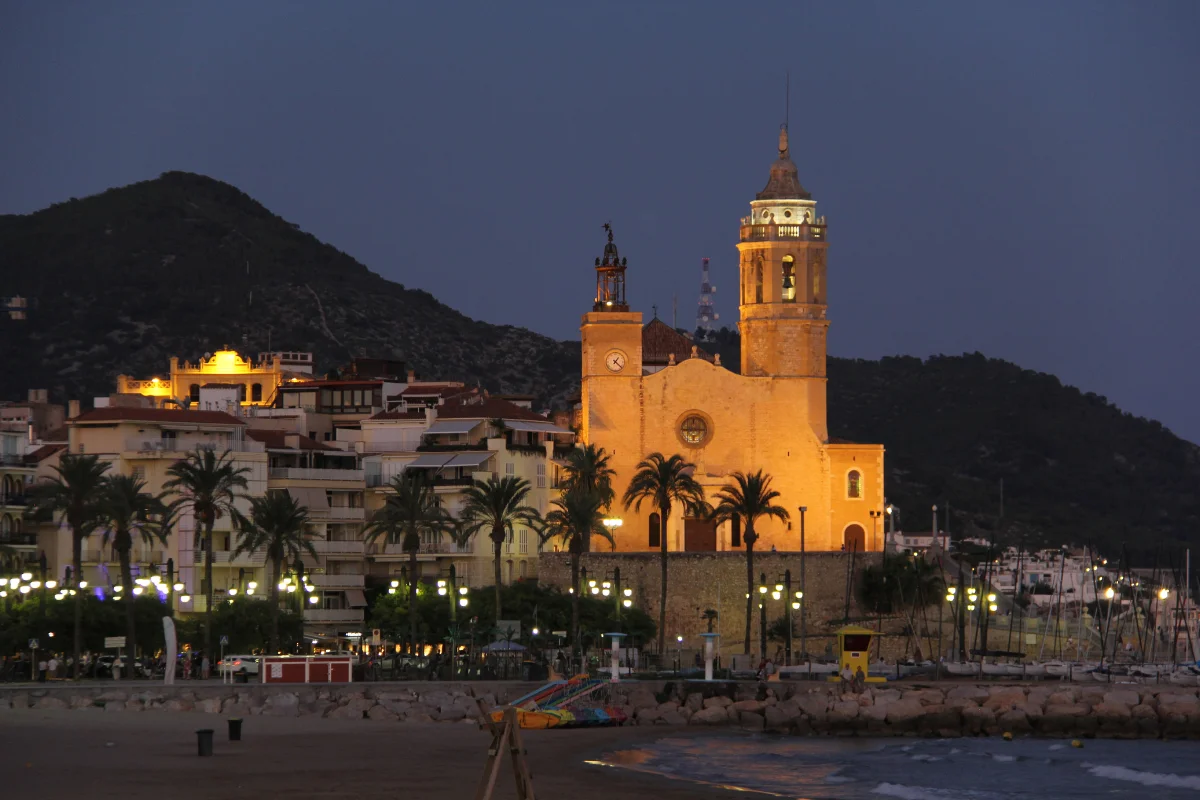
The parochial church of Sant Bartomeu i Santa Tecla was built in the 17th century on a limestone promontory that drops directly into the Mediterranean. Two bell towers of different eras — the octagonal second tower was reformed in 1868 — give it the asymmetry that distinguishes it from every other coastal church in Catalonia.
Inside, the Baroque altarpiece of Sant Telmo (1688) documents Sitges’ maritime history in stone: the bank scenes show ships in distress and shipwrecks, decorated with fish, angels riding sea monsters and aquatic forms. It’s a sailor’s church in the most literal sense — built by a fishing community that understood the sea as the source of both livelihood and death.
The Racó de la Calma — the small passage between the Palau Maricel and the Museu Maricel — is one of the least-crowded and most photogenic spots in Sitges, with direct sea views framed between the two facades. Most visitors walk past it on the way to the church.
The Plaça del Baluard has one of the cleanest viewpoints on the coast: the beach of Sant Sebastià, the seafront promenade and the Mediterranean in a single frame. The best light falls in the late afternoon, when the church becomes the foreground silhouette against the water.
The old town streets — Carrer d’en Bosc, La Davallada, Carrer Major — keep the scale of the original fishing village. These streets predate the modernista expansion and the Indianos mansions; they’re the skeleton of the town before the money arrived.
The Beaches: 26 Options, Organized by What You Actually Want
Sitges’ 26 beaches run along 4 kilometers of urban coast and into the edges of the Garraf Natural Park. The choice depends on what kind of beach day you’re planning.
For the classic Sitges experience: The Platja de Sant Sebastià, between the church and the cemetery, is the local’s beach — less tourist density than La Ribera, direct access to the old town, more neighborhood atmosphere. The Platja de la Ribera is the longest and most central, with chiringuitos, sun loungers and immediate access to the seafront promenade.
For sports: The Platja de la Fragata, directly below the church, has volleyball nets, beach football and the Yacht Club where you can rent kayaks and sailing dinghies.
For the LGBTQ+ scene: The Platja de la Bassa Rodona, between La Ribera and l’Estanyol, is the main LGBTQ+ gathering point in summer, with the Pic-Nic restaurant on the promenade.
For quiet: The Platja de Balmins, east of the church, is a traditional nudist beach divided into three small natural coves with views of the old town and the maritime cemetery. Less serviced, more atmosphere.
For snorkeling and natural settings: The Cala Morisca, already within the Garraf, has clear water and rocky seabed — bring proper footwear for the access.
| Beach | Atmosphere | Length | Services |
|---|---|---|---|
| Sant Sebastià | Local / Family | 250m | Restaurants, promenade |
| La Ribera | Tourist / Central | 260m | Full services |
| La Fragata | Sports | 35m | Volleyball, sailing |
| Bassa Rodona | LGBTQ+ | 285m | Pic-Nic restaurant |
| Balmins | Nudist / Quiet | Small | Minimal |
| Aiguadolç | Surf / Family | 145m | Surf schools |
The Modernista Architecture You’ll Walk Past Without Knowing
The most interesting architecture in Sitges isn’t in the museums — it’s on the facades. The Ruta dels Americans traces the mansions built by the indianos, Sitgetans who emigrated to Cuba and Puerto Rico in the 19th century and returned with enough capital to transform the town’s urban landscape.
The Casa Bartomeu Carbonell at Plaça del Cap de la Vila has a clock tower decorated with white and blue ceramic trencadís — the same technique Gaudí used at Park Güell. The Casa Pere Carreras (1906) on Carrer Francesc Gumà has floral stonework and ironwork balconies. The Casa Isabel Ferret (1899) is the work of Enric Sagnier, one of the most prolific architects of Catalan Modernisme.
The Mercat Vell (1889) in the Plaça de l’Ajuntament was the first iron-frame structure in Sitges. It now houses the Casa Bacardí — because Facundo Bacardí Massó, founder of the Bacardí rum brand, was born in Sitges. This is one of those facts that rewrites a visit retroactively.
The Malvasía de Sitges: Wine from the Last Urban Vineyard in Catalonia
The Malvasía de Sitges arrived from Greece in the 14th century, found ideal conditions in the local microclimate, and nearly disappeared with the phylloxera epidemic at the end of the 19th century. The Llopis family donated their vineyard land to the Hospital de Sant Joan Baptista on the condition that production continue — a 19th-century legal clause is what keeps this wine in existence today.
The Centro de Interpretación de la Malvasía (CIM), in the old village coral, allows visits to one of the last urban vineyards in Catalonia and tastings of varieties from the Blanc Subur (young, 100% Malvasía) to the Llegat Llopis (hand-harvested) and the Malvasía Dolça (4 years in chestnut barrel, toasted notes). It’s the most unusual wine tasting in the Barcelona day-trip circuit and almost nobody knows it exists.
The Xató — Sitges’ winter dish — pairs well with the Malvasía: escarole, salt cod, tuna, anchovies and arbequina olives in a sauce of toasted almonds and hazelnuts, bread, garlic, oil and ñora pepper. The Ruta del Xató runs November to March.
The Garraf Natural Park and the Buddhist Monastery
65% of Sitges’ municipal territory belongs to the Parque Natural del Garraf — 12,000 hectares of limestone rock, caves and sinkholes. The landscape is radically different from the coast: no sand, no beach bars, only the palmito (the only native palm in Europe), lentiscus and the marked trails of the GR 5 and GR 92.
Inside the park, in the former Palau Novella (an 1890 Indianos mansion), the Buddhist monastery Sakya Tashi Ling has been established since 1996. The palace retains its period architecture with the interior adapted for Tibetan art and meditation spaces. Guided visits include the museum and the Stupa of Health in the garden. It’s one of the most unusual visits within 40km of Barcelona, and the contrast with the beach-and-museum circuit of the town couldn’t be more complete.
Getting There and Getting Around
By train: The R2 Sud line connects Estació de França, Passeig de Gràcia and Sants with Sitges in 35–45 minutes. Approximately one train every 15 minutes. This is the most sensible transport for a day trip — no parking issues, arrival directly in the center.
By bus: BusGarraf runs direct service from Ronda Universitat and Plaza de España. There’s a night connection (N30) for those staying into the evening.
From the airport: BusGarraf connects Barcelona Airport Terminal 1 with Sitges in approximately 30 minutes — useful for travelers arriving or departing who want to extend their time.
Within Sitges: The old town and seafront are pedestrian. Three urban bus lines (L1, L2, L3) connect the train station with peripheral neighborhoods. For the Garraf calas, you need a car or bicycle.
Parking: Sitges manages parking by zones (A, B, C, D) with the Blinkay app. The Parking de Can Robert is the most affordable and functions as a park-and-ride.
The Full-Day Plan
For a complete day visit that doesn’t waste time:
- Before 10:00: Old town when the streets are empty — church of Sant Bartomeu, Plaça del Baluard, Racó de la Calma
- 10:00–13:00: Cau Ferrat museum (or Palau de Maricel if visiting on a Sunday — worth the Sunday timing)
- 13:00–15:00: Platja de Sant Sebastià or La Ribera. Xató if in season (Nov–Mar)
- 15:00–18:00: Full seafront promenade walk to the Terramar Gardens and back
- 18:00–20:00: Sunset from the church or Plaça del Baluard
- 20:00 onward: Dinner in the old town or the Carrer de la Primera de Maig area for nightlife
Mistakes to Avoid
- Going specifically to see the Palau de Maricel on any day that’s not Sunday — it’s closed. The most common Sitges scheduling error.
- Assuming the Cau Ferrat is a conventional art museum — it isn’t, and approaching it that way means missing the point. It’s a lived space that happens to have great art in it.
- Scheduling the Xató and then visiting in July — the dish is a winter specialty, November to March. In summer it disappears from menus.
- Arriving by car on a summer weekend without checking the Blinkay parking system — the central zones fill completely and the fines for zone violations are significant.
- Missing the Malvasía tasting — most visitors to Sitges leave without knowing the wine exists. The CIM is small, quiet and one of the most genuinely unusual cultural experiences in the region.
One stop further down the same line, a permanent Prado loan hangs in a port town — Ribera, Murillo, El Greco — free on Thursday evenings, as the Vilanova i la Geltrú guide explains.
Final Insight
Sitges works in January just as well as it does in August. The church, the Cau Ferrat and the promenade are the same quality in any month — the sea changes temperature, but the architecture doesn’t. The mistake most visitors make is treating Sitges as a summer beach destination and missing the nine months when the beaches are empty, the museums have no queue and the Xató is on every menu. January Sitges, with fog on the water and the old town to yourself, is a genuinely different version of the same place.
For extending the trip into Catalonia’s coast, the hiking near Barcelona guide includes Garraf Natural Park routes accessible from the Sitges train station. And for the architectural context that connects what you see at Cau Ferrat with the rest of the Modernisme movement, the Barcelona Modernisme route guide covers Casas, Rusiñol and the rest of the generation in the city.