

Barcelona’s Modernisme route has over 120 signposted buildings across the city. Nobody sees them all in one trip. The useful question isn’t “which buildings exist” — it’s “which ones justify the time, in which order, and at which hour.” The Sagrada Família at 9:00 has different stained glass light than at 17:00. The Palau de la Música’s central skylight only works between 11:00 and 14:00 when sunlight hits it directly. The 400-meter axis between the Sagrada Família and Sant Pau was designed so you walk between the two buildings with both facades in your field of vision simultaneously — and that experience only registers if you know to look for it.
This guide organizes the buildings into two geographic axes with real walking logic, explains what each building has that the others don’t, and gives three itinerary formats based on time available.
Three Corrections Worth Making Before You Walk It
Most Barcelona Modernisme guides treat the three architects as interchangeable decorative stylists. They weren’t. Gaudí eliminated flying buttresses by using catenary arches, hyperboloids, and paraboloids — geometry derived from natural forms. Domènech i Montaner left structural steel exposed and replaced heavy walls with ceramic-and-glass curtain walls. Puig i Cadafalch reinterpreted northern Flemish Gothic with Mediterranean materials. Three architects, same period, irreconcilable philosophies. That tension is why the Block of Discord is so visually dense — and why the buildings make more sense when you understand what each one is trying to argue.
Quick Answer: What is Barcelona’s Modernisme route? Two main axes: Passeig de Gràcia (Block of Discord + La Pedrera, 500m walk) and Avinguda de Gaudí (Sagrada Família → 400m → Sant Pau). Plus Palau de la Música in Sant Pere, Casa Vicens in Gràcia, and Palau Güell in the Raval. The three architects: Gaudí, Domènech i Montaner, Puig i Cadafalch. Advance booking required for all paid interiors.
Before You Start: Four Things That Determine Whether the Visit Works
Book online, no exceptions. Casa Batlló, La Pedrera, Sagrada Família, Park Güell, and Sant Pau all have capped timed entry. In mid and high season, same-day tickets aren’t guaranteed — and when available, they cost up to €15 more than online advance purchase.
The optimal hour for each building:
- Sagrada Família: 9:00–11:00 for the east Nativity facade’s cool-light stained glass; 16:00–18:00 for the west Passion facade’s warm light
- Casa Batlló: midday for the interior with natural light; sunset for the facade mapping projection
- La Pedrera: late afternoon for the rooftop; after dark for the nocturnal audiovisual show
- Palau de la Música: 11:00–14:00 when Rigalt’s central skylight receives direct sunlight
- Sant Pau: late afternoon for the garden walk between pavilions with low light
Three architects, one sentence each. Gaudí eliminated buttresses through nature-derived geometry — catenary arches, hyperboloids, paraboloids. Domènech i Montaner exposed iron structure and replaced heavy walls with ceramic-and-glass curtain walls. Puig i Cadafalch reinterpreted Flemish Gothic with Mediterranean materials.
Booking well in advance. The Sagrada Família in June 2026 marks the centenary of Gaudí’s death. Demand will be exceptional. Book months ahead for that specific period.
Axis 1 — Passeig de Gràcia and the Eixample
This 500-meter stretch is the highest density of first-tier Modernisme per square meter in the city.
The Block of Discord: Five Buildings, Not Three
The name comes from the Greek myth of Paris’s judgment — three goddesses competing for a golden apple. Here it’s three architects competing for commissions from three high-bourgeois industrial families on the same block of the Passeig de Gràcia. But the block has five buildings of architectural interest, not three.
Casa Lleó i Morera, number 35 — Domènech i Montaner, 1906. The most decorative of the main three: mosaics, stained glass, and allegorical sculptures coordinated by a full team of specialist craftsmen. In the facade: figures holding gramophones and cameras — the symbols of technological modernity in 1906. The ground floor was mutilated in the 1940s for a bag shop, destroying some original ornamentation. The interior retains woodwork by Gaspar Homar and mosaics by Lluís Bru — one of the most complete applied arts ensembles in the city.
Casa Amatller, number 41 — Puig i Cadafalch, 1900. Built for industrial chocolatier Antoni Amatller. The stepped red-and-white ceramic facade mixes Catalan Gothic with Flemish references — the gabled crown evokes the palaces of Bruges or Ghent. Decoration includes animals working with chocolate and references to photography (another Amatller passion). Today combines museum, chocolate shop, and luxury tourist apartments. The visit includes hot chocolate tasting.
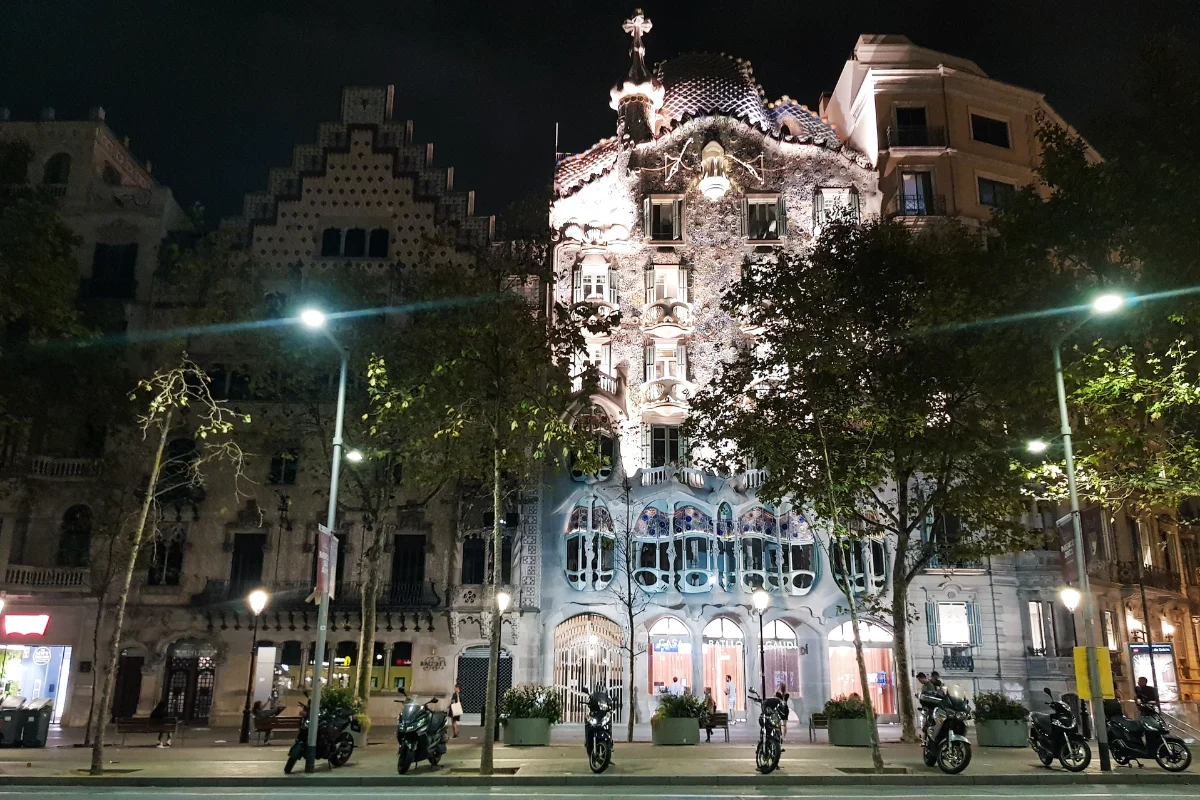
Casa Batlló, number 43 — Gaudí, 1906. The most photographed facade on the Passeig de Gràcia. The prevailing interpretation reads it as the legend of Sant Jordi: the ceramic-scale roof is the dragon’s spine, the iron balconies are victims’ skulls, the tower crowned with a four-armed cross is the knight’s sword. The interior is organic throughout — no right angles in any room. The augmented reality visit reconstructs the building before Gaudí’s intervention on the existing structure.
The two buildings guides omit: Casa Mulleras (number 37, Enric Sagnier, 1915) and Casa Bonet (number 39, Marceliano Coquillat, 1915) complete the block. More restrained, but part of the complete visual ensemble of this stretch.
La Pedrera: 500 Meters North
Casa Milà — La Pedrera — is at number 92, 500 meters north of the Block of Discord. It’s Gaudí’s last major civil work (1906–1912) and the one that best illustrates his structural maturity.
The central innovation: a column-and-beam iron structure that eliminates load-bearing walls. The direct consequence is a free floor plan — each story can be distributed differently without depending on the floor below. In 1912 this was an absolute revolution. The Vilafranca stone facade doesn’t rest on walls — it’s self-supporting, suspended from the interior metal structure.
The difference from Casa Batlló: Casa Batlló is an intervention on an existing structure — Gaudí worked with constraints from a previous building and the result is more expressive than structural. La Pedrera is a new building where Gaudí controlled everything from the foundations. For understanding Gaudí’s architecture, La Pedrera is the most complete building. For the pure visual-emotional experience, Casa Batlló is more intense.
Price: from €25. Nocturnal rooftop show: from €39.
Axis 2 — The 400 Meters Between Sagrada Família and Sant Pau
The Avinguda de Gaudí connects the Sagrada Família with the Recinte Modernista de Sant Pau in a straight line. The 400 meters between the entrances of the two buildings is not coincidental — the axis was deliberately traced so that from the Sant Pau entrance you see the Sagrada Família facade in the distance, and vice versa. Domènech i Montaner designed the Recinte de Sant Pau knowing its main visual axis would point at his rival and friend Gaudí’s building.
The Sagrada Família
The Nativity facade (east) documents Christ’s childhood with extreme sculptural naturalism — over 100 real plant species were modeled for the reliefs. The Passion facade (west), by Josep Maria Subirachs, uses an angular and austere language opposite to Gaudí’s — the tension between the two visual languages is one of the building’s most interesting architectural debates.
The 9:00–10:00 “Hour of Silence” — mandatory quiet, headphones required for any audio device — is the entry slot with the least crowding and the most significant experiential difference from later slots.
For the complete interior guide including stained glass system, column types, and tower access, the full Sagrada Família guide covers the detail.
Price: from €26 without towers, from €36 with towers. Advance booking required.
Recinte Modernista de Sant Pau: The Largest Modernista Complex in the World
The Hospital de la Santa Creu i Sant Pau is the largest Modernista architectural complex in the world — 48 independent pavilions distributed across a nine-hectare site declared UNESCO World Heritage in 1997.
Domènech i Montaner applied 20th-century hygienist principles here: separate pavilions with gardens between them to isolate diseases and ensure ventilation; natural light in all patient spaces; ceramic-surfaced interiors for hygiene and easy cleaning. The result is a hospital where architecture has an explicit therapeutic function.
The detail that surprises most first-time visitors: a kilometer of underground tunnels connects all the pavilions. Patient transfers, medication, and supplies moved below ground to avoid disturbing the gardens and recovery spaces above. The tunnels are visitable.
The Recinte stopped functioning as a hospital in 2009 and now operates as a cultural center and museum. The events program — concerts, exhibitions, Llums de Sant Pau — makes the space worth visiting even without specific architectural interest.
Walking from the Sagrada Família: 400 meters in a straight line along the Avinguda de Gaudí, 5 minutes. This is the most visually dense stretch of the Modernisme route — you walk between both buildings with both facades in simultaneous view.
Price: from €17. Free first Sunday of month.
Three Buildings Off the Central Axes
Palau de la Música Catalana (Sant Pere)
Domènech i Montaner built here the most complete synthesis of the “total work of art” concept — a building where exposed iron structure allowed replacing heavy walls with curtain walls of glass, and where every square centimeter is covered with mosaics, sculptures, stained glass, and wrought iron designed by specialist craftsmen.
Antoni Rigalt’s central skylight — the stained glass covering the concert hall ceiling with an inverted rose of leaded glass — only works with direct sunlight, which enters between 11:00 and 14:00. Outside that window the effect of the skylight is completely different.
The guided visit (€24) includes access to the concert hall and normally closed areas. Best option for the Modernisme route: guided morning visit to see the skylight with light.
📍 Carrer del Palau de la Música 4–6, Sant Pere. Metro Urquinaona (L1/L4).
Palau Güell (Raval)
The first major Gaudí commission from his patron Eusebi Güell (1886–1890) — the building where trencadís, parabolic domes, and sculptural chimneys were invented. It’s the least crowded Gaudí building in the city and the most affordable.
What it has that the others don’t: the central parabolic dome — a double-height space with wooden lattices that filter light so the interior seems to breathe. And the rooftop where Gaudí began experimenting with the ceramic chimneys he would later perfect at La Pedrera.
5 minutes’ walk from Las Ramblas. Price: from €12. The full Palau Güell visitor guide covers the dome geometry, the organ, and the structural innovations in detail.
📍 Carrer Nou de la Rambla 3–5, El Raval.
Casa Vicens (Gràcia)
The first significant Gaudí work (1883–1885) — when he was 31 and had not yet developed the organic naturalism of his mature period. The exposed brick facade with green and white tiles has Orientalist and Mudéjar influences that appear in no other subsequent work. It opened as a museum in 2017 — the most recently accessible Gaudí building and the one with the lowest visitor pressure.
📍 Carrer de les Carolines 20, Gràcia. Metro Fontana (L3). Full Casa Vicens guide.
Three Route Formats by Available Time
Half Day (4 Hours) — Passeig de Gràcia Axis
10:00 → Arrive at Passeig de Gràcia. Walk the exterior of the Block of Discord (numbers 35, 41, 43). Visit the interior of Casa Batlló or Casa Amatller — not both on the same day if you want depth.
12:30 → Lunch in the Eixample.
14:00 → La Pedrera: interior + rooftop. The two buildings are 500 meters apart on the same boulevard.
Full Day (8 Hours) — Both Axes
09:00 → Sagrada Família (morning slot for Nativity facade stained glass).
11:30 → Walk along Avinguda de Gaudí to Sant Pau. Pause at the midpoint to look back at Sagrada Família and forward to Sant Pau simultaneously — this is the view the axis was designed for.
13:00 → Lunch near the Eixample.
15:00 → Block of Discord (exteriors + one interior visit).
17:00 → La Pedrera (rooftop with afternoon light).
Two Days — Full Depth
Day 1: Palau de la Música morning (skylight with sunlight, guided visit) → Born area lunch → Sagrada Família afternoon (Passion facade stained glass) → Sant Pau at dusk.
Day 2: Palau Güell morning (no queues) → Block of Discord complete (Casa Batlló + Casa Amatller) → La Pedrera with nocturnal rooftop show. Add Casa Vicens in Gràcia if you have a free morning — it’s 20 minutes’ walk from Palau Güell and the contrast between Gaudí’s first and mature work is one of the route’s most instructive experiences.
Cost Overview
| Building | Standard ticket | Free access |
|---|---|---|
| Sagrada Família | From €26 (no tower) / €36+ (with tower) | Never |
| Casa Batlló | From €29 | Never |
| La Pedrera | From €25 | First Monday of month (winter) |
| Sant Pau | €17 | First Sunday of month |
| Palau de la Música | €20 (self-guided) / €24 (guided) | Never |
| Palau Güell | €12 | First Sunday of month |
| Casa Vicens | From €19 | Never |
Full route (all interiors): €117–180 per person depending on options selected. Booking online in advance saves up to €15 per building.
The Barcelona travel budget guide covers how to build a full trip budget that includes Modernisme visits alongside accommodation and food costs.
Mistakes to Avoid
-
Mixing Sagrada Família with Palau Güell and Park Güell in the same morning. Three metro journeys in opposite directions and arriving everywhere at the wrong time. Build the route around geographic axes, not importance rankings.
-
Going to Park Güell at midday. The monumental zone in high-summer midday sun is uncomfortable and at its worst photographic moment. Opening time (9:30) or late afternoon are the right slots.
-
Booking Casa Batlló and La Pedrera for the same morning and trying to rush both. Each building needs 75–90 minutes of real engagement. Two buildings in one morning means surface-level visits to both.
-
Ignoring Casa Vicens because it’s less famous. It’s the calmest, most affordable Gaudí building in the city and the one that shows where the architectural language came from before it became the Gaudí you recognize.
-
Underestimating the June 2026 centenary demand for Sagrada Família. This will be the most visited period in the building’s history. Book months in advance for that window.
Is the Full Route Worth It?
Yes for architecture travelers. The combination of Gaudí, Domènech i Montaner, and Puig i Cadafalch in a walkable area with their buildings in direct visual dialogue is genuinely unique. No other city offers this.
Depends for general visitors. The full route at full price (€117–180/person) is substantial. For a first visit, the Sagrada Família + La Pedrera + one Block of Discord building covers the essential range of the movement without saturation.
Not worth it if you’re treating it as a checklist. The buildings reward attention. A rushed visit to six buildings produces less understanding than a thorough visit to three.
FAQ
How much does the full Barcelona Modernisme route cost?
The four main icons (Casa Batlló from €29, La Pedrera €25, Sagrada Família €26, Park Güell €18) total €98 at base prices. Adding Palau Güell (€12), Casa Vicens (€19), and Palau de la Música (€20–24) brings the total to €149–153. Online advance booking saves up to €15 per building. Combined passes can reduce costs 20–25%.
Casa Batlló or La Pedrera — which to visit if you can only choose one?
Depends on interest. Casa Batlló is more visually immersive and has the augmented reality experience — the light court, main salon, and spiral rooftop chimneys are more dramatic. La Pedrera is more architecturally significant — the free floor plan and rooftop represent Gaudí’s technical maturity. Casa Batlló for spectacle; La Pedrera for architecture.
How long does Sant Pau take to visit?
90 minutes to 2 hours for the complete visit including tunnels. The audio guide covers the main pavilions in 75 minutes. The gardens between pavilions are part of the experience — don’t rush the exterior circuit. For the Llums de Sant Pau nocturnal event, allow 2.5 hours.
What is the distance between Sagrada Família and Sant Pau?
400 meters in a straight line along Avinguda de Gaudí. Five minutes on foot. The axis was deliberately designed to create a visual perspective between the two buildings — walk it slowly and look backward from the Sant Pau entrance to see both facades in the same view.
Which Gaudí building has the fewest queues in Barcelona?
Palau Güell in the Raval — entry from €12, without the queues of the Eixample buildings. Casa Vicens in Gràcia is the second quietest option since opening as a museum in 2017. Both are early-period Gaudí, before the organic naturalism of his mature style.
Can you visit the Palau de la Música without a reservation?
Yes, but with limited availability in high season. The self-guided audio tour (€20) and guided visit (€24) can be booked online for guaranteed time slots. The concert hall is only accessible on the guided visit. Best time to see Rigalt’s skylight with direct sunlight: 11:00–14:00.