
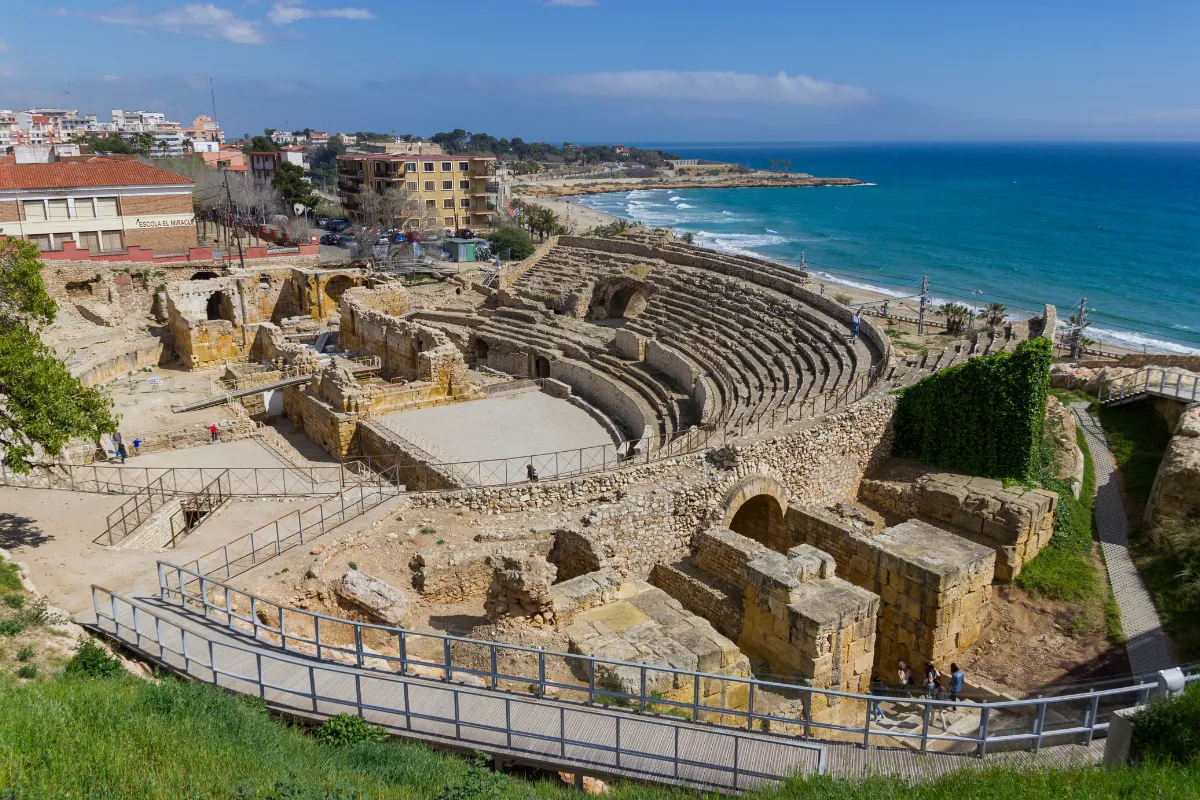

Tarragona was the capital of Hispania Citerior — the most strategically important Roman province on the Iberian Peninsula. The city was Rome’s administrative, military and cultural headquarters for the entire northern and eastern coast of the peninsula for four centuries. What that means on the ground in 2026: a Roman amphitheater directly facing the sea, a chariot-racing circus that could hold 30,000 people and whose vaults are still supporting the medieval buildings on top of them, city walls declared the oldest in Spain outside Italy, and a two-story aqueduct four kilometers from the center. All of it UNESCO World Heritage since 2000. All of it reachable in just over an hour from Barcelona — if you take the right train.
The Train Decision That Determines Your Whole Day
This is the most important practical information in the guide and the mistake that most Barcelona visitors make.
The AVE / Avant / Iryo / Ouigo trains go to Camp de Tarragona station — 32–36 minutes from Barcelona Sants, tickets from €12. This station is in an agricultural area between Perafort and La Secuita, 12 kilometers from the amphitheater. From Camp de Tarragona to the historic center: a shuttle bus (€2–3, frequency every 2 hours) or a taxi (€20–30, 20 minutes). Your 32-minute train journey becomes a 70-90 minute total door-to-monument journey.
The Regional / Regional Express / Media Distancia trains go to Tarragona station — 1h05–1h20 from Barcelona Sants, tickets from €7. This station is in the center of the city, five minutes on foot from the amphitheater. This is the correct train for a day trip.
| Train Type | Journey | Price | Arrival | Walk to Amphitheater |
|---|---|---|---|---|
| Regional / MD | 1h05–1h20 | from €7 | Tarragona Center | 5 min |
| AVE / Avant / Iryo | 30–36 min | from €12 | Camp de Tarragona | 12km + shuttle/taxi |
The Regional train is slower, cheaper and leaves you at the monument. Take the Regional train.
The Amphitheater: Three Buildings in One
The Roman amphitheater of Tarragona is singular for two reasons. The first is its location: it was built directly on the seafront, with the Mediterranean as the backdrop for the spectacle. No other surviving Roman amphitheater in Spain was positioned this way. The choice was practical — the coastal location facilitated the unloading of wild animals from ships directly into the holding cages beneath the arena — and it created a visual relationship between performance and sea that the Roman crowd would have experienced as a constant presence.
The second is its history after Rome. In 259 AD, Bishop Fructuosus and his two deacons were executed in the arena. The martyrdom changed the building’s meaning: in the 6th century, a Visigothic basilica was constructed over the arena floor, using the Roman structure as foundations. In the 12th century, a Romanesque church of Santa María del Milagro was built over the Visigothic foundations. Today, from a single standing position in the arena, you can see the elliptical Roman perimeter, the wall lines of the Visigothic basilica, and the Latin cross plan of the Romanesque church. Three architectural layers, three distinct historical moments, in the same square meters.
The amphitheater also has one of the longest epigraphic texts from Roman Hispania: a 140-meter inscription along the podium wall recording a documented renovation in 221 AD. This inscription is how historians know the building’s construction and modification dates.
Admission: €5 general, free for under 16. Closed Mondays. Summer hours: Tue–Sat 9:00–20:45, Sun 9:00–14:30. Winter hours: Tue–Fri 9:00–18:30, Sat–Sun 9:30–18:30 (Sat) and 9:30–14:30 (Sun). The joint MHT ticket (€11–15) covers the amphitheater, circus, walls and other sites — worth buying if you’re visiting multiple monuments in the same day.
The Roman Circus: 30,000 Seats Still Supporting the City
The Circus of Tarraco was built in the late 1st century AD under Emperor Domitian for chariot racing — the ludi circenses that were the most popular public spectacle in Roman culture. With capacity for 30,000 spectators, it was twice the size of the amphitheater. The 309-meter straight track was the second longest in the Roman Empire after the Circus Maximus in Rome.
What makes the Tarraco circus architecturally remarkable is what happened to it: the medieval city of Tarragona grew directly on top of it. The vaulted substructures of the circus are still physically supporting the medieval and modern buildings of the historic center. In the Plaça del Rei and Plaça del Fòrum areas, you can see the Roman vault arches integrated into the ground-floor levels of buildings that have been continuously inhabited for 1,500 years.
The underground galleries are visitable, including the carceres — the starting gate chambers where charioteers waited before the race. Walking through these vaulted passages, with buildings from the 14th and 18th centuries directly overhead, is the most visceral experience of the layered archaeology that UNESCO recognized.
The Torre del Pretori was the vertical communications hub between the circus terraces and the upper Forum Provincial level. It holds a collection of 3rd-century sarcophagi, including the Sarcophagus of Hippolytus — one of the most important late-Roman funerary art objects in the Iberian Peninsula. From the top terrace of the Praetorium, the view simultaneously captures the amphitheater, the cathedral and the sea.
Admission: €5, same schedule as the amphitheater.
The Walls: Older Than Rome’s Own Imperial Period
Tarragona’s city walls are a 2,000-year palimpsest. The foundation level dates to the 3rd century BC — the period of the Scipio brothers’ arrival during the Second Punic War, making these the oldest defensive walls in Spain outside of Italy. The Roman Imperial period added significant height and length in the 1st and 2nd centuries AD. The 18th century Bourbon reinforcements following the War of Spanish Succession added external bastions that now frame the Roman layers inside them.
1,100 meters of the original 3,500-meter perimeter survive. The Passeig Arqueològic runs between the original Roman wall and the Bourbon reinforcement — a garden corridor where two millennia of defensive engineering are visible simultaneously. The Torre de Minerva contains the oldest Roman inscriptions and reliefs in Hispania. The Torre del Socorro preserves the structural logic of one of the original access gates.
The walls walkway is free and always open. The interior archaeological circuit is included in the joint MHT ticket.
The cathedral facade was never finished
The Cathedral of Santa Tecla was built on the site of the Temple of Augustus — the most sacred building of Roman Tarraco — at the highest topographic point of the city. Construction started in 1171 in Romanesque style and continued in Gothic through the 14th century. In 1348, the Black Death killed a significant proportion of the construction workforce and financial backers. The western façade — which was planned to have an elaborate sculptural portal program similar to the great Gothic cathedrals of France — was never completed.
What this means visually: the façade you see today has the central rose window correctly positioned, but the portal surround is bare stone. The sculptures that should frame the entrance were never carved. For an architectural historian, this is a document of how the plague interrupted building programs across medieval Europe. For a visitor, it’s an unusual façade that rewards knowing why it looks incomplete rather than assuming it was always meant to be this way.
The cloister is one of the largest and most complex in Catalonia. Among the biblical capitals are several secular and popular medieval scenes, including the famous Procession of the Rats — a carved sequence showing rodents carrying a cat in a funeral procession, a medieval parody of funerary ceremony that art historians cite as an example of popular humor surviving in ecclesiastical stonework.
Admission: €12.50 (includes cloister and Diocesan Museum). Free Sunday afternoons. Summer hours: Mon–Sat 10:30–20:00. Winter: Mon–Sat 10:30–17:00.
The Serrallo: Where the Fish Comes From
The Barri del Serrallo is the fishing neighborhood adjacent to the commercial port — a world apart from the Roman heritage circuit three minutes away. In the afternoons when the boats return, the fish auction at the llotja (fish market) runs in real time. The seafront restaurants along La Rambla del Serrallo — Ca l’Eulàlia, Xaloc, Balandra — serve what was in the sea that morning.
The romescada is Tarragona’s identity dish: fish from the rocky bottom (monkfish, scorpionfish, gurnard) cooked in romesco sauce — the emulsion of toasted almonds, ñora pepper, garlic, oil and tomato that originated in this region. The almonds come from Reus, the ñora peppers from the south, and the technique is documented in Tarragona recipe collections from the 18th century. Unlike many dishes described as “traditional,” the romescada’s components and proportions are historically traceable.
The Beaches: What Each One Actually Offers
Platja del Miracle: The closest beach to the amphitheater and the station, literally minutes from both. Serviceable for a quick swim between monument visits. The industrial port backdrop reduces the visual quality — this is a practical beach, not a destination beach.
Platja de l’Arrabassada: The best quality urban beach with full services. 550 meters of fine golden sand, shallow calm water, Blue Flag consistently. Bus lines 8, 11, 12 and 13 from the center. If you want a proper beach afternoon after the morning monuments, this is the correct beach.
Cala Fonda (Waikiki): Approximately 200 meters of wild cove surrounded by cliffs and pine forest. The reason it stays wild: the Bosque de la Marquesa (the Marquess’s Forest) acts as a natural buffer making any motorized access physically impossible. To reach it, walk 20 minutes from Platja Llarga or from La Móra along the coastal path. No services, naturism common, effort required. The forest is the protection.
Cala Jovera (Tamarit): Small cove at the base of the Tamarit Castle — a Romanesque-Gothic fortress that sits literally at sea level above the water. Fine sand, calm water, medieval castle as the background. Ten kilometers from the city center; requires a car or bus to Tamarit.
The Aqueduct: 4 Kilometers from the Center, Free
The Ferreres Aqueduct — known as the Devil’s Bridge — is a 1st-century BC engineering structure built to carry water from the Francolí River to the city. Two tiers of superimposed arches in dry-laid sandstone blocks, no mortar, 217 meters of preserved span with the upper channel still walkable. The engineering principle that makes two-tier aqueduct construction work — the lower tier as foundation for the upper tier’s longer spans — is visible in the structural logic of the surviving arches.
Free, always open. Located in a rest area on the AP-7 motorway or accessible via the N-240 road. The surrounding eco-tourism park has hiking and cycling paths. Requires a car or taxi from the center — not reachable on foot from the historic city in a reasonable time.
Is Tarragona Worth a Day Trip?
Yes — with a specific itinerary. The combination of the amphitheater, the circus, the cathedral and the Serrallo fills a well-paced 7-hour day without rushing. The UNESCO designation is deserved: the layered archaeology — Roman, Visigothic, Romanesque, Gothic, Baroque, modern — is all visible simultaneously in a city that hasn’t been museumified. People live in buildings on top of Roman vaults. The walls are part of the neighborhood.
It’s not worth the trip if: you take the AVE by mistake and lose 90 minutes on transport logistics. Or if you go on a Monday when the amphitheater and circus are closed. Or if you arrive at 11:00 and leave at 14:00 expecting to see the whole city — the UNESCO site alone requires a morning.
The specific best scenario: weekday arrival before 10:00 on the Regional train. Morning circuit (amphitheater, circus, praetorium, walls). Lunch in the Serrallo. Cathedral in the early afternoon. Platja de l’Arrabassada for a swim at 16:00. Regional train back from Tarragona center at 18:30 or 19:00.
One-Day Itinerary
9:00: Arrive by Regional train from Barcelona Sants. Five-minute walk to the Balcó del Mediterrani for orientation.
9:15–10:30: Amphitheater — allow 75 minutes to understand the three architectural layers properly.
10:30–12:00: Circus galleries, Torre del Pretori and the Plaça del Rei — the best place to understand how Roman vaults became medieval architecture.
12:00–13:30: Cathedral and cloister — find the cat funeral procession capital.
13:30–15:00: Lunch in the Serrallo at Ca l’Eulàlia or Xaloc. Order romescada.
15:00–17:00: Walls (Passeig Arqueològic) and the historic Part Alta streets.
17:00: Bus to Platja de l’Arrabassada or walk to Platja del Miracle for a swim.
19:00: Regional train back to Barcelona Sants.
Which train from Barcelona to Tarragona should I take for a day trip?
The Regional or Media Distancia train from Barcelona Sants — 1h05–1h20, from €7, arrives at Tarragona Center station five minutes on foot from the amphitheater. The AVE arrives at Camp de Tarragona, 12 kilometers from the historic center, requiring an additional shuttle bus or taxi. For a day trip, the Regional train is the correct choice.
How much does it cost to visit the Roman amphitheater in Tarragona?
€5 general admission, free for under 16. Closed Mondays. The joint MHT ticket at €11–15 covers the amphitheater, circus, walls and several other sites — worth buying if visiting multiple monuments the same day.
Why is the Tarragona amphitheater unique compared to other Roman amphitheaters in Spain?
It’s the only Roman amphitheater in Spain built directly facing the sea. It also has three architectural layers simultaneously visible: the Roman elliptical structure (2nd century AD), the foundations of a Visigothic basilica (6th century), and the plan of a Romanesque church of Santa María del Milagro (12th century). All three are visible from the arena floor.
Can you visit Tarragona in one day from Barcelona?
Yes. The amphitheater, circus, cathedral and walls fill a well-paced 7-hour day. Arrive before 10:00, start at the amphitheater, finish at the cathedral and take a late afternoon swim. Leave on the 18:30 or 19:00 Regional train. Avoid Mondays — the Roman monuments are closed.
Why does Cala Fonda (Waikiki) stay undeveloped?
The Bosque de la Marquesa (Marquess’s Forest) makes any motorized access physically impossible. The only way to reach it is a 20-minute walk from Platja Llarga or La Móra along the coastal path. No services, no road access, no development possible as long as the forest classification holds.
What is the romescada and where can I eat it in Tarragona?
The romescada is the traditional Tarragona fish dish: rocky-bottom fish (monkfish, scorpionfish, gurnard) cooked in romesco sauce — an emulsion of toasted almonds, ñora pepper, garlic, oil and tomato. Best eaten in the Serrallo fishing neighborhood. Ca l’Eulàlia and Xaloc are the established references. The sauce predates the tomato variant — older versions use only almonds, garlic and bread.
In the opposite direction there is no train at all: Andorra takes 2 h 45 by car or 3 h 15 by direct bus from Sants, from 30 euros, as the Andorra day trip guide explains.
Final Insight
The most useful thing to understand about Tarragona is that it never stopped being a city. It was Roman, Visigothic, Moorish briefly, Catalan, Spanish — and through all of it, people kept living there, building on top of what they inherited, incorporating the old infrastructure into the new city rather than preserving it as a ruin. The result is a UNESCO site where the archaeology is structural, not decorative. The Roman vaults are load-bearing. The walls are the edge of the neighborhood. This is what a 2,000-year-old city that survived looks like from the inside.
For a longer Costa Daurada extension, the best neighborhoods to stay in Barcelona guide gives the base-camp logic for organizing day trips across the region. And for the travel budget across Tarragona and Barcelona together, the Barcelona daily costs guide puts the monument admission prices in the context of a full trip budget.