
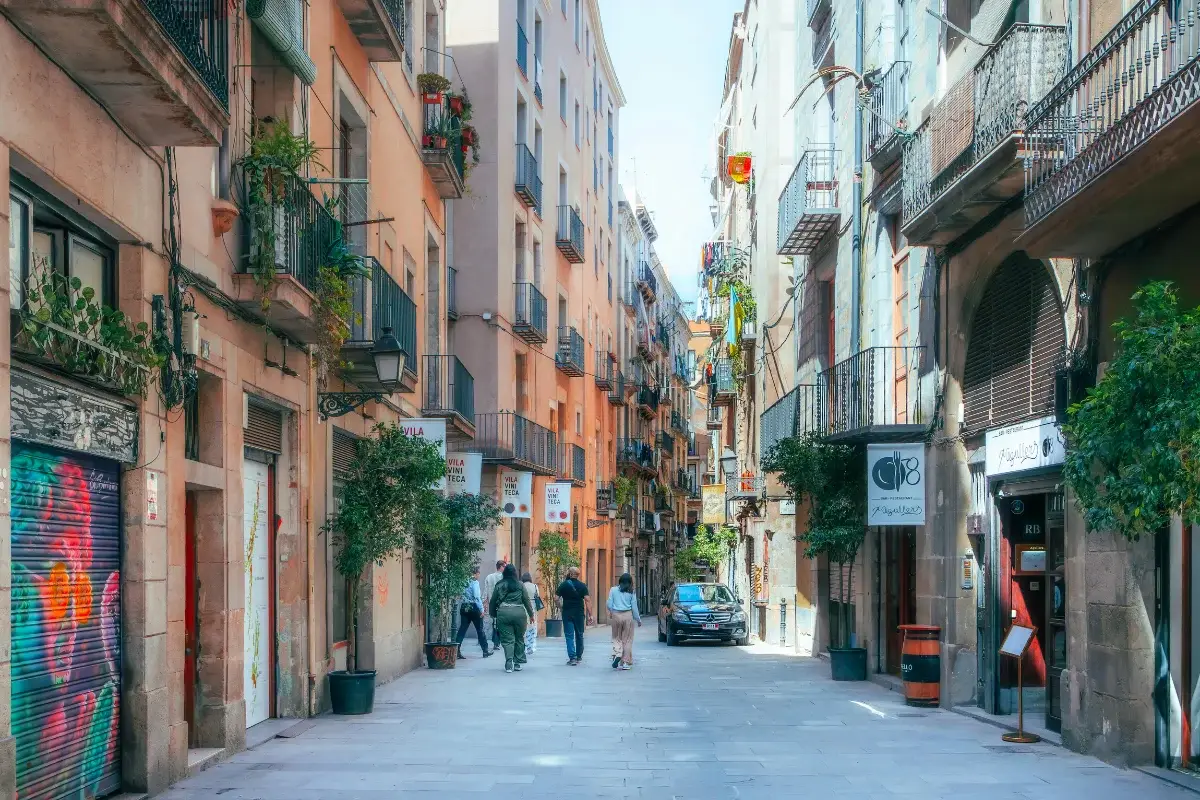

Every Barcelona accommodation guide tells you which neighborhoods exist. Almost none of them tell you the thing that actually changes your experience: the Gothic Quarter has no metro stations inside it. The Eixample isn’t one neighborhood — it’s three with different personalities and price points. And Poble-sec, which appears on almost no shortlist, has the best price-to-location ratio of any neighborhood in the city.
This guide gives you three things per neighborhood that generic lists don’t combine: the real profile, the honest downside that affects sleep or logistics, and a realistic hotel price range for mid-season.
Quick Answer: Which Barcelona neighborhood should you stay in? First-timers: Eixample — central, safe, walkable grid, best metro coverage. Best character + convenience: El Born. Best value: Poble-sec. Local atmosphere on a budget: Gràcia. Beach focus: Poblenou over Barceloneta for better prices and less chaos. Gothic Quarter suits people who want medieval atmosphere and can handle night noise — but note there’s no metro inside it.
Before You Choose: The Cost Nobody Factors In
One cost that varies by street rather than by neighbourhood: the noise ceiling is set section by section, so the same flat can sit on a protected stretch or a commercial one a block apart.
Barcelona charges a mandatory tourist tax on top of accommodation — and it almost never appears in the price you see when booking. It varies by hotel category and applies in every neighborhood:
| Hotel category | Tourist tax per person/night |
|---|---|
| 1–2★ hotels & hostels | €3.50 |
| 5★ hotels & luxury | €7.50 |
For a couple in a 5-star hotel for five nights, that’s an extra €75 that won’t appear until checkout. Budget it separately from whatever nightly rate you find online.
The full breakdown of Barcelona costs — including what the tourist tax looks like across a full trip — is in the Barcelona travel budget guide.
Quick Decision: Which Neighborhood Fits Your Trip?
| You are… | Best neighborhood | Price range/night |
|---|---|---|
| First-time visitor | Eixample (Dreta or Sagrada Família zone) | €80–200 |
| Couple, want character | El Born | €100–160 |
| Budget traveler, want local feel | Gràcia or Poble-sec | €60–120 |
| Digital nomad / long stay | Poblenou | €80–140 |
| Beach-focused (summer) | Poblenou (not Barceloneta) | €80–140 |
| Here for architecture | Eixample Dreta | €120–200 |
| Arriving/leaving by train | Sants | €60–90 |
| Want total quiet | Sarrià-Sant Gervasi | €150–280 |
Eixample: Three Neighborhoods Inside One District
The Eixample is the default recommendation for first-time visitors — and it earns that status. Good security, a logical grid layout, the best metro coverage in the city, and the highest concentration of Modernista architecture. But the district has three distinct zones that serve very different traveler profiles.
Dreta de l’Eixample (Right Eixample)
Between Passeig de Gràcia and Diagonal — the highest density of Modernista landmarks. Casa Batlló, La Pedrera, Casa Amatller all within walking distance. The “Golden Mile” of Passeig de Gràcia runs through here. Most expensive part of the district, highest concentration of international visitors.
Price: €120–200/night mid-season.
Esquerra de l’Eixample (Left Eixample)
West of Passeig de Gràcia. More residential, better neighborhood gastronomy, and the Gaixample — the city’s LGBTQ+ hub with bars and venues open late. The pedestrianized stretch of Consell de Cent reduces ambient noise in that corridor. Slightly lower hotel prices than the Dreta.
Price: €100–160/night mid-season.
Sagrada Família Zone
The quietest part of the Eixample. Immediate surroundings of the basilica are residential with less tourist pressure than the Passeig de Gràcia axis. Best choice within the district for families or anyone who wants Eixample logistics without the central noise and crowds.
Price: €80–140/night mid-season.
Honest downside: The Eixample is less visually characterful than the old town. The grid is comfortable to navigate but lacks the irregular medieval texture of El Born or the Gothic Quarter.
Gothic Quarter: The Logistical Detail Nobody Mentions
The Gothic Quarter is Barcelona’s most-visited neighborhood and the instinctive first choice for anyone who wants to sleep inside the historic core. The Cathedral, the Call (medieval Jewish quarter), Plaça Reial, and Las Ramblas are all walkable from any hotel in the Barri Gòtic.
A logistical detail worth checking before booking: the Gothic Quarter has no metro stations inside it. The nearest stops — Liceu (L3), Jaume I (L4), Urquinaona (L1/L4) — sit on the neighborhood’s perimeter, between 5 and 15 minutes on foot from the center of the Gòtic. For anyone who uses the metro heavily during the day, this adds real distance to every journey.
Price: €75–120/night mid-season. One of the widest price ranges in the city — budget hostels and boutique hotels sit on the same narrow streets.
Honest downside: Night noise near Las Ramblas and Plaça Reial is significant. If the hotel doesn’t have solid soundproofing, sleep suffers. Some inner streets are also higher-pickpocket-risk at night — not dangerous, but requiring more bag and phone awareness than the Eixample or Gràcia.
Best for: Travelers who prioritize medieval atmosphere over sleep quality and metro convenience, and who are staying 2–3 nights rather than a full week.
El Born: The Best Balance in the Old Town
El Born (officially Sant Pere, Santa Caterina i la Ribera) is the old town neighborhood with the best combination of historic character, gastronomy, and security. The Museu Picasso, Santa Maria del Mar basilica, Parc de la Ciutadella, and some of the city’s best design bars and restaurants are all here.
Unlike the Gothic Quarter, El Born has a metro station close by (Jaume I, L4) and a more calibrated nightlife — there’s evening activity but it’s more contained than the Las Ramblas axis. Hotel supply is more limited than the Eixample, with more boutique properties and apartments than large chains.
Price: €100–160/night mid-season.
Honest downside: In peak season (June–September and Easter), El Born saturates quickly. Accommodation is limited and books far ahead — last-minute searches here result in either high prices or nothing available. Book 6–8 weeks in advance minimum for summer.
Best for: Couples, repeat visitors who already know the Eixample, anyone prioritizing food and neighborhood character over convenience.
Gràcia: Lowest Price with Real Local Life
Gràcia was an independent municipality until 1897 and still operates at that scale — squares that function as communal living rooms, local independent shops, neighborhood festivals (the Festes de Gràcia in August are the most distinctive in the city). It has the highest ratio of local residents to tourists of any well-connected neighborhood.
Hotel prices are the lowest of Barcelona’s well-served neighborhoods. No major hotel chains in the central area — small hotels, pensions, and well-reviewed apartments. Park Güell is in the upper part of the neighborhood.
Price: €70–120/night mid-season.
Honest downside: The upper part of Gràcia is far from the old town and requires metro or bus to reach El Born or the Gothic Quarter. From the lower boundary (where Gràcia meets the Eixample), distances to the center become manageable on foot.
Best for: Budget-conscious travelers who want local atmosphere, anyone staying a week or more, visitors specifically interested in the Gràcia neighborhood character and Gaudí’s Casa Vicens — his first major work, located here.
Poble-sec: The Best Price-to-Location Ratio in the City
Poble-sec sits at the foot of Montjuïc, 10–15 minutes from the Raval and the old town, and has Carrer Blai — the city’s most-referenced pintxos street. It’s not touristy but it’s well-connected. The MNAC and Fundació Miró are 15–20 minutes on foot up the Montjuïc hill.
For travelers who want low price, local atmosphere, and no sacrifice of centrality: Poble-sec is the most balanced recommendation in this guide. It’s the neighborhood locals recommend to visiting friends when the brief is “don’t overspend, but don’t compromise.”
Price: €60–100/night mid-season.
Honest downside: Getting to the Eixample or El Born requires metro or bus — it’s not walkable from the center of the neighborhood. The immediate area around Sants station (on Poble-sec’s western boundary) warrants extra awareness at night.
Best for: Value-focused travelers, anyone whose itinerary includes Montjuïc (Montjuïc Castle and the hill’s museums are within walking distance), and visitors who want to eat well without tourist-area pricing.
Barceloneta: Only in Summer, and Only If Beach Is the Priority
Barceloneta is direct Mediterranean access — beach, seafood restaurants, the promenade, the W Hotel. In July and August it has the most energy of any neighborhood in the city.
Price: €120–200/night in peak season. Drops significantly in low season, but so does the atmosphere.
Two honest downsides: First, summer saturation is real — high density of both tourists and locals going to the beach, significant night noise. Second, hotel supply is genuinely limited. There are few standard hotels; most accommodation is tourist apartments, which are being reduced under new city regulations. Anyone searching for a standard hotel room has very few options.
Best for: Travelers visiting specifically in July or August who prioritize beach over everything else. For any other month, other neighborhoods offer better value-to-experience ratios.
Poblenou: For Long Stays and Digital Nomads
Poblenou is the former industrial district converted into the city’s tech hub (22@ district). It has its own beaches (Bogatell, Mar Bella) that are significantly less crowded than Barceloneta, converted industrial architecture repurposed as cultural and gastronomic spaces, and the city’s highest concentration of coworking spaces.
For stays of a week or longer, Poblenou offers a balance the old town neighborhoods can’t: quiet, uncrowded beaches, genuine neighborhood gastronomy, and lower accommodation prices than the center.
Price: €80–140/night mid-season.
Honest downside: Getting to the Gothic Quarter or central Eixample requires the metro (L4, Llacuna or Poblenou stops) — not walkable from the far end of the neighborhood. If you’re combining a long stay with intensive daily sightseeing, plan the metro time into your schedule.
Best for: Digital nomads, anyone staying 5+ days, travelers who want beach access without Barceloneta crowds. The best cafés for working in Barcelona are heavily concentrated in Poblenou and the Eixample.
Sants: For Train Connections
Sants has Barcelona’s main train station — high-speed AVE to Madrid, Valencia, and Paris, plus regional trains to the rest of Catalonia. If the trip involves arrivals or departures by train or connections to other cities, staying in Sants eliminates the transit at the beginning and end of each journey.
The interior of the Sants neighborhood has genuine local life and contained accommodation prices. No major tourist attractions in the area, but well-connected by metro to the whole city.
Price: €60–90/night mid-season.
Honest downside: The immediate surroundings of Estació de Sants have the energy of any major transport hub — functional, anonymous, with the standard inconveniences of constant transit zones. The neighborhood improves significantly as you move away from the station itself.
Best for: Travelers with train-heavy itineraries, day-trippers using Barcelona as a base to visit other Catalan cities.
Sarrià-Sant Gervasi: For Complete Quiet
Barcelona’s upper zone — Sarrià, Sant Gervasi, Pedralbes — has the city’s highest real estate values, lowest crime rates, and most international schools and private clinics. It’s where expatriate families and long-term executives live.
For a standard one-week tourist visit, the upper zone has one significant disadvantage: everything requires transport. The historic center, beaches, and major museums are 20–30 minutes away by metro or FGC train. For travelers who genuinely prioritize total silence and rest over proximity to anything, it’s the only real option in the city.
Price: €150–280/night mid-season. Few hotels in this zone, and all in the upper categories.
Best for: Travelers specifically seeking quiet and willing to accept transit time, or those visiting for reasons (medical, business, school visits) that put them in this part of the city anyway.
Full Comparison Table
| Neighborhood | Price/night | Safety | Night noise | Metro inside | Best for |
|---|---|---|---|---|---|
| Eixample Dreta | €120–200 | High | Low | Yes | First-timers, Modernisme |
| Eixample Esquerra | €100–160 | High | Low–medium | Yes | Gastronomy, LGBTQ+ |
| Sagrada Família zone | €80–140 | High | Low | Yes | Families, quiet |
| Gothic Quarter | €75–120 | Medium | High | No (perimeter) | History, atmosphere |
| El Born | €100–160 | Med–High | Medium | Near (Jaume I) | Couples, gastronomy |
| Gràcia | €70–120 | High | Medium | Yes | Budget, local life |
| Poble-sec | €60–100 | Med–High | Low | Yes | Price-to-location |
| Barceloneta | €120–200 | Medium | High (summer) | Near | Beach, summer only |
| Poblenou | €80–140 | High | Low | Yes | Long stays, nomads |
| Sants | €60–90 | Medium | Medium | Yes | Train connections |
| Sarrià-Sant Gervasi | €150–280 | Very high | Very low | FGC | Total quiet |
The Gothic Quarter has a metro problem
The Gothic Quarter comes with a metro caveat. For anyone doing heavy daily sightseeing by metro, the 5–15 minute walk to the nearest station in every direction adds up across a full trip. This isn’t a dealbreaker — it’s a real logistical factor that should be in the decision.
They treat Barceloneta as a year-round option. In summer it’s a specific, high-energy beach experience. In October through May it’s an underserved neighborhood with limited hotel supply and less reason to be there. The beach argument disappears outside peak season; Poblenou serves the beach+neighborhood combination better for the rest of the year.
They don’t mention that El Born books out. It’s a small neighborhood with limited accommodation. Mentioning it as a top recommendation without flagging the booking timeline means readers arrive at the search page and find nothing available at reasonable prices.
They ignore Poble-sec entirely. The price-to-location ratio is genuinely the best in the city for travelers who don’t need to be in the absolute center. Local restaurants, Montjuïc access, solid metro connections, and prices €30–50 lower per night than comparable Eixample properties.
If you are moving rather than visiting, the neighbourhood average is a poor guide: les Corts alone runs from 54,452 to 145,832 euros across its 35 census tracts, as Barcelona neighbourhoods by income sets out.
Mistakes to Avoid When Booking in Barcelona
Booking based on price alone without checking soundproofing. In the Gothic Quarter and near Las Ramblas, a hotel at €90/night can mean three nights of poor sleep. Read reviews specifically for noise mentions.
Not budgeting the tourist tax. It’s not optional, it’s not small in the upper categories, and it’s not included in any price comparison site’s displayed rate. A couple in a 5-star for five nights pays €75 extra. Full cost breakdown here.
Choosing Barceloneta in any month except June–September. The beach argument that justifies the premium simply doesn’t apply outside summer.
Waiting to book El Born or Gràcia. Both have limited supply. Leave it to the last three weeks in peak season and you’re either paying a significant premium or choosing a different neighborhood by default.
FAQ
What is the best neighborhood to stay in Barcelona for first-timers?
The Eixample — specifically the Dreta (for Modernisme) or the Sagrada Família zone (for quiet). Safe, logical grid layout, excellent metro, and close to the main architectural landmarks. For more character, El Born balances historic atmosphere with good connectivity. Avoid the Gothic Quarter if noise affects your sleep.
How much is the tourist tax in Barcelona hotels?
It varies by hotel category and is charged per person per night. Ranges from €3.50 (budget hostels) to €7.50 (5-star hotels). It’s not included in booking site prices and appears at checkout. A couple in a 4-star hotel for five nights pays €100–120 in tourist tax on top of the room rate.
Does the Gothic Quarter have a metro station?
No, not inside the neighborhood. The nearest stations are on its perimeter: Liceu (L3) to the west, Jaume I (L4) to the east, Urquinaona (L1/L4) to the north. Expect a 5–15 minute walk from the center of the neighborhood to reach any metro station.
What is the cheapest neighborhood to stay in Barcelona?
Sants (€60–90/night) and Poble-sec (€60–100) are the most affordable among well-connected areas. Gràcia also has competitive prices (€70–120) with better atmosphere. The Raval has the lowest prices in the old town but requires more vigilance on certain streets at night.
Where should I stay in Barcelona to be close to the beach?
Barceloneta for direct beach access, but in summer it’s overcrowded and hotel supply is limited. Poblenou has its own less-crowded beaches (Bogatell, Mar Bella) with more hotel options and lower prices. For anyone combining beach with city sightseeing, Poblenou offers better balance.
Is the Raval safe to stay in Barcelona?
The upper Raval (near MACBA and La Boqueria) is safe with standard urban awareness. The lower Raval and streets near Las Ramblas have higher pickpocketing rates than the Eixample or Gràcia — not dangerous in terms of violence, but requiring more attention to bags and phones, especially at night.
Which Barcelona neighborhood has the best value for money?
Poble-sec. It sits at the foot of Montjuïc with direct access to the MNAC, Fundació Miró, and Montjuïc Castle, 10–15 minutes from the old town, with local restaurant pricing and hotel rates €30–50 lower per night than comparable Eixample properties. It’s the neighborhood locals recommend to visiting friends when the brief is “don’t overspend but don’t compromise.”