
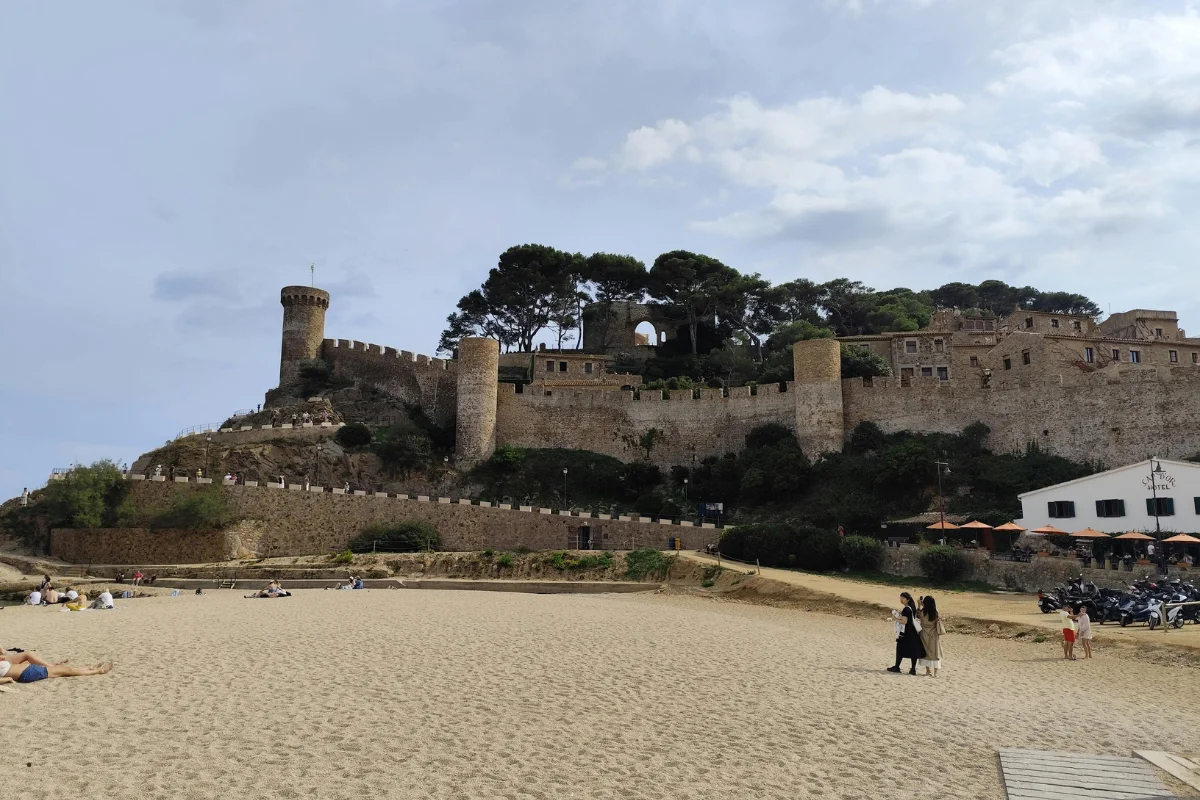

The Costa Brava has dozens of charming coastal towns, several with medieval heritage, some with Roman remains. Tossa de Mar is different in one specific way: it has the only fully intact fortified medieval settlement on the entire Catalan coast. The Vila Vella — a complete walled quarter with seven towers, inhabited houses, active streets and a functioning lighthouse — was declared a National Historic-Artistic Monument in 1931, which is why it didn’t get knocked down for a hotel development in the 1960s like every comparable settlement further up the coast. That single decision is the reason Tossa looks the way it looks.
Marc Chagall arrived in 1933, stayed through 1934 and called it “Blue Paradise” — not a tourist board invention, a direct quote from the artist. He donated a painting to the local museum, which became the first museum in Spain to exhibit contemporary foreign art. The painting is still there.
This guide covers what makes each element of Tossa worth understanding before you see it.
What should you see in Tossa de Mar? The Vila Vella (the only intact medieval walled coastal settlement in Catalonia, free access at any hour). The Villa Romana dels Ametllers (free entry, 1st-century mosaics, the inscription identifying the town’s Roman name). The Municipal Museum (€3, original Chagall 1934, first museum in Spain to show contemporary foreign art). The Camino de Ronda coastal walk north to Cala Bona, Cala Pola and Cala Giverola (2 hours). The Cim i Tomba fish stew at a traditional restaurant. Tossa is 90 minutes from Barcelona by bus — no train access.
The Gothic church inside the walls that exploded
The interior of the Vila Vella contains a ruined church that exploded. The Antiga Església de Sant Vicenç — a 15th-century Gothic building inside the walled enclosure — was used as a munitions store in the 19th century and detonated accidentally. What remains — the apse and parts of the sacristy — is now used as an outdoor concert space in summer evenings. “Ruins of the old church” is the usual description, and it leaves out why they’re ruins.
The second overlooked element: the Forat del Dimoni (Devil’s Hole). This is a passage cut directly through the medieval wall that connects the Vila Vella to the Cala Codolar below. It’s the only point where you can move from the walled town to the sea without going around the perimeter — and it’s the least-visited access point in the entire walled circuit. Finding it from inside the Vila Vella involves deliberately walking away from the main paths.
Third: the fact that the walled enclosure is not a museum. It’s a functioning neighborhood. People live there. Some of the houses have been continuously inhabited since the 15th century. The tourists walk the same streets as the residents, which creates a completely different experience from the managed heritage sites that have been evacuated of daily life.
The Vila Vella: Understanding the Seven Towers
The construction history of the Vila Vella begins in 1187 with a commission from the Abbot of Ripoll to protect the coastal population from Mediterranean piracy. The most significant reconstruction came in the 14th century under Abbot Descatllar, who consolidated the tower system that’s visible today.
Each tower had a specific defensive function:
Torre d’en Joanàs — at the promontory’s furthest point, providing visual control over the entire bay. The tower that appears in most photographs of Tossa from the sea.
Torre de les Hores — in the internal courtyard, housing the clock that regulated communal life and the rotation of watch shifts. The administrative tower.
Torre d’es Codolar — controlling access from the beach below and serving as the final defensive position. The last fallback.
Torre del Homenaje — at the highest point of the promontory, incorporated into the original castle structure. The symbolic center of the defensive system.
The streets inside the walls are paved with rounded stones brought from the beach itself — the same material the sea used to smooth them also makes them comfortable underfoot. The houses date from the 15th and 16th centuries, with Gothic portal and window elements that indicate the town’s fishing and maritime trading prosperity arrived during the late Gothic period.
Access: free, 24 hours. No managed entry, no queues, no ticket office. The walls are public space.
The Lighthouse and the Maritime Interpretation Center
The lighthouse at the summit of the promontory was inaugurated in 1917 — still active, still flashing. It occupies the site of the original medieval castle and houses the Centro de Interpretación de Faros del Mediterráneo, which documents the technological evolution of coastal lighting systems: the Fresnel lens optic that replaced oil flames, the architecture of lighthouse buildings designed for extended isolation, and the daily life of lighthouse keepers who operated in months-long solitude.
The terrace of the lighthouse complex provides the only aerial perspective of the Tossa bay available to visitors: the Platja Gran below, the Sa Roqueta neighborhood and the complete wall circuit in a single frame. The photograph from this vantage — which most visitors take without understanding what they’re looking at — shows 14th-century defensive engineering from above, which is how military engineers originally mapped and assessed it.
The Villa Romana dels Ametllers: Free Entry, 2,000 Years Old
Discovered in 1914 by Dr. Ignasi Melé, the Villa Romana dels Ametllers functioned as an agricultural production and export center from the 1st century BC to the 5th century AD. The primary product was wine, transported in amphorae to ports across the Western Mediterranean.
The site divides into two clearly differentiated sectors. The pars urbana (residential area) occupied the elevated ground to capture sea views and breezes — the Roman logic of status and comfort expressed in topography. The pars fructuaria (production area) sat on lower ground to facilitate amphora transport toward the natural harbor.
Two specific elements make this site unusual within the Catalonia Roman corpus:
The Mosaic of Vitalis in the residential section nominally identifies one of the villa’s owners — one of the few mosaics in Catalonia that names its commissioner directly. This kind of personal inscription in mosaic is a document of individual identity, not just archaeological evidence of occupation.
The Turissa inscription — the Roman place name that confirms the pre-medieval identity of Tossa. When the Latin name Turissa appears in an archaeological context alongside the mosaics, it closes a historical loop: the Roman settlement and the medieval town are demonstrably the same community across fifteen centuries.
Free admission. Five minutes from the main parking area. Rarely has queues, unlike every other monument in the area.
The Municipal Museum: The First in Spain to Show Contemporary Foreign Art
The Museu Municipal de Tossa opened in 1935 in the Palau del Batlle de Sac inside the Vila Vella. The political and social context explains the collection: during the 1930s, Tossa attracted a significant community of European artists and intellectuals fleeing rising totalitarianism. The community that gathered here donated work to the local museum.
Marc Chagall arrived in 1933. His description of Tossa as “Paradís Blau” — Blue Paradise — was a personal statement, not a marketing phrase. The work he donated, El Violinista Celeste (1934), shows a violinist floating above the silhouette of the Tossa walls, fusing Chagall’s Eastern European Jewish folklore with the Mediterranean landscape he had recently encountered. It’s the only original Chagall in a public museum on the Costa Brava.
The collection also contains works by André Masson, Jean Metzinger, Georges Kars and Olga Sacharoff — members of what the art history literature calls the “Babel of the Arts,” the informal international community that made Tossa a node of European avant-garde culture in the pre-Civil War years.
Beyond the painting: the archaeology section holds the original mosaics from the Villa dels Ametllers, establishing a direct visual connection between the Roman settlement and the contemporary building you’re standing in.
Admission: €3. Among the best value cultural institutions on the Costa Brava.
Beaches: Organized by Access and Character
Platja Gran: The main bay beach, 385 meters, with the walled town as the visual backdrop. The image of Tossa that appears in most photographs. Full services, boat excursions. The most accessible and the most photographed.
Playa de la Mar Menuda: The northern end of the bay, with a natural rock formation creating a protected zone called sa banyera de ses dones (the women’s bathtub) — extremely calm water, ideal for snorkeling. The Mar Menuda seabed is a regional reference for seahorse sightings, gorgonians and moray eels.
Cala Es Codolar: Behind the walls, exceptionally clear water due to the cliff protection from northerly winds. Accessible through the Forat del Dimoni from inside the Vila Vella, or by walking around the southern perimeter of the walls. The quietest beach in the urban nucleus.
Cala Pola and Cala Giverola (via Camino de Ronda): 70 and 175 meters respectively, accessible after 1–2 hours of coastal walking north. Cala Pola has coarse sand and turquoise water with a campsite providing basic services. Cala Giverola has fine sand and water sports with a resort.
Cala Futadera: Known locally as “the 300-step cove.” The most demanding access on the coastal path — which is precisely why it has the lowest occupancy of any beach in the municipality. No services. Naturism common. The difficulty is the feature.
The Camino de Ronda: 10 Kilometers of Cliff and Pine
The Camino de Ronda within Tossa’s municipal boundary follows the coast north for approximately 10 kilometers, passing through Cala Bona, Cala Pola and Cala Giverola in roughly two hours of walking. The vegetation — white pines and holm oaks reaching to the cliff edge — creates direct transitions from forest to sea that have no equivalent in the developed sections of the Costa Brava.
The natural viewpoints along the route — Sa Gavina and Sant Jaume — provide the best aerial views of the coves from land. In high season, there’s a boat return service from Cala Giverola to Tossa, which means you can walk north and return by sea without retracing the route.
The Cim i Tomba: A Stew That Names Its Own Technique
The Cim i Tomba is Tossa’s identity dish — a fisherman’s stew of firm white fish (monkfish, skate or turbot) with potatoes and emulsified alioli. The name is functional: cim (peak/top) describes the layered arrangement of fish over potatoes; tomba (turn/flip) describes the specific rocking movement of the clay pot that emulsifies the alioli into the cooking stock without breaking the potato. The technique is the name.
The origin is subsistence cooking: fishermen used the commercially unsaleable fish — those damaged by nets — with the pot technique that could be done on a boat or in a small harbor kitchen. It became an identity dish precisely because it required technique rather than premium ingredients.
September Jornades Gastronòmiques del Cim i Tomba: a specific window with fixed-price menus at participating restaurants using the traditional technique. September is also the lowest-crowd, lowest-price month of the Costa Brava summer shoulder season. If the food and the village appeal equally, September is the correct time to visit.
Restaurants with verified Cim i Tomba:
- La Cuina de Can Simón — Michelin Guide recommendation, cooking-forward
- Can Pini — traditional version as the house specialty, approximately €30 per dish
- Restaurant Castell Vell — inside the Vila Vella, maritime setting
Is It Worth It?
Yes — without qualification — if you care about historical texture in a coastal setting. The Vila Vella is the closest thing the Catalan coast has to a living medieval settlement, not a preserved one. The Chagall museum is genuinely underrated for a €3 admission. The Cala Es Codolar is one of the clearest-water beaches near the walls of any town in the region.
It’s not worth a special trip if: you’re primarily looking for party beach culture (Port Olímpic in Barcelona, Lloret de Mar and Salou all serve that better). It’s also not the right choice if infrastructure convenience is the priority — there’s no train, and the bus takes 90 minutes each way.
The specific exception: the September Cim i Tomba festival is the best time to visit for anyone interested in regional food culture at a local event with genuinely local attendance.
Practical Information
From Barcelona: e12 Express bus from Estació del Nord, approximately 1h20, 22 daily departures on weekdays. Direct airport service from T1 and T2 (1h55–2h15). No rail access — Tossa has no train station.
By car: 90 minutes via AP-7 and C-63. The final approach on the GI-682 from Lloret is scenic but winding. Main parking: Parking Miramar and Platja Gran (~€2/hour), Estació d’Autobusos parking (10–15 min walk, potentially free streets nearby), Sa Riera parking (500m from center).
Best time to visit: June and September for the best water temperature, lowest crowding and reasonable accommodation prices. September for the Cim i Tomba festival. January for the Pelegrí de Tossa — a 40km pilgrimage that the town’s residents have performed since the 15th century as a collective vow against plague, one of the most unusual and un-touristed local traditions in Catalonia.
Does the Vila Vella of Tossa de Mar have an entrance fee or opening hours?
No. The walled enclosure is public space accessible at any hour with no ticket and no managed entry. The Lighthouse and Municipal Museum have separate hours and admission prices (Museum: €3). The streets and walls are free.
How long is the bus from Barcelona to Tossa de Mar?
Approximately 1h20 from Estació del Nord with Moventis, around 22 departures on weekdays. Direct service from Barcelona Airport T1 and T2 takes 1h55–2h15. Tossa has no train station.
Is the Villa Romana dels Ametllers worth visiting?
Yes, and free admission makes the calculation straightforward. The Mosaic of Vitalis naming its commissioner and the Turissa inscription confirming the Roman place name are specific enough to be genuinely interesting even for visitors without an archaeology background. Allow 30 minutes.
What is the Cim i Tomba dish?
A fisherman’s stew of firm white fish (monkfish, skate or turbot) with potatoes and alioli, named after the layering technique (cim = top/peak) and the clay-pot rocking motion that emulsifies the sauce (tomba = turn). Origin is subsistence fishing-boat cooking. September Jornades Gastronòmiques is the best time to find it at traditional restaurants.
Which beach in Tossa de Mar has the clearest water?
Cala Es Codolar, behind the medieval walls, is particularly clear because the cliff walls that carry the fortifications protect it from northerly winds that disturb sediment. Accessible through the Forat del Dimoni passage from inside the Vila Vella.
What is the Chagall painting in the Tossa Museum?
El Violinista Celeste (1934) — a violinist floating above the Tossa wall silhouette, combining the folkloric imagery of Chagall’s Eastern European Jewish heritage with the Mediterranean setting where he painted it. Donated by Chagall himself during his 1933–1934 stay in Tossa. The only original Chagall in a public museum on the Costa Brava. Admission €3.
Final Insight
Tossa survived the Costa Brava development boom of the 1960s and 1970s not because of luck but because the 1931 national monument designation made demolition politically impossible. Most of the coast lost what Tossa kept. The Vila Vella isn’t a reconstruction or a theme park version of a medieval town — it’s the actual thing, lived in, weathered and slightly inconvenient in exactly the ways that authenticity tends to be. That’s what makes it worth the 90-minute bus ride.
For more medieval heritage on the Costa Brava, the hiking routes near Barcelona guide includes coastal path options that connect several of these villages by foot.