

Vic is 70 kilometers from Barcelona and fully walkable in a single day. Before anything else: the R3 train line has active construction works with mandatory bus connections until at least 2027. The journey by rail now involves transfers and can take up to 2h15. The e12 express bus from Sagalés runs the same route in 60–70 minutes from Estació del Nord or Fabra i Puig, costs €9, and is currently more reliable than the train for a day trip. Use the bus.
Once in Vic: the Plaça Major is the geographic and social center of everything. The Cathedral has murals by the same painter who decorated the Rockefeller Center. The Roman Temple sat hidden inside a castle for six centuries before being discovered in 1882. The Llonganissa de Vic has Protected Geographical Indication status and the curing conditions specific to the Plana de Vic climate are the reason it tastes different everywhere else. And the December Medieval Market draws over 100,000 people to 300+ stalls across four days — with a historical theater performance across multiple locations that most visitors miss entirely.
Getting There: The Train Trap and the Bus Solution
The R3 Rodalies line is under a multi-phase modernization with works running through at least 2027. Until May, there’s a complete closure between Montcada Bifurcació and La Garriga, with substitution buses from Fabra i Puig. From May onward, the closure narrows but doesn’t disappear. The total journey time with connections runs 1h30–2h15 from Barcelona Sants. The ticket is about €8.
The Sagalés e12 express bus departs from Estació del Nord and Fabra i Puig every 30–60 minutes. Journey time: 60–70 minutes nonstop. Ticket: approximately €9. No connection, no transfer, no substitute bus chain. For the current situation, this is the right choice.
By car: 68km on the C-17, about 60 minutes in normal traffic. Parking during the December Medieval Market is a serious problem — traffic jams on entry and exit can run two hours. For the market specifically, public transport is the correct choice by a wide margin.
The Plaça Major: 1,000 Years of Market Logic
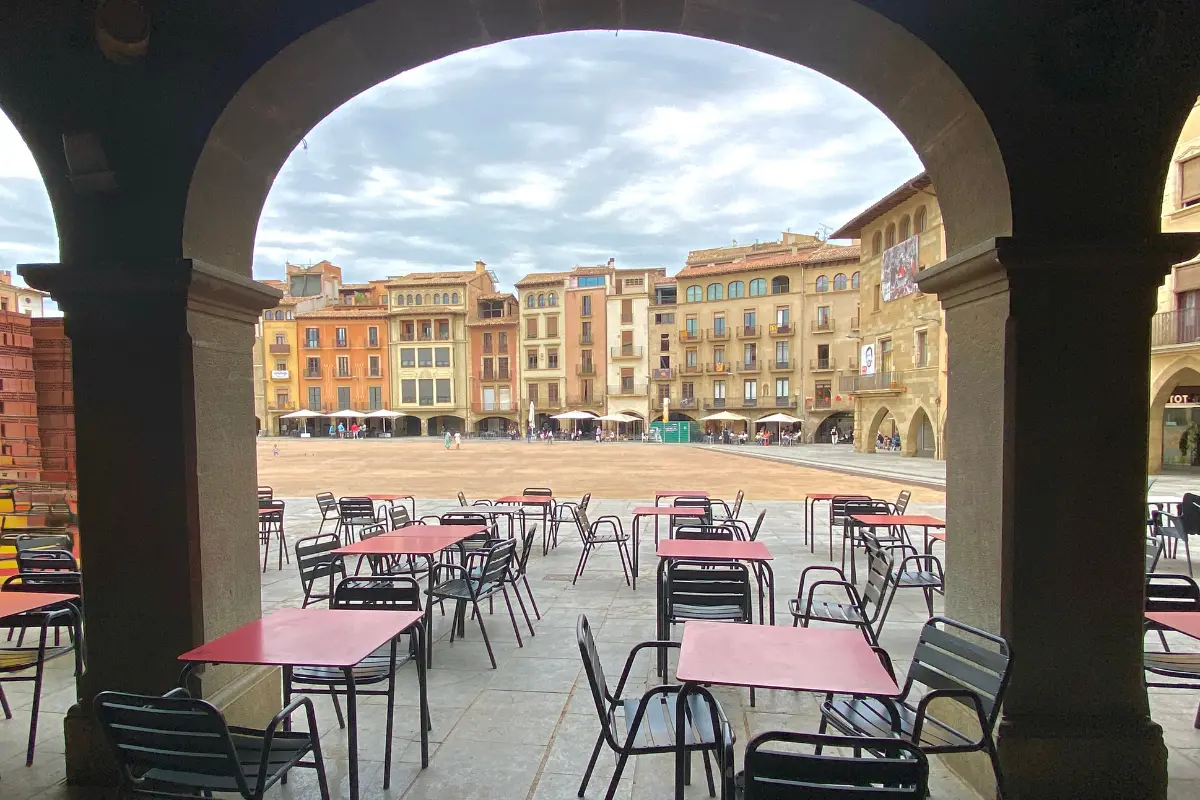
The central square of Vic — also called El Mercadal — has an unpaved sand surface in the center. This isn’t neglect; it’s an intentional maintenance of a surface that’s been used for markets since the 11th century. Natural drainage and adaptability for livestock and agricultural events are why the sand stays.
The arcaded buildings that surround the square represent every era of Vic’s economic development: Gothic, Renaissance, Baroque and Modernisme in the same 360° view. The Casa Comella (1896) was designed by Gaietà Buïgas — the same architect who designed the Columbus Monument in Barcelona — with sgraffito reliefs of the four seasons across the façade.
Every Tuesday and Saturday morning, the weekly market fills the square. Fruits, vegetables, cheeses, bread, and Osona-region charcuterie from local producers. For anyone visiting Vic outside of December, this market is the most alive version of what the Medieval Market recreates — the same square, the same product tradition, without the crowds.
The Cathedral: The Painter Who Also Did the Rockefeller Center
The Cathedral of Sant Pere in Vic accumulates ten centuries of architecture in a single building — Romanesque, Gothic, Baroque and Neoclassical layered without any style erasing the one before it. The Romanesque bell tower stands 46 meters tall with seven levels of windows, the tallest of its kind in Catalonia. The 11th-century crypt retains original capitals from the era of Bishop Oliba, one of the most influential figures in European Romanesque.
What makes this cathedral singular is the murals by Josep Maria Sert. The Barcelona-born painter made three separate decorative interventions here — 1906, 1926 and post-1939 — covering vaults and walls with monumental figures in ochres and gold. The fact that gives the commission its scale: Sert is the same artist who painted the Rockefeller Center in New York and the League of Nations headquarters in Geneva. His Vic commission was the largest-scale interior work of his career in Spain.
The recently opened Espai Sert allows visitors to see all three interventions simultaneously and understand the evolution across 40 years of the same artist’s work. It’s the most complete way to see the cathedral and the only venue in the world where these three phases of Sert’s career are visible in one place.
The Roman Temple: Hidden for Six Centuries
The Roman Temple of Vic was built in the 2nd century AD when the city was Auso, an administrative municipality of Roman Hispania. It survived the medieval period by disappearing inside the walls of the Montcada Castle — the castle’s interior courtyard was built around and over the Roman structure, which remained completely concealed for centuries. When the building housing the Royal Curia and prison was demolished in 1882, the Roman columns emerged from the rubble.
What survives: eight Corinthian columns, part of the elevated podium and sections of the portico. The coexistence of the Roman structure and the medieval castle ruins is visible in the same enclosure — two thousand years of architecture in a space of a few square meters. The physical relationship between the two structures is what makes the site unusual: you’re not looking at a restored Roman temple. You’re looking at what happened when a Roman temple got absorbed by medieval urbanism and then re-emerged.
Free admission (closed Mondays). Visit takes 15–20 minutes.
The MEV: 29,000 Pieces of Medieval Art
The Museu Episcopal de Vic is one of the most important medieval art museums in Europe — not by volume but by the quality of its Romanesque painting and polychrome wooden sculpture collection. Most of these pieces were rescued from rural churches across the Osona region when those buildings fell into disrepair or were threatened by theft or neglect.
Highlights: the Frontal de Sant Vicenç d’Espinelves (c.1187), attributed to the Vic workshop tradition; the Baldaquín de Ribes, an exceptional example of Romanesque liturgical wooden furniture; and Gothic-era works by Lluís Borrassà and Jaume Huguet.
Admission: €8.50, reduced €5.50. Free the first Thursday of each month and on May 18 (International Museum Day). Winter hours: Tue–Fri 10:00–13:00 and 15:00–18:00, Sat 10:00–19:00, Sun 10:00–14:00.
The Medieval Market: What It Is and What You Need to Know
The Mercat Medieval de Vic takes over the entire historic center during the Immaculate Conception bridge — typically December 5–8. Over 300 stalls distributed through the medieval streets, 200+ street performances, characters in period costume, blacksmiths, musicians and storytellers in the alleys and squares.
The element that separates this from similar markets: L’Assalt de l’Altarriba. A theatrical performance with 40 actors across 8 scenes in different locations of the historic center, based on actual documented events in Vic during the 14th century. The route takes spectators into spaces normally closed to visitors, including the cloister of the Casa de Convalescència. This is what makes Vic’s Medieval Market a real event rather than a craft fair with costumes.
Practical:
- Use public transport — car entry creates 2-hour jams on the busiest days
- Arrive in the morning for lower density and better photography
- Book a restaurant in advance if you want to sit down for lunch — every table in the center fills completely
- Weekdays have significantly fewer people than the weekend
The Llonganissa de Vic: What the IGP Actually Means
The Llonganissa de Vic has held Protected Geographical Indication status since 2001. The technical specification is precise: selected pork with salt and black pepper, natural casing only, minimum 38% protein on dry extract, and slow curing. The decisive factor is the Plana de Vic climate — the thermal inversions and frequent autumn and winter fogs create the exact conditions for the white fungal flora on the exterior that’s the visual signature of the product.
This flora isn’t cosmetic. It’s the result of specific ambient humidity and temperature cycles during the curing period that cannot be replicated elsewhere consistently. The IGP exists because the physical location is an ingredient.
Casa Riera Ordeix, founded in 1852, still cures in the same historic building in the center of Vic using original wooden drying rooms. Their llonganisses appear in international gastronomic retail. The most historically continuous producer and the reference for visitors who want to take product home.
The fuet — narrower diameter, shorter cure — is the everyday version. The hierarchy is clear: llonganissa is the prestige product, fuet is the accessible one.
Other products worth seeking in Vic: seasonal black truffle, Bufet potato (a local variety with creamy texture), Osona cheeses, honey and — for dessert — the Pa de Pessic, an extremely light sponge made with potato starch that’s the iconic local pastry. Best sources: Ca l’U and Masramon.
Best Strategy
You have 3–4 hours: Plaça Major → Roman Temple (20 min) → Cathedral with Espai Sert (1 hour) → quick walk through the historic center toward the Pont de Queralt. Skip the MEV for a short visit; it needs 90 minutes to make sense.
You have a full day: Full morning circuit (Plaça Major, Roman Temple, Cathedral) → lunch at Ca la Teresona → MEV in the afternoon (2 hours) → Adoberies quarter + Pont de Queralt → Pa de Pessic from Ca l’U before leaving.
You’re visiting for the Medieval Market (December 5–8): Arrive by 9:30. See L’Assalt de l’Altarriba performance (check the schedule at the tourist office). Spend the morning in the market stalls in the northern streets (less crowded than the Plaça Major area). Eat at 14:00 when the worst of the lunch rush is past. Leave before 18:00 to avoid the worst of the bus/road congestion out of the city.
Mistakes to Avoid
- Taking the R3 train without checking current works — the substitution buses and transfer points change phase by phase. Check Renfe’s current status before leaving. The e12 bus avoids this entirely.
- Going only on a Sunday — the weekly market is Tuesday and Saturday. The MEV has reduced Sunday afternoon hours. A weekday or Saturday visit is fuller.
- Rushing the Cathedral — the Sert murals require time and upward attention. Budget 60 minutes minimum. The Espai Sert context changes what you see when you look at the walls.
- Skipping the L’Assalt de l’Altarriba at the Medieval Market — most visitors don’t know it exists. It’s what makes the December trip worth planning specifically for December.
- Driving to the Medieval Market weekend days — the traffic system around Vic center changes during the market and parking creates 2-hour delays. Non-negotiable: use the e12 bus for the market.
A second inland day trip works on the same logic: the Torre de la Minyona at Cardona was cut from 25 metres to 12.5 metres in 1812 so it could not serve as an artillery reference, and the Cardona day trip guide explains what survives of the castle.
Final Insight
Vic’s Medieval Market is the most visited event, but the most interesting thing about Vic isn’t medieval at all — it’s Sert, a 20th-century artist with international commissions that dwarf anything else in the city, who returned to this provincial Catalan capital and painted his most ambitious Spanish work on walls that most visitors walk past without stopping. The Rockefeller Center connection is the kind of fact that reframes an entire visit. The cathedral rewards knowing it before you walk in.
For more day trips from Barcelona with a similar logic of underexplored depth, the Ebro Delta guide covers the natural reserve day-trip two hours south, and the Penedès wine region guide covers the wine country 45 minutes west.