

Barcelona has over 900 identified literary locations and is a UNESCO City of Literature. Most literary walking guides list places without explaining why each one matters in the work. This guide does the opposite: five routes organized by author and book, with the concrete detail of each location that explains what happened there in the fiction and what it looks like today.
The practical anchor before you start: the Plaça del Diamant air raid shelter is only accessible on Sundays at 11:00. Plaza George Orwell in the Gothic Quarter has surveillance cameras (the irony writes itself). The air raid shelter under the same square where Mercè Rodoreda set her most important novel is 12 meters underground, built by hand by local residents, and one of the most affecting spaces in the city.
Quick Answer: Where are Barcelona’s main literary locations? Five main itineraries: Gothic Quarter (Cervantes, Orwell, Zafón), El Born (Falcones, Zafón), Gràcia (Mercè Rodoreda, air raid shelter — Sundays 11:00 only), Sarrià (García Márquez, 1967–1975), Las Ramblas and Raval (Orwell, Vázquez Montalbán). All walkable. The official Barcelona literary map has 9 downloadable itineraries through the municipal library network.
Quick Decision
- Want the Zafón / Shadow of the Wind experience → Gothic Quarter: Arc del Teatre, Carrer Santa Anna, Plaça Sant Felip Neri, Els Quatre Gats
- Want the most historically layered location → Plaça Sant Felip Neri (real shrapnel + Zafón fiction + 1938 bombing)
- Want the most unusual literary site in the city → Plaza George Orwell with its surveillance cameras
- Want a timed experience (book in advance) → Air raid shelter under Plaça del Diamant — Sundays 11:00 only
- Want the Cervantes connection → Barceloneta beach (Don Quixote’s first sight of the sea and final defeat)
- Want García Márquez without a specific site → Walk Sarrià neighborhood — the community that housed the Latin American Boom
Route 1 — Cervantes and Don Quixote: Barcelona as the End of Illusion
Barcelona is the only real city in Don Quixote of La Mancha. The episode occurs in chapters 61–65 of Part II: Don Quixote and Sancho enter through the Portal de Mar — the monumental gateway of the medieval walls — and the knight sees the sea for the first time in his life.
Cervantes uses this moment with narrative precision: the Mediterranean is where Don Quixote recovers his sanity and suffers his final defeat at the hands of the Knight of the White Moon on the sands of the Barceloneta beach. Barcelona is, for Cervantes, the place where chivalric fantasies dissolve before reality.
Calle Perot lo Lladre (Gothic Quarter): in the novel, this is where the characters find the print shop producing the apocryphal Avellaneda edition of their own adventures. Cervantes turns this visit into an exercise in metafiction without precedent in Western literature — the characters enter a print shop and find the book that claims to tell their story but that they know is false.
Barceloneta Beach: the scene of the defeat. The sand where Don Quixote is conquered and promises to retire for a year to his village. Today a leisure beach; in Cervantes’s text, the endpoint of the era of chivalric novels.
📍 Start at the Portal del Mar area (current Barceloneta). The best streets walking guide covers the Gothic Quarter and Barceloneta neighborhood in more detail.
Route 2 — George Orwell: The Square That Watches Back
George Orwell arrived in Barcelona in December 1936 and described what he found in Homage to Catalonia (1938): a city in revolutionary ferment where class distinctions seemed to have disappeared, hotels were collectivized, and posters covered every facade.
The city has honored that legacy by naming a square after him in the Gothic Quarter. Plaza George Orwell is at the lower end of Las Ramblas, near the Arc del Teatre. Locals call it “Plaça del Tripi” for the alternative atmosphere it had for decades.
The detail that closes the circle: the square has surveillance cameras. The public space dedicated to the author who invented Big Brother in 1984 is monitored by municipal cameras. The coincidence is real and documented — and almost no literary guide mentions it.
Hotel Continental (Ramblas 138): where Orwell and his wife Eileen stayed. While he recovered in hospital from a bullet wound to the throat received at the Aragon front, Stalinist agents searched Eileen’s room and confiscated her notes and diaries.
Teatro Poliorama (Las Ramblas): Orwell spent three days and nights on the roof of this theater during the May Days of 1937, watching the POUM headquarters on the opposite side. The twin domed rooftops are still visible. From there he witnessed the collapse of the republican utopia through internal faction fighting.
Route 3 — Carlos Ruiz Zafón and the Cemetery of Forgotten Books
The Shadow of the Wind and the Cemetery of Forgotten Books tetralogy turned the Gothic Quarter into one of Barcelona’s most visited literary settings. Since Zafón’s death in 2020, routes through his locations have consolidated as one of the most requested cultural experiences in the city.
The important distinction: some locations are fictional but the surroundings are real. The Cemetery of Forgotten Books doesn’t exist, but the Arc del Teatre where Zafón places its access is a real passageway of ancient walls and wooden gates near the Ramblas.
Arc del Teatre: the access to the fictional Cemetery. The network of narrow alleys and wooden gates in the lower Ramblas is exactly as Zafón describes.
Carrer Santa Anna: the real street where Zafón sets the Sempere & Sons bookshop. Still has traditional establishments with the bohemian spirit of the era the novel describes.
Plaça de Sant Felip Neri: one of the most charged locations in the novel. In reality, the shrapnel craters in the church walls are from the fascist bombing of January 1938 — 42 dead, most of them children sheltering there. In Zafón’s fiction, the square accumulates decades of secrets and melancholy. The two layers coincide.
Els Quatre Gats (Carrer Montsió 3): the Modernista café where Picasso designed his first menu, appearing in The Shadow of the Wind as a cultural meeting point. Still operating — closed Mondays.
Plaza Real: in the novel, residence of bookseller Gustavo Barceló. The two lampposts in the square were designed by the young Gaudí — one of his few minor urban design works. In the fiction, the square is the setting for Daniel’s first encounter with Fermín.
📍 Start: Arc del Teatre (Las Ramblas, near Drassanes). Estimated duration: 2–3 hours.
Route 4 — Ildefonso Falcones and the Bastaixos of Santa Maria del Mar
The Cathedral of the Sea sets its action in 14th-century Barcelona, in the Ribera neighborhood. The novel’s axis is the construction of the Basílica de Santa Maria del Mar — a temple financed by fishermen and neighborhood residents, not by royalty or high Church. That sociological distinction is real and is the novel’s core.
The bastaixos — stevedores who carried stones from the Montjuïc quarries to the temple construction site — are represented in the reliefs of the basilica’s main door. It’s one of the rare cases where a medieval working class appears sculpted on the facade of the building they built with their own hands.
Carrer de Montcada: the noblest street of medieval Barcelona, where enriched merchants built palaces that today house the Museu Picasso and the Museu Barbier-Mueller. In the novel it’s the space of protagonist Arnau Estanyol’s social ascent.
Plaça del Àngel: formerly Plaça del Blat (wheat), setting in the novel for public executions under the Inquisition. The name change erases the history Falcones recovers in fiction.
Capella de Marcús (Carrer Carders): one of the oldest churches in Barcelona, departure point for couriers heading to Europe. In the medieval context of the novel, it’s the limit between the known neighborhood and the outside world.
Basílica de Santa Maria del Mar: the route’s destination. The interior has a structural purity that distinguishes it from any other Gothic church in the city — 28-meter nave height, columns that fan out at the top, no added ornamentation. Free entry during worship hours.
Route 5 — Mercè Rodoreda and the Air Raid Shelter Under the Plaça del Diamant
La plaça del Diamant is Mercè Rodoreda’s most important novel and one of the most translated texts in Catalan literature. The protagonist “La Colometa” was born in Gràcia, lives in Gràcia, and returns to the Plaça del Diamant to face her ghosts after decades.
The square has a sculpture by Xavier Medina-Campeny honoring the protagonist — a female figure with doves that reproduces the character’s image at a key moment of the novel.
The route point with a fixed date and time: the Air Raid Shelter 232, discovered accidentally in 1992 during construction work in the square, is 12 meters underground. It has capacity for 200 people and retains the original stone benches, tunnels, exposed brick walls, and infirmary from the moment it was built by neighborhood residents to shelter from Civil War bombardments.
Visiting hours: Sundays at 11:00. Access through the MUHBA (Museu d’Història de Barcelona). This is the only location in this guide with fixed date and time access — book in advance.
The complete Rodoreda route in Gràcia also includes the Mercat de la Llibertat — the Modernista market where the character shopped — and the squares that form the fabric of neighborhood daily life as the novel describes it.
📍 Start: Plaça del Diamant, Gràcia. Metro Fontana (L3).
Route 6 — García Márquez and Eight Years in Sarrià
García Márquez lived in Barcelona between 1967 and 1975 — eight years, not a visit. The date matters: he arrived just after publishing One Hundred Years of Solitude and left one of the most recognized writers of the 20th century. During that stay in the Sarrià neighborhood he wrote The Autumn of the Patriarch.
Literary agent Carmen Balcells — whose square is in Sant Martí — was the figure who brought García Márquez, Mario Vargas Llosa, and Julio Cortázar together in Barcelona in what’s known as the Latin American Boom. The Sarrià of the 1970s had a community of Latin American writers within meters of each other — something the city has never replicated.
The Boom route in Sarrià is more about atmosphere than specific locations — the neighborhood retains its village scale with local commerce and intimate squares that explains why Latin American writers chose this district for extended working stays.
The Biblioteca Gabriel García Márquez in Sant Martí was inaugurated in 2022 and won the Best Library in the World Award 2023 — not in Sarrià, but the name honors Barcelona’s connection with the author.
Bookshops Where Any Literary Route Begins and Ends
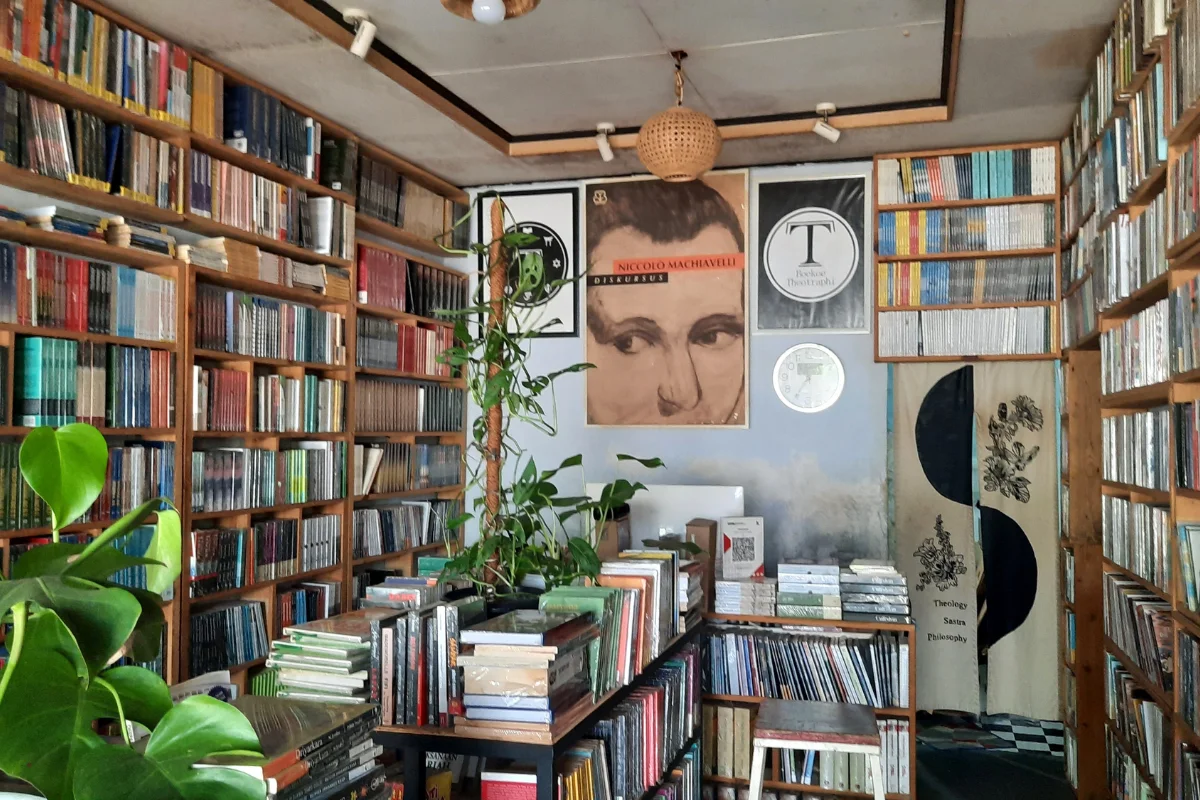
La Central del Raval (Carrer Elisabets 6): in the former chapel of the Casa de la Misericordia, with an accessible interior garden. One of the few spaces in the city where a bookshop and café coexist in a historic building with coherence.
Laie (Pau Claris 85): 300 square meters of bookshop with café-restaurant on the upper floor. Meeting point for editors and literary agents for decades.
Cafès El Magnífico (Carrer Argenteria 64): not a bookshop, but on the same street where Zafón sets the Sempere & Sons bookshop. The oldest specialty coffee shop in Barcelona, steps from the start of the Shadow of the Wind route.
Full Location Table
| Location | Work / Author | Neighborhood | Access | Key detail |
|---|---|---|---|---|
| Barceloneta Beach | Don Quixote / Cervantes | Barceloneta | Free | First sea sight + final defeat |
| Plaza George Orwell | Homage to Catalonia / Orwell | Gothic | Free | Surveillance cameras on Orwell’s square |
| Arc del Teatre | Shadow of the Wind / Zafón | Gothic | Free | Access to fictional Cemetery |
| Plaça Sant Felip Neri | Shadow of the Wind / Zafón | Gothic | Free | Real 1938 shrapnel + Zafón fiction |
| Els Quatre Gats | Shadow of the Wind / Zafón | Gothic | Pay (consumption) | Closed Mondays |
| Santa Maria del Mar | Cathedral of the Sea / Falcones | Born | Free (worship) | Bastaixos on facade |
| Plaça del Diamant | La plaça del Diamant / Rodoreda | Gràcia | Free | Protagonist sculpture |
| Air Raid Shelter 232 | La plaça del Diamant / Rodoreda | Gràcia | MUHBA (pay) | Sundays 11:00 only, 12m underground |
| Sarrià neighborhood | Autumn of the Patriarch / G.Márquez | Sarrià | Free | 8-year residence (1967–1975) |
Plaza George Orwell has surveillance cameras
The Plaza George Orwell and its surveillance cameras make the most perfectly ironic urban detail in the city. An author who invented the concept of being watched by the state, honored by a square that watches everyone who enters it.
The air raid shelter under Plaça del Diamant is consistently under-promoted relative to its actual quality as a visitor experience. 12 meters underground, hand-excavated by neighbors under aerial bombardment, with capacity for 200 people and the original infrastructure intact. The Sunday-11:00-only access makes it difficult to include in standard itineraries — which is exactly why it remains one of the best-kept significant sites in the city.
And the Cervantes connection to Barcelona — that Don Quixote sees the sea for the first time at the Barceloneta and is finally defeated there — is rarely developed beyond a single sentence. The thematic weight of that location (the sea as the place where fantasy ends and reality begins) is what makes Cervantes’s choice of Barcelona meaningful rather than incidental.
Mistakes to Avoid
-
Going to the air raid shelter without booking or checking the time. Sunday 11:00 only. No other public access. If you show up at any other time, you’re looking at a closed door.
-
Expecting the Cemetery of Forgotten Books to exist physically. It doesn’t. The Arc del Teatre area gives you the atmosphere — narrow alleys, wooden gates, ancient walls — but the Cemetery is fictional. The literary experience here is about immersion in the setting, not finding a specific address.
-
Planning Els Quatre Gats for a Monday. Closed. The Zafón route needs to account for this if you’re sequencing stops.
-
Treating Sarrià as a single-site visit. There’s no “García Márquez house” to photograph. The value of the Sarrià route is understanding the neighborhood that produced the conditions for the Latin American Boom — the scale, the quiet, the community. Walk it slowly.
Best Strategy
Short on time (2 hours): → Gothic Quarter only: Plaza George Orwell → Arc del Teatre → Carrer Santa Anna → Plaça Sant Felip Neri. The core Zafón / Orwell circuit.
Half day: → Gothic Quarter circuit (2 hours) → walk to Born → Santa Maria del Mar + Carrer de Montcada (Falcones route, 1 hour).
Full day: → Gothic Quarter morning → Born midday → metro to Gràcia (Plaça del Diamant + Mercat de la Llibertat) → air raid shelter if it’s Sunday at 11:00. Evening: coffee at La Central del Raval or Cafès El Magnífico near the Born.
1-Day Literary Plan (Sunday)
- 11:00 → Air Raid Shelter 232 (Plaça del Diamant, Gràcia) — book in advance, this slot only
- 12:30 → Walk the Gràcia squares — the novel’s neighborhood, the Rodoreda atmosphere
- 14:00 → Lunch in Gràcia — best cafés in Barcelona has options
- 16:00 → Metro to Jaume I, walk to Santa Maria del Mar (Falcones route)
- 17:00 → Gothic Quarter: Plaça Sant Felip Neri → Arc del Teatre → Plaza George Orwell
- 19:00 → Els Quatre Gats for a coffee (open Sunday)
- Evening → Live music in El Born or a walk along the Ramblas
Final Insight
Barcelona has over 900 catalogued literary locations. Most have no plaque, no sign, and don’t appear on any tourist map — they exist only in the pages of the books that describe them. That’s the entire point of a literary route in this city: it asks you to bring the text with you. The streets haven’t changed much. The novels didn’t either.