
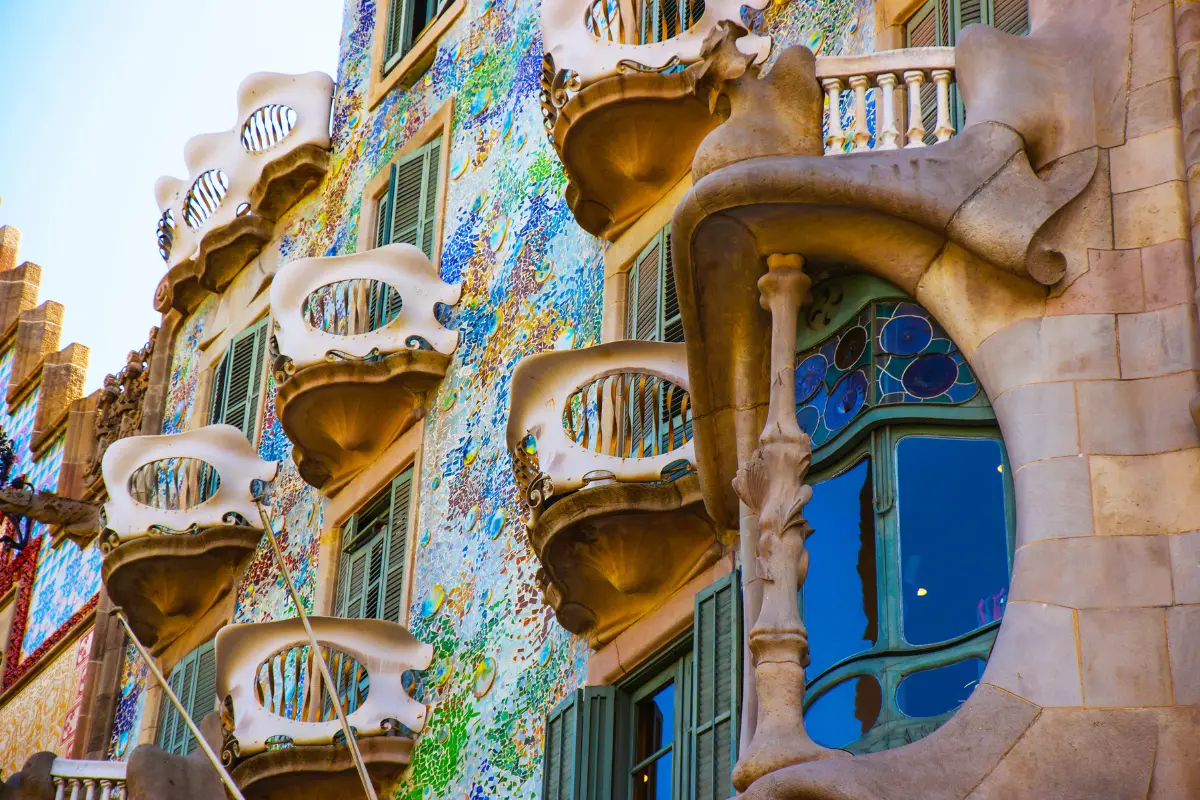

There’s a building in Barcelona that the UNESCO declared a World Heritage Site in 2005 — and you still couldn’t visit it. It sat locked in a narrow street in Gràcia for 130 years while the Sagrada Família drew millions and Casa Batlló became one of the most photographed facades in Europe.
That building is Casa Vicens. Gaudí’s first major work. The place where he invented the method he’d use for the rest of his life.
It’s been open since 2017. Most visitors still haven’t found it.
Quick Answer
Casa Vicens (Carrer de les Carolines, 24 — Gràcia) is Antoni Gaudí’s debut building, constructed between 1883 and 1885 when he was 30 years old. It was a private residence for 130 years before opening as a museum in 2017. UNESCO World Heritage Site since 2005. Tickets from €18. Open daily 10:00–18:00. Far less crowded than Casa Batlló or the Sagrada Família — which is precisely why it’s worth going.
Is Casa Vicens Worth Visiting?
Yes — and for a reason that is rarely explained clearly.
Casa Vicens isn’t the most spectacular Gaudí building in Barcelona. Casa Batlló is more visually overwhelming. The Sagrada Família is more monumental. Park Güell has better views. Casa Vicens wins on a different dimension entirely: it’s where you understand how Gaudí actually thought.
Every idea he’s famous for — integrating nature directly into the building’s structure, engineering passive ventilation through design, combining industrial materials with artisan craft — appears here for the first time, in 1883, in a summer house in Gràcia. If you’ve visited the other buildings and wondered how he arrived at those solutions, this is the answer.
It’s worth it if you:
- Have already seen Casa Batlló or the Sagrada Família and want more depth
- Are genuinely interested in architectural process, not just visual impact
- Want a Gaudí experience without crowds — 200,000 visitors a year vs. over 1 million at Casa Batlló
- Are traveling with a budget — at €18 it’s less than half the price of Casa Batlló
You might skip it if you:
- Have only one day and zero Gaudí background — start with Casa Batlló or the Sagrada Família first
- Expect the same immersive, technology-enhanced experience as Casa Batlló — this is quieter and more museum-like
- Have very limited mobility — the upper floors are not fully accessible
Quick decision: First-time in Barcelona with limited time → Sagrada Família first, Casa Batlló second. Return visitor or architecture-focused traveler → Casa Vicens is the most underrated stop on the entire Gaudí circuit.
Who Should Visit Casa Vicens?
| Visitor type | Verdict |
|---|---|
| First-time Barcelona visitor | ⚠️ Only if you have 3+ days and have done the main Gaudí buildings |
| Architecture enthusiast | ✅ Essential — this is where his method begins |
| Repeat visitor to Barcelona | ✅ The strongest case for a building most people overlook |
| Budget traveler | ✅ Best value on the Gaudí circuit at €18 |
| Visiting with children | ✅ The story of the dragon gate and the tile patterns works well |
| Photography traveler | ✅ Almost no crowds, extraordinary geometric tile work |
| Traveler interested in Gràcia as a neighborhood | ✅ Pairs perfectly with a half-day in the barrio |
The Building Most Gaudí Fans Have Never Seen
Here’s the fact that reframes everything: Gaudí’s client for Casa Vicens was not a ceramics manufacturer. That story has been repeated in guides and documentaries for decades — the idea that the tile-covered facade was a tribute to the client’s profession. Archival research tracing the client’s will at the Historic Protocol Archive of Barcelona confirmed he was a currency and stock broker.
The tiles aren’t a nod to the client. They’re entirely Gaudí’s decision — and the reason matters.
Gaudí left a written account of how he designed the building: he arrived at the plot before construction, found it covered in small yellow flowers (Tagetes erecta, also called marigolds), and adopted them as the ornamental theme for the ceramics. He also found a palm tree on the site; its fronds became the model for the iron gate.
That process — a 30-year-old architect kneeling in a vacant lot, converting what grew there into the visual language of a building — is the foundational moment of his entire career. The Sagrada Família’s forest of columns, Park Güell’s geological forms, Casa Batlló’s dragon scales: they all trace back to this methodology, applied here first.
What Makes the Architecture Different from Later Gaudí
Visitors expecting curves are in for a surprise. Casa Vicens is angular, geometric, and disciplined in ways that feel almost contrary to Gaudí’s reputation.
That contrast is the point.
The Facade: Geometry Before Curves
The exterior uses four materials in deliberate dialogue: stone as the structural base, polychrome ceramic tiles as the chromatic layer, carved wooden celosías (lattice screens) at the windows, and wrought iron at the gates. The white and green tiles in a checkerboard pattern alternate with the marigold-flower ceramic pieces that mirror what Gaudí found on the site. Higher up, the tiles project forward on small columns, giving the facade a sense of dissolving into texture as it rises.
The towers and cupolas at the corners break the rectangular volume in ways that read as almost Oriental — there are documented influences from Moorish architecture and from Japanese prints Gaudí had seen at Barcelona architecture exhibitions in the 1880s. None of this looks like the Gaudí of Casa Batlló. It looks like an architect discovering his own vocabulary.
The Iron Gate: Botanical Precision in Metal
The wrought iron fence surrounding the property replicates the leaves of Chamaerops humilis — the Mediterranean dwarf palm that grew on the site. Sculptor Lorenzo Matamala executed the metalwork with a precision that makes the iron appear to flex like a living leaf. It’s one of the finest examples of modernista metalwork in Barcelona, and one of the few original elements that survived intact from 1883.
The Smoking Room: The Most Unique Space in All of Gaudí
The fumadero is approximately ten square meters and contains something that exists nowhere else in Gaudí’s entire body of work.
The upper walls are lined with tiles made from papier-mâché — paper pulp pressed into relief molds by hydraulic press, then decorated with lithographed palm leaves and date clusters. This was an industrial material, cheap and light, used here alongside handcrafted plaster muqarnas on the ceiling — stalactite-like geometric forms that drop from above, painted in lapis lazuli blue with gold and green accents.
The blue is recent history. During the 2017 restoration, exploratory cuts in the walls revealed that the original colors had been buried under successive layers of neutral repaints over the decades. Recovering the lapis lazuli as the dominant color of the smoking room was one of the most significant discoveries of the entire project. The restoration team worked with the museum already open, allowing visitors to watch the precision interventions in real time.
No other Gaudí building has this technique. No other space in the building looks like this room.
The Dining Room: Paintings Built Into the Walls
The main floor dining room has walls decorated with sgraffito (carved plaster) ivy — a traditional Catalan technique that Gaudí pushed toward unusual realism. More distinctively, 32 oil paintings by artist Francesc Torrescassana are integrated directly into the wooden joinery of the walls: they’re not hung paintings, they’re structural elements of the room’s design.
Before 20th-century modifications, the dining room connected to a terrace with a water fountain at the base, designed to humidify the air entering the house and lower interior temperatures naturally during Gràcia’s hot summers. The 2017 restoration rebuilt this fountain from period photographs.
The Passive Climate System
The building handles temperature and ventilation without mechanical systems in ways that read as 21st-century passive design principles applied in 1883:
- The gallery on the attic floor acts as an insulating air chamber, buffering the living spaces from summer heat
- Windows are oriented to maximize cross-ventilation
- The terrace fountain cooled and humidified incoming air before it reached the interior
- The chromatic tile gradients on interior walls — lighter below, darker above — amplify available light in lower-lit spaces
This isn’t coincidental. It’s the same principle Gaudí would develop more fully in the light-engineered courtyard of Casa Batlló twenty years later — where tile gradations distribute natural light uniformly across all floors without artificial lighting.
Casa Vicens vs. Casa Batlló: Which One?
| Casa Vicens | Casa Batlló | |
|---|---|---|
| Built | 1883–1885 | 1904–1906 (renovation) |
| Ticket price | From €18 | From €35 |
| Annual visitors | ~200,000 | 1+ million |
| Crowds | Low — rarely feels crowded | High — especially peak season |
| Visual impact | Subtle, geometric, surprising | Immediate, overwhelming, polychrome |
| What you learn | The origin of Gaudí’s method | The peak of Gaudí’s visual language |
| Technology | Traditional museum format | Immersive AR audio guide |
| Best for | Architecture curiosity, budget, depth | First-time visitors, maximum impact |
If you can only choose one: Casa Batlló for first-timers, Casa Vicens for anyone who wants to understand what they already saw at Casa Batlló.
If you do both: Do Casa Vicens first chronologically — it makes Casa Batlló significantly richer. They’re 20 minutes apart on foot through Gràcia and the Eixample.
The ceramics manufacturer myth
Manel Vicens was not a ceramics manufacturer. He was a stock and currency broker. The tile-first facade was Gaudí’s decision, not a client brief.
Treating it as a lesser Gaudí. This framing inverts the actual hierarchy. Casa Vicens is where the method begins. The later buildings are the consequences. Calling it “lesser” is like calling a first chapter less important than the climax.
Skipping the smoking room. Most visitors move through it in under two minutes. It deserves at least ten. The papier-mâché tiles alone — the only example in Gaudí’s entire output — justify extended attention.
Not combining it with the Gràcia neighborhood. The building sits in one of Barcelona’s most characterful barrios: independent bookshops, weekend markets, local squares that have nothing to do with tourism. A morning at Casa Vicens followed by an afternoon in Gràcia is one of the best half-days you can spend in the city. For the neighborhood context, the Barcelona complete travel guide covers Gràcia as part of the city’s broader barrio landscape.
Tickets, Hours & Practical Info
Pricing
| Visitor | Price |
|---|---|
| Adult | €18 |
| Reduced (students, 65+, unemployed) | €16 |
| Children under 12 | Free |
| Guided group tour (add-on) | Extra charge |
Buy directly at casavicens.org — no reseller markup, and booking gives you a timed entry that avoids any wait.
Opening Hours
Open daily, 10:00–18:00. Last entry at 17:00. Closed December 25 and January 1. Extended hours during high season — verify on the official site before visiting.
Getting There
Address: Carrer de les Carolines, 24 — Gràcia, Barcelona
Metro: Line 3 (green) to Fontana or Lesseps — 10 minutes on foot
From Plaça Catalunya: 25 minutes walking through Gràcia, or 15 minutes by metro
Accessibility
Elevator access and adapted ground floor. Upper floors present limitations for reduced mobility. Contact the museum directly before visiting to plan the best route.
Best Time to Visit
Casa Vicens doesn’t have the crowd problem that defines visits to Casa Batlló or Park Güell. With around 200,000 visitors per year, it remains manageable even in high season.
Best windows:
- Weekday mornings — consistently quietest
- November through February (excluding holidays) — lowest visitor density
- Late afternoon (16:00–17:00) — good light on the facade from the west
Worth avoiding:
- Easter week and August weekends between 11:00–14:00 — highest concentration of visitors, though still nothing compared to Casa Batlló
The Gaudí Continuity: What He Invented Here and Used Forever
| Casa Vicens element | How it reappears in later work |
|---|---|
| Hexagonal distributors replacing corridors | Column-free open plan of Casa Milà |
| Cooling fountain on the terrace | Light-engineered courtyard of Casa Batlló |
| Site flora as the decorative program | Forest of columns at the Sagrada Família |
| Industrial material + artisan craft in one space | Trencadís mosaic throughout Park Güell |
| Gallery as insulating air chamber | Ventilation towers of La Pedrera |
Understanding this table is the main reason to visit Casa Vicens. It turns every other Gaudí building into a sequel you can read properly.
Planning Your Visit Around Casa Vicens
Casa Vicens works best as part of a half-day that includes the Gràcia neighborhood. The barrio has its own distinct character — independent shops, local squares, a Saturday market culture — that pairs naturally with a thoughtful architecture visit.
Suggested sequence:
- Casa Vicens at opening (10:00) — 75–90 minutes
- Walk through upper Gràcia — Plaça del Diamant, Carrer Verdi
- Coffee break — the best cafés in Barcelona includes several strong options in Gràcia; for serious coffee, the specialty coffee guide covers the neighbourhood’s best third-wave spots
- Continue south toward the Eixample to connect with Casa Batlló or La Pedrera if you’re doing both (but on the same day, pick one)
For a longer day in the area, the best streets in Barcelona walking guide maps a route from Gràcia down through the Eixample grid that covers the architecture of both neighborhoods in sequence.
If you’re spending the evening in the area, best live music bars in Barcelona has options in Gràcia itself.
Technical Data
| Address | Carrer de les Carolines, 24, Barcelona |
| Construction | 1883–1885 |
| Architect | Antoni Gaudí i Cornet |
| Client | Manel Vicens i Montaner |
| UNESCO designation | 2005 (Works of Antoni Gaudí) |
| Opened to public | 2017 |
| Annual visitors | ~200,000 |
| Current owner | MoraBanc |
| Floors | Ground + 2 upper floors + rooftop terrace |
One major Gaudí house in the city has no queue, and the reason is a five-hour opening window rather than its hillside address: the Torre Bellesguard guide sets out the timings.
Frequently Asked Questions
Is Casa Vicens worth visiting?
Yes — especially if you’ve already seen Casa Batlló or the Sagrada Família. Casa Vicens is where Gaudí’s entire method begins. It’s less visually spectacular than his later work but more architecturally revealing. At €18 and with far lower crowds, it’s one of the best-value stops on the Barcelona architecture circuit.
How much are Casa Vicens tickets?
Standard adult entry is €18. Reduced admission (students, over-65s, unemployed) is €16. Children under 12 enter free. Guided tours are available at an additional charge. Book directly at casavicens.org.
Casa Vicens vs. Casa Batlló — which should I visit?
They serve different purposes. Casa Batlló delivers maximum visual impact and is better for first-time visitors with limited time. Casa Vicens is quieter, cheaper, and more intellectually rewarding — it shows you where every idea in Casa Batlló originally came from. If you have time for both, do Casa Vicens first.
Why was Casa Vicens closed for 130 years?
It was a private residence, not a public building. The Vicens family sold it in 1899; it passed through private hands until 2014, when MoraBanc acquired it and commissioned a full restoration. It opened as a museum in November 2017 — twelve years after UNESCO had already declared it a World Heritage Site.
What is the most unique thing inside Casa Vicens?
The smoking room (fumadero). Its upper walls are lined with papier-mâché tiles — pressed paper pulp decorated with palm leaf lithographs — which is the only example of this technique in Gaudí’s entire body of work. The ceiling has hand-plastered muqarnas in original lapis lazuli blue, recovered during the 2017 restoration after being buried under decades of repainting.
How long does the Casa Vicens visit take?
Approximately 60–90 minutes for a thorough self-guided visit. With a guided tour, plan for 90–120 minutes. If you want to spend proper time in the smoking room and on the rooftop terrace, add another 20 minutes.
How do I get to Casa Vicens?
Metro Line 3 (green) to Fontana or Lesseps, then 10 minutes on foot. From Plaça Catalunya, it’s about 25 minutes walking through Gràcia. Address: Carrer de les Carolines, 24.
Is Casa Vicens accessible for visitors with reduced mobility?
The ground floor and main spaces are accessible via elevator. Some upper floor sections present difficulties. Contact the museum directly before your visit at casavicens.org to plan the best adapted route.
Was Gaudí’s client a ceramics manufacturer?
No — this is one of the most repeated myths about the building. Manel Vicens was a currency and stock broker. The tile-covered facade was entirely Gaudí’s decision, based on his observation of the site’s vegetation before construction began.