
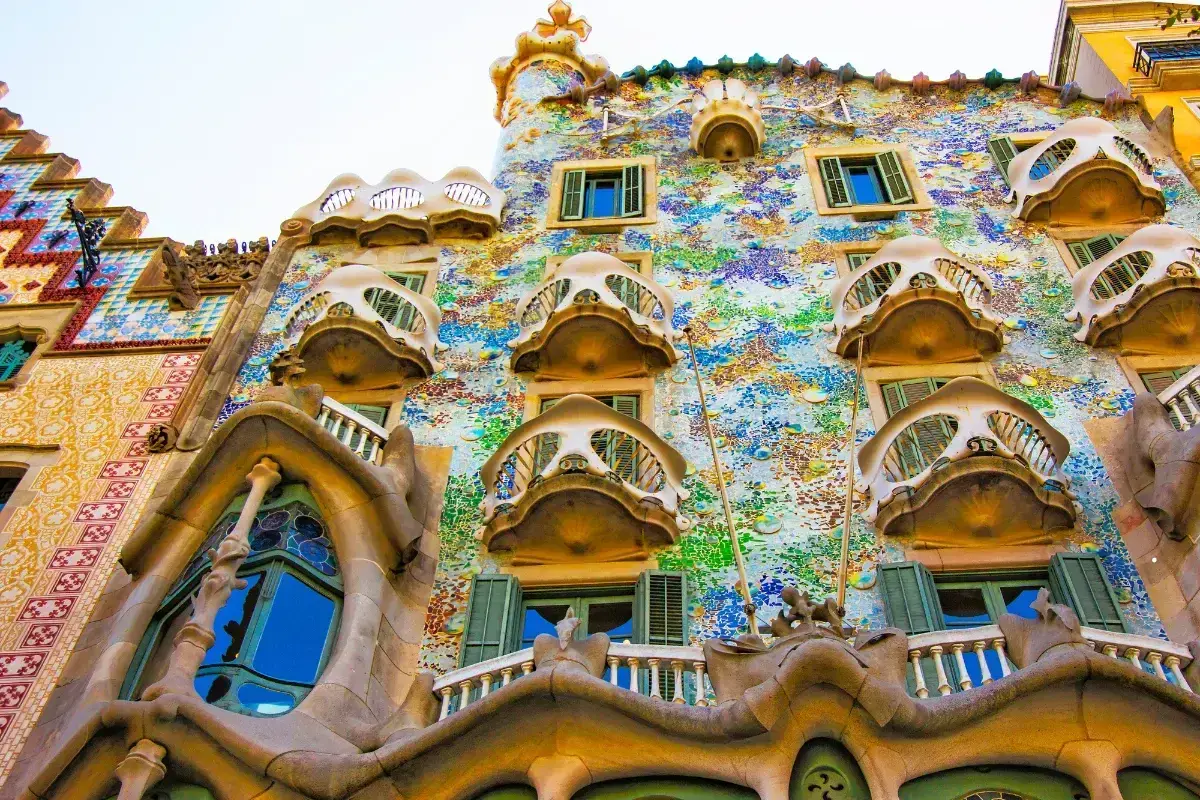

Most people visit Casa Batlló without understanding what they are actually looking at, and leave thinking it is just a beautiful building. It is not. It is a coherent system of engineering, symbolism and bioclimatic design that Gaudí compressed into a structure he was not even allowed to demolish and rebuild from scratch. Once you understand that, every surface reads differently.
This guide makes that happen before you walk in — and flags the one ticket rule that catches thousands of visitors every year.
What Casa Batlló Is
Casa Batlló is Antoni Gaudí’s radical 1904–1906 transformation of an existing building at Passeig de Gràcia 43, Barcelona. The iridescent ceramic facade, the dragon-spine rooftop and the entirely organic interiors make it one of the most visually distinctive buildings on Earth. It receives over 1 million visitors a year and holds UNESCO World Heritage status since 2005.
How much are tickets and is it worth it? The entry-level Blue ticket starts around €29 and excludes the rooftop. Silver (from ~€38) adds the famous Dragon’s Rooftop; Gold and Platinum run higher. Booked in advance and given 90 minutes on a weekday morning, Casa Batlló is one of the most memorable built spaces in Europe. Rushed or visited without a reservation in summer, it disappoints.
Is Casa Batlló Worth Visiting
Yes, but only if you visit it the right way. The people who leave disappointed share one of three profiles: they did not book ahead and lost an hour queuing, they rushed through in 40 minutes treating it as a photo stop, or they visited back-to-back with La Pedrera the same day and could not absorb either.
Done right — booked in advance, given at least 90 minutes, ideally a weekday morning in shoulder season — Casa Batlló is one of the most memorable built spaces in Europe. The experience is almost entirely determined by how you approach it, not by the building itself.
It is worth it if you:
- Have never visited before and want maximum visual impact from a single Gaudí building
- Are genuinely curious about how and why the building works the way it does
- Can visit on a weekday or early morning in shoulder season
You might reconsider if you:
- Are on a very tight budget and can only afford one major ticket — in that case the Sagrada Família is harder to justify skipping
- Are visiting on a packed summer weekend with no flexibility on timing — crowd density in small interior spaces degrades the experience significantly
- Expect a conventional museum with labeled exhibits — this is immersive and sensory, not didactic
For broader context on how this building fits into the city’s architectural identity, the guide to the best things to see in Barcelona places it within the city.s essential sights.
Who Should Visit Casa Batlló
| Visitor type | Verdict |
|---|---|
| First-time Barcelona visitor | Yes — highest visual return per hour of any Gaudí building |
| Architecture enthusiast | Must — the engineering logic rewards close attention |
| Traveling with children | Works well — kids under 7 enter free, the dragon narrative engages them |
| Budget traveler | Consider carefully — at €29+, it competes with the Sagrada Família for the same budget |
| Repeat Barcelona visitor | Stronger case than Park Güell for a second look |
| Photography-focused traveler | Yes — facade at dusk and rooftop in morning light are exceptional |
| Traveler with very limited time | Only with 90 minutes minimum — do not rush it |
Why Casa Batlló Is Different From Every Other Gaudí Building
Here is what most Barcelona guides bury in paragraph four — Gaudí did not build Casa Batlló from scratch. The city denied the demolition permit for the original 1877 structure, so he had to transform what existed: structural walls, floor plates and all.
What he produced under those constraints is arguably more revealing of his intelligence than any of his new-build projects. The polychrome facade, the light-engineered courtyard, the entirely curvilinear interior — none of it was inevitable. All of it was a solution to a problem.
That is the frame that makes everything inside more interesting. Keep it in mind as you walk through. To see how this single building sits within Gaudí’s seven UNESCO works across the city, the Gaudí route itinerary sequences them with real times and prices.
The Architecture, What Every Element Actually Means
Gaudí did not decorate. He designed systems where structure, light, symbolism and technical function operated simultaneously. At Casa Batlló, each formal decision has a rationale that goes well beyond aesthetics, and understanding that transforms what you see.
The Facade, Bones, Scales and the Legend of Sant Jordi
Locals call it la Casa dels Ossos, the House of Bones. The ground-floor columns mimic femur bones; the balconies echo jawbones and skull shapes. The most widely supported scholarly interpretation reads the entire facade as a retelling of Sant Jordi (Saint George), patron saint of Catalonia:
- The bony columns and skull-shaped balconies — the remains of the dragon’s victims
- The undulating, scale-covered roofline — the dragon’s back
- The tower capped with a multicolored sphere and cross — Sant Jordi’s lance driven into the dragon
- The trencadís mosaic — thousands of broken ceramic and Murano glass fragments forming the dragon’s scales, with tonal gradations calculated to shift with daylight
Gaudí never confirmed this reading. What is documented: the cold blues at the base shift to greens and golds toward the top. At midday the surface appears to ripple; at dusk it glows amber. This is calculated ceramic engineering, not ornament.
The Interior Courtyard, Passive Light Design in 1906
This is the least-photographed and most technically brilliant element in the building. Eixample buildings have a known structural problem — middle-floor apartments facing the interior courtyard receive little natural light. Gaudí solved it by varying the tone of the wall tiles from dark blue-gray at the top to bright white at the bottom.
Upper floors receive direct light and need no amplification. Lower floors receive less, so the brighter, more reflective tiles multiply what little reaches them. The result is near-uniform luminosity across all floors, achieved with glazed ceramic and zero electricity. That is passive building science, implemented in 1906, expressed through tile.
If your ticket includes courtyard access, start here. It reframes everything else you see upstairs.
The Rooftop, the Dragon’s Spine
The ceramic-scaled roof curves like a reptile’s back viewed from above. The twisted chimneys wrapped in helical trencadís are not whimsical — their spiral form prevents rain ingress without any mechanical cap. Form follows function; function becomes form. The four-armed cross on the tower is deliberately oriented, each arm pointing toward a different cathedral: Barcelona, Mallorca, Vic and Tortosa.
Give the rooftop at least 20 minutes. The light, the skyline and the detail density reward time. One critical caveat before you book, covered in the ticket section below: the cheapest ticket no longer includes this terrace.
The Noble Floor, Where Orthogonal Geometry Stops Existing
The planta noble, designed for the Batlló family, is where the rejection of right angles is complete. Ceilings suggest moving water. Doorframes have no parallel lines. Window glass transitions from deep blue at the exterior to lighter tones inside, deliberately graduated to ease the eye from outdoor light to interior. This is also the floor visitors move through fastest, and it deserves the opposite treatment. Slow down here.
Casa Batlló vs La Pedrera, Which One to Visit
Both are on Passeig de Gràcia, both are Gaudí, both are UNESCO World Heritage Sites. They are not interchangeable experiences, and for a first visit Casa Batlló wins on immediate emotional impact.
| Casa Batlló | La Pedrera (Casa Milà) | |
|---|---|---|
| Type | Renovation of existing building | New construction |
| Built | 1904–1906 | 1906–1912 |
| Facade | Polychrome, symbolic, narrative | Monumental, undulating stone |
| Interior highlight | Noble floor, light courtyard, rooftop | Column-free structure, model apartment, rooftop warriors |
| Experience | Immersive, sensory, emotional | Structural, rational, architectural |
| Ticket (approx.) | From €29 | From €25 |
| Best for | Visual impact, first-time visitors | Structural logic, architecture depth |
Direct recommendation: for a first visit, Casa Batlló delivers more immediate emotional return. For visitors already fluent in Gaudí’s formal language who want to understand structural innovation, La Pedrera adds a different kind of depth. If you visit both, do them on separate days — processing either building fully requires undivided attention. Both sit in the Eixample district guide, which maps the modernista buildings worth pairing with them on the same walk.
Tickets, Pricing and How to Book
Casa Batlló sells tiered tickets, and the tier you choose now determines whether you reach the rooftop at all. Online booking at casabatllo.es is the same price or cheaper than the door, where queues can exceed 60 minutes in August.
- Blue (entry-level): from ~€29 — SmartGuide audio tour, Noble Floor and the Gaudí Cube 360° experience. Does NOT include the rooftop.
- Silver: from ~€38 — everything in Blue plus the Dragon’s Rooftop terrace. The minimum tier for the famous roof.
- Gold: around €45 — adds AR tablet, Gaudí Dôme, Concierge Room and the private Batlló residence.
- Magic Nights: from ~€55 — evening visit with rooftop concert, projections and a welcome drink, March to November.
The one rule: buy direct on the official website. Resellers charge the same or more, and in peak season the best time slots sell out weeks ahead. Prices vary by season, so verify current pricing at casabatllo.es before planning.
Best Time to Visit Casa Batlló
The best time to visit Casa Batlló is a weekday morning in the first entry slot (9:00–9:30), ideally between November and February outside public holidays. Crowd levels drop significantly in low season and the experience is meaningfully better in the small interior volumes.
Best windows:
- Weekday mornings, first entry (9:00–9:30)
- Late afternoon weekdays, the final slots before closing
- November to February excluding public holidays — least crowded, most comfortable
Worst windows:
- July and August weekends, 11:00–15:00 — peak density in small interior spaces
- Easter week — queues form before opening even with a reservation
A 30-minute difference in arrival time can genuinely change the quality of your visit. The same seasonal logic applies citywide — the best time to visit Barcelona guide breaks down crowds and weather month by month.
The rooftop is not in the cheapest ticket
The rooftop is no longer in the cheapest ticket. Since January 2025, the entry-level Blue ticket excludes the Dragon’s Rooftop. Anyone booking the cheapest option to see the famous dragon-scale terrace will be turned away from it. You need Silver or above. This single fact changes more visits than any other detail on this page.
The back facade. Visible from the interior courtyard block, the rear elevation is architecturally distinct — less ornamented, more functional — and almost entirely unknown to visitors.
The courtyard is often skipped on rushed routes. Understanding the light engineering makes the rest of the building make sense — it is the clearest demonstration that Gaudí’s formal choices were technical decisions.
Ten minutes of pre-reading multiplies what you absorb inside. The audio guide is well-produced but covers a lot of ground quickly; context read before entry fills the gaps.
After your visit, the streets around Passeig de Gràcia reward a slow walk — the best streets in Barcelona walking guide covers the Eixample grid, and the specialty coffee guide has strong options within a few blocks.
Mistakes That Ruin the Visit
- Booking the Blue ticket expecting the rooftop. It is not included since January 2025. Book Silver or above for the terrace.
- Arriving without a reservation in high season. July and August door tickets are gone within the first hour of opening. This is not an exaggeration.
- Combining it with La Pedrera the same day. Two full Gaudí buildings in one day means you process neither. Space them out.
- Spending all your time on the facade and rushing inside. The exterior is extraordinary; the interior is more so.
- Skipping the noble floor. It has the most detail in the building and most visitors rush through it.
- Underestimating rooftop time. Budget at least 20 minutes up top, assuming your ticket includes it.
Getting There
Address: Passeig de Gràcia, 43, 08007 Barcelona. Metro: Passeig de Gràcia (Lines 2, 3, 4), a 2-minute walk. On foot from Plaça de Catalunya: 10 minutes south along Passeig de Gràcia.
On the same block: Casa Amatller (Puig i Cadafalch, no. 41) and Casa Lleó Morera (Domènech i Montaner, no. 35) — the full Manzana de la Discordia. Both are visitable and neither generates the same queue or ticket price. If you are spending the evening nearby, the best live music bars in Barcelona has several options within walking distance.
Technical Data
| Address | Passeig de Gràcia, 43, Barcelona |
| Renovation years | 1904–1906 |
| Architect | Antoni Gaudí i Cornet |
| Client | Josep Batlló i Casanovas |
| UNESCO designation | 2005 (Works of Antoni Gaudí) |
| Floors | Ground + 6 upper floors + rooftop terrace |
| Original use | Residential (rental apartments + noble floor for the Batlló family) |
| Current use | Museum, event space, partial residence |
| Annual visitors | Over 1 million |
Frequently Asked Questions
Is Casa Batlló worth visiting?
Yes, with the right approach. Book in advance, give it at least 90 minutes, and visit on a weekday morning if possible. Visitors who rush it or arrive without a reservation in peak season are the ones who leave underwhelmed. Done properly, it is one of the most memorable buildings in Europe.
How much do Casa Batlló tickets cost?
The Blue entry-level ticket starts around €29 and does not include rooftop access. The Silver ticket from about €38 adds the Dragon’s Rooftop. Gold runs around €45. Evening Magic Nights start near €55. Online booking at casabatllo.es is the same price or cheaper than the door.
Does the basic Casa Batlló ticket include the rooftop?
No. Since January 2025 the entry-level Blue ticket no longer includes the Dragon’s Rooftop. You need at least the Silver ticket to access the dragon-scale terrace. This is the single most common mistake visitors make when booking the cheapest option expecting to see the famous roof.
What is the best time of day to visit Casa Batlló?
The first morning slot, 9:00 to 9:30 on a weekday, is consistently the least crowded. The facade also looks exceptional at dusk when the trencadís catches warm light. November to February outside public holidays sees the lowest crowd levels of the year.
Did Gaudí design Casa Batlló from scratch?
No. An 1877 building already existed on the site. The city rejected the demolition permit, so Gaudí performed a complete renovation — new facade, transformed interiors, redesigned rooftop — while preserving the original load-bearing structure. Many architects consider this more impressive than his new-build projects.
Casa Batlló or La Pedrera, which one to visit?
For a first visit, Casa Batlló delivers more immediate emotional impact through its symbolic facade and sensory interiors. La Pedrera rewards visitors who want to understand structural innovation. If you do both, space them across separate days — back-to-back means you process neither fully.
Gaudí’s other buildings announce themselves as monuments. Casa Batlló disguises itself as a house and hides an entire bestiary in the plumbing, the light wells and the tilework. The visitors who slow down are the ones who actually see it.