

Barcelona runs one of Europe’s most productive legal street art programs and simultaneously spends €16 million a year erasing graffiti in tourist zones. That tension — between institutional support and institutional removal — is what makes the city’s street art scene genuinely complex to navigate. Some works have been there for decades. Others disappear in 48 hours.
Before you walk anywhere: the Keith Haring mural near the MACBA is a 2014 restoration of the 1989 original. The Wallspot platform manages 180 meters of legal wall in Poblenou where works can change weekly. Plaza George Orwell in the Gothic Quarter — named after the author of 1984 — has surveillance cameras. Those are the details that change what you are looking at.
Quick Answer: Where is the best street art in Barcelona? Poblenou has the highest density of large-format murals (Carrer de Pere IV axis, La Escocesa). Raval has the Keith Haring mural near the MACBA. Jardins de les Tres Xemeneies (Poble Sec) is the city’s most active legal wall with constant rotation. Gràcia has detailed work on shop shutters, visible when businesses close. Nau Bostik (Sant Andreu) has curated murals with active programming.
Quick Decision
- Want the most murals per kilometer walked → Poblenou, Carrer de Pere IV axis
- Want the most historically significant work → Keith Haring mural, Raval (MACBA wall)
- Want constantly changing work → Jardins de les Tres Xemeneies, Poble Sec
- Want curated, programmed murals → Nau Bostik, Sant Andreu
- Want detail work and shutters → Gràcia, evening when businesses close
- Want a free tool to track what’s there now → Wallspot app (wallspot.me) or Street Art Cities (376 geolocated works)
Zone 1 — Poblenou: The Open-Air Industrial Museum
Poblenou is where Barcelona’s street art scene operates at its largest scale. The former industrial warehouses of the “Catalan Manchester” offer multi-story surfaces that simply don’t exist in the historic center. The main axis runs along Carrer de Pere IV and its cross streets — Doctor Trueta, Pallars, Selva de Mar.
What’s there and why it matters
La Escocesa (Carrer de Pere IV, 345) — a former factory declared Cultural Heritage and now an artist residency. The exterior facade changes each season. It’s one of the most sought-after surfaces by international artists passing through the city, which means the work here is consistently at a high level.
Os Gemeos mural (Carrer de Pere IV) — the Brazilian brothers left one of their characteristic visual narratives here, with fantastical figures and an ochre palette. One of the few works by internationally significant artists that has remained standing in the neighborhood.
PobleZoo by Tim Marsh — a series of geometric animals (wolves, parrots, chameleons, tortoises) distributed across Carrer Llull, Marina, and Cristóbal de Moura. Some are linked to an augmented reality app that animates the murals on your phone. The tortoise on the shutter of La Bonita Cooperativa (Carrer de Cristóbal de Moura, 105) is one of the most photographed.
Neus Català mural (Carrer del Taulat) — a work by Roc Blackblock honoring the Catalan resistance fighter who survived Nazi concentration camps. Roc Blackblock is also known for murals critical of mass tourism in the Gothic Quarter — in Poblenou the register is more commemorative.
Pau Donés tribute (corner Selva de Mar / Perú) — a portrait of the Jarabe de Palo singer by JLG. Since it appeared it’s become a pilgrimage point for fans and a visual reference for the neighborhood.
Wallspot walls on Carrer de Selva de Mar — 180 meters of legal wall managed by the Wallspot platform. Works here have frequent rotation — they can last days or weeks. The Carrer de l’Agricultura and the Glòries area are other regular booking points.
How to walk it
Start at metro Selva de Mar (L4). Walk Carrer de Selva de Mar west toward Pere IV. Turn north on Pere IV toward La Escocesa. Cross streets east and west add the PobleZoo animals. Allow 2–3 hours for the full zone.
Zone 2 — Raval and Poble Sec: History and the Active Legal Wall
Keith Haring Mural (MACBA wall, Carrer dels Àngels)
Keith Haring painted this wall in 1989 during a visit to Barcelona — as an act of AIDS activism. The current version is a faithful 2014 restoration after the original deteriorated. Haring died in 1990, making this one of his last major public gestures.
The symbols he used have internal logic: the Radiant Baby represents innocence and vital force; the Barking Dog represents authority and social tension; the Dancing Figures represent collective energy. Understanding that vocabulary changes how you look at the wall.
Directly opposite is the permanent gathering of MACBA skaters — one of the most photographed spots in the Raval not because of the mural itself but because of how both elements coexist.
Àgora Joan Andrés Benítez (Carrer de l’Aurora, 13)
A plot reclaimed by neighbors in memory of a resident who died following a police intervention. The walls are used to project themes of social justice, historical memory, and solidarity. Community art, subject to frequent change.
Jardins de les Tres Xemeneies (Avinguda del Paral·lel — Poble Sec)
The most active legal wall in the city, at the foot of the three chimneys of the former La Canadenca power station. Managed by Wallspot. Wildstyle and 3D graffiti predominate. Works rarely last more than two weeks.
The key thing to understand: whatever you see in a photo from a month ago is almost certainly gone. The value here isn’t specific works — it’s the live state of the wall. Always current, never the same. Metro L2 and L3 (Paral·lel).
Zone 3 — Gràcia: Art That Whispers
Gràcia operates at a completely different scale from Poblenou. Narrow streets don’t admit five-story murals — street art here lives on the metal shutters of shops, on garage doors, and on the corners of alleys. This creates a unique dynamic: many works are only visible when businesses close, turning the neighborhood into a nocturnal gallery.
Zach Oreo has colonized Carrer de les Guilleries with his “Badassbearz” — bears with comic aesthetics that interact with pop culture characters.
Joel Arroyo uses shutters for portraits of global icons, from Nelson Mandela to Frida Kahlo, with intense color palettes.
Axe Colors is known in Gràcia for hyperrealistic portraits of series characters (Breaking Bad, Game of Thrones) with spray technique that mimics brushwork.
The best time to walk Gràcia for street art is between 21:00 and 23:00 when shops are closed and the full shutters are visible. During the day you’re seeing only the upper portions of what’s there.
Zone 4 — Gothic Quarter: Art and Identity
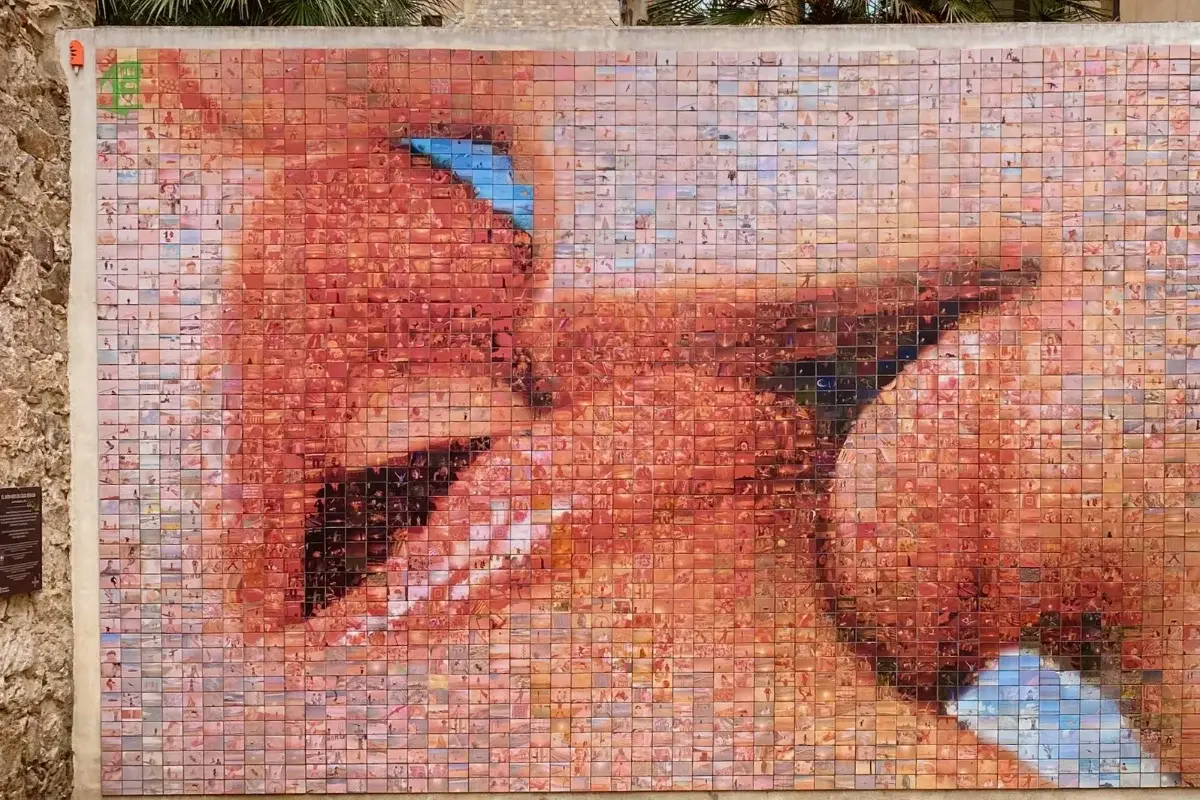
El Beso de la Libertad (Plaça d’Isidre Nonell) — a photomosaic by Joan Fontcuberta composed of 4,000 photographs of citizens. Created for the tricentenary of 1714. It merges ceramic tradition with participatory culture.
Gats by Arnal Ballester (Carrer d’en Xuclà, 7) — a 1998 mural restored by the city government twice, making it one of the few street art pieces elevated to the status of protected cultural heritage.
Roc Blackblock works in the Gothic Quarter with pieces that directly critique mass tourism — some welcome visitors with references to the impact of tourist colonialism on the neighborhood. Art that challenges the person looking at it.
Nau Bostik (Sant Andreu): The Curated Option
Nau Bostik at Carrer de Ferran Turné, 1–11 in La Sagrera is a former adhesives factory converted into a self-managed cultural center. The B-Murals project manages its walls with active curation — on its tenth anniversary it renewed 13 interventions. Standouts include the main facade by Emilio Cerezo (a participatory process with local residents) and work by Martí SAWE on the Puente del Treball Digne.
Metro L1 (Sant Andreu Arenal). Worth combining with a walk through the Sant Andreu neighborhood, which has its own emerging community mural scene.
The city spends €16 million removing what it also funds
The 2024 Plan Endreça allocates €16 million annually to removing graffiti in tourist zones — while the same city simultaneously funds and manages the legal walls that produce the work that appears in every Barcelona street art guide. The institutional relationship with urban art in Barcelona isn’t support or suppression: it’s active management of where it’s allowed to exist.
The permit reality: informal small-group sessions in parks and public spaces don’t require permits. Organized groups with an instructor or 15–20+ people in municipal spaces technically should. This is why many organized works shift locations or operate with reduced group sizes. It’s also why the legal wall platforms (Wallspot) have become central to how ambitious work gets made here — they provide the legal cover that makes large-format pieces possible.
The Wallspot platform has 60% foreign artists registered — a detail that tells you how internationally connected Barcelona’s street art scene actually is. This isn’t a purely local phenomenon.
Mistakes to Avoid
-
Planning around a specific photo you saw online. Works on legal rotation walls (Jardins de les Tres Xemeneies, Wallspot sites) change constantly. Check Wallspot and Street Art Cities (376 geolocated works) close to your visit date, not weeks before.
-
Going to Gràcia for street art before 20:00. The shutter work is the point — and it’s hidden behind open shutters during business hours. Evening is the only time to see it.
-
Treating the Keith Haring as the original. The 2014 restoration is faithful but it’s a restoration. The original was painted by a dying artist as an act of political urgency. The difference in context matters for how you understand what you’re looking at.
-
Skipping Nau Bostik because it’s in Sant Andreu. It’s one metro stop. The curation quality is higher than most Poblenou walls and the programming around the murals (events, talks, workshops) makes the visit richer than a standard mural walk.
Best Strategy
Short on time (2 hours): → Poblenou only. Metro Selva de Mar, walk the Carrer de Pere IV axis. Highest density per kilometer of any zone.
Half day: → Poblenou morning → metro to Paral·lel → Jardins de les Tres Xemeneies (active wall) → Keith Haring mural in the Raval (10-minute walk from Paral·lel).
Full day: → Nau Bostik morning (Sant Andreu, metro L1) → Poblenou early afternoon → Jardins de les Tres Xemeneies → Keith Haring at dusk → Gràcia after 21:00 for the shutter walk.
1-Day Street Art Route
- 09:30 → Metro to Sant Andreu Arenal (L1), Nau Bostik — the curated works and the Puente del Treball Digne
- 11:30 → Metro to Selva de Mar (L4), Poblenou — La Escocesa, Os Gemeos, PobleZoo
- 14:00 → Lunch in Poblenou — the best cafés in Barcelona guide has options in the neighborhood
- 16:00 → Metro to Paral·lel (L2/L3) — Jardins de les Tres Xemeneies
- 17:00 → Walk north to Raval — Keith Haring mural, MACBA skaters
- 21:00 → Metro to Fontana (L3), walk Gràcia shutters — the nocturnal gallery
Indoors, the city’s first major street-art museum gathers over 35 works across seven rooms by figures like Okuda and Aryz: the street art museum guide covers it.
Tools for Finding Works
Wallspot (wallspot.me) — the official legal wall platform with a map of locations and recent work. Essential for knowing what’s on rotation walls before you go.
Street Art Cities (streetartcities.com) — database with 376+ geolocated works in Barcelona, with photos and artist names. Some entries are outdated, but it’s the most complete reference for long-duration pieces.
The best walking routes in Barcelona covers the neighborhoods in more geographic detail — useful for combining a street art walk with the architectural and neighborhood context around it.
Street art is not the only art out in the open. A 2,200-kilo bronze cat and a submarine that only surfaces when it rains are in the quirky sculptures guide.
Final Insight
Street art in Barcelona doesn’t need your help to find it — it finds you if you’re in the right neighborhoods. The useful skill is knowing which walls are permanent enough to plan around and which ones are points of ongoing production. The Keith Haring will be there. The Jardins de les Tres Xemeneies will have something, but not what was there last month. Plan accordingly, and the city’s street art layer becomes one of its most rewarding to navigate.