
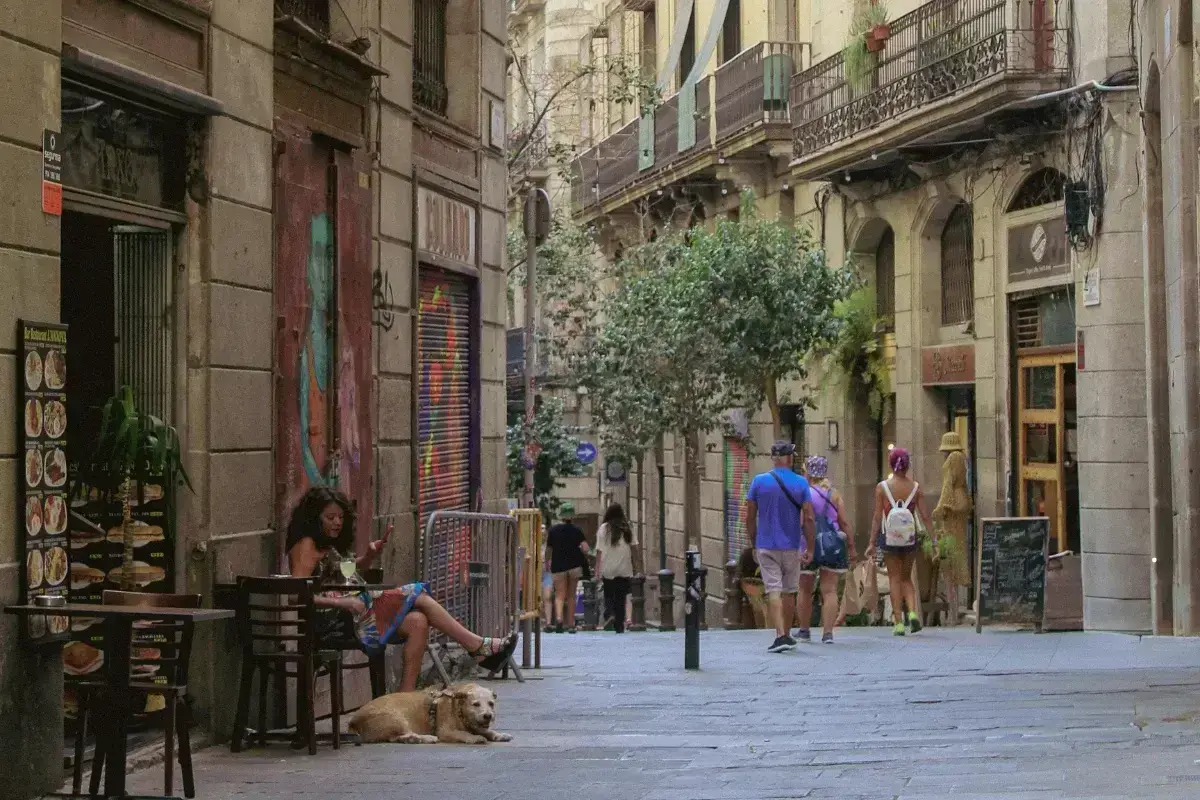

Every city has a neighbourhood it tried to erase. Barcelona has El Raval — and it failed at the erasing, spectacularly, three separate times.
The neighbourhood that was once called the Barrio Chino (there were no Chinese residents; the name was borrowed from San Francisco’s slums as a shorthand for urban shame) is now home to a Richard Meier museum, a 15th-century Gothic hospital turned national library, and one of the highest concentrations of contemporary cultural institutions in southern Europe. It also has one of the highest poverty rates in the city and an ongoing displacement crisis that no urban regeneration plan has resolved.
El Raval is not a success story or a cautionary tale. It is both, simultaneously, in the same streets.
This guide covers the real history, what to actually see, what most visitors miss — and why the neighbourhood’s contradictions are the most honest thing about Barcelona.
Quick Answer: What Is El Raval? El Raval is Barcelona’s densest, most diverse neighbourhood — 47,000 people in 1.08 km², roughly 60% foreign-born. It borders Las Ramblas to the east and Sant Antoni to the north. Key landmarks: MACBA (contemporary art museum), CCCB (cultural centre), Biblioteca de Catalunya (national library in a Gothic hospital). Metro: Liceu (L3), Sant Antoni (L2), Universitat (L1/L2).
Quick Decision: How to Approach El Raval
| You want to… | Go to | Time needed |
|---|---|---|
| Understand the neighbourhood’s history | Hospital de la Santa Creu + walk south | 2–3 hours |
| See world-class contemporary art | MACBA | 2 hours minimum |
| Find the least-touristy cultural space | Filmoteca de Catalunya | 2 hours |
| Experience daily life, not tourist Barcelona | Carrer dels Tallers + Sant Antoni market | Morning |
| Understand the urban transformation debate | Rambla del Raval + surrounding blocks | 1 hour walk |
| See the CCCB courtyard (almost no one does) | CCCB | 30 minutes |
Why the City Wanted to Demolish It (And Why It Couldn’t)
The word raval comes from the Arabic rabad — outskirts, what lies beyond the walls. When Barcelona expanded beyond its Roman fortifications in the Middle Ages, the land to the west absorbed everything the city needed but didn’t want near its centre: hospitals, slaughterhouses, convents, unguilded workers, the poor.
A second city wall in the 14th century enclosed this territory physically inside Barcelona. But it was never truly integrated. The city needed El Raval. It also despised it. That tension — utility and rejection in the same breath — runs through every chapter of the neighbourhood’s history.
By the 19th century Industrial Revolution, El Raval had become Barcelona’s factory heart. Textile mills occupied the desamortised convents. Rural workers arrived and packed into buildings with no ventilation, no sanitation. Population density reached levels with no precedent in Spain. European hygienists wrote clinical horror reports about infant mortality rates and tuberculosis.
In 1925, a journalist named Àngel Marsà published an article comparing the southern section to San Francisco’s Chinatown. The Barrio Chino name spread immediately. It named urban shame. It also attracted: Jean Genet wrote there, George Orwell walked its streets during the Civil War and described them in Homage to Catalonia, Federico García Lorca was a regular. Official rejection and cultural fascination occupied the same geography.
Three Failed Attempts to Erase the Neighbourhood
1932: Le Corbusier’s Plan Macià
The most radical proposal came from Le Corbusier and Josep Lluís Sert: the Plan Macià called for demolishing almost all of El Raval and replacing it with rationalist housing blocks surrounded by green space. The plan was never executed — the Civil War stopped it. But the idea that El Raval was an urban problem solvable only by demolition remained embedded in city planning thinking for decades.
1950s–60s: Partial Demolitions Under Franco
Piecemeal clearances opened some interior streets but left the fundamental structure intact. The density remained brutal. The infrastructure, obsolete. The social stigma, unchanged. The neighbourhood absorbed the interventions and continued being exactly what it was.
1992 Olympics: The Surgical Approach
Barcelona’s Olympic candidacy came with an urban strategy. The city chose four neighbourhoods for transformation — El Raval was one of them. The approach this time wasn’t total demolition but surgical intervention: open interior public space, implant high-impact cultural institutions, use architecture to shift perception.
The most visible operation was the Rambla del Raval, completed in 2000. Opening it required demolishing an entire residential block. Thousands of residents were displaced. The operation was one of Barcelona’s first major gentrification controversies — before the word gentrification was common currency in Spanish urban planning debates.
The second operation was the MACBA.
The MACBA Effect: How a Museum Changed Everything (Including the Things It Wasn’t Supposed To)
The Museu d’Art Contemporani de Barcelona opened in 1995 in Richard Meier’s white geometric building on Plaça dels Àngels. The location was a deliberate provocation: a museum of international architectural prestige planted in the city’s most stigmatised neighbourhood.
The theory was explicit — a world-class cultural institution would generate activity, attract visitors, elevate the neighbourhood’s perception, and trigger urban revaluation. The Bilbao Effect before the Guggenheim had even opened.
The effect happened. It just wasn’t entirely what was planned.
The MACBA drew art students, galleries, alternative spaces, and bars. The Raval became one of the centres of Barcelona’s cultural and nightlife scene through the 2000s. The MACBA plaza became a gathering point for skaters, tourists, and residents from every background — one of the genuinely democratic public spaces in the city.
It also accelerated pressure on housing stock, pushed rents upward, and became one of the triggers for the population substitution the neighbourhood has been experiencing ever since.
The MACBA is still worth visiting — its permanent collection and temporary programme are among the strongest in Spain. But understanding it as both a museum and an instrument of urban policy is the honest way to experience it.
What Most Visitors Never See
Biblioteca de Catalunya — The Most Beautiful Room Nobody Enters
Installed in the former Hospital de la Santa Creu (founded 1401), the national library of Catalonia occupies a 15th-century Gothic complex that is one of the most impressive interiors in Barcelona. The main reading room — stone arches, diffused light, complete silence — is practically unknown to tourists despite being in the heart of the old city.
Entry is free. You don’t need a library card to walk in. Go in the morning on a weekday.
📍 Carrer de l’Hospital 56.
CCCB Courtyard — The Most Photographed Space That Doesn’t Appear on Any List
The Centre de Cultura Contemporània de Barcelona occupies part of the former Hospital de la Misericòrdia. Its courtyard — a glass facade that reflects the neighbourhood back at itself, designed by Helio Piñón and Albert Viaplana — is one of Barcelona’s most architecturally significant spaces and appears on almost no tourist itinerary. The CCCB’s exhibition programme is consistently one of the most interesting in the city.
Filmoteca de Catalunya — The Serious Cinema Reference
Opened in 2012, it’s one of the few purpose-built new structures in El Raval in recent years. Its programme of auteur cinema, restored classics, and retrospectives makes it a European reference for serious film culture. If you’re interested in cinema beyond blockbusters, this is worth an evening — see the best independent cinemas in Barcelona guide for the full picture.
Hospital de la Santa Creu Courtyard
The Gothic cloister of the old hospital complex — now shared between the Biblioteca de Catalunya and the Institut d’Estudis Catalans — is one of the quietest and least-visited spaces in the entire old city. It functions as a garden. It is almost always empty of tourists.
The Rambla del Raval: What the Controversy Was Actually About
The Rambla del Raval is Barcelona’s most contested urban experiment after the 22@ district.
Built on the cleared site of a demolished residential block, it was officially designed to decompress the neighbourhood’s density and create interior public space where almost none existed. On its own terms — as a physical space — it works. It is wide, pedestrian, walkable.
The problem is what it became. The density of restaurant terraces, the tourist pressure, and the gentrification of surrounding buildings transformed what was designed as a neighbourhood square into a consumption zone oriented toward visitors. The Hotel Barceló Raval — a cylindrical design tower opened in 2008 — became the most visible symbol of this transformation. For many residents, its construction confirmed that urban regeneration had been designed to replace them, not improve their conditions.
The debate has not closed. The Rambla del Raval is still there, still contested, and still the most honest physical manifestation of what Barcelona’s urban policy in El Raval actually produced.
El Raval Today: Incompatible Realities in the Same Square Kilometre
El Raval in 2026 contains realities that should not be able to coexist, and do.
It is the Barcelona neighbourhood with the highest concentration of museums and cultural centres. It also has the highest percentage of population at risk of social exclusion.
It is a consolidated tourist destination with boutique hotels, gastronomy routes, and coworking spaces. It is also the neighbourhood where the most illegal tourist apartments have been shut down in the last five years.
It is where the most independent art projects in Barcelona are active. It is also where residential rents are rising fastest.
The population is approximately 47,000 people in 1.08 km² — one of the highest densities in Europe. Around 60% are foreign-born, with established communities from Pakistan, Bangladesh, the Philippines, Morocco, and India. The neighbourhood’s food shops open at 6am. South Asian restaurants operate next to century-old Catalan bars. A contemporary art gallery, a mosque, and a traditional grocery store share the same street.
None of these realities cancels the others. El Raval is not resolved. It is the place where Barcelona has been negotiating with itself for decades about what kind of city it wants to be — and hasn’t reached a conclusion.
El Raval is not one place, and the north-south split explains it
Safety is the wrong frame. To the question of whether El Raval is safe, the useful answer: the north (around MACBA and CCCB) is busy and well-transited at any hour. The south, near the port, has more incidents at night, as in any dense urban area. This is not specific to El Raval — it applies to dense old-city neighbourhoods across Europe.
They reduce it to the MACBA. The MACBA is the most legible institution in El Raval for international visitors, but it’s not the reason the neighbourhood is interesting. The Biblioteca de Catalunya, the Filmoteca, and the CCCB courtyard are equally significant and far less crowded.
They ignore the displacement story. The cultural richness of El Raval and the ongoing displacement of its longest-term residents are part of the same process. Visiting without that context means missing what the neighbourhood is actually about.
Practical Information
Getting there: Liceu (L3) for the south and MACBA area. Sant Antoni (L2) for the north. Universitat (L1/L2) for the upper section toward Eixample. Walking from anywhere in the old city takes under 10 minutes.
Best time to visit: Weekday mornings for the Biblioteca de Catalunya and the hospital courtyards. The MACBA plaza is most alive on weekends. The Sant Antoni market (technically just outside El Raval’s boundary, but functionally connected) is best on Sunday mornings — relevant context in the best flea markets in Barcelona guide.
Combine with: El Raval connects directly to Las Ramblas and the Gothic Quarter to the east, Sant Antoni to the north. If you’re building a full old-city day, the Barcelona complete travel guide has the routing logic. For the budget implications of a full Barcelona visit, the Barcelona travel budget guide covers what to expect across different spending levels.
Eating in El Raval: The neighbourhood has genuine food options outside the tourist circuit — South Asian restaurants on Carrer del Carme and surrounding streets, traditional Catalan bars, and the back entrance of La Boqueria market on the eastern edge. For a broader food picture, the best paella in Barcelona guide covers options within walking distance.
Key Facts
| Element | Data |
|---|---|
| Area | 1.08 km² |
| Population | Approx. 47,000 |
| Density | Approx. 43,500 residents/km² |
| Foreign-born population | Approx. 60% |
| District | Ciutat Vella |
| Main cultural institutions | MACBA, CCCB, Filmoteca, Biblioteca de Catalunya |
| MACBA opened | 1995 |
| Rambla del Raval opened | 2000 |
Frequently Asked Questions
Why is it called Barrio Chino if there’s no Chinese community?
A journalist named Àngel Marsà popularised the term in 1925, comparing the area to San Francisco’s Chinatown as shorthand for urban marginality. There was no Chinese community — the name labelled a place of poverty and social stigma. The term is now considered pejorative and rarely used; the neighbourhood is simply El Raval.
Is El Raval safe to visit?
The northern section around MACBA and CCCB is well-transited and safe at any hour. The southern section near the port has more incidents at night. Standard urban awareness applies — the same as in any dense old-city neighbourhood in a major European city.
What’s the difference between El Raval and the Gothic Quarter?
The Gothic Quarter preserves the Roman medieval street plan and has a more homogeneous historical character. El Raval is more heterogeneous — greater population diversity, more contemporary cultural institutions, and a more recent and visible urban transformation. They are adjacent but have completely distinct characters.
What’s the most underrated thing to see in El Raval?
The Biblioteca de Catalunya reading room in the Hospital de la Santa Creu — a 15th-century Gothic space that is free to enter and almost always empty of tourists. The CCCB courtyard is the second answer.
Why was the Rambla del Raval controversial?
Opening it required demolishing an entire residential block and displacing thousands of residents. Many felt the regeneration operation was designed to attract investment and tourism rather than improve conditions for existing residents. The debate about who urban transformation actually benefits has never been resolved.
Which writers lived in or wrote about El Raval?
Jean Genet wrote part of his work in the neighbourhood. George Orwell walked its streets during the Civil War and described them in Homage to Catalonia. Federico García Lorca was a regular. For decades, the neighbourhood attracted European artists and writers looking for a Barcelona outside the bourgeois order of the Eixample.
How do I get to El Raval from Barcelona airport?
Take the Aerobús or metro to Plaça Catalunya, then walk 10 minutes south, or connect to Liceu (L3). Full transport options from the airport are covered in the Barcelona airport to city centre guide.
Before or After El Raval
If you’re spending a full day in the old city, the best Barcelona walking streets guide maps the routes that connect El Raval, the Gothic Quarter, and El Born without backtracking. The best neighbourhoods to stay in Barcelona guide covers why staying near El Raval gives you direct access to three distinct old-city characters within walking distance.
El Raval didn’t become what Barcelona intended. That’s exactly what makes it worth understanding.