
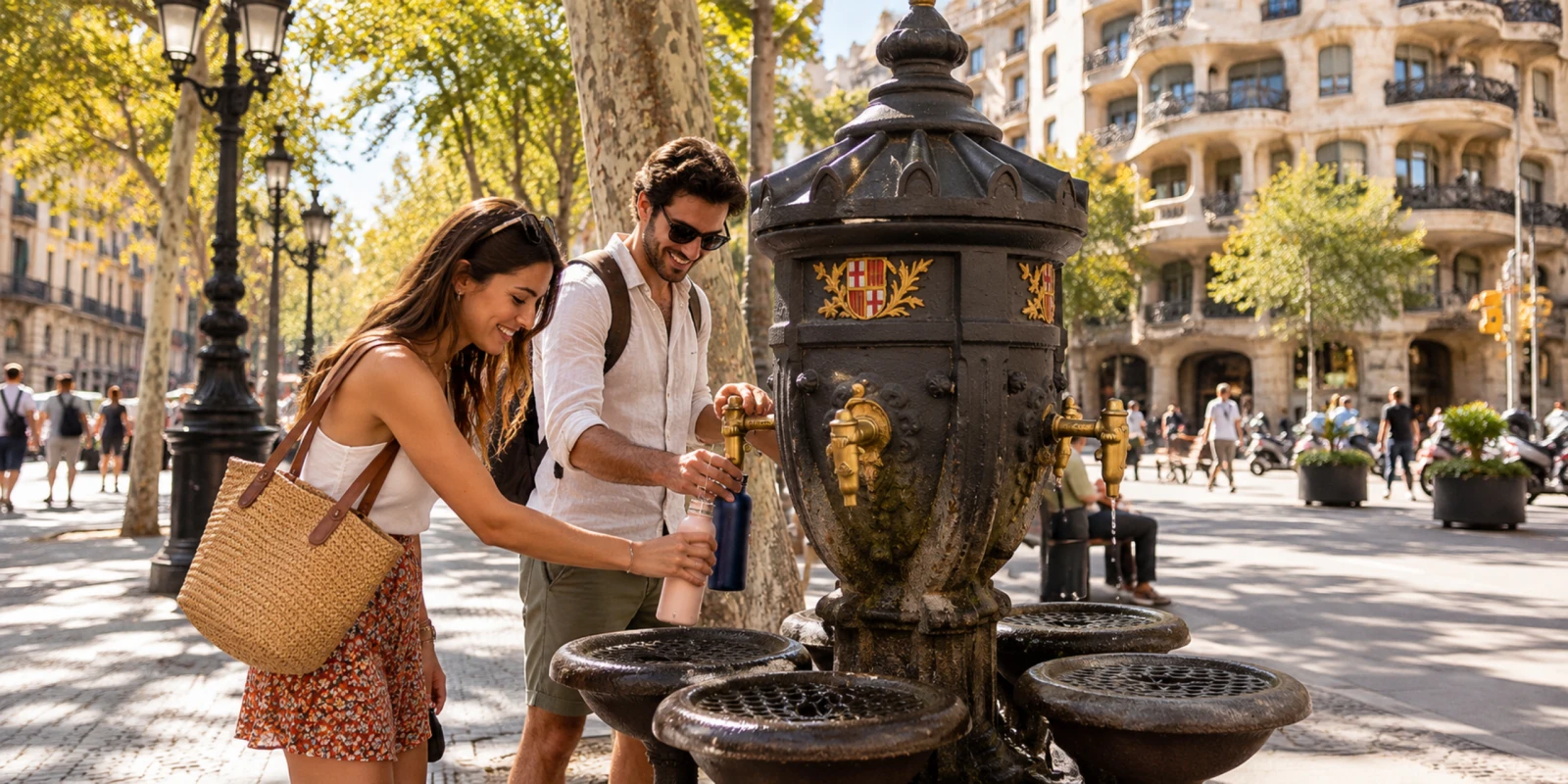

The short answer to the question everyone asks before flying is yes: Barcelona’s tap water is safe. The supply meets the EU drinking water directive and the 1.760 public fountains in the street run off the same network. What makes visitors reach for a bottle anyway is taste — the water is hard and chlorinated — and that is a preference, not a health warning. Of the 1.760 on file, 349 have no name recorded and 10 no neighbourhood. Meanwhile there is a second free source almost nobody uses: since a 2022 waste law, every bar and restaurant in Spain must serve unbottled water free to anyone who asks. On a 4-day trip at 3 bottles a day, that is 18,00 euros at 1,50 euros a half litre, or 24,00 euros at tourist-zone prices. Poble-sec alone has 77 of the fountains and the Dreta de l’Eixample 59, and the free Fonts BCN app finds the nearest in seconds.
Is tap water in Barcelona safe to drink? Yes. The supply meets the EU drinking water directive and the 1.760 street fountains carry the same water. It is hard and chlorinated, which affects taste rather than safety, and since 2022 bars must serve free tap water on request.
What a trip’s worth of water costs, and what it could cost
| Source | What to ask for | Cost |
|---|---|---|
| A bar or restaurant | Agua del grifo — free by law since 2022 | 0 euros |
| A street fountain | Any of the 1.760 in the register | 0 euros |
| A shop | Half-litre bottle | 1,50 euros |
| A shop in a tourist zone | Half-litre bottle | 2,00 euros |
The first row is a legal obligation, not a favour. It is worth saying plainly because visitors assume asking will be awkward: it is not, and the phrase agua del grifo does the whole job. Four days of buying instead is 18,00 to 24,00 euros that buys nothing a tap would not have given free.
Where that money is better spent is set out in Barcelona on a daily budget.
The taste, which is the real reason people buy bottles
Barcelona’s water is hard and carries chlorine, and that combination is what produces both the flavour and the smell. It is a preference problem with two cheap fixes before you resort to the supermarket:
- Let it stand in a jug. Some of the chlorine simply leaves.
- Chill it. Cold masks most of what is left.
Neither costs anything, and between them they account for the difference between locals who drink it happily and visitors who do not.
Where the fountains are, and why the hill has so many
| Street on Montjuïc | Fountains |
|---|---|
| Passeig de Santa Madrona | 5 |
| Carretera de Miramar | 4 |
| Passeig de Montjuïc | 3 |
| Avinguda de Miramar | 3 |
| Avinguda de l’Estadi | 3 |
| Carrer de Pierre de Coubertin | 3 |
Poble-sec has more fountains than any other neighbourhood, 77, ahead of the Dreta de l’Eixample with 59. That is not municipal generosity: the neighbourhood climbs the side of Montjuïc, and at least 21 of its fountains sit on mountain roads. The fountains follow the slopes, because that is where they are needed.
The practical consequence for a visitor is good news. Walking up to Montjuïc does not require carrying water, and the best time to do it is before 11.00, while the hillside still has shade. What is up there is in the attractions worth the ticket.
The Eixample is the reverse case: 208 fountains in absolute terms, third highest in the city, and still the worst served per head because 277.353 people live there.
Why the one on the map is dry
The municipal register records location and name, and nothing else. It does not say whether a fountain is working that day, or what its flow is like, and in 349 cases there is no name either — just a street and a number. Of the 1.760 on file, 10 have no neighbourhood assigned, so the real per-neighbourhood split runs over 1.750.
So the rule is simple: do not set out relying on one specific fountain. The free Fonts BCN app needs no registration and finds the nearest, which is how you always have a second option when the first is dry or boarded up for works.
Drought does not touch the drinking water
When restrictions are in force they target garden hoses, ornamental fountains and refilling swimming pools. Household taps, bar taps and drinking fountains carry on. A visitor during a drought notices nothing at the sink.
On the beach it is different, because the services there follow a season: out of season only four toilet blocks open, from 10.00 to 19.00, as beach services sets out. On a day too hot for walking, surviving the heat has the indoor options, and getting around is the travel ticket calculation — 13,00 euros for 10 journeys — with the airport into the centre in about 35 minutes.
Ask for agua del grifo before you open your wallet.
Frequently asked questions about drinking water in Barcelona
Is tap water in Barcelona safe to drink?
Yes. The supply meets the EU drinking water directive and is monitored to Spanish and European standards, and the public fountains in the street carry the same water. The objection people raise is taste, not safety.
Why does it taste like that?
Barcelona water is hard and chlorinated, which is what produces the flavour and the smell. Neither is a health issue. Letting it stand in a jug drives off some of the chlorine, and chilling it hides most of the rest.
Do restaurants have to give you free tap water?
Yes, anywhere in Spain. A 2022 waste law obliges hospitality businesses to offer unbottled water free of charge to anyone who asks for it. Asking for agua del grifo is enough, and it applies on a Gothic Quarter terrace as much as in a neighbourhood bar.
Where are the public fountains?
There are 1.760 in the municipal register, and the free Fonts BCN app finds the nearest one. Poble-sec has the most of any neighbourhood, 77, because it climbs the side of Montjuïc and at least 21 of them sit on the mountain roads.
Does a drought stop the drinking water?
No. Restrictions target garden hoses, ornamental fountains and topping up swimming pools. Household taps, bar taps and drinking fountains are not affected, so a visitor during a drought notices nothing at the sink.