
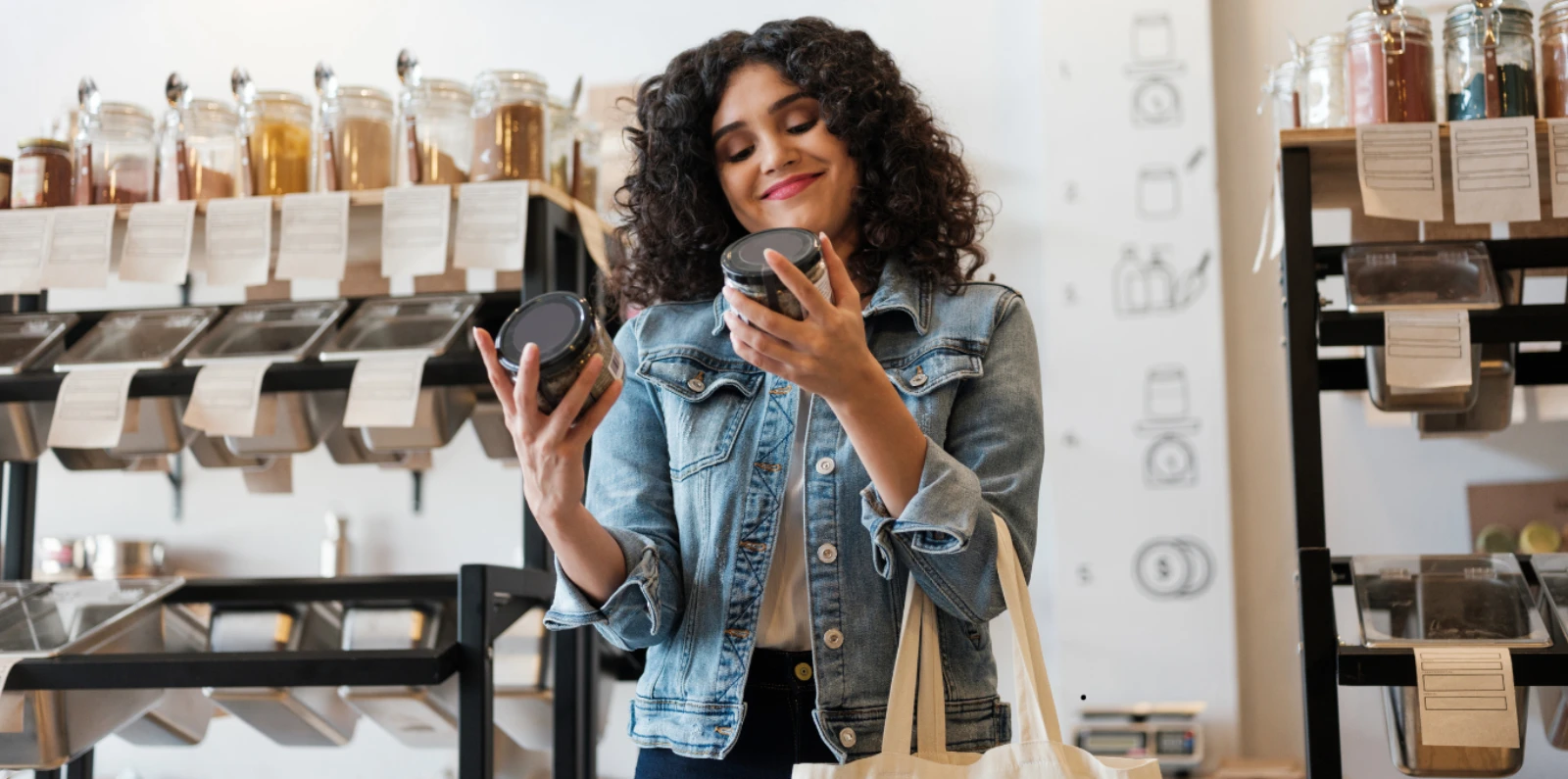

The word is granel, and English does not really have it. Say bulk to an English speaker and they picture a warehouse and a five-kilo sack. Say a granel in Barcelona and it means the exact opposite: 80 grams of saffron, three lentils if you insist, precisely what you need and not a gram more. That mistranslation is why visitors walk past a shop that has been selling this way since 1945 and end up in a supermarket buying quinoa wrapped in plastic.
The two systems, and which one you actually want
Barcelona runs two parallel models and they solve different problems. The traditional bulk trade, clustered in the Born, offers enormous range and competitive prices on staples, without everything being certified organic. The zero waste supermarkets, led by Yes Future in Sant Antoni, guarantee organic produce and plastic-free shopping with a fraction of the range and a higher price.
Where can you shop package-free in Barcelona? The Born holds the traditional bulk trade, with Jaime J. Renobell (Passeig Picasso 34) carrying nearly 2,000 lines since 1945. For certified organic with no plastic, Yes Future (Viladomat 66, Sant Antoni) opened in 2017 as Spain’s first zero waste supermarket. Both let you bring your own containers.
The essentials in 30 seconds
- The word — a granel means loose and by weight, not bulk quantity
- The oldest — Jaime J. Renobell, trading since 1945, around 2,000 lines
- The first zero waste — Yes Future, Sant Antoni, opened 2017
- The catch — loose does not mean organic, and neither means cheap
- The step nobody explains — ask for la tara so your jar is weighed empty
- The worst time — Saturday morning in the Born, roughly 10-minute waits
Loose, organic and cheap are three different things
Almost every sustainable-shopping list for Barcelona uses those three words as if they meant the same. They do not, and separating them decides which door you walk through.
Loose is a selling format: no packaging, you buy the exact amount. Organic is a farming method, certified by Catalonia’s CCPAE or the EU leaf, and entirely independent of how it reaches you — supermarket shelves are full of organic quinoa in plastic. Cheap is a third variable, and neither of the other two guarantees it.
All four combinations exist in the city. Loose but not organic covers much of the Born’s traditional range. Organic but packaged fills the bio chains. Organic and loose is the zero waste model. Conventional and packaged is the ordinary supermarket. According to experts in responsible consumption, the only reliable check is the certification on the individual product, never the sign above the door.
The practical fallout is simple. Walk into the Born expecting certified organic across the board and you will leave with less than you planned. Walk into a zero waste shop expecting 1945 prices and the till will surprise you. Each model does one thing well, and that is the comparison the listicles never make.
How to actually buy it, step by step
This is the part that intimidates people into skipping the shop entirely, and it takes about forty seconds to learn.
- Bring a container. Glass jar, cloth bag, bottle. If you forget, the shops sell reusables — but that defeats half the point.
- Ask for the tare first. Say “la tara, por favor” and hand over the empty container. They weigh it and record it.
- Take a number if there is one. In the Born this is standard, like a deli counter. Grab your ticket on the way in.
- Ask for the amount, not the packet. “Cien gramos de…” is a hundred grams of. Nobody blinks at small quantities. That is the point of the system.
- Pay for contents only. The tare is subtracted at the till, so the glass of your own jar is not charged at the price of the almonds inside it.
Without step two you are paying for your own jar by weight. It is the mechanism that turns zero waste from a gesture into arithmetic.
The words that get you served
| English | Spanish | Notes |
|---|---|---|
| Loose, by weight | a granel | The core phrase. Ask for it by name. |
| The tare | la tara | Weighing your empty container first |
| A hundred grams of | cien gramos de | Small amounts are normal, not rude |
| Half a kilo | medio kilo | 500 g, the common ask for pulses |
| Is it organic? | ¿es ecológico? | Bio and orgánico also work |
| Whose turn is it? | ¿quién es el último? | Or take the paper ticket if there is one |
The Born, 1945, and a market that no longer exists
Barcelona’s traditional bulk trade survives in a few blocks of the Born for a specific historical reason. This was the site of the Mercat del Born, the city’s central fruit and vegetable market, and the surrounding streets filled with food wholesalers. In 1972 the market closed and moved out to MercaBarna. Most of those shops went with it or simply vanished.
Jaime J. Renobell stayed. The family business started in 1945, when Jaime himself took over a nut wholesaler, and after the market closed it survived by diversifying into sweets and fairground toys sold to street traders, kiosks and chestnut sellers. In 1989 they bought the shop at Passeig Picasso 34, where the third generation now serves behind the counter with a dozen staff.
The range explains the reputation: close to 2,000 lines, including 18 kinds of white bean, 14 rices and 8 lentils, over a hundred nuts and dried fruits, spices, bread and pastry flours, seeds, honey and sweets. It is where Barcelona’s home bakers go, and the wall of breakfast cereals is why half the city’s food photographers have been through the door. Casa Perris, metres away on Plaça Comercial, covers the same ground with pulses, grains and spices.
Range, old versus new
| Model | Approx. product lines | |
|---|---|---|
| Traditional bulk (Renobell) | ~2,000 | |
| Zero waste supermarket (Yes Future) | ~300 |
The 1945 shop carries roughly six times the range of the modern zero waste supermarket. That is not a quality gap, it is a difference of purpose: one sells variety, the other sells a method.
Yes Future and the plastic-free supermarket
The opposite model opened in 2017 at Carrer de Viladomat 66 in Sant Antoni. Yes Future was the first zero waste supermarket in Barcelona and in Spain, won the city council’s Most Innovative Business award, and opened a second branch in Poblenou in 2019. It carries around 300 lines across food, drinks, cleaning and personal care, all organic and all either loose or in compostable packaging.
The problem it set out to fix is worth understanding, because it explains the format. Before it existed, a package-free weekly shop meant three separate trips: one shop for dry goods, another for drinks, another for detergent. Yes Future put them under one roof. According to experts who follow the sector, suppliers are filtered for small scale and cooperatives, and the tare system runs as standard on everything.
The trade-off is real and worth naming. You get certification and a complete shop with no plastic, and you pay for it, with less choice than the Born offers. That is a fair deal if what you want is the method. It is a bad deal if what you want is fourteen kinds of rice. Pair either with the design and local product shops guide for a fuller picture of how the city shops.
Comparison table of bulk and zero waste shops
| Shop type | Neighbourhood | What you’ll find | Best for | Limitation |
|---|---|---|---|---|
| Jaime J. Renobell | Born (Pg. Picasso 34) | ~2,000 lines, pulses, flours, nuts | Range and volume | Not all certified organic |
| Casa Perris | Born (Plaça Comercial) | Pulses, grains, spices | Classic loose trade | Smaller range than Renobell |
| Yes Future | Sant Antoni and Poblenou | ~300 lines, all organic, no plastic | A complete zero waste shop | Higher price, less choice |
| Neighbourhood granería | Gràcia, Sants, Sant Andreu | Pulses, grains, spices, teas | Regular shopping without the trek | Range varies by shop |
| Refill drugstore | Gràcia | Detergents, cleaning, personal care | Refilling cleaning bottles | No food |
| Organic supermarket | Eixample and citywide | Fresh, wine, frozen, certified | A certified weekly shop | Little or no loose section |
Mistakes to avoid
- Assuming the sign means the products. A shop can sell loose without being organic. Check the individual label.
- Skipping the tare. Without it you pay for the weight of your own jar. Two words fix it: la tara.
- Going Saturday morning. The Born counters are at their worst. Weekday afternoons are empty.
- Expecting bulk-buy prices. Certified organic loose usually costs more than packaged equivalents, not less.
- Using paper bags every visit. Single-use kraft has its own footprint. Glass and steel are the point.
- Being shy about small amounts. Asking for 50 grams is normal here. The whole system exists for that.
Hours, queues and getting there
Logistics decide more shopping trips than people expect, and here is the detail no shop window carries. Renobell runs a ticket-number system, like a deli. You take a number on the way in and wait. The average wait runs about 10 minutes, and Saturday morning is by far the worst, when the whole neighbourhood turns up at once.
Hours are 9:15am to 2pm and 4:15pm to 8pm, Monday to Friday, mornings only on Saturday. The sweet spot is a weekday at the 4:15pm reopening: empty counter, staff free to talk. And talking is worth it — they know the product cold, and that expertise is half of what you are buying.
For getting there, the Born sits between Jaume I (L4) and Barceloneta (L4), with Arc de Triomf (L1) close on the other side. Sant Antoni has its own L2 stop. Set the cost of the trip against a realistic daily budget by traveller type, and walk the neighbourhood afterwards with the Born walking route.
Storing what you buy
This is where zero waste falls apart at home. Buying unpackaged means losing the protective atmosphere of industrial packaging, so preservation becomes your job.
| Product | Container | Rough shelf life | Tip |
|---|---|---|---|
| Flours | Airtight glass | 6-12 months | Freeze 48h on arrival to kill pests |
| Nuts | Opaque glass or tin | 6-12 months | Refrigerate so the oils don’t turn |
| Pulses | Glass or cloth bag | Up to 1 year | Older ones need longer cooking, rotate stock |
| Coffee and tea | Opaque container | 6 months to 2 years | Whole beans hold aroma far better |
| Spices | Opaque glass | 1-2 years | Away from the hob and direct light |
The rule underneath all of it: glass and steel, not single-use biodegradable paper. The reusable container is the part of the system that actually cuts waste. Label with the purchase date and eat the oldest first, and you solve the other waste problem, the food one. For the city’s benchmark market experience, La Boqueria works differently.
Frequently asked questions about bulk shopping in Barcelona
What does a granel mean in Spanish shops?
Loose, unpackaged, sold by weight in whatever quantity you want. It is the opposite of the English sense of bulk buying: instead of a five-kilo sack, you can ask for 80 grams of saffron. The phrase to use at the counter is a granel, pronounced ah-grah-NEL.
Is everything sold loose in Barcelona organic?
No, and this trips up most visitors. Jaime J. Renobell has sold loose since 1945 with nearly 2,000 lines, but not all of it is certified organic. Loose describes the format; organic describes the farming method. A shop can be one, both or neither, so check the product not the sign.
How do I use my own container in a Barcelona zero waste shop?
Hand it over empty at the counter before filling. Staff weigh it, note the tare and subtract it at the till, so you pay only for contents. Ask for la tara. Without that step you pay for the weight of your own jar at the price of the food inside it.
Where is Spain’s first zero waste supermarket?
Yes Future, at Carrer de Viladomat 66 in Sant Antoni, Barcelona. It opened in 2017 as the first plastic-free supermarket in the city and the country, won the city council’s Most Innovative Business award, and added a second branch in Poblenou in 2019.
When should I visit the Born bulk shops to avoid queues?
Weekday afternoons, right at the 4:15pm reopening. Renobell runs a ticket-number system and Saturday morning is the worst slot, with waits around 10 minutes. It closes for lunch and opens 9:15am to 2pm and 4:15pm to 8pm Monday to Friday.
Learn one phrase and the system opens up. Walk in, say a granel, hand over your jar.
Barcelona will sell you exactly as much as you want, which is something most of Europe forgot how to do.