
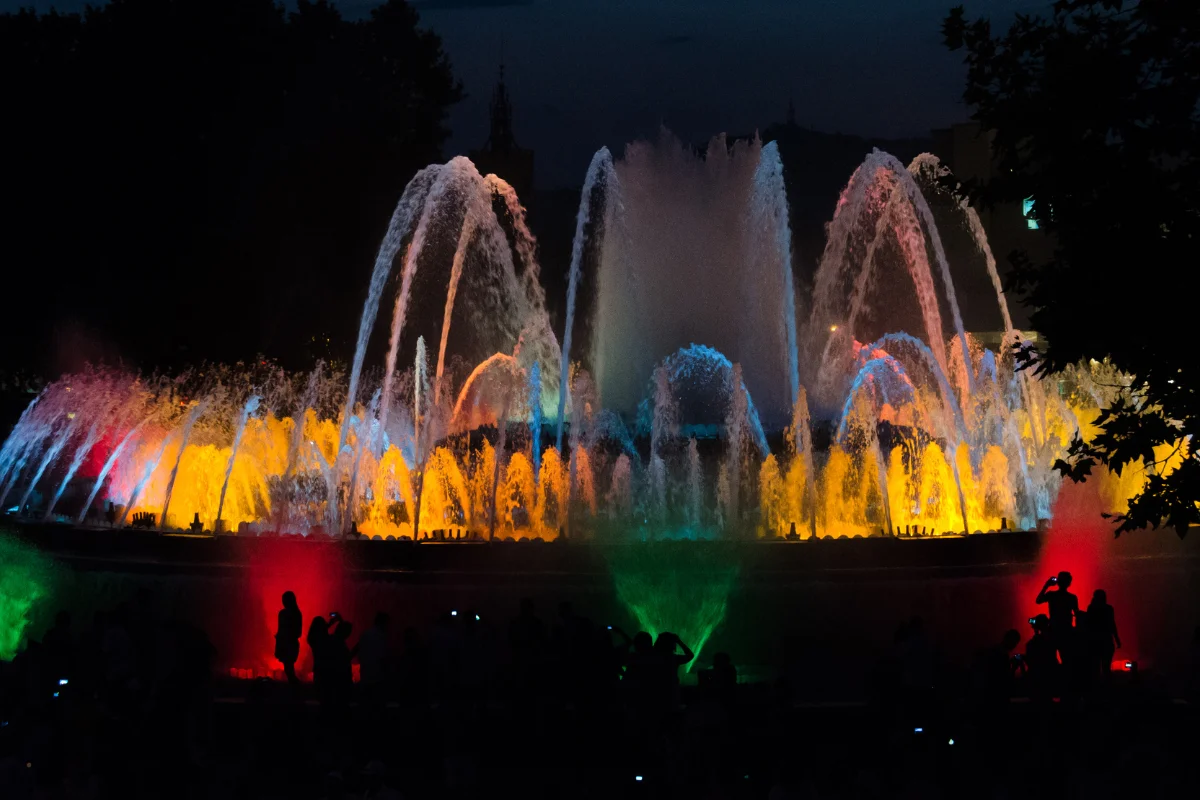

Barcelona has approximately 1,800 public fountains. The vast majority are functional water points with no story attached. The ones worth visiting each have a specific fact that makes them irreplaceable — the wrong attribution that every guide repeats, the medieval rite performed annually since the 14th century, the disciple of Gaudí nobody connects to the design.
This guide covers ten fountains with those facts — the ones that change how you see what you’re standing in front of.
Quick Answer: Best Fountains in Barcelona Most famous: Font Màgica de Montjuïc (free shows Thu–Sun, closed-loop water system). Most misattributed: Cascada del Parc de la Ciutadella (Gaudí did the plumbing, not the sculpture). Most overlooked: Fuente de la Plaza de España (designed by Gaudí’s closest disciple, Jujol). Oldest surviving: Font de Santa Anna (origin 1356, Gothic Quarter). Most atmospheric: Font de les Tres Gràcies, Plaça Reial (1878, young Gaudí designed the lampposts around it).
Quick Picks
- Best night visit → Font Màgica de Montjuïc (free shows, illuminated, musical)
- Best hidden gem → Font de Sant Just (oldest continuously running fountain, 1367, almost no tourists)
- Best for architecture context → Fuente de la Plaza de España (Jujol, ignored by most)
- Best medieval story → Font de Santa Anna (1356 origin, novecentista ceramics added in 1918)
- Best for photography → Font de les Tres Gràcies in Plaça Reial (palm trees, porticoed buildings)
- Most surprising technical fact → Font Màgica (moves 7 billion litres a year, consumes almost none)
Which Option Should You Choose?
- First time in Barcelona, want the spectacle → Font Màgica, Thursday to Sunday evenings, free
- Interested in Gaudí → Cascada del Parc de la Ciutadella (he did the hydraulic engineering) + Plaça Reial lampposts (early commission)
- Following a Gothic Quarter walking route → Font de Santa Anna + Font de Sant Just + Font de la Portaferrissa + Font de les Tres Gràcies (under 20 minutes on foot)
- Want the least-visited fountain with the most history → Font de Sant Just, Plaça de Sant Just (650+ years of continuous operation, almost no tourists)
- Looking for a medieval ritual → Plan around Corpus Christi for the ou com balla at the Cathedral cloister
- Interested in urban design → Font d’Hèrcules on Passeig de Sant Joan (Jujol, 1929, Eixample’s most sculptural street furniture)
Font Màgica de Montjuïc — 7 Billion Litres That Cost Almost Nothing
Carles Buïgas designed the Font Màgica for the 1929 International Exposition with a proposal that initially generated scepticism: synchronise water, light, and colour at an unprecedented scale. The result became the most-visited fountain in southern Europe — over 2.5 million visitors annually — and the first large-scale installation of what is now called kinetic water art.
The fact every guide omits: the Font Màgica moves over 7 billion litres of water per year, but actual consumption is minimal. The system operates with underground tanks that collect water after each show, filter it, and return it to the circuit. Almost everything is recycled. The apparent extravagance is, technically, an optical illusion.
The restoration completed in 2025 — the most significant in decades — replaced the lighting with 4,760 LED spotlights enabling instantaneous musical synchronisation, partially powered by solar energy. The choreographed soundtrack was added in the 1980s to deepen the spectacle.
Current schedule (verify before visiting — varies by season): Thursday to Sunday. High season (June–September) adds Wednesday. Approximate times between 20:00 and 22:00 depending on month. Free entry.
Getting there: Metro Espanya (L1, L3). The fountain is at the far end of Avinguda de la Reina Maria Cristina, visible from the square. The Montjuïc Castle guide covers the full hill — the castle and the Font Màgica are on the same route.
📍 Plaça de Carles Buïgas, Sants-Montjuïc.
Cascada del Parc de la Ciutadella — What Gaudí Actually Did Here
The Cascada was designed by Josep Fontserè between 1875 and 1888. It is monumental — triumphal arch, Venus sculptures, quadrigas, stone waterfall — and directly inspired by Roman classical style.
Antoni Gaudí’s involvement, as a student at the time, was in the hydraulic system: the water distribution engineering, the conduits, the pressure of the jets. Not the sculpture. Not the architectural composition. It is his first documented intervention in a public work, but it is not what you see visually when standing in front of the cascade.
The claim that “Gaudí designed the Cascada” is inaccurate. What he designed was the plumbing that makes it function. That distinction matters both for understanding Gaudí’s early career and for understanding what Fontserè actually built.
The park surrounding the cascade is free access daily. The cascade is in the northeast corner.
📍 Parc de la Ciutadella, Sant Pere / La Ribera. Metro Arc de Triomf (L1) or Ciutadella-Vila Olímpica (L4).
Fuente de la Plaza de España — Gaudí’s Disciple and the Rivers of Spain
In the centre of Plaza de España stands a 33-metre fountain that most visitors walk past without looking up because the square is a traffic junction and attention goes to the Venetian towers and the Palau Nacional beyond.
The designer is Josep Maria Jujol — Gaudí’s closest disciple, the same architect responsible for the undulating benches of Park Güell. The fountain was commissioned for the 1929 Exposition with an explicit iconographic programme: four sculptural groups representing Spain’s rivers — the Ebro to the east (a youth with an Aragonese headscarf), the Tagus and the Guadalquivir to the south, and the Nervión with children to the west. The central body has three Corinthian columns symbolising Religion, Heroism, and the Arts.
At the base, six cartouches carry the inscription Senatus Populusque Barcinonensis — Barcelona’s version of Rome’s SPQR, same Latin structure, different city name.
The sculptural groups are by Miguel Blay and the Oslé brothers. Jujol’s contribution was the architecture.
📍 Plaça d’Espanya, Sants-Montjuïc. Metro Espanya (L1, L3).
Font de Canaletes — The Real Origin of the Football Tradition
The Font de Canaletes on Las Ramblas was designed by municipal architect Pere Falqués in 1892. It is a cast-iron fountain-lamppost with four jets and the Barcelona city shield on top. The design was successful enough that the city commissioned around 15 replicas distributed across different neighbourhoods — anyone wanting a Canaletes fountain without the tourist crowds can find identical versions in Eixample and Sant Antoni.
The legend that anyone who drinks from it will return to Barcelona is why it appears in every guide. The FC Barcelona celebration tradition is why local residents know it. The origin of that football ritual is more prosaic: in the 1930s, the sports newspaper La Rambla posted match results on a board outside its offices, directly beside the fountain. Fans gathered to read the scores. The meeting point consolidated organically — not by any deliberate decision.
The Canaletes kiosk, operating since 1878 as a social gathering space, sits alongside.
📍 La Rambla (corner Plaça de Catalunya), Gothic Quarter.
Font de Santa Anna — The Oldest Fountain, with Ceramics Added 562 Years Later
On Carrer de la Cucurulla, one minute from Plaça de Catalunya, stands a hexagonal stone fountain whose current form dates to 1819 — but the original fountain on this site was inaugurated in 1356, making it the oldest in the city to retain its function.
The original was conceived as a drinking trough for horses and mules moving toward the medieval wall. The 1819 reform gave it the hexagonal stone form visible today. In 1918, decorated ceramic panels were added by urbanist and ceramist Josep Aragay — feminine figures and garlands in novecentista style that contrast visibly with the medieval solidity of the structure.
The cloister of the adjacent Santa Anna Church has its own interior fountain in a Gothic garden — one of the quietest spaces available within 200 metres of the pedestrian chaos of Portal de l’Àngel.
📍 Carrer de la Cucurulla, Gothic Quarter.
Font de Sant Just — Oldest Continuously Running Fountain in the City
In Plaça de Sant Just, less than 100 metres from the City Hall, stands a Gothic fountain with three mascarons and the Crown of Aragon shield dating to 1367. It is the oldest fountain in Barcelona in continuous operation from its original installation — which means over 650 years of water flowing through the same spouts.
In front of it stands the Basílica de Sant Just i Pastor, one of the least-visited Gothic churches in the old city. The combination of a medieval fountain and a Gothic basilica facade in the same small, quiet square is one of the densest concentrations of historical continuity available anywhere in central Barcelona.
📍 Plaça de Sant Just, Gothic Quarter.
This square is a natural stopping point on any Barcelona walking route through the Gothic Quarter — it sits between the Cathedral and the Born without appearing on most tourist itineraries.
Font de la Portaferrissa — The Tiles That Show a Vanished City
On Carrer de la Portaferrissa, between Las Ramblas and the Gothic Quarter, a fountain carries a painted tile panel depicting neighbourhood life in the 18th century. The image shows the medieval gateway that stood on this exact spot — the Portaferrissa, or iron-gate door — with the market that operated at its base.
The tile panel was commissioned in the 20th century as a visual reconstruction of medieval life, not an original 18th-century work. But the scene it depicts — the gateway, the market stalls, the movement of the walled city — is the most accessible visual documentation of what this point looked like before the walls disappeared. It is a painted map of a city that no longer exists, attached to a fountain that is still running.
📍 Carrer de la Portaferrissa, Gothic Quarter.
Font de les Tres Gràcies — Three Goddesses Between Palm Trees
The Plaça Reial holds at its centre an 1878 cast-iron neoclassical fountain with three female figures representing Aglaia, Euphrosyne, and Thalia — the Three Graces of Greek mythology, goddesses of charm, creativity, and fertility. The surrounding square was designed by Francesc Daniel Molina and opened in 1848 over the site of the former Capuchin convent.
The lampposts flanking the fountain are an early commission of the young Gaudí — one of the first public works he completed. Tall palms, porticoed buildings, the illuminated fountain: the most Mediterranean composition available in the heart of the city after dark.
📍 Plaça Reial, Gothic Quarter. The best live music bars in Barcelona guide covers the Jamboree jazz club on the same square — the fountain and a late-night concert work naturally as a single evening.
Font d’Hèrcules — Jujol Again, in the Eixample
At the corner of Passeig de Sant Joan and Carrer de Còrsega stands a bronze Hercules figure designed by Josep Maria Jujol in 1929 — the same year as his Plaza de España fountain. The figure with its club is the most directly mythological piece of street furniture in the Eixample.
Passeig de Sant Joan has several ornamental fountains along its length, making it the tree-lined boulevard with the highest density of historical fountain design outside the old city.
📍 Corner of Passeig de Sant Joan and Carrer de Còrsega, Eixample.
The Ou Com Balla — A Medieval Ritual Performed Every Corpus Christi
Every year during Corpus Christi, several historic cloisters and patios in Barcelona perform the ou com balla (the dancing egg): an empty eggshell is placed over the jet of a fountain decorated with flowers and fruit, and the egg spins and holds its position on the water column without falling. It is an allegory of the Eucharist documented since the 14th century and considered an exclusively Barcelonan tradition.
Locations include the Cathedral cloister, the Museu Frederic Marès at Plaça de Sant Iu, the Casa de l’Ardiaca adjacent to the Cathedral, the Museu Marítim in the Drassanes, and the cloister of the Monestir de Pedralbes. The Cathedral cloister fountain is guarded year-round by thirteen white geese — one for each year of Santa Eulàlia’s life according to tradition.
This ritual has been running for over 600 years without interruption. It is one of the few medieval practices still performed in a major European city exactly as documented in its original sources.
Mistakes to Avoid
- Visiting the Font Màgica on a Tuesday or Wednesday in low season. Shows run Thursday to Sunday from October to May. Wednesday is added only in high season (June–September). Always verify the current schedule on the city website before making it the reason for an evening trip.
- Assuming Gaudí designed the Cascada del Parc de la Ciutadella visually. He engineered the water system. The sculptures and architectural composition are Fontserè’s. Repeating the wrong attribution means misreading both architects’ contributions.
- Walking past the Plaza de España fountain without stopping. It is the most underlooked monumental fountain in the city — Jujol’s iconographic programme with the Latin inscription is visible at ground level in under five minutes.
- Missing the Font de Sant Just entirely. It is not on most tourist maps. It is 100 metres from City Hall and has been running continuously since 1367. The quietest Gothic square in the centre.
- Planning for the ou com balla without checking the Corpus Christi date. The festival moves each year (late May or June). All participating venues confirm their specific times in the week before.
- Confusing Font de Canaletes with the actual FC Barcelona connection. The club itself has no formal relationship with the fountain — the tradition formed around a nearby newspaper office in the 1930s.
Fountain Walking Route: Gothic Quarter in Under 30 Minutes
The five Gothic Quarter fountains — Santa Anna, Sant Just, Portaferrissa, Tres Gràcies, and Canaletes — form a walkable circuit under 20 minutes that can be combined with any old-city itinerary. The Barcelona complete travel guide has the routing framework for combining architecture, markets, and specific sites in the same area without backtracking.
For the Montjuïc fountains — Font Màgica and the Plaza de España fountain — both sit on the same avenue and can be combined in a single afternoon before an evening show. The Montjuïc Castle guide covers the full hill programme.
For the Ciutadella Cascade, the best Barcelona walking streets guide maps the route from El Born through the park — combining the Born neighbourhood, Santa Maria del Mar, and the cascade in a natural sequence.
Frequently Asked Questions
When do the Font Màgica shows run in Barcelona?
Thursday to Sunday year-round, with Wednesday added in high season (June–September). Approximate show times between 20:00 and 22:00 depending on the month. Always verify the current schedule on the Barcelona city website before visiting — it adjusts seasonally.
What is the oldest fountain in Barcelona?
The Font de Santa Anna on Carrer de la Cucurulla, with an origin of 1356. The Font de Sant Just in Plaça de Sant Just (1367) is the oldest in continuous operation from its original installation — over 650 years of uninterrupted function.
What did Gaudí actually design in the Ciutadella Cascade?
The hydraulic system — the water distribution engineering, conduits, and jet pressure. Not the sculptures or the architectural composition, which are Josep Fontserè’s work. It is Gaudí’s first documented contribution to a public project, made while he was still a student.
Why do Barcelona fans celebrate at Font de Canaletes?
The tradition started in the 1930s when the sports newspaper La Rambla posted match results on a board outside its offices beside the fountain. Fans gathered to read scores. The meeting point consolidated naturally. FC Barcelona has no formal connection to the fountain.
Does the Font Màgica waste a lot of water?
No. It moves over 7 billion litres per year but operates on a closed-loop system — underground tanks collect, filter, and recirculate the water after each show. Actual consumption is minimal. The 2025 renovation also added LED lighting partly powered by solar energy.
What is the ou com balla and where does it happen?
A Corpus Christi ritual documented since the 14th century: an empty eggshell dances on a fountain jet decorated with flowers without falling. It takes place at the Cathedral cloister, Museu Frederic Marès, Casa de l’Ardiaca, Museu Marítim, and Monestir de Pedralbes. It is considered an exclusively Barcelonan tradition still performed annually.
Continue the Visit
The Barcelona festivals calendar covers Corpus Christi in context alongside the city’s other major annual events — useful if you’re timing a visit around the ou com balla.
For anyone building a day around El Born and the Ciutadella park, the best cafes in Barcelona guide includes several options within the Born neighbourhood that work well before or after the cascade walk.
An empty eggshell spinning on a Gothic fountain jet without falling. That image has been produced in Barcelona every Corpus Christi since the 14th century — quietly, in the same courtyards, without anyone making much of a fuss about it.