
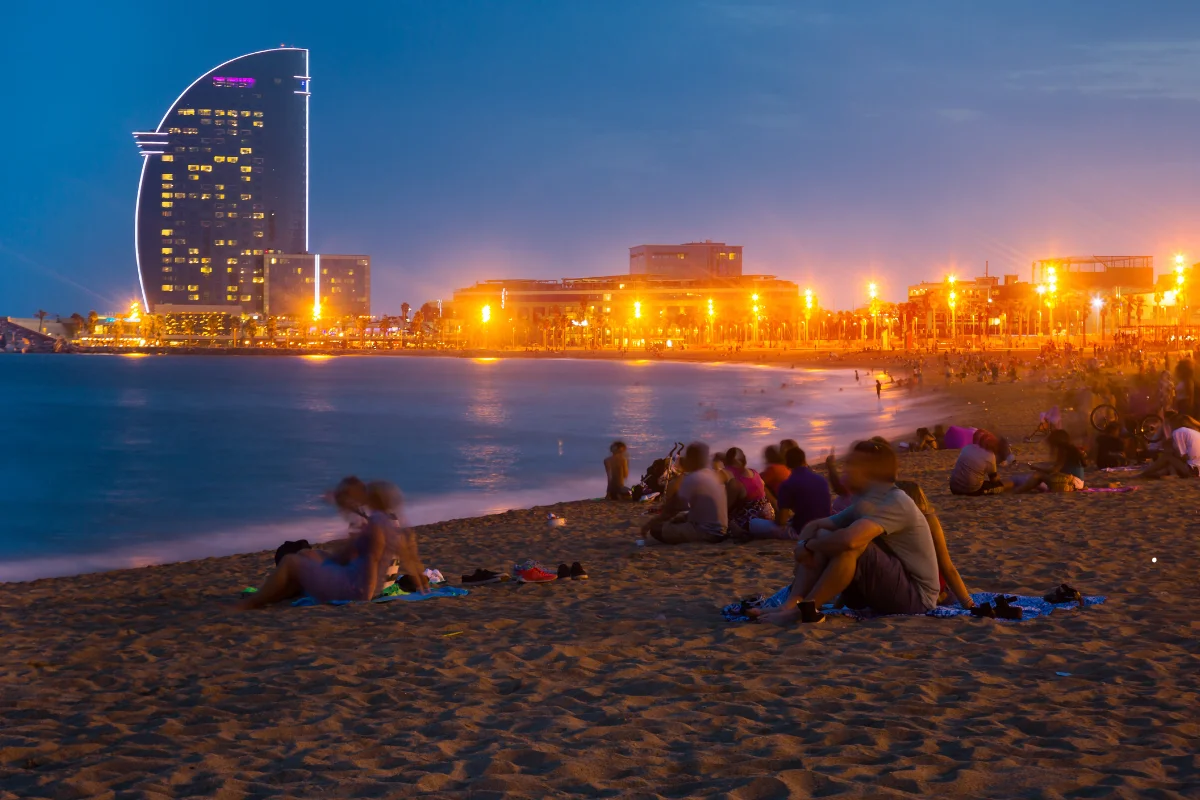

La Barceloneta did not exist until 1753. Before that, the people who would eventually live here were squatting in shacks on the harbour sandbanks, displaced residents of the Ribera neighborhood that had been demolished to make room for the Ciutadella fortress after the military defeat of 1714. They waited 39 years for the Marquis of La Mina to commission engineer Juan Martín Cermeño to design a replacement, but the new neighborhood came on military terms. The orthogonal street grid was defensive not aesthetic, building height was restricted to ground floor plus one storey so the Ciutadella’s cannons maintained an unobstructed firing line toward the sea, and the regularity of the blocks responded to a specific political moment that still shapes the streetscape 270 years later.
The military DNA that shaped the entire neighborhood
The street geometry of La Barceloneta is the most legible piece of 18th-century military urbanism still functioning as a residential neighborhood in Europe. Cermeño’s plan applied the same engineering logic used in fortified colonial settlements across the Spanish empire, with uniform block dimensions, fixed street widths and a strict hierarchy between primary axes and secondary streets. According to urban historians who study the founding of Spanish coastal neighborhoods, La Barceloneta represents one of the rare cases where a military engineering grid survived intact as a working civilian district into the modern era.
The height restriction created the neighborhood’s physical DNA. For the first century, the rule held. Then 19th-century densification began adding upper floors illegally and eventually with municipal tolerance, which is why most blocks today reach four or five storeys despite the original limit. The only original 18th-century building surviving intact at Carrer de Sant Carles 6 is the visual control sample for what the entire neighborhood was supposed to look like permanently. It is a single building of ground floor and one storey, low and narrow, sitting in a street where everything else around it has risen above the historical cap.
The two cable cars that keep getting confused
The two cable cars associated with La Barceloneta are not the same cable car, and the two are routinely mixed up. The Aeri del Port departs from the Torre de Sant Sebastià at the southern end of the neighborhood and crosses the harbour to Montjuïc, designed by Carles Buigas for the 1929 International Exhibition. The Montjuïc cable car operates exclusively within the mountain from the Parc de Montjuïc station to the Castell, rebuilt in 2007. They were built 41 years apart, serve different routes and arriving at the wrong tower can cost an entire afternoon.
Beyond the cable car confusion, three more things worth knowing. The Mercat de la Barceloneta was redesigned in 2007 with photovoltaic panels that generate 40 percent of the building’s energy consumption, making it one of the few 19th-century European markets with documented partial energy self-sufficiency. La Torre del Rellotge from 1772 is not just decorative architecture, Pierre Méchain used it in 1792 as the southern reference point to measure the meridian arc between Dunkirk and Barcelona that defined the original length of the metric metre. And the public art on the seafront (Gehry’s Peix and Horn’s L’Estel Ferit) was installed not as decoration but as commentary on the displacement and Olympic transformation that created the modern coastline.
What should you actually do in La Barceloneta? Visit the Barceloneta beach via metro L4 (Barceloneta stop), the Museu d’Història de Catalunya for its panoramic rooftop terrace, the Mercat de la Barceloneta from 1884, La Cova Fumada for the original bomba at Carrer del Baluard 56, the Aeri del Port cable car from Torre de Sant Sebastià crossing the harbor in historic red cabins, the Peix Dorado sculpture by Frank Gehry beside the Hotel Arts, and the Torre del Rellotge from 1772 with its scientific connection to the metric system. Half a day covers the essentials.
The beach before 1992 and what changed
The Barceloneta beach as a public recreational space did not exist before 1992. For most of the 20th century the shoreline was an industrial front with factories, railway tracks and warehouses between the neighborhood and the sea. The transformation required for the Olympic Games buried the railway, removed the industrial infrastructure and redesigned the coastline as public space. The neighborhood and the beach were only connected as we know them today after that intervention.
Today the central beach is the most accessible urban beach in Barcelona via metro L4, with full services including showers, lifeguards, equipment rental and adapted access, but it is also the highest-density coastal point in the city during peak season. According to coastal management data from the Ajuntament de Barcelona, between July and August the central stretch can exceed 1.2 persons per square metre between 12:00 and 16:00, which is the threshold for what coastal planners classify as overcrowding. The adjacent beaches of Somorrostro to the north (toward Port Olímpic) and Sant Sebastià to the south (toward the port) connect along the same Passeig Marítim and consistently show lower density readings.
For visitors planning around the beach, the best windows are before 10:00 or after 19:00 in peak season. The shoulder months of May, June, September and October offer the best combination of swimmable water temperature (consistently 19-23°C in the Mediterranean Barceloneta stretch) and manageable crowd density. The best time to visit Barcelona guide breaks down the seasonal trade-offs for the coast specifically.
Is La Barceloneta worth a dedicated visit
Yes, if you approach it as a neighborhood with archaeological layers rather than as the access point to a beach. The beach is the reason most people come, and it is genuinely a good urban beach in the right conditions. But treating La Barceloneta as only a beach misses the only orthogonal urban grid in Barcelona designed by military engineers, the oldest functioning cable car crossing in the city’s port, the bar where the most-copied tapa in Barcelona was invented in 1944, and two pieces of public art doing something significantly more interesting than decoration.
It is not worth the visit if your plan is to spend the central hours of a peak summer day on the central beach. Between July 15 and August 31, between 12:00 and 16:00, the experience is closer to an endurance test than a pleasure. The combination of maximum heat, maximum density and the urban setting that amplifies both make it the worst possible time window for a first encounter with the neighborhood. Come earlier in the day, later in the day, in September, or come for the neighborhood itself rather than the sand.
La Cova Fumada and the documented origin of the bomba
The bomba is the most-copied tapa in Barcelona, a ball of mashed potato filled with minced meat, breaded, fried and served with alioli and a hot tomato-based sauce. It appears on menus across the neighborhood and across the city. The original was created by María Pla at La Cova Fumada in 1944, and the recipe has remained essentially unchanged since then. According to gastronomic historians who document Catalan working-class cuisine, the bomba is one of the few Barcelona tapas with a fully documented single-restaurant origin.
The visit to La Cova Fumada at Carrer del Baluard 56 is part of the dish. The bar has no sign on the door, no printed menu, payment is cash only, tables are shared, the day’s offerings appear on a chalkboard, there are no reservations and the kitchen closes when the food runs out (typically before 15:00). Three other establishments cover the rest of the local gastronomic spectrum.
- La Cova Fumada (Carrer del Baluard 56) — documented origin 1944, María Pla’s exact recipe, cash only, lunch hours only
- La Bombeta (Carrer de la Maquinista 3) — four decades of its own version, exclusively pork mince, considers beef a deviation
- Can Solé (Carrer Sant Carles 4) — open since 1903, the oldest seafood restaurant in the neighborhood, paella negra speciality
- Can Ganassa (Plaça de la Font 1) — bridge between tradition and Mediterranean cuisine, paellas and rice dishes with market produce
- 7 Portes (Passeig Isabel II 14, adjacent) — Catalan cuisine since 1836, paella Parellada is their documented in-house creation
The general rule for value: every block away from the Passeig de Joan de Borbó the quality-to-price ratio improves. Menus on the main promenade run 25-35 euros, the equivalent at interior streets runs 12-18 euros for comparable quality.
Public art with biographical and historical context
The three pieces of public art on the Barceloneta seafront work as commentary on the displacement and transformation that created the modern neighborhood. Each rewards the visitor who reads the context before photographing it.
The Peix Dorado by Frank Gehry
The 56-metre golden fish sculpture beside the Hotel Arts was designed for the 1992 Olympic Games. The stainless steel mesh scales respond to changing sunlight, the piece looks different at noon than at 17:00 in October. Gehry described it as a reference to the maritime character of the neighborhood and as a sculptural counterpoint to the Olympic skyline being built simultaneously. The best photographic window is the late afternoon between 19:00 and 20:30 in summer when oblique western light hits the scales at the angle that maximises the colour shift.
L’Estel Ferit by Rebecca Horn
The four stacked metal cubes at the shoreline are commonly known as “Los Cubos”. The visual instability of the structure is deliberate. Horn lived in Barcelona in 1964 and suffered serious lung disease from working with fibreglass without respiratory protection during her studies. The stacked cubes evoke the wooden chiringuito structures that stood on this same shoreline before being demolished for the Olympic project, and the apparent fragility of the piece reflects both her biographical experience and the impermanence of what stood here before.
The Torre del Rellotge
The 1772 clock tower built as the first lighthouse of the Barcelona port has a scientific footnote worth the detour. Pierre Méchain used it as a southern reference point in 1792 to measure the meridian arc between Dunkirk and Barcelona, and that measurement was the basis for calculating the original length of the metre as a unit of measure. The tower is also the geometric intersection point of the Paral·lel and Meridiana avenues in Cerdà’s 1860 Eixample plan. The Barcelona first-time visitor guide places this kind of layered historical detail in the broader navigation of the city.
The Museu d’Història de Catalunya and the panoramic terrace
The museum occupies the Palau de Mar, a 19th-century portuary warehouse rehabilitated for the 1992 Olympic Games. The permanent exhibition covers Catalan history from prehistory to the present across four floors and approximately 4000 square metres, with multimedia installations. The adult ticket is 4.50 euros, free on the first Tuesday of each month from 14:00 and every Sunday from 15:00.
For visitors with limited time, the permanent collection can be treated as optional. The rooftop terrace on the fourth floor is not. It has a café and direct views over the marina, the working port and the Barceloneta neighborhood from above, and it is independently accessible from the museum ticket (consumption minimum applies). According to travel planners who design walking itineraries through the maritime district, the terrace is one of the few free panoramic vantage points in central Barcelona that combines harbour, neighborhood grid and Mediterranean horizon in a single visual frame. The best things to see in Barcelona guide sequences this viewpoint in the optimal first-day order alongside Montjuïc and the Sagrada Família.
The Aeri del Port and the cable car confusion
The Aeri del Port is the more interesting cable car experience from La Barceloneta. Designed by Carles Buigas for the 1929 International Exhibition and inaugurated in 1931, it departs from the Torre de Sant Sebastià at 78 metres and crosses 1292 metres over the harbour to Montjuïc, with an intermediate stop at the Torre Jaume I at 107 metres. The two historic red cabins each carry around 20 passengers and the crossing offers visual perspectives of the port, the city skyline and the Olympic seafront unavailable from any ground-level position.
| Feature | Aeri del Port | Montjuïc Cable Car |
|---|---|---|
| Inauguration | 1931 | 1970 (rebuilt 2007) |
| Route | Barceloneta to Montjuïc | Parc Montjuïc to Castell |
| Distance | 1292 m over harbour | 750 m inside the mountain |
| Main towers | Sant Sebastià (78m), Jaume I (107m) | Multiple stations |
| Cabins | 2 historic red cabins (20 pax) | 55 modern gondolas (8 pax) |
| Adult one-way fare | 12.50 € | 9.40 € |
| Best for | Unique harbour views | Reaching Castell de Montjuïc |
| Limitations | Closes with strong winds | High frequency, no restrictions |
The two cable cars are commonly confused because both end in Montjuïc, but they serve different purposes. The Aeri del Port is a panoramic harbour experience starting from La Barceloneta. The Montjuïc cable car is a mountain transport for visitors continuing from the Parc de Montjuïc up to the Castell. Arriving at the wrong tower means a significant walk or a taxi, and the Aeri del Port closes in strong wind conditions with no advance notice.
The Mercat de la Barceloneta and the market as social space
Founded in 1884 and renovated by architect Josep Miàs in 2007, the Mercat de la Barceloneta preserves the original wrought-iron structure (damaged during the Spanish Civil War) and incorporates photovoltaic panels generating 40 percent of the building’s energy consumption. It is one of the few 19th-century European markets with documented partial energy autonomy and one of the cleanest examples in Spain of heritage-respectful sustainable renovation.
For visitors who have experienced the Boqueria and found it overwhelming with tourism, the Barceloneta market is the functional alternative most never discover. It serves the neighborhood as an actual market, not as a tourist food hall. The fish and seafood specialisation reflects the maritime history and the still-operating Barceloneta fishing community, and the market bars serve tapas and vermouth at local prices: vermouth plus a tapa runs 4-6 euros, the daily plate runs 9-14 euros. Opening hours run Monday to Saturday 7:00 to 14:30, with extended Thursday hours from 17:00 to 20:30.
Best strategy for the visit
Three scenarios cover most useful itineraries through La Barceloneta. Each is designed around the constraints of the neighborhood rather than a generic checklist.
- Half day (4 hours) → Start at the Museu d’Història de Catalunya and climb to the panoramic terrace. Walk toward the Torre del Rellotge. Enter the neighborhood interior via Carrer de Sant Carles and visit the Iglesia de Sant Miquel del Port. Stop at the Mercat de la Barceloneta if open. Continue to La Cova Fumada for the bomba at lunch (arrive before 14:00 minimum). Walk the Passeig Marítim to the Peix Dorado. End at the Torre de Sant Sebastià for the Aeri del Port view.
- Full day (8-10 hours) → Add the Aeri del Port harbour crossing, the Barceloneta beach in the early morning or late afternoon, and dinner in the neighborhood interior. Combine with the Eixample neighborhood guide for the urban contrast between Cerdà’s grid and Cermeño’s military grid.
- Architecture day → La Barceloneta morning (military urbanism), Eixample afternoon (Cerdà’s rational expansion), comparing the two grids in sequence. This is the single most pedagogically clear way to understand 250 years of Barcelona urban planning in one day.
Mistakes to avoid in La Barceloneta
Five mistakes appear repeatedly in over-budget or under-rewarding visits to the neighborhood. All five are avoidable with minimal advance planning.
- Confusing the two cable cars — arriving at the wrong tower means a significant walk or a taxi. The Torre de Sant Sebastià is at the southern end of the Barceloneta. The Montjuïc cable car departs from the Parc de Montjuïc, not from the beach
- Going to La Cova Fumada after 15:00 — the kitchen closes when food runs out. Arriving at 14:45 is too late on most days. Plan lunch around it, not the other way around
- Eating on the Passeig de Joan de Borbó because it is the first thing you see — the promenade restaurants are visually dominant and price-premium. The interior streets have better food at lower prices, with the quality-to-price ratio improving every block away from the main promenade
- Visiting the Museu d’Història de Catalunya without checking the terrace access — the terrace is the primary reason to enter for most visitors. If a private event restricts access, the visit calculus changes
- Treating the Barceloneta beach as the entire neighborhood — the beach is the most-crowded part. The neighborhood is the grid of streets behind it, with the market, the bombas, the military history and the cable car tower
A sixth less visible mistake is underestimating the time required to reach the Torre de Sant Sebastià from the metro exit. The walk through the neighborhood is around 12 minutes and the Aeri del Port has limited daily capacity, with queues of 30-45 minutes common in peak season. The Barcelona safety guide covers how the Passeig de Joan de Borbó behaves at different times of day for pickpocketing patterns.
La Barceloneta in 2026
In 2026 La Barceloneta is operating under the tightest tourism regulation framework in its modern history. Municipal restrictions on tourist apartments have reduced informal accommodation supply by approximately 15 percent compared to 2024 according to figures released by the Ajuntament de Barcelona, and terrace operating hours on the Passeig de Joan de Borbó have been formally limited. The tourist tax applicable in the neighborhood ranges from 3.50 to 8.50 euros per person per night depending on accommodation category, in line with the rest of Barcelona.
The major event of the year, Barcelona being designated UNESCO World Capital of Architecture, includes official guided tours of La Barceloneta as a documented example of 18th-century military urbanism converted into a working maritime neighborhood. The Museu d’Història de Catalunya has extended its operating hours and is proposing specific exhibitions tied to the centenary of Gaudí’s death and the closing chapter of the Sagrada Família construction. Hospitality prices in the neighborhood have risen between 8 and 12 percent over 2025 according to official sources, with the most visible effect on the main promenade menus.
Frequently asked questions about La Barceloneta
What is La Barceloneta known for in Barcelona?
La Barceloneta is the orthogonally planned maritime neighborhood founded in 1753 after the 1714 military defeat. It hosts the most accessible urban beach in Barcelona via metro L4, the historic Aeri del Port cable car from 1931, the Mercat de la Barceloneta from 1884, La Cova Fumada where the bomba was invented in 1944, the Frank Gehry 56-metre Peix Dorado sculpture, and the only 18th-century building still intact at Carrer de Sant Carles 6.
Is La Barceloneta safe for tourists?
Yes with standard precautions. Pickpocketing exists in crowded areas like the metro exit, the Passeig de Joan de Borbó and the central beach during peak season. Keep bags at the front, phone secured in beach areas, attention in central terraces during summer. The neighborhood interior is safe at all hours. The beach strip in July and August between 11:00 and 17:00 is the highest density zone.
Where can I eat the original bomba in La Barceloneta?
La Cova Fumada at Carrer del Baluard 56 is where María Pla created the bomba recipe in 1944. No exterior sign, no reservations, cash only, lunch hours only and closes when food runs out (usually before 15:00). La Bombeta at Carrer de la Maquinista 3 has its own version for 40 years using strictly pork mince. Can Solé at Carrer Sant Carles 4 has been open since 1903.
What is the difference between the Aeri del Port and the Montjuïc cable car?
The Aeri del Port (1931) departs from Torre de Sant Sebastià in La Barceloneta at 78 metres and crosses 1292 metres over the harbour to Montjuïc in two historic red cabins of 20 passengers each. The Montjuïc cable car (1970, rebuilt in 2007) operates only inside the mountain between the Parc de Montjuïc and the Castell in 55 modern gondolas. They are different infrastructures with different routes.
How much time do I need to visit La Barceloneta?
Half a day (4 hours) covers the essentials, the beach, the museum terrace, the Aeri del Port and a meal inside the neighborhood. A full day adds the Port Vell, the Parc de la Barceloneta and the complete gastronomic route with the bomba at La Cova Fumada and La Bombeta. In peak season avoid the central beach hours between 11:00 and 17:00.
When is the best time to visit La Barceloneta beach?
Before 10:00 or after 19:00 in July and August. The central beach stretch is unmanageable between 11:00 and 17:00 in peak summer due to crowd density. May, June, September and October offer the best combination of swimmable water temperature and manageable density. The neighboring Somorrostro (north) and Sant Sebastià (south) beaches connect along the same promenade with lower density.
La Barceloneta is not the beach the tourist photographs. It is the barracks the orphan of the Ribera photographed in his memory 250 years before.