
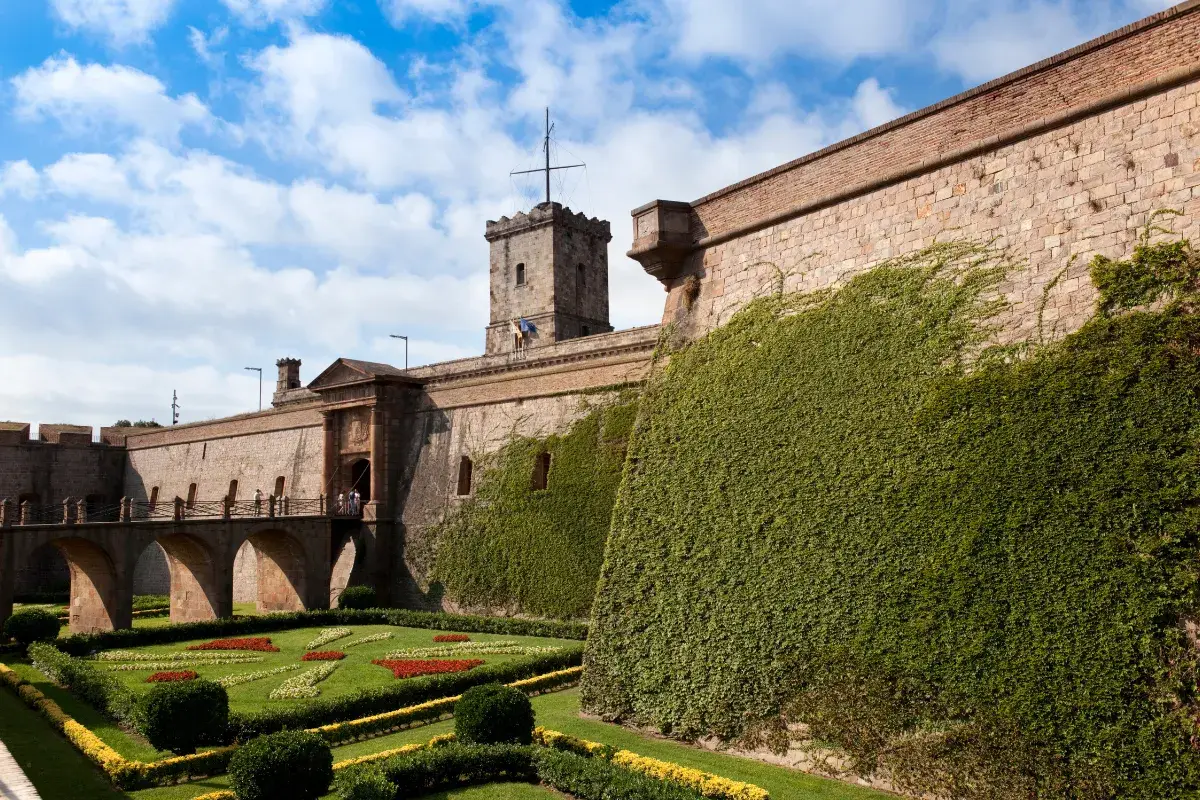

Most travel guides describe Montjuïc Castle as a hilltop fortress with panoramic views. That framing misses the point almost entirely.
This is a military structure that was deliberately built to aim its cannons at the city below — and used them three times. It held political prisoners for decades. It was the execution site of a president in 1940. The scientific measurement that gave the world the metric system was conducted from its watchtower. It wasn’t returned to Barcelona until 2007.
If you visit without knowing that, you’re just looking at old walls. If you know it, every stone reads differently.
Quick Answer
Montjuïc Castle is a 17th–18th century military fortress sitting 173 meters above Barcelona’s port. It functioned as a tool of political repression for over two centuries before being transferred to the city in 2007. Now open as a historical memory site. General admission €12, free on Sundays from 15:00 and all day on the first Sunday of the month. The guided tour (€4 extra) opens the cisterns, dungeons, and the top of the Watchtower — the most historically significant parts of the site.
Is Montjuïc Castle Worth Visiting?
Yes — but the value depends entirely on what you bring to it.
The views alone justify the trip. From the ramparts you get a 360-degree panorama over the port, the Mediterranean, the Olympic Ring, and the full city skyline — one of the best elevated perspectives in Barcelona. On that basis alone, at €5 (or free on Sunday afternoons), it clears the bar easily.
But the views are the least interesting thing here.
The castle’s real argument is historical. It’s one of the few sites in Barcelona where the city’s darkest chapters are physically present — the dungeon walls, the moat where Lluís Companys was executed, the bastions from which Barcelona was shelled by its own government. That history is rarely presented this clearly or honestly anywhere else in the city.
Worth it if you:
- Want the best free panoramic view in Barcelona (Sunday afternoons)
- Are interested in Spanish Civil War history, Catalan political memory, or urban fortification architecture
- Are combining it with a full Montjuïc day — the MNAC, Fundació Miró, or Olympic Ring are all nearby
- Want a genuinely quiet site compared to the Sagrada Família or Park Güell
Worth reconsidering if you:
- Have very limited time and haven’t seen the Sagrada Família or Casa Batlló yet
- Are only coming for the views and not planning to engage with the history
- Expect a medieval castle with towers and turrets — this is a functional military fortification, angular and austere
Quick decision: On a Sunday afternoon → go for free, combine with MNAC or the Olympic area. On a weekday → pay the €5 and add the guided tour for €9 total. It’s the best-value historical experience in the city.
Who Should Visit Montjuïc Castle?
| Visitor type | Verdict |
|---|---|
| History traveler | ✅ Essential — the Civil War and Franco-era layers are physically present |
| First-time Barcelona visitor | ⚠️ Only if you’ve covered the architectural highlights first |
| Budget traveler | ✅ Free on Sunday afternoons — one of the best free experiences in the city |
| Photography traveler | ✅ Sunrise and sunset views from the ramparts are exceptional |
| Families with children | ✅ The fortress scale and dungeon access work well with older kids |
| Visiting in summer | ✅ Outdoor cinema (Sala Montjuïc) runs in the moat on summer evenings |
| Architecture enthusiast | ✅ The star-shaped bastions are a textbook example of Vauban military design |
The History Behind the Walls
Built to Control the City, Not Just Defend It
The first watchtower on Montjuïc dates to 1073 — a signal tower where sentinels used candles by day and bonfires at night to warn the city of approaching ships. The transformation into a serious defensive structure came in 1640, during the Guerra dels Segadors, when the city council raised a quadrangular fort in thirty days to resist Philip IV’s troops. That fort proved decisive in the 1641 Battle of Montjuïc, where Catalan militia repelled the royal army.
After Barcelona fell in 1652, the Spanish Crown took control and commissioned engineer Juan Martín Cermeño to build the fortress that stands today — constructed between 1751 and 1779. Star-shaped plan, stone-cut moats, bastions, and a cistern system capable of supplying a garrison of 3,000 soldiers. Over 120 cannons. The central Parade Ground enclosed by arcaded galleries.
The critical detail: the artillery pointed both outward toward the sea and inward toward the city. That was intentional.
The Three Times It Fired on Barcelona
This fact is what separates Montjuïc Castle from any other fortification in Europe.
1842 — General Espartero crushed a popular uprising against free-trade policies threatening Catalan textile industry. He ordered a twelve-hour bombardment, launching more than a thousand shells onto the city below. The date is burned into Barcelona’s collective memory.
1843 — During the revolt known as “La Jamancia,” General Prim ordered a two-month bombardment that killed 335 civilians and wounded 354. The city had no means of responding to artillery positioned 173 meters above its rooftops.
1856 — A third uprising, a third bombardment from the same position. Approximately 400 dead.
No other city in modern European history was shelled from its own defensive fortress on three separate occasions by its own national government. This is the fact that defines everything else about this site.
The Dungeons and the Trials
In 1896, following an anarchist attack during a religious procession in the Carrer dels Canvis Nous, hundreds of suspects were detained in the castle’s dungeons. Documented reports of systematic torture caused an international scandal — the episode became known as the Montjuïc Trials and drew protests from across Europe and Latin America.
In 1909, in the aftermath of the Setmana Tràgica (Tragic Week) riots, educator and freethinker Francesc Ferrer i Guàrdia was executed in the Moat of Santa Eulàlia despite an absence of direct evidence linking him to the events. The execution drew condemnation worldwide.
In 1919, during the La Canadiense strike — the general strike that forced the eight-hour workday into Spanish law — the castle held 3,000 workers who refused military mobilization orders.
The Execution of Lluís Companys
The defining moment of the castle’s modern history came on October 15, 1940.
Lluís Companys, President of the Generalitat de Catalunya, had fled to France after the Republic’s defeat. He was captured there by the Gestapo during the Nazi occupation and handed to Franco’s government. After a summary court-martial, he was shot at dawn in the Moat of Santa Eulàlia. He asked to be executed barefoot — to die in direct contact with Catalan soil. His last words were “Per Catalunya!” (For Catalonia).
The moat now holds a monument to his memory. An annual tribute takes place here on the anniversary of his death. More than 4,000 Republican prisoners are estimated to have been executed at the castle during the Franco dictatorship.
The Scientific Fact Almost Nobody Knows
In 1792, French astronomer Pierre-André Méchain installed his observation equipment in the castle’s Watchtower to measure an arc of the Earth’s meridian between Dunkirk, Paris, and Barcelona. The goal: calculate one ten-millionth of the distance between the North Pole and the equator — the basis for defining the meter as a universal unit of measurement.
Méchain chose Montjuïc as the southern endpoint of his measurement because it offered the altitude and visibility required. The work was conducted under difficult conditions — France and Spain were at war. His data formed the foundation of the decimal metric system now used across most of the world.
There’s a sculpture in the moat commemorating this. It’s one of the least-visited and most significant details on the entire site.
What to See Inside
The Ramparts and Watchtower (General Admission)
The highest point on the site. 360-degree views over the port, the Mediterranean coastline, the Olympic Stadium, and the full Barcelona skyline. The watchtower is where Méchain made his measurements. Visible from the top: the cruise terminals, cargo port, and container infrastructure that give real scale to the maritime control the castle exercised over the city’s access to the sea.
The Parade Ground
The central square with arcaded galleries on three sides — the heart of the fortress and the organizing space of the visit. Information panels here cover the full architectural and political history. Worth taking slowly before moving to the peripheral spaces.
The Moat of Santa Eulàlia
The most significant space on the site from the standpoint of historical memory. The execution point of Companys and hundreds of others. Now a garden with the memorial to Companys and the metric system sculpture. The atmosphere is deliberately quiet. It’s the one space in Barcelona where the weight of 20th-century political history is physically tangible.
The Marina Wall
155 meters of defensive stonework facing the port. The dungeons where political prisoners were held for decades are embedded in its base. The wall itself is a UNESCO-listed element of cultural interest.
The Guided Tour (€4 extra)
Unlocks three spaces closed to general visitors:
- The cisterns — the underground water storage system built to supply a siege-ready garrison, now one of the most atmospheric spaces on the site
- The dungeons — the cells in the Marina Wall where prisoners from the Montjuïc Trials, the Tragic Week, and the Franco era were held
- The top of the Watchtower — the highest point in the castle and the exact location of Méchain’s measurements
If you’re visiting once, pay the €4. The guided context makes the physical spaces legible in a way the panels don’t.
Tickets, Hours & Free Entry
Pricing
| Admission | Price |
|---|---|
| General adult | €5 |
| Reduced (65+, students, groups) | €3 |
| Guided tour (add-on) | +€4 |
| Full visit with guided tour | €9 |
Free Entry Windows
| When | What’s free |
|---|---|
| Sundays from 15:00 | Full general admission |
| First Sunday of the month | Full general admission all day |
| BCNCultural card holders | Free permanent access |
| Gaudir+BCN beneficiaries (Barcelona residents) | Free permanent access |
The Sunday afternoon window is significant. The castle isn’t crowded even in peak season — combine with the MNAC (also free Sunday afternoons) for one of the best free cultural days in the city.
Opening Hours
Summer (March 1 – October 31): 10:00–20:00. Last ticket at 19:30.
Winter (November 1 – February 28): 10:00–18:00. Last ticket at 17:30.
Closed December 25 and January 1.
Getting There
Bus 150 from Plaça Espanya — direct to the castle, stopping at the MNAC and Olympic Ring along the way. Integrated into the city fare system: €2.90 single or T-Casual card. The most practical and economical option.
Cable car (Telefèric de Montjuïc) — 750-meter aerial crossing with three stations (Parc, Mirador, Castell). Round trip adult €19 (10% online discount). The ride itself is a view experience over the port. Treat it as an attraction in its own right, not just transport.
Funicular: Closed since October 2025 for infrastructure works on the Vila i Vilà water main, with reopening expected mid-April. TMB operates a replacement bus service from Paral·lel metro station with integrated fares.
On foot from Plaça Espanya: Escalators to the MNAC (30 min), then 40–50 min walking uphill to the castle. Worth it in spring or autumn with good weather.
Best Strategy: Planning the Full Montjuïc Day
Montjuïc covers 200 hectares. The castle is the highest point but not the only reason to come. The most effective approach: arrive at the top and work downward.
Half-Day (Castle + Views)
Take Bus 150 directly to the castle. Visit with guided tour (2 hours). Walk down through the Jardins de Miramar toward the Mirador del Alcalde. End at the MNAC or Fuente Mágica if timing allows.
Full Day
| Time | Stop |
|---|---|
| 10:00–12:00 | MNAC or Fundació Joan Miró |
| 12:30–14:30 | Cable car to castle, guided tour |
| 14:30–16:00 | Lunch at La Caseta del Migdia (weekends, informal grill) |
| 16:00–18:00 | Olympic Ring or Botanical Garden descending from castle |
| 21:00+ | Fuente Mágica (Thu–Sat in spring/summer) |
Summer Evening Option
The Sala Montjuïc outdoor cinema runs in the Moat of Santa Eulàlia on summer evenings — classic films and new releases preceded by live jazz. One of the most-loved local cultural events of the Barcelona summer, in the same space where executions took place. The juxtaposition is neither accidental nor uncomfortable — it’s how the city reclaims the site.
The Watchtower where the metre was defined
The metric system connection. Every guide mentions the panoramic views. Almost none mention that the Watchtower is where the meter was defined. The sculpture in the moat is easy to miss without knowing to look for it — ask the guide specifically.
The architecture itself. The star-shaped plan with angled bastions is a textbook example of the Vauban military design school that transformed European fortification in the 17th and 18th centuries. The geometry isn’t decorative — it eliminates the blind angles that made earlier rectangular forts vulnerable to flanking attack. Worth understanding before you walk it.
Sunday afternoon timing. Free entry from 15:00 makes this one of the best budget decisions in Barcelona. Combine it with the MNAC’s free Sunday window and you have a full afternoon of serious culture at zero cost.
The neighborhood at the base. Poble Sec sits immediately below Montjuïc — one of the most locally-oriented barrios in the city, with Carrer Blai’s pintxos bars, independent restaurants, and the Civil War tunnels of Refugi 307. An afternoon at the castle followed by dinner in Poble Sec is one of the most complete days you can have in Barcelona away from the tourist circuit. The Barcelona complete travel guide covers how Poble Sec fits into the wider city.
After a heavy history visit, a slow coffee break is earned — the best cafés in Barcelona and specialty coffee guide both cover options near the Paral·lel area at the base of the hill.
Mistakes to Avoid
Going only for the views and skipping the history. The view is free on Sunday afternoons. The history requires engagement — read something before you go, or pay the €4 for the guided tour. The view without context is a missed opportunity.
Not booking the guided tour. The cisterns, dungeons, and Watchtower top are closed without it. These are the three spaces that make the site genuinely distinctive. The €4 is the best-value upgrade on the Barcelona circuit.
Combining it with too much on the same day. The MNAC and Fundació Miró are both nearby and both excellent. Trying to do all three in one day usually means doing none of them properly. Pick two.
Going on a Sunday morning. Free entry only starts at 15:00. If you go at 10:00 on a Sunday, you pay €5. The first Sunday of the month is fully free all day — mark that one.
Expecting a medieval fairy-tale castle. This is an 18th-century military fortification. The architecture is precise, functional, and historically legible — but it has no towers, no drawbridge, no romanticism. It looks exactly like what it was: a machine for controlling a city.
Montjuïc Castle vs. Other Barcelona Viewpoints
| Viewpoint | Cost | Crowd level | Unique value |
|---|---|---|---|
| Montjuïc Castle | €12 (free Sun PM) | Low | History + 360° panorama |
| Bunkers del Carmel | Free | Medium-high | Best city skyline view |
| Park Güell (paid zone) | €18 | Very high | Gaudí architecture |
| Tibidabo | €15+ | Medium | City + sea combined |
| MNAC rooftop | Free (Sun PM) | Low | Close-up Eixample grid |
For a full guide to Barcelona’s elevated perspectives, the best streets in Barcelona walking guide maps routes that connect several viewpoints in a single walk through the Eixample and toward Montjuïc.
Technical Data
| Address | Carretera de Montjuïc, 66, Barcelona |
| Altitude | 173 meters above sea level |
| Construction | 17th century (current structure: 1751–1779) |
| Architect | Juan Martín Cermeño |
| Transferred to Barcelona | 2007 |
| Annual visitors | ~600,000 |
| Current use | Historical memory site, cultural venue |
For a night outside the city, a campsite near Barcelona competes with a city hotel rather than with other campsites, which is the calculation the campsites guide makes.
Frequently Asked Questions
Is Montjuïc Castle worth visiting?
Yes — especially if you engage with the history. The views alone justify the trip at €5 (or free on Sunday afternoons). Add the €4 guided tour for access to the cisterns, dungeons, and Watchtower, and it becomes one of the most rewarding historical experiences in the city. Avoid it only if you have a single day and haven’t yet seen the Sagrada Família or Casa Batlló.
How much does Montjuïc Castle cost?
General admission is €5. Reduced admission (65+, students, groups) is €3. The guided tour costs an additional €4 and includes the cisterns, dungeons, and top of the Watchtower. Free entry every Sunday from 15:00, and all day on the first Sunday of the month.
Why did Montjuïc Castle fire on Barcelona?
In 1842, 1843, and 1856, government forces used the castle’s artillery to suppress popular uprisings and labor movements in the city below. The fortress was deliberately designed with cannons pointing toward Barcelona as well as toward the sea — functioning as a tool of political control, not just coastal defense.
What’s the best way to get to Montjuïc Castle?
Bus 150 from Plaça Espanya is the most practical and affordable — integrated into the city fare system (€2.90 or T-Casual card). The cable car (€19 round trip) is more scenic and worth it if you treat the ride as part of the experience. The funicular is closed until mid-April 2026 for works; a replacement bus runs from Paral·lel metro.
What is the Moat of Santa Eulàlia?
The moat where Lluís Companys, President of the Generalitat de Catalunya, was executed on October 15, 1940, after being captured by the Gestapo in France and handed to Franco’s government. It also contains a sculpture commemorating Pierre-André Méchain’s metric system measurements from the castle’s Watchtower in 1792. The space is now a garden and the site of an annual tribute to Companys.
Is the Montjuïc Castle guided tour worth it?
Yes. It’s the only way to access the cisterns, the dungeons in the Marina Wall, and the top of the Watchtower. These are the three most historically significant spaces on the site. At €4 extra (or €4 total on free-entry Sundays), it’s one of the best-value upgrades in the city.
Can I visit Montjuïc Castle for free?
Yes. General admission is free every Sunday from 15:00, and all day on the first Sunday of each month. BCNCultural card holders and Gaudir+BCN beneficiaries (Barcelona residents) have free permanent access. The guided tour is not free on these days but the €4 fee still applies.
Is Montjuïc Castle accessible for visitors with reduced mobility?
The main terrace and Parade Ground are accessible. Some rampart sections and the Watchtower present limitations. Contact the castle directly before your visit to plan the best adapted route.