
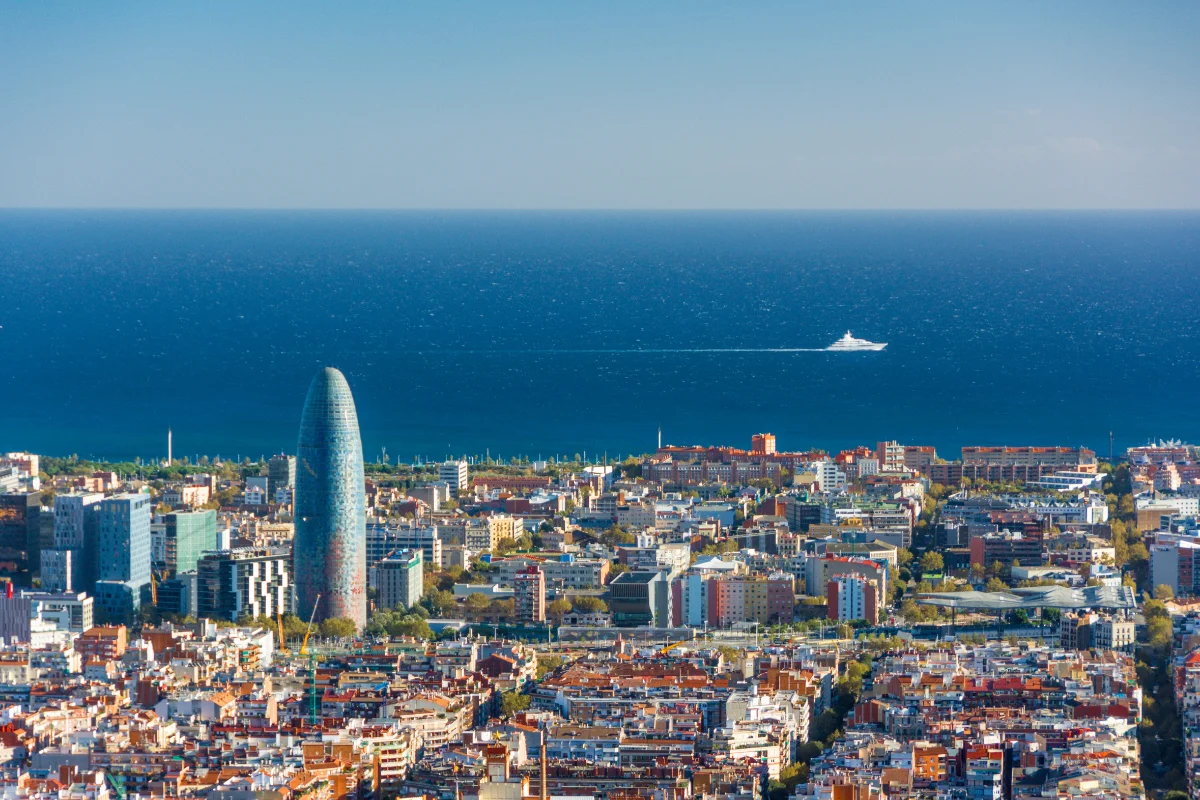

Barcelona is one of those cities where first-time visitors consistently underestimate what they’re walking into. Yes, there’s Gaudí. But there’s also 4.2 kilometres of urban beach, the world’s largest Art Nouveau complex, a Gothic quarter with standing Roman columns from the 1st century BC, and a food culture that operates on a completely different schedule from the rest of Europe. This guide is built around the specific facts that make each place worth your time — not just the names.
Barcelona essentials at a glance Sagrada Família (world’s tallest church structure, 172.5m — book weeks ahead). Park Güell (paid monumental zone + free accessible areas). Gothic Quarter (Roman columns from 1st century BC, Gothic cathedral). Sant Pau Recinte Modernista (world’s largest Art Nouveau complex, underground tunnels). MNAC (world’s most important Romanesque art collection). Barceloneta Beach (4km of Mediterranean urban coastline).
Gaudí’s Barcelona: the details behind the facades
Sagrada Família — the tallest church structure on Earth
When the Tower of Jesus Christ reaches its full height of 172.5 metres, it will surpass Ulm Minster in Germany as the world’s tallest church structure. Construction began in 1882 — first under a neo-Gothic design, then completely reimagined by Gaudí from 1883 — and has been funded exclusively by donations and ticket sales ever since. No public money. No state subsidy.
The interior is what most travel content fails to describe accurately. Gaudí’s columns branch upward like trees in a forest — the metaphor is his own. The stained glass on the Nativity façade (east side) uses warm amber and gold tones; the Passion façade (west) runs cold: deep blues and greens. At 9am on a clear morning, when eastern light pushes through the warm glass and floods the nave, the effect is unlike anything photography can capture. That’s the specific reason to book the first entry slot of the day.
Barcelona residents with local registration get 50% off tickets.
Advance booking is non-negotiable. Tickets sell out weeks ahead in mid and high season. Buy directly through the official Sagrada Família website.
📍 Carrer de Mallorca 401, Eixample. Metro: Sagrada Família (L2, L5).
Park Güell — the free section most visitors never use
Park Güell divides into two distinct zones. The Monumental Zone — the iconic mosaic terrace, the dragon stairway, the hypostyle room — requires a paid ticket and timed entry reservation. The rest of the park, including the forested hillside paths, the Turó del Calvari viewpoint, and the stone viaducts integrated into the slope, is entirely free and open without booking.
Most tourists only see the paid area. Those who arrive early and climb to the Turó del Calvari get one of the cleanest unobstructed views of the city available anywhere — without the queues, the crowds, or the entry fee.
📍 Carrer d’Olot, Gràcia. Bus 24 or 92 from Diagonal.
Casa Batlló and Casa Milà on the same street
On a single block of Passeig de Gràcia three Modernista buildings by three different architects stand within metres of each other. Barcelonans call it the Manzana de la Discordia (Block of Discord). Casa Batlló and Casa Milà (La Pedrera), both by Gaudí, are the most visited.
Casa Batlló’s roofline mimics the scaled back of a dragon in iridescent trencadís mosaic. Casa Milà has no load-bearing interior walls at all — the entire structure is supported by columns and iron beams, leaving every floor completely open plan.
Modernisme beyond Gaudí
Sant Pau Recinte Modernista — the world’s largest Art Nouveau complex
400 metres from the Sagrada Família — connected by the straight line of Avinguda de Gaudí — sits the building that most consistently surprises first-time visitors. Lluís Domènech i Montaner designed Sant Pau not as a single hospital block but as a garden city of medicine: 27 independent pavilions surrounded by gardens, connected underground by a full kilometre of tiled corridors.
It’s the world’s largest Art Nouveau complex — larger than Domènech i Montaner’s own Palau de la Música Catalana, larger than any Modernista work outside Barcelona. It functioned as a working hospital until 2009, when the historic site was restored as a museum and cultural space.
📍 Carrer de Sant Antoni Maria Claret 167. Metro: Sant Pau-Dos de Maig (L5).
Palau de la Música Catalana — the only concert hall lit entirely by natural light
The Palau de la Música, in El Born, is the only concert auditorium in the world designed to operate on natural light. The central stained glass skylight uses 1,250 coloured glass pieces. Daily guided tours offer access without a concert ticket.
Barcelona’s neighbourhoods — matched to what you’re looking for
Gothic Quarter — 2,000 years of layered history
At Carrer Paradís 10, inside a building belonging to the Centre Excursionista de Catalunya, four Corinthian columns from the 1st century BC are still standing. They were part of the Temple of Augustus — the tallest structure in the Roman forum of Barcino. Free to visit during opening hours.
The Cathedral’s Gothic cloister has housed thirteen white geese since the Middle Ages — one for each year of the life of Santa Eulàlia, the city’s patron saint.
El Born — the neighbourhood that was demolished and then recovered
El Born has the highest concentration of medieval civil architecture in Barcelona. Santa Maria del Mar — built entirely by the merchants and tradespeople of the neighbourhood between 1329 and 1383, with no noble or royal funding — is arguably the most structurally pure Gothic building in the city. The Museu Picasso holds 58 versions of Las Meninas in a single dedicated room.
Gràcia — the village that resists being a city
Gràcia was an independent municipality until 1897. Its squares — Plaça del Sol, Plaça de la Vila de Gràcia, Plaça de la Virreina, Plaça del Diamant — function as neighbourhood living rooms. The Festa Major de Gràcia each August transforms every street with elaborate themed installations built entirely by residents.
Eixample — the city designed with a ruler
Ildefons Cerdà drew the Eixample grid in 1859. Every block measures 113 metres per side. The chamfered corners at every intersection are not aesthetic — Cerdà specified them so that horse-drawn carts could turn without multi-point manoeuvres. The Eixample holds over 150 Modernista buildings from 1880 to 1930.
Poblenou — Barcelona’s creative district
Poblenou was Catalonia’s Manchester in the 19th century. Today it has the highest concentration of creative studios and tech startups in Barcelona, with former industrial buildings converted into galleries and coworking spaces.
The museums — what makes each one worth visiting
MNAC: holds the world’s most important collection of Romanesque art. Frescoes from Pyrenean churches were removed and reinstalled in rooms replicating the original apse architecture.
Museu Picasso: 4,000 works covering Picasso’s Barcelona years. The complete series of 58 versions of Las Meninas is here — and nowhere else in the world.
CosmoCaixa: the Flooded Forest is a 1,000 square metre section of living Amazonian ecosystem inside the building — the only one in Europe outside a specialist botanical greenhouse.
Fundació Joan Miró: designed by Josep Lluís Sert, former Dean of Architecture at Harvard. Natural light enters each gallery space in a way calculated specifically for that room.
The beaches
Barcelona’s 4.2 kilometres of urban coastline break into several sections. Barceloneta is the most famous and most crowded in summer. Bogatell and Mar Bella attract more local residents. Sant Sebastià consistently has the clearest water on the urban stretch.
Mediterranean water temperature reaches 26–27°C in August and drops to 13–14°C in January — swimmable for more than six months a year.
Best viewpoints in Barcelona
Bunkers del Carmel: former Civil War anti-aircraft batteries at 262 metres above sea level. Free, 360° views — the widest unobstructed horizon in the city without paying. Arrive 45 minutes before sunset in summer.
Montjuïc: the MNAC rooftop terraces are free without a museum ticket. The Montjuïc Castle terrace overlooks the port.
Tibidabo: at 512 metres with one of Europe’s oldest amusement parks (operating since 1901) and views extending to the islands on clear days.
Food and markets
La Boqueria on Las Ramblas is the most visited market but the central stalls are tourist-oriented — better products at better prices are along the perimeter. The Mercat de Santa Caterina in El Born offers better value with far less crowding.
Pa amb tomàquet — toasted bread rubbed with ripe tomato, olive oil and salt — is part of the UNESCO-recognised Mediterranean Diet. Not a bar snack: the basic way Catalans eat bread at home, at every meal.
The calçotada season runs December through March — grilled spring onions eaten dipped in romesco sauce. Outside that window, there are no fresh calçots.
Practical planning
Getting around
The T-Casual 10-trip card covers metro, bus, FGC, tram and local rail within Zone 1. The Hola BCN pass (2, 3, 4 or 5 days) gives unlimited trips. Metro runs until midnight Sunday–Thursday and 2am Friday–Saturday.
What to book in advance
Sagrada Família: weeks ahead in mid and high season. Park Güell monumental zone: several days ahead. Casa Batlló and La Pedrera: a few days ahead. Sant Pau: generally accessible with less lead time.
Eating on local time
Lunch starts at 1:30–2pm and runs until 4pm. Dinner rarely starts before 9pm. Restaurants with 8pm reservations often have tables — locals won’t arrive until 9:30 at the earliest.
Petty theft — specific and avoidable
Opportunistic theft is common on Las Ramblas, the L3 metro line and the beaches. Bag worn on the front in crowded transport, phone in a front pocket on Las Ramblas. The problem is specific and predictable.
Three itineraries by available time
1 day: Sagrada Família (first morning slot) → Passeig de Gràcia (Casa Batlló or La Pedrera exterior) → Gothic Quarter → Las Ramblas toward the sea.
2–3 days: Add Park Güell (morning, free zone) + El Born (Santa Maria del Mar, Museu Picasso) + Barceloneta + Montjuïc (MNAC, Fundació Miró or castle).
4+ days: Gràcia and Poblenou + Sant Pau Recinte Modernista + local markets + Bunkers del Carmel + unhurried meals in neighbourhood restaurants.
Frequently asked questions
What should I visit first in Barcelona if it’s my first time? The Sagrada Família with a first-slot morning booking. Then Passeig de Gràcia and the Gothic Quarter. Those three points cover Modernista architecture, medieval history and neighbourhood life in a walkable sequence.
Do I need to book Sagrada Família tickets in advance? Yes, always. Tickets sell out weeks ahead in mid and high season. Book through the official website. Without advance booking, entry is effectively impossible.
What is the best free viewpoint in Barcelona? Bunkers del Carmel at 262 metres, with a 360° view over the entire city and the sea. The MNAC rooftop terraces on Montjuïc are also free without a museum ticket.
How many days do you need in Barcelona? Three days covers the main landmarks with room for one neighbourhood and proper meals. Five days adds the more local areas, secondary museums and unhurried beach time.
Where should I stay in Barcelona? The Eixample is the most practical: metro access in all directions, dense food options, safe and quiet at night. El Born is atmospheric but louder at weekends. The Gothic Quarter is most central but has the most constant tourist volume.
Is Barcelona expensive for tourists? Mid-to-high by European standards. Landmark entry tickets range from €15 to €35. A lunchtime set menu costs €12–16. The T-Casual 10-trip card costs around €12. Hotels on Passeig de Gràcia are expensive; Gràcia, Sants and Poblenou offer more affordable options.
What surprises first-time visitors most? Sant Pau Recinte Modernista — 400 metres from the Sagrada Família, with a kilometre of underground corridors and none of the queues. And the interior of the Sagrada Família itself, which no exterior photograph prepares you for.
Go deeper
Architecture: Inside the Sagrada Família · Gaudí route · Modernista walking route · Casa Batlló
Neighbourhoods: Gothic Quarter · El Born · Gràcia · Poblenou · Eixample
Food: Best restaurants · Best tapas
Planning: 1-day itinerary · 2-day itinerary · 3-day itinerary
Barcelona has 4,000 years of layers. Every visit finds a different one.