
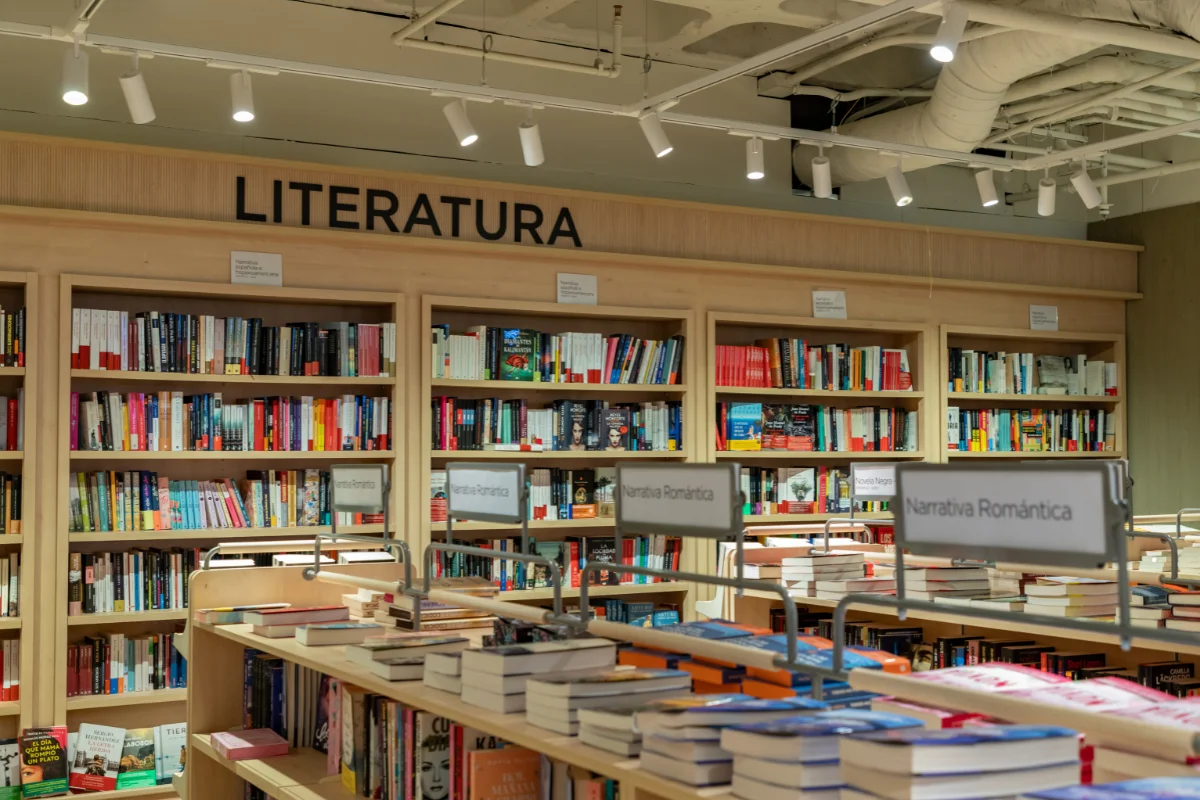

Most cities have bookshops. Barcelona has destinations — spaces where the architecture, the editorial curation, and the rules of use turn a visit into something you don’t forget. The city has over 300 bookshops. This guide covers the ones worth going out of your way for: what makes each one different, what kind of afternoon it’s built for, and what most visitors miss entirely.
Quick Answer: What are the best bookshops in Barcelona?
Finestres (Eixample, 600 m², absolute silence policy, fireplace, courtyard). La Central del Raval (18th-century chapel, 80,000 titles, orange tree garden). Ona Llibres (1,000 m², Catalan books, free piano). Altaïr (largest travel bookshop in Europe). Hibernian (only English-language second-hand bookshop, 40,000+ titles). Fabre, founded in 1860, is the oldest bookshop in the city still in operation.
Quick Picks
- Best overall experience → La Central del Raval (chapel atmosphere, multilingual, garden)
- Best for silence and focus → Finestres (strict no-phone policy)
- Best for English books (second-hand) → Hibernian, Gràcia
- Best for travel books → Altaïr, Gran Via (largest in Europe)
- Most unexpected → Ona Llibres (piano you can actually play)
- Best neighbourhood cluster → Sant Antoni (3 independents within 10 minutes on foot)
Who Is This For?
- First-time visitor looking for a cultural afternoon → La Central del Raval or Finestres
- English-speaking resident or long-stay traveller → Hibernian for second-hand, La Central for new titles
- Traveller preparing a next trip → Altaïr, no competition
- Someone who wants to browse without buying pressure → Any of these — none require a purchase
- Local culture immersion → Ona Llibres or La Calders (Sant Antoni)
Finestres: The Bookshop With a Silence Rule
Finestres opened in 2021 on Carrer de la Diputació with a policy no other bookshop in Barcelona enforces: absolute silence. No phones. No conversations. Reading treated as a concentrated act, not background activity.
The space covers 600 m² with dark wood shelving, sofas, a fireplace, and a courtyard that is probably the quietest corner in the commercial Eixample. The selection focuses on contemporary fiction, essay, and ideas — curated by someone with a clear point of view, without the bestseller-list logic that drives chain bookshops.
The second Finestres location occupies Casa Garriga i Nogués — a Modernista building nearby — with 200 m² dedicated exclusively to visual arts, photography, and music. The two spaces don’t overlap: visitors looking for novels go to Diputació; those interested in art books need the second location.
The silence policy isn’t a marketing gimmick. It’s the reason Finestres has a community of regulars who treat it as their own library. A 4.8 rating across 2,000+ reviews reflects exactly that.
📍 Carrer de la Diputació 249, Eixample.
La Central del Raval: An 18th-Century Chapel With 80,000 Books
The building that houses La Central del Raval is the former Capella de la Misericòrdia — an 18th-century baroque nave that survived the demolition of its surrounding convent, decades of abandonment, and the construction of the Ronda de Sant Antoni. When La Central opened here, they chose to work with the architecture rather than cover it: the nave arches, the ceiling height, the proportions of a sacred space.
The result is a bookshop where the air feels different when you walk in. Eighty thousand titles in humanities — philosophy, history, social sciences, literature — in a space with the scale of something built for meaning. Around 40% of the stock is in foreign languages, making it the most linguistically diverse bookshop in the old city.
The interior garden with an orange tree is the detail regulars keep to themselves. Tables, summer shade, the quiet of a courtyard in the middle of El Raval. The Bar Decameron serves coffee and food. The standard use pattern: browse books, stop for lunch, return to books. The space makes it easy.
Open every day. Free entry.
📍 Carrer d’Elisabets 6, El Raval. Worth combining with El Raval’s wider cultural circuit — MACBA, CCCB, and the Boqueria are all within walking distance.
Ona Llibres: 1,000 m², Catalan Books, and a Piano You Can Play
Ona Llibres is the most ambitious statement in favour of the Catalan-language book that exists anywhere in the city. The 1,000 m² space on Pau Claris breaks with the traditional bookshop aesthetic — open floor plan, white light, colour — and organises its stock by theme in a way that reads as a cultural manifesto about Catalan as a living language of ideas.
The piano in the middle of the floor is not decorative. It’s there to be played. There’s also a children’s area with projection walls, reading sofas, and a workspace. The Teatro la Bookeria is a literal stage surrounded by bookshelves — used for book launches, reading groups, and small-format concerts.
Ona’s cultural programme is one of the densest of any bookshop in Barcelona: debates, film clubs, sports reading groups, author events. For anyone wanting to enter the Barcelona cultural scene in Catalan, Ona is the most complete map available in a single space.
📍 Carrer de Pau Claris 94, Eixample.
Laie: The Original Book-and-Food Combination
Laie was the first bookshop in Barcelona to understand that selling books and serving food aren’t contradictory activities. That was in the 1990s, when the idea was genuinely unusual. Today it’s the model dozens of spaces in the city have followed.
The Pau Claris location occupies a full Eixample floor with everything that implies: high ceilings, street-facing windows, original hydraulic tile floors. The Sala Shakespeare — the events space — has the late-afternoon light that enters obliquely through Eixample windows and turns any book launch into something that also works as an architectural experience.
The restaurant terrace operates most of the year. The menu reads like a bistro, not a bookshop café. The natural sequence: browse, eat, return to books. The space is designed for that loop.
📍 Carrer de Pau Claris 85, Eixample.
The Specialists: Each With Its Own Territory
Altaïr has been the largest travel bookshop in Europe since 1979. The lower floor is organised by geographic zone — arriving for books on Japan and leaving with three on the Maghreb is a standard accident. A café on the same floor extends the visit. For anyone planning a trip or simply wanting to read about a place, Altaïr has stock that no general bookshop can match.
📍 Gran Via de les Corts Catalanes 616, Eixample.
On the Road pays homage to Kerouac and the Beat Generation from a small space near the Antic Teatre in El Born. Every book is personally selected by the owner — counterculture, feminism, LGBTQ+ literature, experimental poetry. The kind of bookshop where asking for a recommendation works, because whoever answers has read the shelves.
📍 Carrer de la Virreina 3, El Born.
Hibernian in Gràcia is the only bookshop in Barcelona dedicated exclusively to second-hand books in English, with over 40,000 titles. For English-speaking residents or travellers looking for original editions that don’t circulate in Spanish, Hibernian carries stock that doesn’t exist anywhere else in the city.
📍 Carrer de Montseny 17, Gràcia.
Comparison Table: Which Bookshop for What
| Bookshop | Vibe | Special feature | Best for |
|---|---|---|---|
| Finestres | Quiet, curated | Silence rule, fireplace | Deep browsing, no distractions |
| La Central del Raval | Cultural, multilingual | 18th-c chapel, garden | Humanities, foreign languages |
| Ona Llibres | Open, activist | Free piano, stage | Catalan culture, events |
| Laie | Literary bistro | Full restaurant | Books + lunch combo |
| Altaïr | Geographic | Europe’s largest travel section | Pre-trip research |
| Hibernian | Relaxed, curated | 40,000 English second-hand | English readers, rare finds |
| La Calders | Neighbourhood | Sunday opening, bar, piano | Sunday market circuit |
The Historic Bookshops
Fabre was founded in 1860 and is the oldest bookshop in Barcelona still operating. The wooden train running along the ceiling and the life-size Pinocchio at the entrance have been there for generations. The specialisation in German literature dates from the founder’s origins and has survived as a defining identity for over 160 years.
Espai Quera has been on Carrer dels Petritxol in the Gothic Quarter since 1916, specialising in mountain, travel, and gastronomy. The back room serves wine and small plates — the bookshop that becomes a wine bar at the end of the corridor, a logic that only works when you’ve been in the same neighbourhood for over a century.
📍 Carrer dels Petritxol 2, Gothic Quarter.
Pompeia opened in 1922 near the Ramblas and keeps the original wooden beams and the personal service that is the reason its regulars don’t go anywhere else.
Sant Antoni: The Neighbourhood With the Highest Bookshop Density
The Sant Antoni area — particularly Passatge de Pere Calders and the streets around the Mercat de Sant Antoni — concentrates more independent bookshops per block than anywhere else in the city.
La Calders is on the Passatge de Pere Calders and opens on Sundays to catch the market flow. The former button factory it occupies has a bar with a piano — the intersection of bookshop, neighbourhood space, and music venue that would feel forced elsewhere and here feels entirely natural. Strong emphasis on Catalan-language books and local literature.
Byron has a fireplace, second-hand furniture, and the atmosphere of a living room someone decided to fill with books. Organises small-format concerts and poetry readings. The line between customer and regular disappears quickly.
Terranova is in a 19th-century Modernista former shoe shop — books are displayed cover-out, not spine-out, which turns the space into something that also functions as a gallery. Careful selection, small space, no noise.
The Sunday combination — Mercat de Sant Antoni second-hand book stalls, La Calders, Byron, and Terranova within a ten-minute radius — is one of the culturally densest half-days the city offers.
Is It Worth It?
Yes — and more specifically, yes to doing it slowly.
Barcelona’s independent bookshops are not tourist attractions in the conventional sense. They’re functioning neighbourhood spaces that happen to be architecturally or editorially remarkable. The value is in spending time: arriving at Finestres with no agenda, sitting in La Central’s garden for an hour, browsing Hibernian’s English shelves without a list.
The mistake is treating them as boxes to check. The payoff comes from treating them the way locals do: as places to be, not just places to visit.
Mistakes to Avoid
- Going to La Central del Raval only for the architecture — the stock is just as good as the building. Budget 45 minutes minimum, not 10.
- Missing the Finestres arts location — the two branches have completely different catalogues. One visit covers only half the offer.
- Arriving at La Calders on a weekday morning — it opens Sunday specifically for the market crowd. That’s when the energy is right.
- Overlooking Hibernian if you read in English — 40,000 second-hand titles in English don’t exist anywhere else in the city. Most visitors don’t know it exists.
- Assuming Altaïr is only for active trip planning — the stock is good enough to read about places you have no immediate plans to visit.
- Skipping the FAQ at Ona Llibres — the events programme changes weekly. Check before you go, not after.
Best Strategy
- 1–2 hours → La Central del Raval + walk through El Raval. Self-contained, free, covers architecture and books.
- Half day → Finestres (Diputació) + Finestres arts (Garriga i Nogués) + Laie for lunch. All within walking distance in the Eixample.
- Sunday full morning → Mercat de Sant Antoni second-hand stalls + La Calders + Byron + Terranova. Finish at the market food section.
- For English readers → Hibernian (Gràcia) + afternoon at one of the city’s best cafés nearby.
Three things a list of addresses cannot show
Three things a list of addresses cannot capture:
The silence at Finestres is enforced, not suggested. Staff will ask you to put your phone away. That’s not a complaint — it’s the reason the space works. Knowing this before you arrive means you come prepared rather than caught off guard.
La Central del Raval has a different character on weekday afternoons. Weekend mornings bring a tourist crowd drawn by the architecture. Weekday afternoons belong to the regulars — researchers, translators, writers — using it as a working library. The experience is completely different.
The Sant Antoni bookshop cluster and the Sunday market are the same visit. The Mercat de Sant Antoni has second-hand book stalls outside every Sunday. La Calders is sixty seconds away. Byron is two minutes. Terranova is five. This isn’t three separate stops — it’s one neighbourhood circuit that takes a morning.
Practical Information
| Bookshop | Neighbourhood | Days open | Entry |
|---|---|---|---|
| Finestres (books) | Eixample | Mon–Sat | Free |
| Finestres (arts) | Eixample | Mon–Sat | Free |
| La Central del Raval | El Raval | Every day | Free |
| Ona Llibres | Eixample | Mon–Sat | Free |
| Laie | Eixample | Mon–Sat | Free |
| Altaïr | Eixample | Mon–Sat | Free |
| Hibernian | Gràcia | Mon–Sat | Free |
| La Calders | Sant Antoni | Tue–Sun (closed Mon) | Free |
| Byron | Sant Antoni | Tue–Sun | Free |
| Terranova | Sant Antoni | Tue–Sat | Free |
| Espai Quera | Gothic Quarter | Mon–Sat | Free |
For planning your visit alongside Barcelona’s art gallery scene or combining with weekend workshops and cultural events, most of these bookshops sit within the same neighbourhood circuits.
Frequently Asked Questions
What is the oldest bookshop in Barcelona?
Librería Fabre, founded in 1860. It specialises in German literature and educational wooden toys. The wooden train running along the ceiling is an original decorative element that has been there for generations. Still operating in the Eixample.
Which Barcelona bookshops have a café or restaurant?
Laie (full restaurant with terrace on an Eixample floor), La Central del Raval (Bar Decameron in the interior garden), Finestres (café in the courtyard), Altaïr (café on the lower floor), and Espai Quera (wine and small plates in the back room).
Where can I buy second-hand books in English in Barcelona?
Hibernian in Gràcia is the only bookshop in Barcelona dedicated exclusively to second-hand English-language books, with over 40,000 titles. For new titles in English, La Central del Raval has the widest foreign-language stock in the city centre.
Which bookshop in Barcelona has the largest Catalan-language selection?
Ona Llibres in the Eixample, with over 1,000 m² dedicated exclusively to books in Catalan. La Calders in Sant Antoni also emphasises Catalan and local literature with a stronger neighbourhood character.
What is the best travel bookshop in Barcelona?
Altaïr on Gran Via has been the largest travel bookshop in Europe since 1979. Shelves are organised by geographic zone. Espai Quera in the Gothic Quarter also has a strong travel and mountain section with over a century of history.
Can I sit and read in Barcelona bookshops without buying anything?
Yes, in most of them. Finestres has sofas and a fireplace designed for reading. La Central del Raval has garden tables. Laie has a restaurant where you can sit with a coffee. Byron feels like a living room. None require a purchase to use the space.