
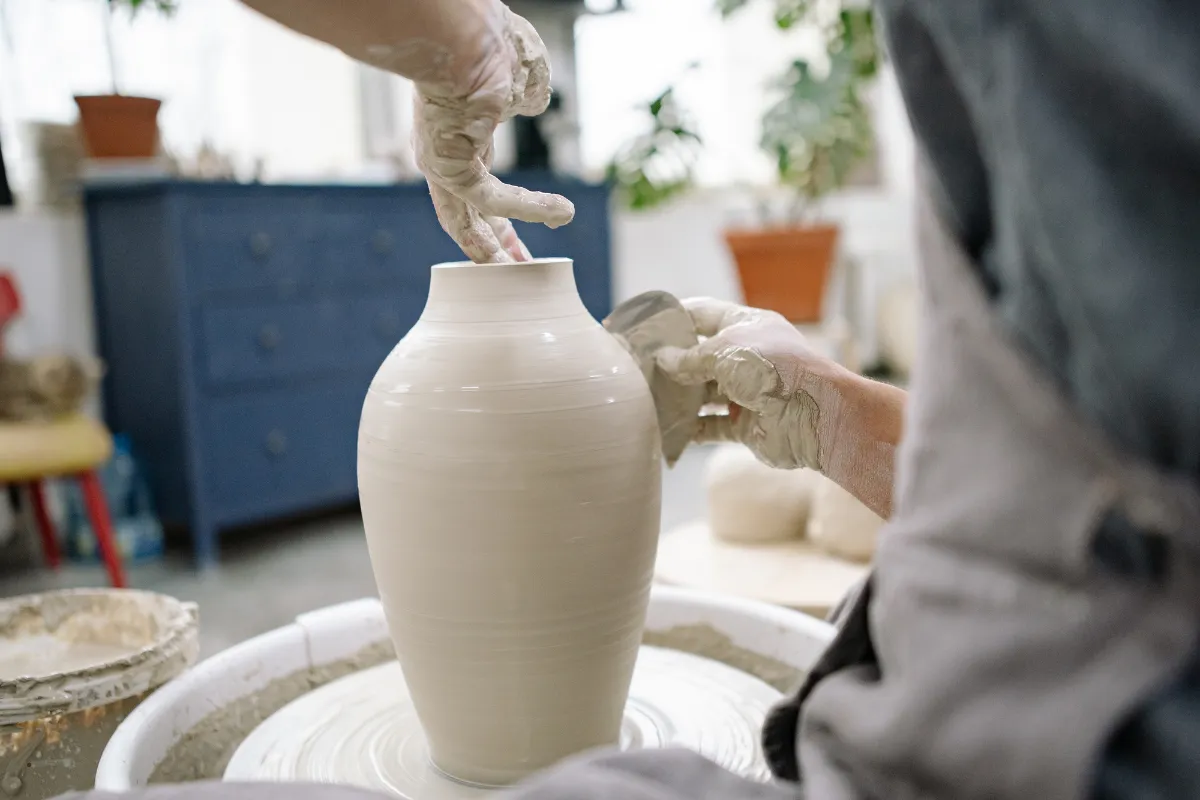

Most visitors to Barcelona spend their weekends queuing for monuments. A different approach: spend a Saturday morning actually making something — a ceramic bowl, a silver ring, a meal cooked with ingredients you chose that morning at the Boqueria. Barcelona has over 1,000 active workshops at any given moment, ranging from a two-hour pottery-and-wine session for €30 to a 16-hour technical ceramics intensive, professional-grade CNC and laser fabrication at the city’s Fab Lab, and a network of civic centers that offer the same disciplines as private studios for a fraction of the price.
The question isn’t whether there’s something to learn. It’s knowing which format matches what you’re actually looking for.
Quick Answer: What are the best weekend workshops in Barcelona? Cooking: Sabores or Cookiteca, 3–4 hours, €40–70. Ceramics: Born to Clay (social, €30–60) or 137º Ceramic Art Studio (technical 16h, €240). Photography: Training Photo, one full Saturday in the city, €110–130. Silversmithing: Aiguamaria Joies, €39–120. Digital fabrication: Fab Lab Barcelona (CNC, laser, robotics), €150–200. Free options: Civic centers in every neighborhood with yoga, art, and digital skills at minimal or zero cost.
Quick Decision: Which Format Is Right for You?
| You want… | Best option | Price range |
|---|---|---|
| A fun social experience | Pottery & Wine (Born to Clay) | €30–60 |
| A real skill to take home | 137º ceramics intensive (16h) | €140–240 |
| Cook and eat the same day | Sabores or Cookiteca | €40–70 |
| Professional-level tech access | Fab Lab Barcelona | €150–200 |
| Low cost, still quality | Civic center workshops | Free–€15 |
| Make something with your hands | Silversmithing (Aiguamaria) | €39–135 |
| Improve your photography | Training Photo (full Saturday) | €110–130 |
The biggest distinction in Barcelona’s workshop market: experiential (one session, social, you leave with a piece) vs. technical (multi-session, skill-building, you leave with a foundation). Both are valuable — they’re just solving different problems.
Cooking Classes: The Most In-Demand Weekend Activity
Sabores Taller de Cocina
The most established international cooking school in Barcelona. Small groups, 100% hands-on — you cook everything, then eat it together at the end. The most-booked sessions: Japanese sushi, Thai (Pad Thai, green curry), Peruvian (ceviche, ají de gallina), and fresh Italian pasta. Also runs vegetarian and pastry workshops.
Duration: 3–4 hours. Price: €40–70 depending on the session.
Cookiteca
Specializes in pastry, paella, and Spanish desserts. Saturday sessions run 13:00–15:00 with a tasting and a glass of wine included. Lower time commitment than Sabores — good if you want a genuine introduction without a half-day block.
Price: from €55.
Market-to-Table at La Rambla 58
The most complete format on this list: starts with a guided visit to the Boqueria market to select ingredients with the chef before heading to the kitchen to cook the paella. You understand the full chain from product to plate — not just the technique.
Price: €125. Duration: half-day.
Escuela Hofmann
The city’s Michelin-starred cooking school (one star since 2004) runs occasional pastry and baking days open to non-professionals. If technique at a professional level is the goal, this is the access point.
Price: €90–150.
Ceramics: Two Completely Different Models
Ceramics is the fastest-growing workshop category in Barcelona. The demand reflects something real — tactile work, screen-free time, the satisfaction of making a functional object. But the two formats available serve completely different needs.
The Social Model
Short sessions (2–3 hours) that pair ceramics with drinks and a relaxed atmosphere.
Born to Clay (El Born) is the best-known: “Pottery & Wine” or “Pottery & Vermut” sessions with flexible scheduling, no annual enrollment, materials and firings included. You leave with an unfired piece; it’s ready for collection a few weeks later after the kiln. Good for a first experience or a memorable afternoon.
Price: €30–60. Also available: Tiwona and Mil Vueltas Studio (Poblenou) with similar single-session formats. Ceràmica Forma (Gràcia, founded 1970) offers 90-minute wheel sessions with a more academic approach for those who want foundational technique without committing to a full course.
The Technical Model
137º Ceramic Art Studio runs the most complete intensive in the city: 16 hours split across four sessions (two consecutive weekends). Sessions 1 and 3 cover the wheel — centering, cylinders, trimming, handles. Sessions 2 and 4 cover hand-building — pinch, slab, engobes, sgraffito and mishima techniques.
Full course: €240. Partial module: €140. Materials and firings included.
The difference between the two models is concrete: the social workshop produces one piece in an afternoon. The intensive produces the ability to work with clay independently afterward.
Photography: Learn with the City as Your Classroom
Barcelona’s combination of Modernista architecture, medieval streets, coastline, and Mediterranean light makes it an unusually good outdoor classroom for photography. The best workshops use the city itself as the curriculum.
Training Photo
Intensive one-Saturday courses to take participants from automatic mode to full manual control in 6 hours of outdoor practice. The route covers central Barcelona while working on light metering, depth of field, and motion capture. Separate workshops cover night photography (3 hours) and urban photography.
Price: €110–130 (full-day manual course), €50 (night session).
Street Photography Barcelona
Full-day workshops in neighborhoods like El Born, the Raval, or Barceloneta. The format includes a final collective review session — your images critiqued alongside others’, which accelerates improvement faster than solo practice.
Price: €80 for 8 hours.
Barcelona Photography Tour
Architecture and urban photography workshops of 4 hours with local professional photographers.
Price: €100–150.
For smartphone photographers, dedicated mobile photography workshops run 3 hours from €35–50 via platforms like Atrápalo. No camera required.
Silversmithing: Make a Piece in One Afternoon
Several Barcelona jewelers have opened their professional techniques to beginners through short-format sessions.
Aiguamaria Joies — direct silver work. Learn to solder, texture, and polish metal to create a ring or earrings in a single session. Price: €39–120 depending on duration (2–4 hours).
Olga Muxart — lost-wax technique over two sessions: first session for wax modeling, second (after casting) for finishing and polishing. Wax is considerably more forgiving for beginners than direct metal, and allows more freedom of form. Price: €135 for both sessions.
Cristina Bermeo (Gràcia) — sustainable focus. Participants bring their own old or unused silver jewelry to melt down and transform into a new piece. You learn the casting and rolling technique while working with a material that already has personal history. Price from €64.
Sustainable Fashion and Textile Workshops
Barcelona’s textile tradition runs deep — the city was Spain’s textile manufacturing center for over a century. Today that knowledge gets channeled into workshops on construction and upcycling.
MuchaFibra — Saturday sessions (11:00–14:00) covering garment transformation and a 16-hour program on elastic fabrics (lycra, linings, elastic techniques for lingerie and swimwear). Technical and sustainable in approach.
Atelier Meravelles — from the Express Dress workshop (€65) to pattern-making and customization modules (€85). The intensive “El Favorito” course costs €165. Zero-waste philosophy using industrial textile surplus.
Duduá — embroidery, crochet, and sewing with a more artisanal, less technical emphasis.
Woodworking and Digital Fabrication
TMDC Carpentry Co-Workshop (Sant Martí / Cornellà)
15,000 m² of industrial workshop space. The “Introduction to Woodworking” course runs 8 hours over a weekend with access to both modern industrial machinery and traditional hand tools under supervision from carpenters with 20+ years of experience. By the end, participants can tackle mid-complexity furniture projects independently.
Mamüll (Sant Andreu)
Creative woodworking and furniture restoration. The adult restoration course lets you bring your own piece of furniture and learn the techniques to recover it. Also runs children’s workshops for ages 5–12.
Fab Lab Barcelona (IAAC, Poblenou)
The most technically advanced option in the city — and one of the most advanced Fab Labs in Europe. Weekend workshops cover CNC milling machines, laser cutters, 3D printers, Arduino, and the Kuka robot for complex design applications. The “Robotic Ceramics” workshop uses robotic 3D printing for ceramic production — a session that exists nowhere else in Barcelona’s workshop landscape.
Price: €150–200 depending on workshop. The only place in the city combining professional-grade digital fabrication with an accessible weekend format.
Wine, Perfume, and Sensory Workshops
Wine: Maitre y Sommelier at Hotel Barceló Raval runs 2-hour tastings of 6+ wines from different appellations, with a gourmet menu and an official certificate. Price: €66 (promotional; standard €82.50).
Perfumery: The Perfumery Barcelona runs 4-hour workshops covering olfactory tasting of natural raw materials and creation of a personalized fragrance to take home. Smell Lab BCN (Gràcia) takes a more experimental, lab-oriented approach.
Natural cosmetics: Mon Petit Pot (Poblenou) teaches solid cosmetics production (shampoo bars, conditioners), natural soaps, and emulsions in sessions that balance theory with hands-on practice.
The Civic Center network, 50 venues at a fraction of the price
Barcelona has over 50 Civic Centers (Centres Cívics) distributed across every district, each running a quarterly program of workshops across virtually every discipline covered above. Prices are a fraction of private studios — €50–95 for 8–10 week courses, with many single sessions and special workshops available for free or near-free.
The most interesting centers for creative programming:
- Convent de Sant Agustí (Ciutat Vella) — music and digital arts
- Can Felipa (Poblenou) — visual arts, theater, dance
- Sagrada Família (Eixample) — photography and gastronomy
Cibernàrium (Barcelona Activa, also free): digital skills training open to anyone. SQL, Python, web design, Google Analytics, Meta Ads. 2–4 hour capsule sessions covering specific skills rapidly. Completely free for Barcelona residents and, in many cases, open to visitors with registration.
If budget is a primary consideration, the civic center network offers the same disciplines as private studios for 80–90% less cost. The tradeoff: less flexible scheduling and fewer niche specializations.
For a broader picture of Barcelona’s budget options across accommodation, food, and attractions, the Barcelona travel budget guide breaks down daily costs across traveler profiles.
Full Reference Table
| Discipline | Short format | Price | Intensive format | Price |
|---|---|---|---|---|
| Cooking | 3–4h (Sabores, Cookiteca) | €40–70 | Full day (Hofmann) | €90–150 |
| Ceramics | Session + drink (Born to Clay) | €30–60 | 16h technical (137º) | €240 |
| Photography | 3h night (Training Photo) | €50 | Full Saturday manual (6h) | €110–130 |
| Silversmithing | Direct silver (Aiguamaria) | €39–120 | Lost-wax / 2 sessions | €135 |
| Woodworking | Own piece restoration | Variable | 8h industrial (TMDC) | Variable |
| Digital fabrication | Arduino basics | €80–100 | CNC / Laser / Robot | €150–200 |
| Wine | 2h tasting (Maitre & Sommelier) | €66 | — | — |
| Perfumery | 4h custom fragrance | €80–120 | — | — |
| Wellness / yoga | Civic center session | Free–€15 | Weekend retreat | €280–320 |
Mistakes to Avoid
Booking a social ceramics session when you want to actually learn the skill. The pottery-and-wine format is genuinely enjoyable and produces a real piece — but it doesn’t teach you how to throw a pot. If you want to leave with a skill rather than just an experience, the 137º intensive is the right call.
Ignoring the civic centers. The Convent de Sant Agustí and Can Felipa run programs that rival private studios in quality, at 10% of the cost. They’re not tourist-facing, which is exactly why they’re underused by visitors.
Not checking Fab Lab availability in advance. Weekend workshops at the IAAC fill up. The Kuka robot sessions in particular have limited spots and book out weeks ahead.
Choosing a cooking class based on price alone. The market-to-table format at La Rambla 58 costs nearly double a standard Sabores session — but the structure (market → selection → cooking → eating) produces a fundamentally different understanding of local cuisine. The price difference is justified if that depth is what you’re after.
Best Strategy by Trip Length
One day in Barcelona: Morning ceramics session at Born to Clay (3 hours) → lunch in El Born → afternoon exploring the neighborhood. The Born and Gothic Quarter area has enough to fill the rest of the day without planning.
Weekend in Barcelona: Saturday: cooking class (morning) + specialty coffee spot + afternoon free. Sunday: photography workshop in the city’s streets + evening at a live music venue. Two disciplines, two neighborhoods, no tourist-circuit overlap.
Week in Barcelona: Add the 137º ceramics intensive (spread across two weekends, or ask about condensed scheduling), a Fab Lab session, and a Cibernàrium digital capsule. You leave with three distinct skills and a very specific understanding of what Poblenou looks like on a working day.
Is a Barcelona Workshop Worth It?
For most travelers, yes — but the value depends on choosing the format that matches your actual goal.
A pottery-and-wine session is worth €35–60 as an experience: it’s social, tactile, and more memorable than another museum visit. A 16-hour ceramics intensive at €240 is worth it only if you genuinely want the skill — not as a tourist activity.
The Fab Lab is remarkable and genuinely unique in the city. If digital fabrication or robotics interests you professionally or creatively, there’s no comparable access point at that price point anywhere else in Barcelona.
The civic centers are almost always worth it on pure value: the quality gap between a €10 civic center yoga session and a €25 private studio session is smaller than the price gap suggests.
Whatever you choose, the complete Barcelona travel guide covers how to build workshops into a broader itinerary without overloading the schedule.
FAQ
How much do cooking classes cost in Barcelona?
Standard 3–4 hour sessions at Sabores or Cookiteca run €40–70. Market-to-table formats with a chef guide cost around €125. Escuela Hofmann’s professional-level pastry days start at €90–150. All are hands-on — you cook and eat what you make.
Where can I do a ceramics workshop in Barcelona?
Born to Clay (El Born) runs pottery-and-wine sessions from €30–60 with flexible scheduling. For technical skill-building, 137º Ceramic Art Studio offers a 16-hour intensive across two weekends for €240 (or a partial module for €140). Ceràmica Forma in Gràcia (founded 1970) has 90-minute wheel sessions.
Are there free workshops in Barcelona on weekends?
Yes. The city’s 50+ Civic Centers (Centres Cívics) run yoga, meditation, photography, and art workshops at minimal or zero cost. Cibernàrium (Barcelona Activa) offers completely free digital skills training — SQL, Python, web design, analytics — in 2–4 hour sessions open to visitors with registration.
What is Fab Lab Barcelona and what can you learn there?
The Fab Lab Barcelona at the IAAC (Poblenou) is one of Europe’s leading digital fabrication spaces. Weekend workshops cover CNC milling machines, laser cutters, 3D printers, Arduino, and the Kuka industrial robot. Price: €150–200 depending on the workshop. “Robotic Ceramics” — ceramic production through robotic 3D printing — is their most distinctive offering.
How much does a photography workshop in Barcelona cost?
Training Photo runs a full-Saturday manual photography course (6 hours outdoors) for €110–130. Night photography sessions cost €50 (3 hours). Street Photography Barcelona offers full-day workshops with collective image review for €80.
What’s the best workshop in Barcelona for a first-time visitor?
Depends on your interest. For a social experience: Born to Clay pottery session (€30–60). For cooking: Sabores (€40–70) covers international cuisine hands-on. For something uniquely Barcelona: the market-to-table paella class (€125) combines the Boqueria with cooking — two of the city’s most specific elements in one session.