
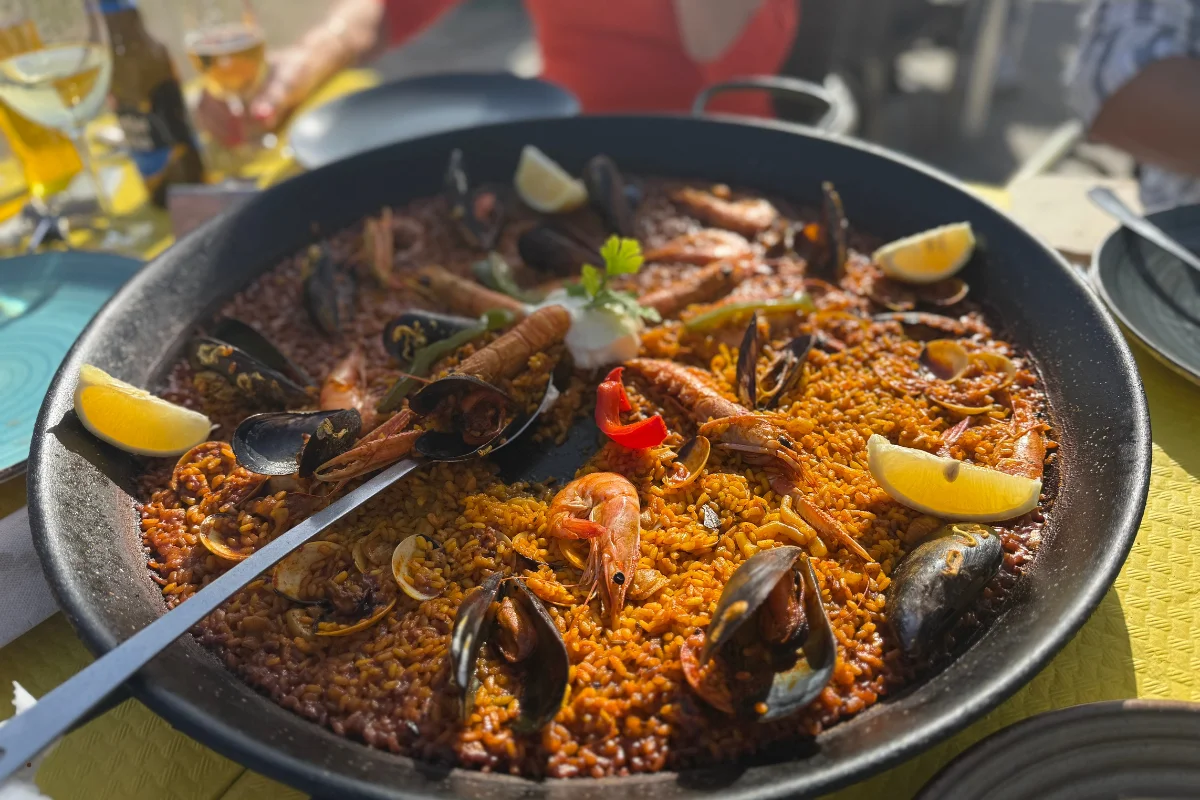

Here’s the thing to know about paella in Barcelona: the city has no traditional paella of its own. Paella is Valencian. What Barcelona has is a cluster of restaurants that make it well — and a much larger number that serve reheated rice at tourist prices to people who don’t know the difference.
The gap between the two isn’t hard to spot once you know what to look for. This guide covers the three checks to make before you order, then the specific restaurants worth going to, organized by neighborhood.
Quick Answer: Where to eat authentic paella in Barcelona? Can Solé (Barceloneta, since 1903): seafood paella and lobster rice, €30–35/person. 7 Portes (since 1836): the Parellada paella — all shells and bones removed before serving — €25.50. Can Ros (Barceloneta): reference for arròs negre (Catalan black rice with cuttlefish), €17.50. La Mar Salada: crayfish and prawn rice, modern technique. Avoid any restaurant on Las Ramblas with paella photos and prices in the window.
Quick Decision: Which Restaurant for What?
| You want… | Go to | Price/person |
|---|---|---|
| Best classic seafood paella | Can Solé | €30–35 |
| Most historic / unique experience | 7 Portes (Parellada paella) | €25.50 |
| Catalan black rice (arròs negre) | Can Ros | €17.50 |
| Modern technique, varied menu | La Mar Salada | €25–30 |
| Open kitchen, groups, gluten-free | Maná 75 | €22–35 |
| Authentic Valencian (no seafood) | La Paella de Su (Eixample) | €20–30 |
| Mountain-style rice (Catalan) | Bodega Joan (Eixample) | €20 |
| Best value in the neighborhood | Can Ros | €17.50 |
Three Checks Before You Order
Most visitors to Barcelona get bad paella not because they chose badly but because they didn’t know what to look for. These three checks take 30 seconds and filter out 80% of the tourist-trap options.
Check 1: The Price Floor
Bomba rice costs nearly double standard short-grain rice. Homemade fish or shellfish stock requires 1–2 hours of preparation. Fresh seafood has a market price with no margin for shortcuts.
A real paella for two people with genuine ingredients cannot be priced below €18 per person. When a restaurant advertises paella at €8 or €10, that price is mathematically incompatible with those ingredients — it signals ordinary grain rice, powdered or frozen stock, and pre-cooked seafood.
The practical rule: if there are paella photos with prices in the restaurant window and the location is Las Ramblas or a nearby tourist street, the price alone tells you what’s inside.
Check 2: The Cooking Time
Bomba rice paella takes 18–20 minutes over the flame, plus resting time and the socarrat finish. Total time from order to table: 30–40 minutes.
If a restaurant brings paella in 10–15 minutes, it’s pre-cooked rice being reheated. The wait is uncomfortable but it’s the most reliable signal that the rice is being made to order.
Check 3: The Socarrat
The socarrat is the toasted rice crust that forms on the bottom of the paellera. It’s not burned rice — it’s deliberately controlled toasting. To achieve it, the cook raises the heat to maximum for the last 3–5 minutes without touching the rice. It requires calibration: one minute too many and the dish is ruined; one minute too few and there’s no socarrat.
A restaurant that achieves the socarrat is paying attention during that final stage. You can verify it at the table: the scraping sound of a spoon against the pan bottom should produce a distinct crunch. That sound is what you’re listening for.
Barceloneta: The Neighborhood with the Highest Density of Real Rice
Can Solé (Since 1903)
Can Solé at Carrer de Sant Carles 4 has been in the same fishing neighborhood for over 120 years. The specialty is seafood paella and lobster rice — the latter being the ingredient that most clearly distinguishes the serious rice restaurants from everything else, because fresh lobster has a market price that allows no shortcuts.
Price range: €30–35 per person for lobster dishes. The clientele skews toward Barcelona locals and food industry professionals, which keeps the standard honest.
Reservation essential — especially weekends and high season. Walk-in waits are long or simply impossible.
📍 Carrer de Sant Carles 4, Barceloneta.
Can Ros: The Reference for Catalan Black Rice
Can Ros at Carrer de l’Almirall Aixada 7 is the neighborhood restaurant most recommended by Barceloneta locals specifically for arròs negre — black rice with cuttlefish, which is a Catalan specialty, not Valencian.
The distinction matters technically: real arròs negre has the cuttlefish ink incorporated during the stock-cooking phase, not added at the end. The result is uniformly deep black rice with a concentrated sea flavor throughout. Restaurants that add ink at the end produce black-looking rice without the correct flavor profile — the two are distinguishable by anyone who has had the real version.
Price: around €17.50 per person. No-frills neighborhood restaurant aesthetic.
📍 Carrer de l’Almirall Aixada 7, Barceloneta.
Maná 75: Open Kitchen and Gluten-Free Rice on the Promenade
Maná 75 at Passeig de Joan de Borbó 101 is the most accessible and transparent rice option on the Barceloneta seafront — the practical antidote to the pre-cooked paella that defines most promenade restaurants. The kitchen is open to the dining room, with a paella line that prepares up to 19 rice dishes simultaneously, in full view. You watch the rice being cooked, which is the opposite of the regenerated-rice model on the front line.
The technical argument is in the stock: house fumets follow a family recipe with a minimum of 8 hours of simmering, built on fresh proximity product. The menu runs to 10 rice varieties — seafood, meat and vegetable — plus Barceloneta fideuà and black fideuà. The black rice with squid and mussels and the carabinero prawn rice are the most ordered. Every paella is made gluten-free, which matters for groups with coeliac diners. Rated 4.4 with over 7,900 reviews.
Average à la carte spend €22–35 per person. The Menú Ilusión at €42 (starter, rice of your choice, dessert and coffee) is built for a full table. It’s the most comfortable promenade option for groups, families and long lunches. More information and bookings on their official website.
📍 Passeig de Joan de Borbó 101, Barceloneta.
La Mar Salada: Modern Technique, Fresh Product
La Mar Salada on Passeig de Joan de Borbó runs a broader rice menu than most Barceloneta restaurants and works with daily fresh market product. The crayfish and prawn paella is the most-ordered dish. More contemporary in presentation than Can Solé or Can Ros while maintaining correct cooking technique.
Price: €25–30 per person.
7 Portes: The Paella with an Author’s Name
7 Portes at Passeig d’Isabel II 14 — on the boundary between the Gothic Quarter and Barceloneta — has been open continuously since 1836, making it one of the oldest functioning restaurants in Spain.
The Parellada paella is the restaurant’s signature creation: named after chef Joan Parellada, it consists of a full seafood paella in which every shell and every bone is removed before the dish reaches the table. The diner gets all the flavors of a traditional seafood paella without handling any shells or picking any bones. It’s the only paella in Barcelona with a named author, and it’s been on the menu since the 19th century.
Price: €25.50 per person. The dining room preserves the atmosphere of a turn-of-the-century Barcelona restaurant — high ceilings, mirrors, dark wood, formal table service.
To book: demand from locals and informed visitors is consistent. Reserve at least 48–72 hours ahead for weekends.
📍 Passeig d’Isabel II 14.
Beyond the Barceloneta: Rice in the Eixample
Bodega Joan: Mountain-Style Catalan Rice
Bodega Joan at Carrer de Rosselló 164 in the Eixample makes arròs de muntanya amb botifarra — mountain rice with Catalan sausage, wild mushrooms, and meat instead of seafood. It’s the most distance from the tourist paella concept and the closest to Catalonia’s actual inland gastronomic tradition.
Price: approximately €20 per person. Consistently high ratings with a large volume of reviews.
La Paella de Su: Authentic Valencian in the Eixample
La Paella de Su at Carrer de Pau Claris 118 specializes in Valencian paella — chicken, rabbit, flat green beans (bajoqueta), and large white beans (garrofó). No seafood. This is the only option in this guide for the original inland version of paella as it exists in Valencia.
Authentic Valencian paella doesn’t contain seafood. The addition of prawns and mussels is an urban adaptation that doesn’t exist in Valencia itself. For anyone who wants the original rather than the coastal Barcelona interpretation, La Paella de Su is the destination.
Price: €20–30 per person.
📍 Carrer de Pau Claris 118, Eixample.
Paella vs. Arròs Negre: What’s Actually Different
Most visitors to Barcelona conflate the two, but they’re distinct dishes from different culinary traditions.
| Paella | Arròs Negre | |
|---|---|---|
| Origin | Valencian | Catalan |
| Main protein | Shellfish, meat, or both | Cuttlefish or squid |
| Color | Golden-yellow | Uniform deep black |
| Ink | None | Cuttlefish ink in the stock |
| Served with | Lemon | Homemade alioli |
| Flavor profile | Complex, saffron-forward | Intense, iodic, sea-concentrated |
The arròs negre at Can Ros in the Barceloneta is the local reference. If you’re visiting Barcelona specifically and want the Catalan version rather than the Valencian one, this is the dish to order.
Paella is Valencian, and Barcelona has its own rice
Paella is Valencian, not Catalan. Barcelona’s own contribution to rice culture is arròs negre — the Catalan black rice that predates the Barceloneta’s seafood paella tourism by centuries. Treating them as the same dish obscures what’s actually local.
They recommend Las Ramblas restaurants. No restaurant on Las Ramblas worth recommending for paella exists. The economics of Las Ramblas frontage make real ingredients and correct technique financially unviable at the prices those restaurants need to charge. The Barceloneta is a 10–15 minute walk and a completely different world.
They don’t mention the single-serving limitation. Paella is cooked in a paellera and requires a minimum quantity of rice to form a thin, even layer for the socarrat to develop correctly. Almost every serious restaurant requires a minimum of two diners per paella. Solo travelers should order arròs melós (soupy rice) or arròs al forn (oven rice), both available as single portions.
Mistakes to Avoid
Ordering based on photos in the window. In tourist-facing areas, paella photos in restaurant windows are a reliable negative signal, not a positive one. The restaurants that make it well rarely need to advertise it that way.
Not reserving Can Solé or 7 Portes. Both have consistent demand from locals and informed visitors. Weekend evenings without a reservation mean long waits or no table. Book 48–72 hours ahead minimum.
Confusing speed with efficiency. A paella arriving in under 20 minutes is pre-cooked. If the waiter says it’ll take 30–40 minutes, that’s the correct answer — it means the rice is being made from scratch.
Skipping the alioli with arròs negre. Homemade alioli served alongside arròs negre is not optional decoration — it’s part of the dish’s flavor balance. The fat and garlic of the alioli cut the intensity of the cuttlefish ink. Restaurants that make it in-house (rather than serving commercial mayonnaise) are the ones treating it seriously.
Best Strategy: How to Plan a Paella Meal in Barcelona
Lunch, not dinner. Rice dishes are traditionally a midday meal in Catalan and Valencian culture. The best restaurants prioritize their rice service at lunch — the rice is fresher, the kitchen is more focused on it, and you avoid the evening rush. Many Barceloneta restaurants stop serving rice after 16:00.
Book ahead for Can Solé and 7 Portes. Same-day walk-in works better at Can Ros, La Mar Salada and Maná 75, especially on weekdays.
Pair it with the neighborhood. The Barceloneta is worth more than a meal. After lunch at Can Solé or Can Ros, the beach, the port, and the maritime neighborhood streets are all within a few minutes on foot. The complete Barcelona travel guide covers how to build the Barceloneta into a wider city itinerary without it feeling like a single-purpose trip.
If you’re planning the meal as part of a first day in the city after arriving by plane, the Barcelona airport transport guide covers how to get to the Barceloneta directly from the airport without going through the city center first.
Cost Breakdown
| Restaurant | Price/person | Best dish | Reservation needed |
|---|---|---|---|
| Can Ros | €17.50 | Arròs negre | Recommended |
| Maná 75 | €22–35 | Black rice / carabinero rice, gluten-free | Recommended |
| 7 Portes | €25.50 | Parellada paella | Yes (48–72h) |
| La Mar Salada | €25–30 | Crayfish paella | Recommended |
| Bodega Joan | €20 | Mountain rice | Recommended |
| La Paella de Su | €20–30 | Valencian paella | Recommended |
| Can Solé | €30–35 | Lobster rice | Yes (48–72h) |
The Barcelona travel budget guide has full daily cost breakdowns by traveler profile — useful context if you’re calibrating how much to spend on a paella lunch versus other meals during the trip.
Is Paella in Barcelona Worth the Cost?
At €17–35 per person, a paella lunch at one of the restaurants on this list is one of the higher per-meal costs you’ll encounter in Barcelona. Whether it’s worth it depends on what you’re comparing it to.
The alternative — a €10 tourist paella near Las Ramblas — isn’t cheaper. It’s a different product that costs less money. The flavor gap between pre-cooked rice with frozen seafood and bomba rice made to order with fresh product and correct socarrat technique is not subtle. If you’re going to eat paella in Barcelona once, it’s worth doing it once at a restaurant that actually makes it.
If you’re pairing the meal with a day in the Barceloneta, the best neighborhoods guide covers the area as a base option — though for a single lunch, staying in the Eixample or El Born and coming to the Barceloneta specifically is the more common approach.
FAQ
What is the best paella restaurant in Barcelona?
Can Solé (Barceloneta, since 1903) for classic seafood and lobster rice at €30–35/person. 7 Portes (since 1836) for the unique Parellada paella with all shells and bones removed, at €25.50. Can Ros for the best-value Catalan black rice at €17.50. La Paella de Su in the Eixample for authentic Valencian paella without seafood.
What is socarrat in paella?
The toasted rice crust that forms on the bottom of the paellera during the last 3–5 minutes of cooking at high heat. It’s not burned rice — it’s a deliberately controlled technique that requires the cook to raise heat to maximum without touching the rice. The signal: a distinct crunching sound when you scrape the pan bottom with a spoon. It’s the clearest indicator that the paella was cooked correctly.
How much does good paella cost in Barcelona?
Between €17.50 (Can Ros) and €35 (Can Solé with lobster) per person at restaurants using real ingredients and correct technique. Below €15 per person, either the product quality or the technique is compromised. Tourist-area paellas at €8–10 use pre-cooked rice and frozen or powdered ingredients.
What is the Parellada paella at 7 Portes?
A paella created by chef Joan Parellada in which all shells and bones are removed before serving. The diner gets the full flavor of a traditional seafood paella without handling any shells or picking any bones. It’s the only paella in Barcelona with a named author. Price: €25.50 per person. 7 Portes is at Passeig d’Isabel II 14.
Is arròs negre the same as paella negra?
Not exactly. Arròs negre is a Catalan specialty made with cuttlefish and cuttlefish ink incorporated during the stock phase — it’s not a variant of Valencian paella but a distinct Catalan dish. It’s served with alioli. The Can Ros version in the Barceloneta is the local reference.
Can you get good paella near Las Ramblas in Barcelona?
No. The economics of Las Ramblas frontage make genuine ingredients and correct technique financially unviable at the prices those restaurants charge. The Barceloneta is 10–15 minutes on foot and is where the serious rice restaurants are concentrated.
Can one person order paella in Barcelona?
Usually not. Paella requires a minimum rice quantity to form the correct layer thickness for socarrat development. Most serious restaurants require a minimum of two diners per paella. Solo diners should order arròs melós (soupy rice) or arròs al forn (oven-baked rice), both available as single portions.