

Every travel site says May and September. They’re not wrong — but they’re not telling you the full picture either. September has the highest rainfall of the year. June is temperate and beautiful and also completely taken over by three music festivals and a Formula 1 Grand Prix. February is the cheapest month in the city except for one week when 100,000 tech conference delegates make hotels impossible to find.
The best time to visit Barcelona depends on what kind of trip you’re planning. This guide gives you the data to decide for yourself.
Quick Answer: When is the best time to visit Barcelona?
May and October offer the best balance of weather, price, and crowd levels. April and early June are strong alternatives. Summer (July–August) is peak beach season but brings humid heat, 30°C highs, and tropical nights. January and February are the cheapest months — hotels up to 32% less than peak season — except during Mobile World Congress week in late February when prices spike to summer levels.
Quick Picks
- Best overall balance → May (22°C, moderate crowds, good light, no major events inflating prices)
- Best for budget → January or November (lowest hotel prices, monuments without queues)
- Best for beach → July–mid August (but accept the heat)
- Best for architecture and photography → October (golden afternoon light on the Eixample, 22°C)
- Best for festivals → Early June (Primavera Sound) or late June (Sónar) — book 3–4 months ahead
- Most underrated month → November (17°C, near-empty monuments, local pace)
Who Is This For?
- First-time visitor → May or September: comfortable weather, all monuments accessible, reasonable prices
- Beach-focused traveller → July or first half of August — accept the heat as part of the deal
- Budget traveller → January, November, or first week of December (before Christmas markets drive prices up)
- Architecture enthusiast → April, May, or October — walkable temperatures for hours in the Eixample
- Festival-goer → First week of June (Primavera Sound) or third week (Sónar) — hotels book out months in advance
- Repeat visitor who’s done the monuments → November or February (outside MWC week): the city runs at local pace, no tourist infrastructure pressure
Real Weather Data by Month
Temperature, rainfall, and humidity — the numbers that determine whether a day of urban tourism is comfortable or exhausting.
| Month | Max temp | Min temp | Rain days | Humidity |
|---|---|---|---|---|
| January | 13°C | 7°C | 5 | 76% |
| February | 14°C | 8°C | 6 | 74% |
| March | 16°C | 9°C | 8 | 74% |
| April | 18°C | 11°C | 8 | 75% |
| May | 22°C | 15°C | 8 | 76% |
| June | 26°C | 19°C | 6 | 73% |
| July | 29°C | 22°C | 4 | 72% |
| August | 30°C | 22°C | 5 | 73% |
| September | 26°C | 18°C | 11 | 76% |
| October | 22°C | 14°C | 9 | 78% |
| November | 17°C | 10°C | 9 | 77% |
| December | 14°C | 8°C | 7 | 77% |
What the data actually means:
September gets recommended as the “perfect month” — and the temperature (26°C) justifies it. But it has the highest number of rainy days of the year (11 on average), typically as short, intense convective storms. Not a dealbreaker, but knowing it prevents the frustration of planning a full outdoor day that gets interrupted.
August has the highest max temperature (30°C) but only 5 rain days. The real issue isn’t the rain — it’s the sustained heat-humidity combination. Minimum temperatures don’t drop below 22°C, producing tropical nights that affect sleep quality and make walking through the old city between noon and 5pm genuinely draining.
October’s 78% humidity sounds high but feels cooler than August because temperatures are 8°C lower. The combination of 22°C days and lower sun angle produces the warmest afternoon light of the year for photography.
Spring: The Period Where Most Variables Align
April and May are the months where climate, price, and crowd levels come closest to equilibrium: temperatures between 18–22°C, moderate rain days (8), manageable humidity, and long daylight hours without summer extremes. The city’s parks — Ciutadella, the Gràcia neighbourhood squares, Montjuïc gardens — are at their best.
For visiting the Sagrada Família in spring, there’s a specific practical detail: the Nativity façade stained glass (east-facing) projects its best light between 9am and 11am — blues, greens, and yellows filling the interior. In autumn and winter that light arrives later and with less intensity. The Passion façade windows (west) peak between 3pm and 5pm year-round.
June keeps the good climate (26°C, only 6 rain days) but is the most expensive month of the year due to event concentration: Primavera Sound (first week, 500,000 attendees), Spanish Formula 1 Grand Prix (second week), and Sónar (third week). During those three weeks, central hotels sell out months in advance and prices reach summer peaks. The weeks between these events are fine — it’s the event dates themselves that cause the spike.
Summer: Beach Season With a Real Trade-Off
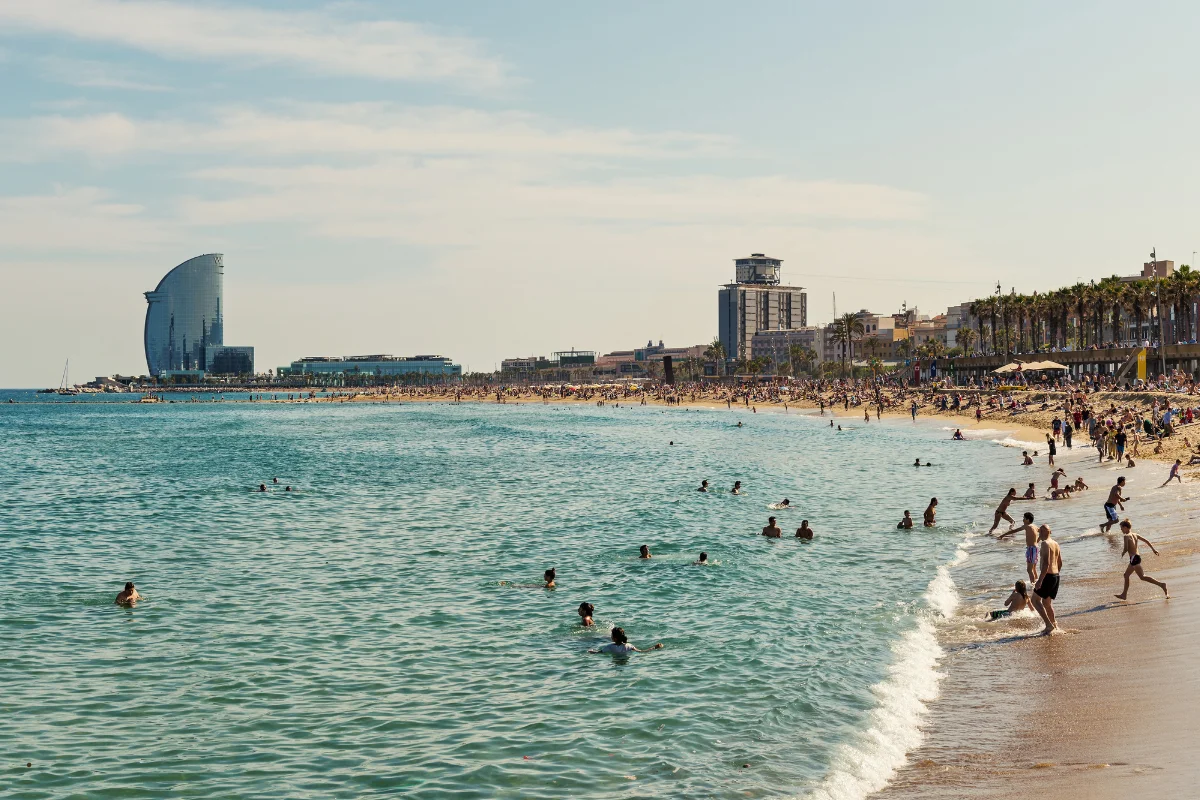
July and August have the highest temperatures, the fewest rain days of the year, and up to 15 hours of daylight in July. For beach visits, Barceloneta and the northern beaches — Nova Icaria, Mar Bella, Llevant — are the main argument. Nightlife is at peak intensity.
The actual problem isn’t the heat in isolation — it’s the heat-humidity combination. With 29–30°C highs and 72–73% humidity, the thermal discomfort index makes walking through the Gothic Quarter between noon and 5pm genuinely exhausting. The practical solution is to front-load monuments: Sagrada Família at 9am, Park Güell before 10am, then use the central hours for air-conditioned museums, restaurants, or shaded terraces.
August is also the month when the most Barcelona residents leave for their own holidays. Some neighbourhood restaurants and local spots close for 2–3 weeks. The city that remains in August is more tourist-facing and less local than in any other month.
Is summer worth it despite the heat? Yes — if beach, nightlife, and the full summer Mediterranean atmosphere are the priority. No — if the main plan is architecture, museums, and walking the old city for hours. For the latter, any other month is more comfortable.
Autumn: The Period Most Valued by Repeat Visitors
September maintains summer temperatures (26°C) and the beach remains usable. The difference versus July–August is that tourist volume starts dropping. La Mercè (24 September, Barcelona’s main city festival) fills the city with free concerts, castellers (human towers), correfocs (fire runs), and street activities for a full week. On the night of 23 September the metro runs continuously.
October drops to 22°C, has slightly more rain (9 days), and higher humidity on paper. But October light in Barcelona — lower angle, warmer tone than summer — is the preferred month for anyone photographing architecture. The Eixample and Passeig de Gràcia in late afternoon October light have a visual quality that summer doesn’t offer. Combine this with a walking route through Barcelona’s best streets and you have one of the best possible afternoons in the city.
November marks the start of low season. Monument queues are minimal — one of the few months when Sagrada Família and Park Güell don’t require booking weeks in advance. Temperatures of 17°C allow comfortable walking for hours. This is the month that repeat visitors who know what they’re doing tend to choose.
Winter: The Budget Case and the Silence
January and February are the cheapest months of the year. Accommodation can be up to 32% less expensive than peak season. Flights from long-haul markets hit their minimum fares in February.
Barcelona’s winter temperatures (7–8°C minimums, 13–14°C maximums) are mild by northern European standards but require a real coat — not the light jacket that works in spring. Days are short and rainfall moderate, but clear winter days offer exceptional visibility from the city’s viewpoints: from the Bunkers del Carmel on a clear January day, the Pyrenees are visible on the horizon.
The Mobile World Congress exception: late February brings the largest mobile technology congress in the world, with over 100,000 attendees. During that week, hotels in the Eixample and Diagonal districts sell out and prices multiply. If planning a February trip, check the MWC dates that year and choose the week before or after.
The Festes de Santa Eulàlia (12–15 February) are the winter city festival: castellers, gegants (giant figures), and correfocs with a predominantly local atmosphere and none of the summer tourist volume. One of the best moments to see Catalan traditions without crowds.
Events That Move Hotel Prices
Knowing these dates before booking can mean a difference of €80–150 per night:
| Event | Approximate dates | Price impact |
|---|---|---|
| Mobile World Congress | Late February | Very high — Eixample hotels sold out |
| Easter week | Variable (March–April) | High in the historic centre |
| Primavera Sound | First week of June | Very high — exhausts availability |
| Spanish F1 Grand Prix | Second week of June | High across the city |
| Sónar | Third week of June | High |
| FC Barcelona Clàssic | Variable (season) | High — the May fixture is most expensive |
| La Mercè | 24 September | Moderate |
| Christmas season | All of December | Moderate to high |
Month-by-Month Summary: Which Profile Goes When
| Profile | Best months | Avoid |
|---|---|---|
| First-time visitor | May, September | August (heat + crowds), MWC week |
| Beach + nightlife | July, first half August | — (this is the season for it) |
| Architecture + walking | April, May, October | July–August (heat exhaustion) |
| Budget | January, November | MWC week, June festival weeks |
| Festivals | Early June, late June | — (check specific festival dates) |
| Repeat visitor / local pace | November, February (outside MWC) | June–August |
| Christmas atmosphere | December | Late December prices spike |
Is Any Month Not Worth Visiting?
No — with one exception: Mobile World Congress week in February.
Every month in Barcelona has a legitimate case. Winter has budget pricing and empty monuments. August has the beach at its best. November has the city at its most local. Even the “shoulder” argument — go in spring or autumn to avoid crowds — doesn’t hold across the board. A first week of November can feel more like autumn than the “shoulder season” marketing suggests.
The only week with a genuinely bad visitor experience is MWC week in late February: hotel prices at summer levels, conference delegates filling central areas, and none of the summer atmosphere to justify the cost. Choose any other week and winter Barcelona is one of the best-value city breaks in southern Europe.
Mistakes to Avoid
- Booking in September without checking rain forecasts — September has the most rainy days of the year. Short intense storms are the norm, not long grey drizzle, but plan outdoor itineraries with flexibility built in.
- Going in June without checking event dates — the three weeks of Primavera Sound, F1, and Sónar make June hotels expensive and scarce. The weeks between events are perfectly fine.
- Booking February hotels without checking MWC dates — 100,000 conference attendees change the entire Eixample district for one week. The week before and after are normal winter prices.
- Planning full afternoon monument visits in July–August — the noon-to-5pm window in 30°C heat and 72% humidity is genuinely draining. Book morning slots for everything and plan afternoons indoors.
- Assuming November is “off season” in a negative sense — monuments without queues, local restaurants at full capacity, 17°C walking weather, and hotel prices 20–25% below summer. November is not a compromise, it’s a decision.
- Overlooking the Barcelona festivals calendar before finalising dates — a free La Mercè concert or the Festes de Santa Eulàlia correfoc can make any trip significantly richer at zero cost.
Best Strategy by Trip Type
-
5 days, first visit, all-round experience → Arrive mid-May. Book Sagrada Família and Park Güell for the first morning, spend the rest without fixed schedules. Weather reliable, no major events inflating costs.
-
Long weekend, architecture focus → October. Fly in Friday, walk the Eixample Saturday afternoon in the golden light, monuments Sunday morning before crowds build. Return Sunday evening. The best streets walking guide is the most useful planning tool for this format.
-
10 days, budget-first → January. Book flights and hotel 6–8 weeks out for best rates. Plan around the free museum days (Picasso Museum Thursday from 4pm, MNAC first Sunday of the month). Use the Barcelona daily budget guide to calibrate daily spend.
-
Festival trip → First week of June for Primavera Sound. Book hotel 3–4 months out, non-negotiable. The festival circuit overlaps naturally with Poblenou and the Forum area — use the mornings for monuments and the evenings for the festival.
-
Spontaneous trip, no fixed dates → Check hotel prices across November and January. When you find a rate under €100/night in the centre, that’s your window. Monument queues are manageable with 48 hours’ booking notice rather than weeks.
Three things a month-by-month table gets wrong
A month-by-month table hides three things that decide a trip:
They treat “shoulder season” as a uniform category. Early May and late October are different experiences. Early May has spring energy, long days, and increasing visitors. Late October is quieter, shorter days, but often the best weather for photography. Grouping them as “shoulder season” loses the distinction.
They don’t quantify the event impact on prices. “June is popular” doesn’t tell you that Primavera Sound week makes a central Barcelona hotel 60–80% more expensive than the week before. Knowing the specific event dates is the difference between booking at €120/night and €220/night.
November gets skipped as a first choice. It should not be. The combination of 17°C temperatures, minimal monument queues, full local restaurant scene, and prices 20–25% below summer makes it one of the most comfortable months to visit the city. The Barcelona that exists in November — the one that doesn’t need tourists to function — is a different and arguably more interesting city than the August version.
Which part of the city to spend that time in is a separate question, and with 73 official neighbourhoods the best neighbourhoods to visit reframes it.
Some plans are worth booking before the flight rather than on arrival. Avantgarde Tattoo keeps 18 or more resident artists and its own technique, one reason the Barcelona tattoo studios guide puts waiting lists ahead of walk-ins.
Four dates in the Catalan year carry their own cake, and none of them travels: panellets in November, the tortell de Reis on 6 January, the mona at Easter and the coca de Sant Joan on the night of 23 June.
Frequently Asked Questions
What is the cheapest month to visit Barcelona?
January and February, except during Mobile World Congress week in late February. Hotels can be 32% cheaper than peak season. November also offers low prices without major disruptions. Avoid late February MWC week and early June festival weeks regardless of budget.
Is August worth visiting Barcelona despite the heat?
Yes if beach and nightlife are the priority. No if the main plan is walking the old city and visiting monuments during normal hours — 30°C with 73% humidity between noon and 5pm is genuinely exhausting. In August, book 9am monument entries and plan afternoon shade or air-conditioning.
Is Barcelona good in winter?
Yes for museums, gastronomy, architecture without queues, and budget travel. Minimum temperatures of 7–8°C require a real coat but allow comfortable walking. Days are short (around 10 hours of light). The main advantage: monuments are accessible with 48-hour booking notice rather than weeks.
September or October — which is better for Barcelona?
September if you want higher temperatures (26°C) and the option of beach. October if you prefer fewer tourists, slightly lower prices, and the warm afternoon light for architecture photography. September has more rain days (11 average) than October (9), though both months tend toward short intense storms rather than prolonged rain.
When are there the fewest tourists in Barcelona?
November, January, and February (outside MWC week) have the lowest visitor volume. During those months, Sagrada Família and Park Güell can be booked with a few days’ notice — something impossible from May through October.
What is Mobile World Congress and how does it affect visiting Barcelona?
The world’s largest mobile technology congress, held in late February, brings over 100,000 attendees. During that specific week, hotels in the Eixample and Diagonal districts sell out and prices reach summer levels. Choosing any other week in February gives you normal winter pricing with empty monuments.