
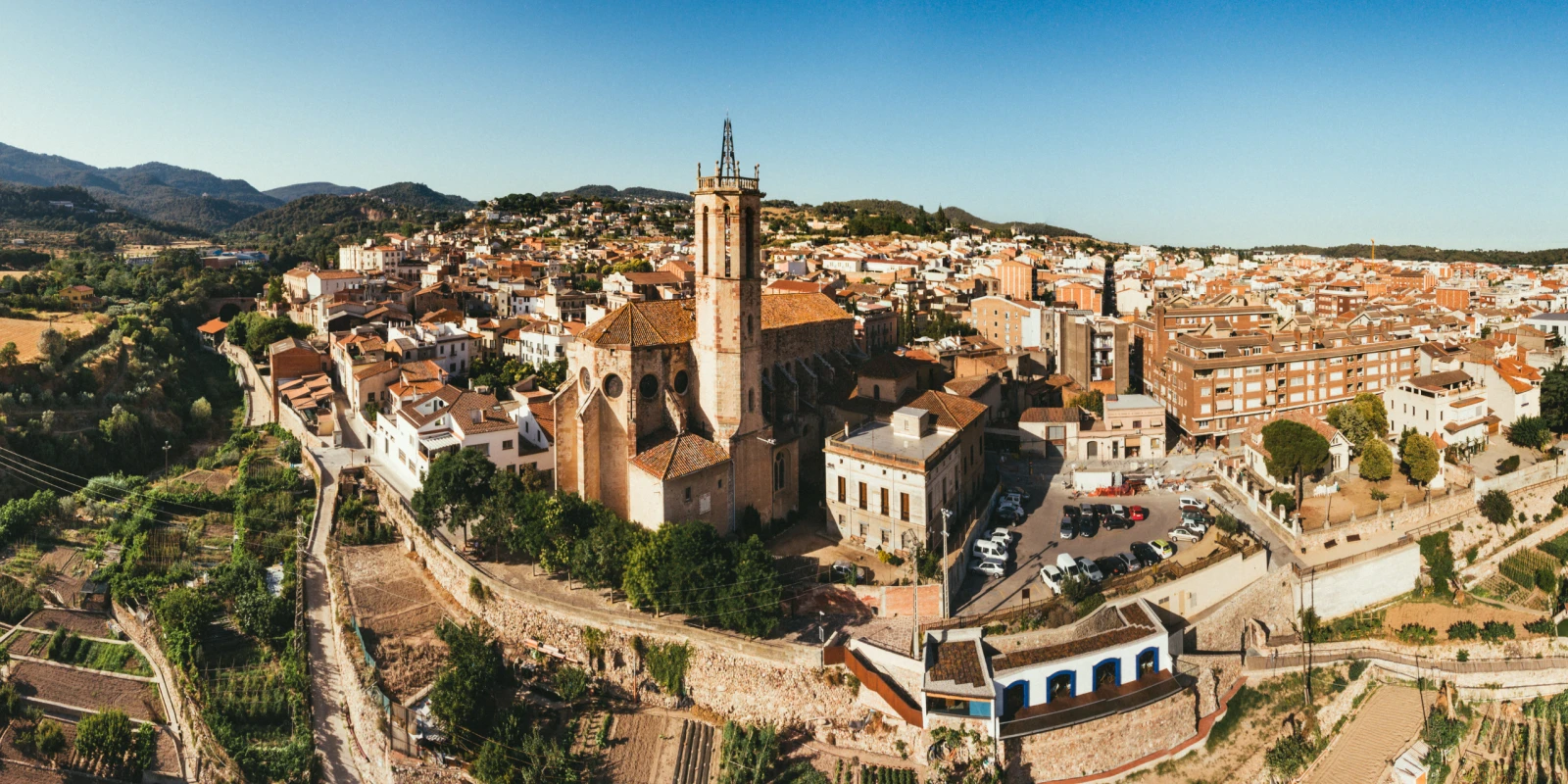

The public washhouses in Caldes de Montbui are still used for laundry, and the water in them is thermal. It is not a reconstruction for visitors but a working town service fed by the mineral spring under the streets.
That one detail explains the rest. Here hot water is infrastructure rather than a spa product, and it has been since the Romans built baths on the same spring.
What is there to see in Caldes de Montbui? Roman baths among the best preserved in Europe, the Font del Lleó spring running at 74 degrees, public washhouses still in use, and the Thermalia museum, which holds work by Manolo Hugué and Picasso for 3.70 euros. The town has no train station.
Getting there without a station
Caldes de Montbui has no railway station: no Rodalies line reaches it. Travel is on the Sagalés e9, which leaves Barcelona every 20 to 30 minutes and takes around 45.
That is what separates Caldes from thermal towns like La Garriga or Arenys de Mar, which are on the commuter network, and why it appears less often in rail day-trip lists. The full comparison is in Catalonia without a car.
The tourist office is the museum itself, at plaça de la Font del Lleó 20, on 938 654 140. For a visitor without a car the practical consequence is good: the bus drops you in town and all five sights are within the old centre on foot, so one bus ticket and 45 minutes covers the day’s travel.
What to do first, in order
The whole town works on foot from one square, so the order matters less than the clock. Museum mornings and bath evenings is the pattern that fits the opening hours.
- Arrive by 11:00 on the Sagalés e9, 45 minutes from Barcelona.
- Thermalia and the Roman baths, 3.70 euros, roughly 90 minutes for both.
- Font del Lleó and the washhouses, free, on the walk between the two.
- Lunch in the old town, all of it inside the same few streets.
- El Safareig baths at 19:00, 7 euros, open until 22:00.
Total admissions for that day come to 10.70 euros.
The Roman baths, in the middle of town
The Termes Romanes of Caldes are among the best preserved classical bathing complexes in Europe, and they sit in the middle of the town rather than in a fenced archaeological site.
They are visited through the museum, which manages the complex and doubles as the tourist office. The town kept growing on top of the hot water instead of moving away from it, which is why the Roman baths, the communal washhouses, the 7-euro municipal bath and the two hotel spas all share a spring and all sit around the plaça de la Font del Lleó.
Guided walks leave from the museum, last around 50 minutes and cost between 2.35 and 3.70 euros. They earn their price because much of the thermal heritage here is built into everyday streets and not labelled as a monument.
A spring at 74 degrees
At the Font del Lleó the water emerges at 74 degrees, the highest temperature of any thermal water in the Iberian Peninsula. It can be seen without paying or booking anything.
The obvious warning applies: at that temperature the water scalds. Spas cool it in stages before use, so no circuit anywhere runs at the temperature of the spring itself.
The two hotel spas, the municipal bath and the washhouses all draw on that same 74-degree source, and the only difference between them is how far the water is cooled and how much you pay to sit in it: 34 euros at Broquetas, 7 at El Safareig, nothing at the washhouses.
Broquetas sells a 90-minute circuit with a drink at 34 euros and neither spa requires a room booking, which surprises most people reading their hotel pages. Termes Victòria publishes no price at all and takes bookings on 93 865 01 50; it runs two separate spaces, the Espai CEL and the classic balneario. Put against the 3.70-euro museum, a 34-euro circuit is nine times the price of the town’s best exhibit. The wider picture is in thermal spas near Barcelona.
Bathing for 7 euros
The Banys Termals El Safareig belong to the town council. Entry is 7 euros and the reduced rate 4.50 for under-16s, students, pensioners, unemployed visitors and youth card holders.
It opens Wednesday to Sunday in three blocks, 10:00 to 15:00, 16:00 to 18:00 and 19:00 to 22:00, with booking through safareigtermal.cat or on 618 796 725. The booking line runs Wednesday to Sunday and holidays from 10:30 to 14:00 and 16:30 to 21:00, a shorter window than the baths themselves.
That evening block is what no hotel spa in the area offers, and it is what turns the trip into an after-dinner plan rather than a full-day commitment.
Practical note on the calendar: the baths close Mondays and Tuesdays and the museum closes non-holiday Mondays, so a three-day weekend falling on those days can leave both shut. Pairing the 3.70-euro museum in the morning with the 7-euro bath in the evening is the standard day here, at 10.70 euros of admissions in total.
The museum with the Picasso collection
Thermalia occupies the former Hospital de Santa Susanna, a Gothic building from the late 14th century that incorporates a Romanesque chapel consecrated in 1403.
Inside there are three separate things: a temporary exhibition hall, an interpretation centre on thermalism, and two floors given over to the Mas Manolo collection. That collection is the main public showing of the sculptor and painter Manolo Hugué, and it comes with a series of ceramics, lithographs and drawings by his friend Pablo Picasso.
| Ticket | Price |
|---|---|
| General admission | 3.70 euros |
| Reduced | 2.35 euros |
| Under-10s | free |
| First Sunday of the month | free |
| Guided tour | 2.35 to 3.70 euros |
| Combined ticket | 5.30 to 5.45 euros |
The reduced rate covers pensioners, students, unemployed visitors and large families. ICOM members, teachers and youth card holders also enter free, and the first Sunday of the month opens the whole museum to everyone at no cost.
Two of the three floors are given to the Mas Manolo collection, so this is not a token display tucked beside the thermal exhibits. The thermalism interpretation centre and the temporary exhibition hall take the remaining space, which makes the visit closer to 90 minutes than the 30 a village museum usually needs.
A collection including Picasso ceramics for under four euros is the single strongest argument for making the trip, and it reframes what looks like a spa day. For scale, the Picasso Museum in Barcelona is a different order of size and price entirely.
Opening hours change with the season
The museum runs two timetables a year, and Monday closing is the constant.
September to May it opens Tuesday to Saturday from 10:00 to 14:00 and 16:00 to 19:00, with Sundays and public holidays from 10:00 to 14:00.
In June, July and August the afternoon shifts later: Tuesday to Saturday from 10:00 to 14:00 and 17:00 to 20:00, with the same Sunday hours.
Non-holiday Mondays are closed. That is the easiest mistake to make here, because the municipal baths also rest on Mondays and Tuesdays, so a Monday in Caldes leaves the town running at half power. The same first-Sunday logic that governs the museum applies to the free museum days in Barcelona.
Why this works as an off-season day
Caldes makes a poor summer trip and a very good winter one, which is the opposite of most day trips out of Barcelona.
The contrast between a 74-degree spring and cold air outside is most of the appeal, and the museum’s later summer closing at 20:00 does not compensate. Between October and March the same combination of museum, Roman baths and an evening bath costs 10.70 euros for the two tickets and fills a short winter day cleanly.
It is also indoor-heavy, which makes it one of the more reliable wet-weather options among the best villages near Barcelona. For choosing the month, the best time to visit Barcelona uses the same criteria.
Frequently asked questions about Caldes de Montbui
Is there really a Picasso collection in Caldes de Montbui?
Yes. Two floors of the Thermalia museum hold the Mas Manolo collection, the main public showing of sculptor and painter Manolo Hugué, together with ceramics, lithographs and drawings by his friend Pablo Picasso. General admission is 3.70 euros.
How do you get to Caldes de Montbui from Barcelona?
By bus, because the town has no railway station. The Sagalés e9 line leaves Barcelona every 20 to 30 minutes and takes around 45. That is what separates Caldes from thermal towns like La Garriga or Arenys de Mar, which sit on the Rodalies network.
What does the Thermalia museum cost and when does it open?
General admission is 3.70 euros and the reduced rate 2.35. Under-10s go free and the first Sunday of each month is free for everyone. It opens Tuesday to Saturday and Sunday mornings, and closes on non-holiday Mondays.
Is Caldes de Montbui worth a day trip from Barcelona?
As a winter or wet-weather day, yes. Museum plus municipal bath costs 10.70 euros for the two tickets, the bus takes 45 minutes each way and everything sits inside one old town on foot. As a summer trip it competes badly with the coast.
Can you bathe in the thermal water cheaply?
Yes, at the municipal Banys Termals El Safareig. Entry is 7 euros, or 4.50 reduced. It opens Wednesday to Sunday and includes an evening slot from 19:00 to 22:00, with booking through safareigtermal.cat or on 618 796 725.
The other Girona thermal town works the opposite way: three hills, three springs and five street fountains giving the water away, in the Caldes de Malavella guide.
Which day not to come
Monday. The Thermalia museum closes on non-holiday Mondays and the Banys Termals El Safareig rest Monday and Tuesday, so a long weekend falling on those days locks out both of the tickets the visit rests on, the 3.70-euro one and the 7-euro one.
What survives any day is the street. The Font del Lleó at 74 degrees, the Roman baths and the public washhouses are all outdoors, free and without opening hours, so a morning in the town works even with everything shut.
The second weak slot is Sunday afternoon, because the museum opens only from 10:00 to 14:00 on Sundays and public holidays while the municipal bath runs until 22:00.
For a single day, museum in the morning and bath in the evening from Wednesday to Saturday is the arrangement that fits both timetables. Prices and hours were read on 21 August 2026 from visiteucaldes.cat and the Ajuntament de Caldes de Montbui.
In Caldes the hot water is still a town service rather than a product.