

An hour after leaving Barcelona by train, the modern coastline gives way to a hilltop where Latin inscriptions still sit in the walls of lived-in buildings. This is the closest you get in Catalonia to walking inside a Roman provincial capital without paying for a guided tour or driving anywhere. Ancient Tarraco was not fenced off into a single dig — it is scattered under the balconies, bars and squares of the old town, which is exactly why one day on foot covers it.
Is one day enough to see Roman Tarragona? Yes. The main monuments of Tarraco — the walls, circus, praetorium and amphitheatre — cluster within roughly one square kilometre of old town and can be walked in a single day. Individual entry costs €5 and the combined Museum of History ticket €15. The site has been a UNESCO World Heritage listing since 2000.
Tarragona rewards the day-tripper because of how tightly its ruins are packed. What would need a car in most Roman cities here becomes a continuous walk downhill, following the same terraced layout the Romans built — worship at the top, administration in the middle, entertainment by the sea.
Getting there from Barcelona, train versus high-speed
The single most useful decision happens before you arrive, and it is which train to take. According to Tarragona’s tourism board, the regional Rodalies line drops you in the centre, while the faster AVE leaves you 10 km outside town. For a one-day visit centred on the old town, the slower train is almost always the better choice.
| Option | From | Time | Arrives | Note |
|---|---|---|---|---|
| Rodalies regional | Barcelona-Sants | 1h-1h15 | Tarragona central | Walk to the old town in minutes |
| AVE high-speed | Barcelona-Sants | ~35 min | Camp de Tarragona | 10 km out, bus or taxi transfer needed |
| Car | Barcelona | ~1h15 | City edge | Low-emission zone restricts the historic centre |
If you are stringing several stops together, this fits neatly alongside other day trips by train from Barcelona.
What changes in 2026 before you go
Check what is open before mapping anything. According to the official Museum of History calendar, in 2026 the Forum of the Colony and the Castellarnau House are closed for building works, and the Necropolis remains under restoration. The main museum is also under works, so its collection is shown meanwhile at the TARRACO/MNAT exhibition in Tinglado 4 at the port, for €4.
One date worth checking before you book: on 5 July 2026, every Museum of History site opens free, coinciding with the Tour de France stage departing from Tarragona. If your visit lands on that day, you save the €15 combined ticket.
Quick decision by what you want
- Arriving by train without a car → walking route through the high town — everything within about 1 km, no transport
- Family with kids under 12 → the Tarraco model with video mapping — free entry for children, €5 for adults
- Photographer → the amphitheatre by the sea early — side light across the arena with the Mediterranean behind
- Half a day only → walls, circus-praetorium and amphitheatre — the three essentials on the €15 combined ticket
- Visiting three or more sites → combined Museum of History ticket €15 — versus €5 for each separate monument
- Travelling on a Monday → cathedral and the Francolí complex — the Museum of History sites close that day
Before you set off, a warning on prices. Many resale sites still show outdated fares of €11.05 or €7.40. The current official prices are €5 per site and €15 for the combined ticket — ignore the rest.
The high town, where most of Tarraco sits
Start at the Tarraco model in the Pallol Vault, not a monument but a map of one. It reproduces the 2nd-century city at 1:500 scale and fills 18 m³, making it the second-largest model of the Roman world in Europe after Rome’s. Entry is €5, free for under-12s, and local guides recommend it first because it explains the terraced layout before you climb through it. The video mapping projected onto it needs a prior booking.
The walls are the oldest standing Roman construction outside Italy. Built in the 2nd century BC, they originally ran about 3,500 metres, of which 1,100 survive around the old town. Walk the Archaeological Promenade between the Roman wall and a later outer one, and look for the Tower of Minerva, which holds the oldest Roman sculpture and inscription on the Iberian Peninsula.
A few minutes on, the Roman circus shows Tarraco fused into the modern city. Built in the late 1st century AD for chariot races, it held around 30,000 spectators and ran more than 300 metres, much of it now buried under 19th-century buildings — the town hall square sits directly on the old central barrier. The same €5 ticket lets you climb the Praetorium tower for a 360-degree view over the old town and the sea, with vaulted passages connecting down to the circus galleries.
The cathedral crowns the hill over the former imperial cult enclosure. Its foundations sit on the temple dedicated to Augustus, who lived in the city between 27 and 25 BC during a Hispanian campaign. Note that the cathedral is run separately and is not part of the combined ticket — entry is €12.50, so decide in advance whether to include it.
Down to the sea and beyond
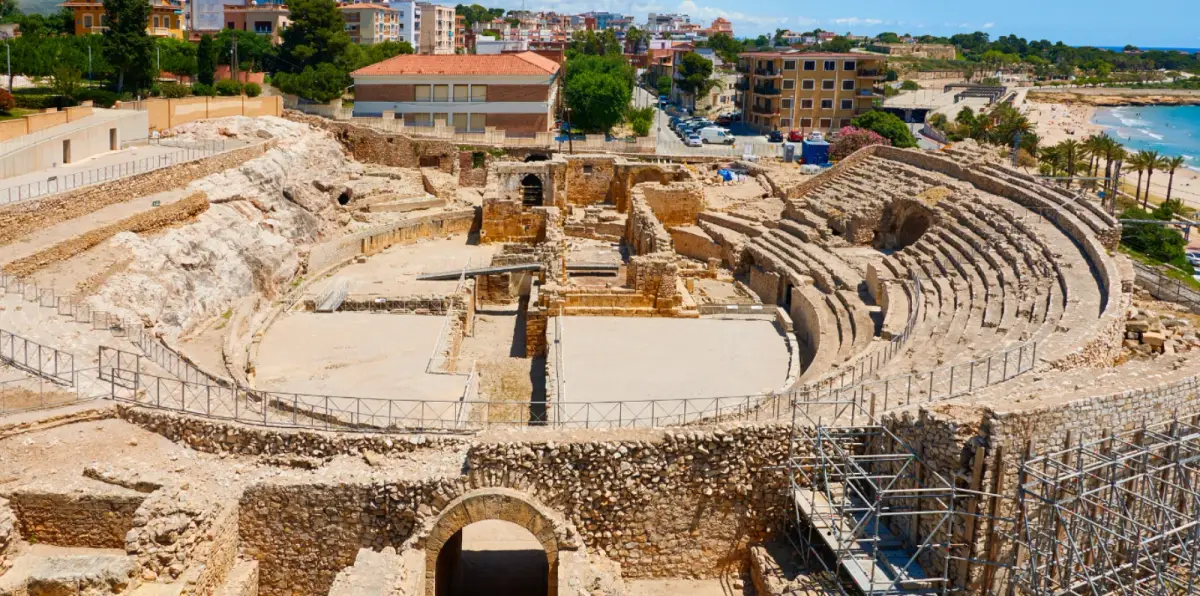
The amphitheatre is the city’s defining image, cut in an ellipse into the slope that drops to the Mediterranean. Built in the late 2nd century AD, it measured 130 by 102 metres and seated 14,000 for gladiator fights and animal hunts, with the shoreline making it easy to unload animals and materials. On the arena floor, two later layers survive — Bishop Fructuosus was executed here in 259, and a Visigothic basilica and the Romanesque church of Santa María del Miracle were later built over the sand. Entry is €5.
Four kilometres from the centre, the Les Ferreres aqueduct, known as the Devil’s Bridge, closes the day away from the crowds. This double tier of arches from the 1st century AD runs 217 metres long and nearly 27 metres high, fitted without mortar across a wooded ravine. You can walk along the upper channel where the water once flowed, and access is free every day — city buses 5 and 85 reach it from Plaça Imperial Tàrraco.
Is it worth building a full day around it
Verdict — yes, with one condition. Tarragona is worth a dedicated day if you want Roman depth rather than a single photo stop, because nowhere else on the Catalan coast packs this many standing monuments into a walkable centre.
It is not worth it if you are travelling on a Monday, when the Museum of History sites close and you are left with the cathedral and the Francolí complex, or if you are chasing only the amphitheatre — that single view does not justify the trip on its own. For a slower coastal alternative, Sitges as a day trip leans on beaches over ruins, while Girona trades Roman scale for medieval streets.
Hour-by-hour route to avoid wasting time
This plan spends the morning in the high town and leaves the sea and outskirts for the afternoon, when the sun is lower.
| Time | Stop |
|---|---|
| 09:00 | Tarraco model and video mapping |
| 09:30 | Walls and Archaeological Promenade |
| 10:30 | Circus and Praetorium tower |
| 11:30 | Cathedral over the Temple of Augustus |
| 13:00 | Lunch in the high town |
| 14:30 | Amphitheatre by the sea |
| 16:00 | Les Ferreres aqueduct |
The Roman theatre, more fragmentary, can only be visited by prior booking on Sundays at 11:00, free through the MNAT. If your day is not a Sunday, leave it out.
Costs and tickets worth knowing
- Individual Museum of History ticket €5 per site — valid for one monument
- Combined Museum of History ticket €15 — amphitheatre, walls, circus-praetorium and Casa Canals, pays off from 3 sites
- TARRACO/MNAT at Tinglado 4 €4 — the museum collection during the works, €2 reduced
- Cathedral €12.50 — run independently, not in the combined ticket
- Les Ferreres aqueduct free — open-access site every day
Entry is free for under-12s, on the last Tuesday of each month during the Museum of History open day, and on 5 July 2026 for the Tour de France. Students, young people aged 12 to 17, and seniors get 50% off, applied at the ticket desk with proof. To pick the right season for the trip, the best time to visit the region is worth checking first.
What to know before you go
- The Museum of History sites close on Mondays; the cathedral and the Francolí complex open instead
- Last entry is 30 minutes before closing at every monument
- The amphitheatre and walls have no shade, so bring a hat and water
- The Imageen Tarraco app reconstructs the monuments in augmented reality on site
- The Forum of the Colony and Castellarnau House are closed for works
- The high-town streets are cobbled, so wear comfortable shoes
Tarragona works best as a first escape for travellers who already know the capital and want something beyond the main sights of Barcelona, or as one stop on a wider trip planned around the complete Barcelona travel guide.
Frequently asked questions about Roman Tarragona
Is one day enough to see Roman Tarragona?
Yes. The main monuments of Tarraco — the walls, circus, praetorium and amphitheatre — cluster within the old town and can be walked in a single day. Individual entry costs €5 and the combined Museum of History ticket €15. The site is a UNESCO World Heritage listing.
How much do the Roman monuments in Tarragona cost?
Each Museum of History site costs €5 separately, and a combined ticket to four sites is €15, which pays off from three visits. The MNAT collection at Tinglado 4 in the port costs €4, and the aqueduct outside town is free to visit any day.
Which Tarragona monuments are closed right now?
According to the official Museum of History calendar, the Forum of the Colony and the Castellarnau House are closed for building works, and the Necropolis is under restoration. Its pieces are shown in the TARRACO/MNAT exhibition at Tinglado 4 in the port instead.
How do you get from Barcelona to Tarragona?
A Rodalies regional train leaves Barcelona-Sants and reaches Tarragona’s central station in 1h-1h15, within walking distance of the old town. The high-speed AVE takes around 35 minutes but arrives at Camp de Tarragona, 10 km out, needing a bus or taxi transfer.
Take the regional train, start at the model, then follow the slope down to the amphitheatre and leave the aqueduct for last. Tarraco is not a ruin you enter; it is a living city that never stopped using its own foundations.