
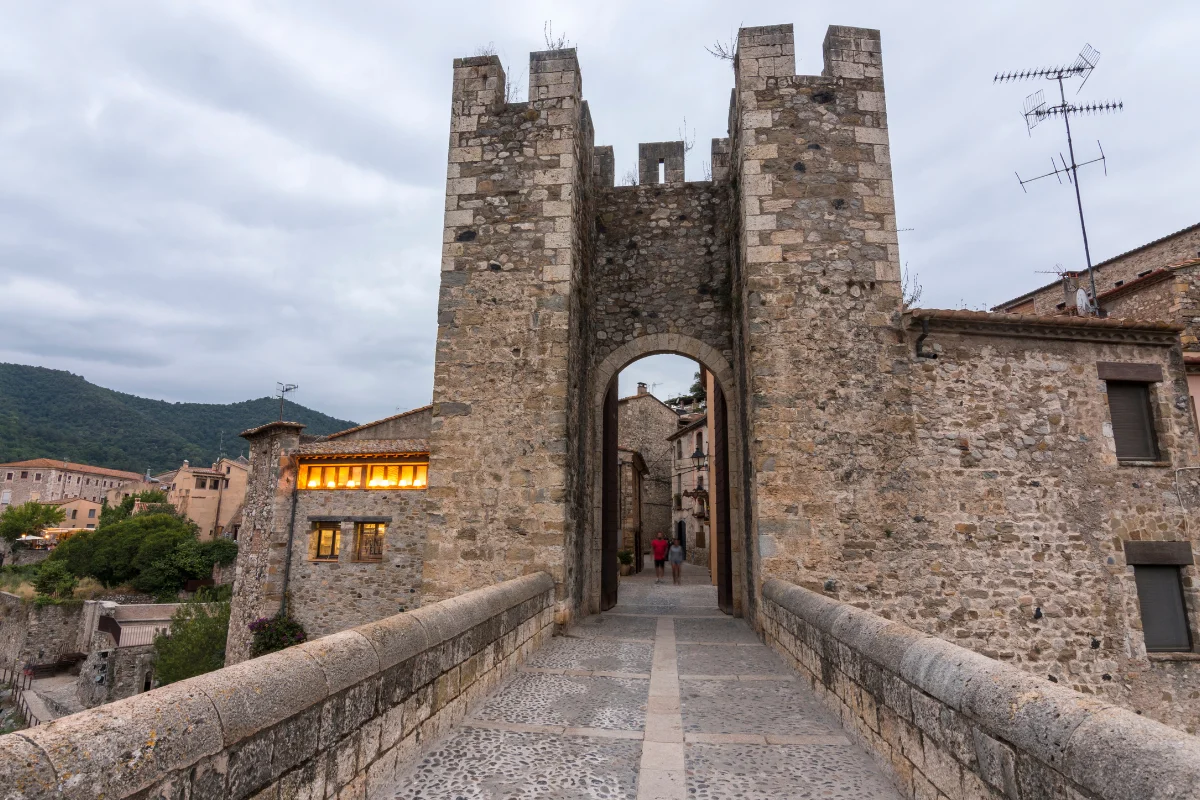

Ten villages within 200 kilometers of Barcelona, each worth the trip for a specific reason that the others don’t replicate. The decision is not “which is the most beautiful” — that question has no answer that doesn’t depend entirely on what you’re optimizing for. The correct questions are: How much time do I have? Do I need public transport? Am I looking for medieval architecture, coastal coves, natural landscape or cultural depth?
This guide answers those questions first, then delivers the villages.
What are the best villages near Barcelona for a day trip? Sitges (35 min by train, art museums + 26 beaches). Montserrat (1h by train, Caravaggio original + hiking). Tossa de Mar (90 min by bus, only intact medieval walled town on the Catalan coast, original Chagall €3). Besalú (1h30 by car, medieval mikvé unique in Spain €2.25). Peratallada (1h30 by car, 7-meter moat cut into bedrock). Cadaqués (2h15 by car, Dalí museum, deliberate inaccessibility). Begur (2h35 by bus, coined the name “Costa Brava”). Calella de Palafrugell (2h by car, Les Voltes arches + Cap Roig Festival). Rupit (1h20 by car, 822m altitude, highest waterfall in Catalonia). Cardona (1h10 by car, medieval salt mine + halved tower).
Decision Matrix: Choose Before You Plan
| Village | By Public Transport | Best For | One Fact That Decides It |
|---|---|---|---|
| Sitges | Yes (35 min train) | Art, beaches, LGBTQ+ | First chiringuito in Spain, still operating |
| Montserrat | Yes (1h FGC+cremallera) | Mountain, Escolanía, hiking | Caravaggio original, €5.50 |
| Tossa de Mar | Yes (90 min bus) | Medieval walls, coves | Only Chagall on Costa Brava, €3 |
| Besalú | Partial (2h bus) | Medieval heritage, Jewish history | Mikvé unique in Spain, found under a well in 1964 |
| Peratallada | No (car + Girona train) | Pure medieval, gastronomy | 7-meter moat cut directly in limestone bedrock |
| Cadaqués | Difficult (2h45 bus) | Dalí, rocky coves | 13km of deliberate curves before arrival |
| Begur | Yes (2h35 bus Sarfa) | Coastal coves, Cuban colonial houses | Named the “Costa Brava” in 1908 |
| Calella Palafrugell | Partial (car+local bus) | Coastal culture, Cap Roig | Les Voltes arches (former fishermen’s workshops) |
| Rupit | No (car only) | Stone village, waterfall | Highest waterfall in Catalonia — can disappear in dry summer |
| Cardona | Partial (4x daily bus) | Salt mine, Parador castle | Tower cut in half in 1812 to remove it as artillery reference |
The Train-Accessible Villages: No Car Required
Sitges: 35 Minutes, Three Museums, 26 Beaches
The R2 Sud line runs from Passeig de Gràcia every 15 minutes, reaching Sitges in 35–45 minutes. No other village on this list has transport this frequent or this direct from the city center.
The Museu Cau Ferrat holds two El Greco canvases that Santiago Rusiñol brought from Paris in 1894 in an actual public procession from the train station — the event that effectively launched Catalan Modernisme as a movement. The Palau de Maricel opens Sundays only (10:00–14:00) — the single most important scheduling constraint for a Sitges cultural visit. The first chiringuito in Spain is still operating on the same seafront where it opened.
The Sitges from Barcelona guide covers the full cultural circuit, the beaches by profile and the Malvasía wine produced from the last urban vineyard in Catalonia.
Montserrat: 1 Hour, One Caravaggio, One World-Class Choir
The FGC R5 line from Plaça Espanya + rack railway or cable car. Total approximately 1 hour. The Trans Montserrat ticket (€50) covers everything: train, ascent and unlimited funiculars.
The Museu de Montserrat has a San Jerónimo en meditación by Caravaggio — one of only four original Caravaggios in Spain — alongside Picasso, Dalí, Miró, Monet and Degas. Entry €5.50.
The critical scheduling fact: the Escolanía boys’ choir (Europe’s oldest, 14th century) does not perform on Saturdays. Weekday performances at 13:00 and Monday–Thursday at 18:45; Sunday at 12:00 and 18:45. The Montserrat from Barcelona guide covers the complete booking requirements, the Moreneta reservation system and the Sant Jeroni hiking route to the 1,236-meter summit.
The Coastal Villages: Water, Rock and Medieval Layers
Tossa de Mar: The Only Intact Medieval Walled Town on the Catalan Coast
The Vila Vella of Tossa de Mar — a complete walled medieval quarter with seven towers — was declared a National Historic-Artistic Monument in 1931 and is the only fully intact fortified medieval settlement on the entire Catalan coastline. Free access at any hour.
The Municipal Museum was the first in Spain to exhibit foreign contemporary art. Marc Chagall arrived in 1933, called the town his “Blue Paradise” (not a marketing phrase — his direct quote), and donated El Violinista Celeste (1934) — the only original Chagall in a public museum on the Costa Brava. Entry: €3.
The Villa Romana dels Ametllers has free entry and 1st-century mosaics that identify the Roman name of the town: Turissa.
Transport: Moventis bus from Estació del Nord, approximately 1h20, 22 daily departures on weekdays.
Begur: Where the Name “Costa Brava” Was Coined
Journalist Ferran Agulló published the phrase “Costa Brava” for the first time in 1908, written from Fornells — one of Begur’s coves. The denomination that now names an entire coastline originated in this municipality.
The town has eight coves in three geological sectors: the turquoise water of Cala Aiguablava, the red rock island of Illa Roja (naturism traditional), the painted fishing houses of Cala Sa Tuna and the cliff-only access of Platja Fonda. Six 16th-century private defense towers built against Berber piracy still stand in the historic center. Carmen Amaya lived in one of them from 1961 until her death in 1963 and personally financed the first illumination of the castle.
The Begur guide covers the full cove comparison, the indianas colonial houses funded by Cuba and Puerto Rico emigrants, and the Cold War Radio Liberty station that preserved one beach by making its development politically inconvenient.
Transport: Sarfa (Moventis) bus from Estació del Nord or El Prat Airport, approximately 2h35, around €26.
Calella de Palafrugell: The Arches That Were Workshops
Les Voltes — the vaulted arches facing Port Bo — were built in the 19th century as working spaces for fishermen. Their conversion into restaurants preserved the historic volume completely. The ensemble is declared a National Cultural Heritage asset; the fishing boats on the sand are still operational.
The Jardins de Cap Roig (17 hectares, 800 plant species) were created from 1927 by Nicholas Woevodsky and Dorothy Webster, both buried in the garden alongside their pets. The Cap Roig Festival (July–August) has limited capacity of 2,440 per concert. The Cantada de Habaneras (first Saturday of July) draws up to 30,000 people — it began in 1966 in a tavern to celebrate a book publication.
Transport: approximately 2 hours by car or Sarfa bus to Palafrugell + local bus to Calella.
The Medieval Interiors: History Without the Coast
Besalú: The Mikvé Found Under a Well in 1964
Besalú was the capital of an independent county with its own currency for over 100 years before Barcelona absorbed it in 1111. The Pont Vell (135 meters, 12th-century, hexagonal tower that served as a customs post) was dynamited in 1939 during the Republican retreat and rebuilt in 1950–1960.
The mikvé — a 12th-century Jewish ritual immersion bath — was discovered by accident in 1964 when a resident digging to install a water well broke through the floor of the underground chamber. Rabbis from Perpignan and Paris confirmed it as one of only four medieval mikvaot preserved in Europe and the only one in Spain. Access by guided tour only from the Tourism Office. Price: approximately €2.25. Tours run approximately at 13:30 and 17:00.
The Besalú guide covers the monastery ambulatory (a pilgrimage-church architectural solution rare in Catalan Romanesque), the mezuza slots still visible in door frames throughout the Jewish quarter, and Circusland — the world’s largest miniature circus, in the former abbot’s palace.
Transport: 130km, 1h30 by car. TEISA bus from Carrer de Pau Claris 117, approximately 2 hours.
Peratallada: The Name Means “Cut Stone” — Because It Is
The word Peratallada comes from the Latin Petra Taiata — cut stone. The defensive moat surrounding the historic center is not built of stone; it is cut directly into the limestone bedrock the village stands on. At its deepest the moat reaches 7 meters. This has no equivalent in any comparable medieval settlement in the region.
The castle dates to 1065, is privately owned but has an accessible courtyard. The Torre de les Hores (Hours Tower) can be climbed for free and provides the only aerial view of the historic nucleus available to visitors. The Plaça dels Esquiladors has ivy-covered facades that turn amber and red in autumn. The Gelat Artesà ice cream shop makes savory flavors — gazpacho, vermouth with olives, anchovies from L’Escala — and has its own queue in high season.
The Peratallada medieval village guide covers all four towers, the church built outside the walls (and why that’s architecturally significant), and how to combine with Ullastret and Pals in a single day.
Transport: 135km, 1h30 by car. No direct public transport — most practical via AVE to Girona + car rental (40km from Girona).
Cardona: The Salt Mountain and the Halved Tower
Cardona has two interdependent resources: the most important salt deposit in Western Europe funded a fortress that was never taken by military force. The Romanesque collegiate church of Sant Vicenç (consecrated 1040) is the masterpiece of Lombard Romanesque in Catalonia — Orson Welles chose it as the location for Chimes at Midnight (1965), recognized as a European Cinematographic Cultural Treasure.
The Torre de la Minyona: 25 meters tall in 1811, reduced to 12.5 meters in 1812 when Spanish authorities deliberately cut the tower in half to eliminate it as an artillery reference point for French forces. The cut line is still visible in the masonry. The Mina Nieves salt mine reached 1,308 meters depth and generated 300 kilometers of galleries between 1929 and 1990. The Parc Cultural allows descent to 86 meters at a constant 17°C temperature.
The castle is now a Parador Nacional. Room 712 is only assigned on explicit request.
Transport: 87km, 1h10 by car. ALSA bus from Estació del Nord, 4 daily departures.
Cadaqués: The Village That Stayed Itself on Purpose
Cadaqués is 180km from Barcelona. The last 13 kilometers on the GI-614 are a deliberate design decision — tight curves that the town chose not to improve for decades to limit tourist volume. That choice explains why the historic center retains the rastrell (a patterned stone pavement made from sea stones) that no other Costa Brava town maintains.
The Casa-Museu de Dalí at Portlligat has a capacity of 8–10 visitors per guided visit. Advance booking is mandatory — no walk-ins at any time. Tickets must be collected 30 minutes before the scheduled visit or the booking is automatically cancelled. Entry: €15.50.
Pablo Picasso spent the summer of 1910 in Cadaqués — a period art historians identify as decisive for the development of analytical cubism.
Transport: 2h15 by car. Moventis Sarfa bus from Estació del Nord, 2h45.
Rupit: The Waterfall That Can Disappear
Rupit is at 822 meters altitude in the Collsacabra massif. The suspension bridge was built in 1945 by four local craftsmen — not medieval — and holds a maximum of 10 people simultaneously. The house lintels carry construction dates in carved stone; some exceed 400 years.
The Salt de Sallent falls 100–115 meters and is the tallest waterfall in Catalonia. The critical information: in a dry summer, the waterfall can reduce to a trickle or disappear entirely. The best times: autumn after the first rains, spring after snowmelt. In dry July or August, the walk along the riera (stream) is worth doing regardless, but the waterfall expectation should be calibrated.
Parking costs €5 per day. The historic center is blocked to visitor vehicles with retractable bollards. The Rupit village guide covers the hidden Early Medieval rock-cut graves at the Bassis plateau (9th–11th century, anthropomorphic form, on the Bassis–Sallent circular route), the village forge that served as the model for the Poble Espanyol replica, and the Quality Night Sky certification that makes the Milky Way visible with the naked eye on clear nights.
Transport: 98km, 1h20 by car only.
How to Combine These Visits
One day without a car: Sitges (cultural morning) or Montserrat (full day). These are the only two with transport frequent enough to be genuinely flexible.
One day with a car, medieval focus: Besalú + Castellfollit de la Roca (village on a 50-meter basalt cliff, 10km from Besalú) — covers the medieval bridge, the mikvé and the most unusual village location in Catalonia.
Weekend on the Costa Brava: Tossa de Mar (Saturday, Vila Vella + Cim i Tomba stew) and Begur or Calella (Sunday, coves and coastal path).
Weekend Empordà circuit: Peratallada (Saturday morning, moat and towers) + Ullastret (Saturday afternoon, 4th-century BC Iberian ruins, 7km away) + Besalú (Sunday, mikvé + Pont Vell). Three completely different heritage typologies in two days.
Mountain and medieval combination: Rupit (Saturday, stone village + waterfall route) + Tavertet (Sunday, village on a cliff above the Sau reservoir, 15 minutes by car) — the most atmospheric inland Catalonia two-day circuit.
Mistakes to Avoid
- Going to Montserrat on a Saturday expecting the Escolanía — it doesn’t perform on Saturdays. The choir schedule is the first thing to check when choosing the day.
- Arriving at the Palau de Maricel in Sitges on any day except Sunday — it’s closed. The Sunday-only constraint eliminates it from most day trips.
- Trying to drive to Cadaqués without knowing what the last 13km are like — the curves are real, the road is genuinely demanding, and the parking problem in high season is severe. The bus is often more practical.
- Planning Rupit specifically for the waterfall in August without checking recent rainfall — a dry summer can leave no waterfall. The village is worth visiting regardless; the waterfall expectation needs calibration.
- Visiting Besalú without booking the mikvé tour in advance — it fills in high season. The tour is the reason many people make the trip; missing it because of a same-day arrival is the most common Besalú disappointment.
One village on the Maresme coast removes the walk between station and sea altogether: the R1 platform at Sant Pol de Mar sits beside the sand, and the hilltop hermitage above it only opens by arrangement, as the Sant Pol de Mar guide explains.
Final Insight
The ten villages in this guide survived what most Catalan villages didn’t — mass development, road-widening, speculative demolition — each for a specific reason. Tossa survived because the 1931 monument designation made demolition politically impossible. Peratallada survived because the limestone bedrock made reconstruction expensive. Cadaqués survived because the road was left deliberately tortuous. Rupit survived because it was 822 meters above sea level and inconvenient to access. The historical accident that preserved these places is now their primary attraction. Understanding why each village looks the way it does is the same as understanding why it’s worth visiting.
For planning the Barcelona base between village visits, the best neighborhoods to stay in Barcelona guide covers the geographic logic for outward day-trip access from each district. And for the hiking connections between some of these villages — particularly the Garrotxa volcanic landscape near Besalú and the Collsacabra above Rupit — the hiking near Barcelona guide covers the technical details.