
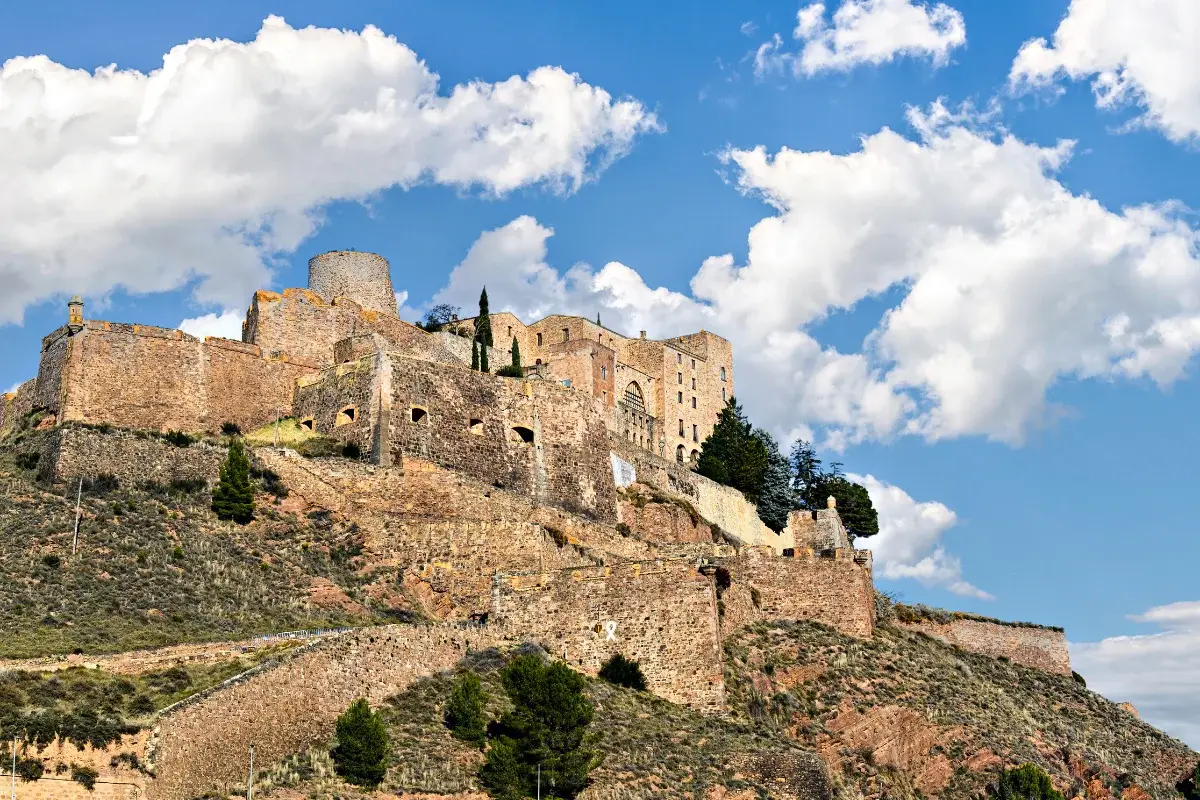

The salt paid for the stone. The stone protected the salt for a thousand years. That’s the simplest explanation for why Cardona — 87 kilometres from Barcelona — has a Romanesque collegiate church that Orson Welles chose as a film set, a castle that was never taken by force, and a salt deposit that is geologically still growing. The three are not separate attractions — they’re the same story told in three registers.
What is Cardona and is it worth a day trip from Barcelona?
Cardona is a medieval hilltop town in the Bages region, 87km from Barcelona (about 1h 10min by car). The three main sites are the Parque Cultural de la Montaña de Sal (underground salt mine, guided visit to 86m depth, €12–22), the Cardona Castle with the Collegiate Church of Sant Vicenç (Romanesque, 1040, UNESCO-level architecture), and the medieval old town. Everything can be done in a single day with a car.
Is It Worth the Trip?
Yes — if you go with the right expectations.
Cardona is not a tourist infrastructure town. The sites have specific opening hours, the guided visits are the only way to access the mine, and the castle closes on Mondays. If you book in advance and arrive with some context, it’s one of the most architecturally and geologically rich single-day trips available from Barcelona. If you show up unplanned on a Monday, you’ll be eating lunch and looking at an exterior.
When it’s not worth it: if you’re only going for the “medieval village” atmosphere without genuine interest in the salt, the Romanesque church, or the military history — there are more visually immediate alternatives closer to Barcelona. Cardona rewards preparation.
Quick Decision
- Geology and industrial history → Salt mountain guided descent: 86m deep, 17°C constant, active crystallisation on the walls
- Military architecture → The castle’s seven 17th-century bastions and the deliberately truncated Torre de la Minyona
- Cinema history → Sant Vicenç collegiate church, Orson Welles’ Chimes at Midnight main set, 1965
- Unusual overnight → Parador Nacional inside the castle — room 712 is only assigned on specific request
- Free access → Old town, Plaza del Mercat, Pont del Diable — no entry fees
The Salt Mountain: A Geological Event Still in Progress
The Cardona salt deposit is a diapir — a geological structure formed when salt, being less dense than surrounding materials, rises vertically through overlying rock layers. Around 40 million years ago, during the Eocene, evaporation of an arm of sea in the Ebro basin deposited salt layers that were subsequently buried. Pyrenean mountain-building pressures pushed them upward until they broke the surface.
What makes this deposit unique in western Europe: the salt is still actively growing. Rain erodes the surface layers continuously, exposing new crystalline masses. The 120 visible metres are the tip of a diapir reaching nearly two kilometres deep.
The Mine That Went 1,308 Metres Down
Artisanal salt extraction at Cardona dates from the Neolithic. The scale changed completely in 1912 when engineer Emili Viader identified potassic salts — critical for the fertiliser industry. The Mina Nieves, operational from 1929 to 1990, reached 1,308 metres depth and generated 300 kilometres of galleries. At lower levels, ambient temperatures exceeded 50°C, requiring advanced ventilation engineering for the era.
In 61 years of operation, 37,874,843 tonnes of mineral were extracted. The closure in 1990 came not from depletion but from the collapse of international potassium prices.
Visiting the Salt Mountain
The Parque Cultural de la Montaña de Sal allows descent to 86 metres depth on a guided visit. Temperature inside is a constant 17°C — bring a layer regardless of outside weather. The route passes walls of salt in tones from white to pink and ochre, produced by iron oxide mixing. Stalactites and stalagmites of salt are in active formation.
The geological strata visible in the “La Minilla” gallery function as a visual record of the tectonic forces that folded the Pyrenees — the detail that best contextualises everything else you see.
Hours: Tuesday–Friday 10am–3pm; Saturday–Sunday 10am–6pm (extended in summer). Price: €12–22 depending on visit type. Book in advance at cardonaturisme.cat — weekend guided visits fill quickly. The theatrical visit “Proyecto Alquimia: El secreto del Liber Salis” is the best option for families.
The Castle: The Tower That Was Deliberately Cut in Half
The Cardona Castle has documentation from 886 AD, when Count Guifré el Pilós established it as a cornerstone of the Marca Hispànica against Al-Andalus. The frequently quoted claim that it was “never taken by arms” has nuance: in 1711 it withstood a 34-day siege by 15,000 Bourbon soldiers. In September 1714 — one week after Barcelona fell — a surrender of 23 negotiated clauses was signed to protect civilian lives. This was not unconditional surrender; it was a political agreement.
The Truncated Tower
The Torre de la Minyona, originally from the 11th century, once stood 25 metres tall. In 1812, during the Peninsular War, military engineers made the decision to cut it down to 12.5 metres — exactly half its original height — to prevent it from serving as an artillery aiming reference for enemy forces. The tower you see today is the deliberate result of that calculation. Its truncated silhouette makes sense once you know the reason.
The same war left the Casamata — a covered battery bunker built between 1811 and 1813, designed to withstand heavy calibre bombardment. Ferdinand VII’s signature is carved into its portal.
Seven 17th-Century Bastions
Between 1692 and 1795, military engineers Pedro Borrás and Sebastián Fernández de Medrano added a ring of seven bastions with 4-metre-thick frontal walls and capacity for one hundred gun emplacements. This system transformed the medieval castle into a modern fortified citadel capable of resisting 18th-century artillery — which is why it survived the sieges it faced.
The Parador Inside the Castle
The castle operates today as a Parador Nacional de Turismo — one of the few in Catalonia inside an active medieval complex. Room 712 has a paranormal reputation tied to the legend of Adalés, daughter of the 11th-century viscount, said to have been imprisoned in the Torre de la Minyona for falling in love with a Muslim prince. The Parador only assigns that room on specific request.
Sant Vicenç Collegiate Church: The Romanesque Orson Welles Chose
The Collegiate Church of Sant Vicenç, consecrated in 1040, is the masterwork of Lombard Romanesque in Catalonia — the architectural style that master builders from northern Italy introduced to the Catalan northeast in the early 11th century.
The central nave reaches nearly 20 metres in height. The octagonal lantern over the crossing — which floods the transept with overhead light — was a technically experimental solution in the context of 1040 Romanesque construction. The crypt, with monolithic columns and unornamented pyramidal capitals, was designed to house relics and contains the remains of 23 members of the Cardona lineage.
155 Years as a Military Warehouse
In 1794, military necessity overrode religious function. The church was stripped of its liturgical use and converted into a warehouse and barracks for military units. It remained in that state until restoration in 1949 — 155 years of military occupation that explain the interior’s austerity. What reads as aesthetic restraint is partly the consequence of having been stripped and repurposed.
Orson Welles and the Cinematographic Heritage
Orson Welles chose the collegiate church as the primary interior set for Chimes at Midnight (Campanadas a medianoche) in 1965. The scale of its Romanesque naves appears in several of the film’s most memorable sequences. In 2016, Sant Vicenç received recognition as a European Cinematographic Cultural Treasure — the only Romanesque building in Catalonia with that designation, and one of very few religious buildings anywhere in Europe to receive it for cinematic rather than artistic heritage.
The Old Town and the Bridge That Was Never Finished
Cardona’s medieval old town is a National Cultural Asset. The Plaza del Mercat has an arcaded gallery with nine arches of distinct styles — each from a different era, from the 12th to the 20th century — making the ensemble a compressed visual history of the town’s architectural evolution over eight centuries. No two arches are identical.
The Portal de Graells is the only surviving fragment of the northern Gothic town wall. The Chapel of Santa Eulàlia (14th century) preserves a vaulted-arch corridor that connected it with the former medieval hospice for the poor and pilgrims.
The Pont del Diable: Unfinished by Design
The Pont del Diable on the Cardener river is singular in Catalan medieval bridge architecture for an unexpected reason: it’s incomplete. Designed in the 15th century to facilitate pilgrim passage on the Montserrat–Santiago de Compostela route, only two of the planned four or five arches were ever built. The two existing arches reach nearly 25 metres in height — the scale of what the complete bridge would have been is legible precisely because of the disproportionate relationship between height and length.
Two problems with the standard Cardona day trip
Two problems turn up in almost every plan for Cardona:
They treat the salt mine as the main event and the castle as secondary. The salt mine is spectacular, but the Collegiate Church of Sant Vicenç is architecturally equal to anything in the broader circuit that includes Montserrat. Visiting Cardona only for the mine misses the reason the mine was worth protecting for a thousand years.
They don’t explain why the tower is short. The Torre de la Minyona appears in every photograph of the castle with its truncated silhouette, and almost no coverage explains that it was deliberately cut in half in 1812. That single military decision explains the castle’s entire skyline.
Mistakes to Avoid
- Going on a Monday — both the castle and the salt mine close. The only day not to visit Cardona is Monday.
- Not booking the salt mine in advance — weekend guided visits sell out, particularly the theatrical options. Book at cardonaturisme.cat before leaving Barcelona.
- Arriving without a car — the bus from Barcelona (ALSA from Estació del Nord, ~4 departures daily) gets you there but limits flexibility between sites. With a car, the salt mine, castle, old town, and Pont del Diable fit comfortably in one day.
- Missing the free access days — free entry on all Tuesdays (non-holidays), 23 April (Sant Jordi), 18 May (Museums Day), and 11 September.
- Not bringing a layer for the mine — 17°C at 86 metres deep feels cold after an August morning. Even in summer, a light jacket is necessary.
Best Strategy
- Morning → Salt mountain (book first slot, 1.5–2 hours with guided descent)
- Midday → Castle and Collegiate Church (guided visits Saturday and Sunday at 11am, 1pm, 4:30pm — check weekday availability)
- Afternoon → Plaza del Mercat, old town circuit, Pont del Diable
From Barcelona by car: 87km via C-16 or C-55, approximately 1h 10min. By bus: ALSA from Estació del Nord, ~4 daily departures, return ticket €25–30.
For context on the broader day trip landscape from Barcelona, the Ebro Delta day trip guide covers a completely different landscape — marshlands, birdlife, rice paddies — at similar distance.
Frequently Asked Questions
How much does it cost to visit the Cardona salt mountain?
Between €12 and €22 depending on visit type. The standard guided visit descends to 86 metres with a constant 17°C temperature. The theatrical visit “Proyecto Alquimia: El secreto del Liber Salis” is the most recommended for families. Book in advance at cardonaturisme.cat — weekend groups fill quickly.
Can you sleep in Cardona Castle?
Yes — the castle is a Parador Nacional de Turismo. Room 712 has a paranormal reputation tied to the Adalés legend and is only assigned on specific request. The Parador restaurant serves traditional Catalan menus inside the medieval complex.
Why is the Torre de la Minyona so short?
It was deliberately cut in half. The original 11th-century tower stood 25 metres tall. In 1812, during the Peninsular War, military engineers reduced it to 12.5 metres to prevent it from serving as an artillery reference point for enemy forces. The current tower is exactly half the original height.
What is the Collegiate Church of Sant Vicenç famous for?
It’s the masterwork of Lombard Romanesque in Catalonia (consecrated 1040), with a central nave of nearly 20 metres. Orson Welles used it as the primary interior set for Chimes at Midnight (1965). In 2016 it was recognised as a European Cinematographic Cultural Treasure — the only Romanesque building in Catalonia with that designation.
How do you get from Barcelona to Cardona?
By car via C-16 or C-55, 87km, approximately 1h 10min. By bus, ALSA from Estació del Nord with approximately 4 daily departures, return ticket €25–30. A car is strongly recommended to combine the salt mine, castle, and Pont del Diable in a single day.
When is Cardona free to visit?
Free entry on all Tuesdays (non-holidays), 23 April (Sant Jordi Day), 18 May (International Museums Day), and 11 September (Catalan National Day). The Monday closure applies to both the castle and the salt mine — never visit on a Monday.