
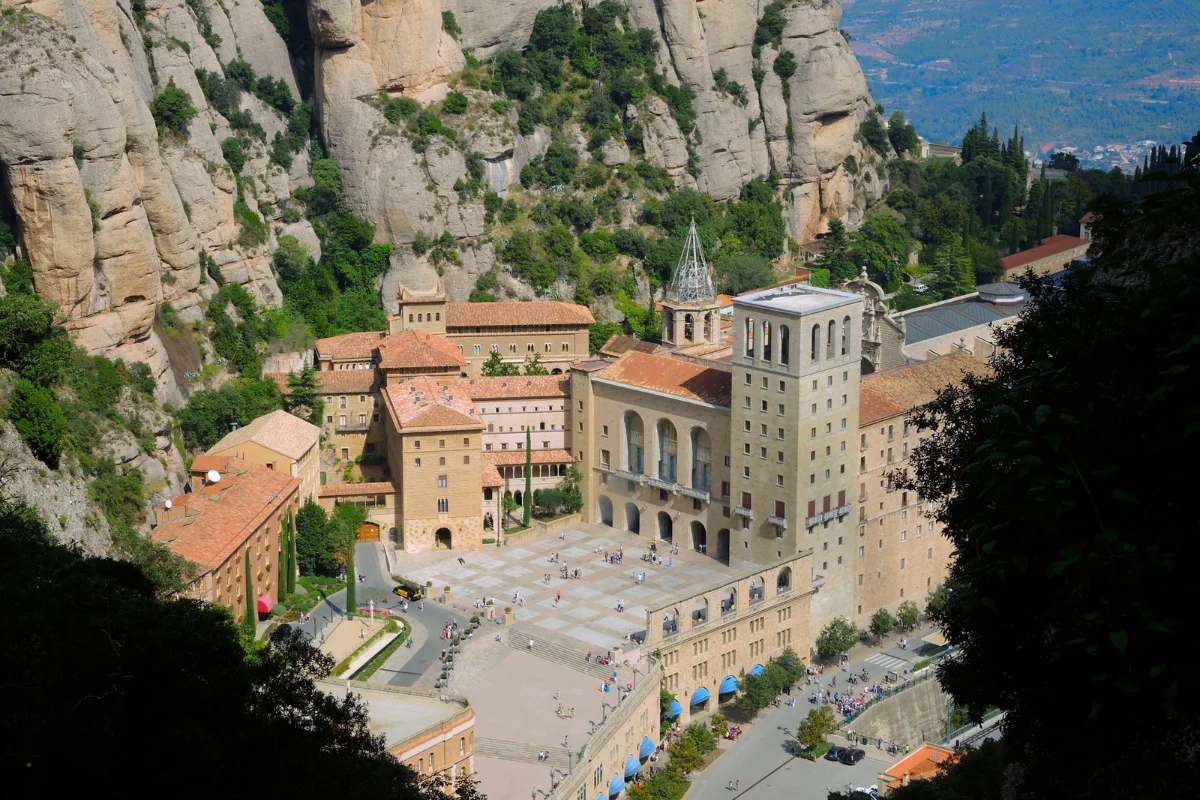

The most common planning mistake in Montserrat: arriving on a Saturday expecting to hear the Escolanía. The boys’ choir — Europe’s oldest, documented since the 14th century — does not perform on Saturdays. It also doesn’t perform during school holidays. Saturday is the highest-traffic day on the mountain. It’s the one day with no choir.
The second most common mistake: arriving at the Moreneta without a reservation. The Black Virgin requires advance online booking — even for Spanish residents who qualify for free admission. Without a booking, no access, regardless of queue length.
This guide starts with those constraints because they determine everything else: which day you go, what you book before leaving Barcelona, and how to structure the visit once you’re there.
What should you see in Montserrat? The Basilica and the Moreneta (Black Virgin, 12th-century Romanesque talla, advance booking required, free for Spanish residents). The Escolanía choir (Mon–Fri 13:00 and Mon–Thu 18:45; Sun 12:00 and 18:45 — not Saturdays). The Museum (Caravaggio original, Picasso, Dalí, Miró — €5.50). The Sant Jeroni summit at 1,236m (2h30 via Camí Nou). The Santa Cova path with Gaudí, Llimona and Puig i Cadafalch sculptures. From Barcelona: FGC R5 from Plaça Espanya, 1 hour.
The Train Decision and the Ticket Decision
Getting there: the FGC R5 line from Plaça Espanya takes approximately 55 minutes to the base of the mountain. From there, two options for the ascent:
- Rack railway (cremallera) from Monistrol de Montserrat: 15 minutes, 550 meters of elevation, panoramic windows. The most comfortable option for visitors with reduced mobility. Departs from one stop after Montserrat-Aeri on the R5.
- Cable car (Aeri de Montserrat) from the Montserrat-Aeri station: 5 minutes, dramatic vertical rise over the Llobregat river and conglomerate walls. Faster, more visually intense, slightly more weather-dependent.
Which ticket to buy:
| Ticket | Price | What’s Included |
|---|---|---|
| Trans Montserrat | €50 | R5 train + cremallera or Aeri + Sant Joan and Santa Cova funiculars unlimited + audiovisual |
| Tot Montserrat | €78 | Trans Montserrat + Museum + buffet lunch |
| Individual components | Variable | Can be combined separately if visiting fewer elements |
Critical note: the integrated transport ticket (ATM) is not valid for the cremallera or the funiculars — these operate on separate tourist pricing. Buy the Trans Montserrat in advance to avoid queues at the base.
The Escolanía: Planning Around It
The Escolanía de Montserrat is documented from the 14th century. The boys live and study at the monastery during the school year and perform as a choir. The schedule is:
| Day | Morning | Evening |
|---|---|---|
| Mon–Thu | 13:00 (Salve and Virolai) | 18:45 |
| Friday | 13:00 | No evening performance |
| Saturday | No performance | No performance |
| Sunday | 12:00 | 18:45 |
| Religious holidays | 12:00 | 18:45 |
If hearing the Escolanía is your primary reason for visiting: go on a weekday or Sunday. The Monday–Thursday combination of both the 13:00 and 18:45 performances gives two opportunities in the same day.
During school holidays: the Escolanía doesn’t perform. Verify the calendar on the Abbey website before choosing your date — the school holiday periods vary and aren’t always obvious.
The Virolai — Montserrat’s dedicatory hymn — lasts approximately 15 minutes. The acoustics of the Basilica amplify the boys’ voices in a way that recordings don’t reproduce. This is the correct reason to plan around the choir schedule.
The Moreneta: Booking and What You’re Actually Seeing
The Black Virgin of Montserrat is a 12th-century Romanesque carving, 95 centimeters tall, in poplar wood. The dark color — which gives it its name — is the result of lead white pigment oxidizing over centuries of candle smoke, reinforced by a 19th-century repainting. The body is original 12th-century Romanesque. The faces of the Child and the Virgin’s hands are 19th-century naturalistic additions — a detail that changes how you read the sculpture.
Access:
- Basilica: open 7:00–20:00 daily
- Throne of the Moreneta: 8:00–10:30 and 12:00–18:25
- Advance online reservation required — including for Spanish residents with free admission
- Without a booking, no access
The route to the Camarín (the throne chamber) passes through the Angel Portal — a staircase with alabaster portalada and mosaics. Gaudí contributed to the design, though the space has been modified multiple times.
The Camino del Ave María — behind the Moreneta visit, a passage flanked by thousands of colored votive candles — is one of the most visually intense experiences in the complex and one that most visitors miss because they don’t know it exists behind the main chapel exit.
The Museum: A Caravaggio in the Mountains
The Museu de Montserrat was declared of National Interest in 2006. The building, designed by Josep Puig i Cadafalch between 1928 and 1933, houses 1,300+ works in six thematic areas.
The centerpiece is the San Jeroni en meditació by Caravaggio — one of only four original Caravaggios in Spain. The chiaroscuro in this canvas is intense enough to read as surprising against the mountain light of the surrounding landscape.
The painting collection spans from Catalan Modernisme — Ramon Casas, Santiago Rusiñol, Isidre Nonell — to Picasso, Dalí, Miró, and French Impressionists including Monet, Degas and Renoir. For anyone doing a broader circuit of Catalan art, this museum connects to what’s visible in the best art galleries in Barcelona — the same generation of painters, the same moment in Catalan cultural history.
The archaeological section includes an Egyptian sarcophagus from the Ptolemaic period, a mummy, and approximately 1,200 Mesopotamian cuneiform tablets. The 2023 “Montserrat s. XIV” room integrates in-situ medieval architectural fragments.
Admission: €5.50.
The Santa Cova Path: Gaudí in the Landscape
The Santa Cova is the site where medieval tradition places the discovery of the Black Virgin in 880. The path from the monastery to the cave is 1.5km with approximately 200 meters of descent. It can also be done partially by the Funicular de la Santa Cova (€3.90 one way / €6 return) which eliminates most of the elevation change.
What makes this path worth doing beyond the religious destination: the Rosari Monumental, a series of sculptural stations along the route made by Gaudí, Josep Llimona and Puig i Cadafalch. This is one of the most complete Modernista artistic interventions in a natural landscape anywhere near Barcelona — comparable in ambition to what these architects were doing in the city simultaneously, and almost always absent from Modernisme route guides.
For the full context of how the Montserrat commissions connect to the architects’ urban work, the Barcelona Modernisme route guide covers the same figures — Puig i Cadafalch, Gaudí — in their city buildings.
Hiking: Routes Organized by Effort
Sant Jeroni, the summit at 1,236 meters
Two main variants:
Camí Nou (9.3km, 545m elevation, 2h30): The more accessible route — takes the Sant Miquel path to the upper Sant Joan Funicular station, then continues by track to the summit. Easy-medium difficulty.
Camí Vell (11.7km, 760m, 4h): Through the valley floor and forest, with stone stairways and significant elevation changes. More spectacular scenery, more demanding physically. Proper footwear required, avoid in wet conditions.
For families and shorter visits:
| Route | Distance | Elevation | Time | Character |
|---|---|---|---|---|
| Santa Cova | 2.5km | -118m | 1h | Spiritual path, Modernista sculptures |
| Camí dels Degotalls | 3.5km | Minimal | 1h | Flat, Virgin mosaics, Bages valley views |
| Creu de Sant Miquel | 2km | 130m | 45min | Best monastery photography viewpoint |
| Sant Jeroni (Camí Nou) | 9.3km | 545m | 2h30 | Summit, Pyrenees visible on clear days |
Temperature note: the Sant Jeroni summit can be 10°C cooler than Barcelona, with constant wind even in summer. Bring a layer regardless of the season.
Santa Cecilia and the Sean Scully Intervention
A few kilometers from the main monastery, the church of Santa Cecilia dates from around 900 AD — one of the purest examples of early Catalan Romanesque architecture accessible to visitors. In 2015 it reopened as the Sean Scully Space, where the Irish-American abstract artist intervened the interior with murals, stained glass and a steel-and-glass cross.
The work — titled Holly, in memory of the artist’s mother — creates a dialogue between chromatic abstraction and 10th-century stone that’s the kind of contemporary-historic encounter that usually exists only in major museums. Santa Cecilia receives very few visitors. Access is either by scheduled guided visit or on specific open dates — check the Abbey calendar before the trip.
What to Eat and the One Product to Take Home
The Mató de Montserrat is the reference product: fresh goat’s milk cheese made in Marganell and Monistrol, served as the dessert Mel i Mató (cheese with local honey). The Cal Puixolet family has been producing it for five generations.
The Aromes de Montserrat liqueur (31°) is distilled from 15 herbs of the massif — thyme, lavender and local plants. Available in the artisan market at the monastery entrance.
Eating on the mountain:
- Restaurant Hostal Abat Cisneros — in 16th-century stables with vaulted ceilings, Catalan cooking
- Buffet Montserrat — self-service with views from the Apostles Mirador, €19/adult with drink
- Bar de la Plaça — sandwiches and quick meals in the monastery center
For a full hiking day, bringing food from Barcelona is more efficient — the mountain prices are high and the options are limited for a long route.
How to Organize the Day by Available Time
Basic visit (3–4 hours): Basilica and Moreneta (reservation required) → Escolanía if the schedule aligns → Camino del Ave María → monastery plaza. No hiking.
Full day (7–8 hours): Early monastery and Moreneta → 13:00 Escolanía (weekday) → Museum → Sant Joan Funicular → Sant Jeroni via Camí Nou → Santa Cova descent. Requires leaving Barcelona before 9:00.
Family visit: Monastery + Santa Cova Funicular + Camí dels Degotalls + artisan market. No significant elevation.
Is Montserrat Worth It?
Yes — with correct planning. The combination of the geological spectacle, a functioning 1,000-year-old monastery, a world-class choir, a Caravaggio and accessible summit hiking is genuinely unusual. Very few places in Europe offer all of those things within a single day from a major city.
When it fails: arriving on a Saturday without prior research, missing the Escolanía, finding the Moreneta queue unmanageable without a reservation, and spending 4 hours in the monastery complex without hiking. That’s the most common version of a disappointing Montserrat visit.
The correct version: weekday, Escolanía reserved for 13:00, Moreneta booked online, afternoon on the Sant Jeroni trail, Trans Montserrat ticket purchased in advance.
Does the Escolanía sing every day at Montserrat?
No. The Escolanía does not perform on Saturdays or during school holiday periods. Weekday performances are at 13:00 (Salve and Virolai) and 18:45 Monday to Thursday. Sunday performances at 12:00 and 18:45. Verify the schedule on the Abbey website before choosing your visit date.
Do you need to book in advance to see the Moreneta?
Yes. Advance online reservation is mandatory, including for Spanish residents who qualify for free admission. Without a reservation, access to the Throne is not possible regardless of queue length. Booking windows open several weeks in advance.
How long does the trip from Barcelona to Montserrat take?
Approximately 1 hour total — 55 minutes on the FGC R5 from Plaça Espanya plus 5–15 minutes for the cable car or rack railway ascent. The rack railway station is one stop further on the R5 than the cable car station.
What does the Trans Montserrat ticket include?
The FGC R5 train from Barcelona, the rack railway or cable car ascent, unlimited use of the Sant Joan and Santa Cova funiculars, and the audiovisual space. €50 for adults. The Tot Montserrat at €78 adds the Museum and buffet lunch.
Is the Sant Jeroni hiking route difficult?
The Camí Nou variant (9.3km, 545m elevation, 2h30) is easy-medium and accessible to visitors with normal fitness. The Camí Vell (11.7km, 760m, 4h) is more demanding and requires proper footwear. The Sant Joan Funicular eliminates 250m of elevation if the goal is the view rather than the walk.
What is the Montserrat Museum’s most important painting?
The San Jeroni en meditació by Caravaggio — one of only four original Caravaggios in Spain. The museum also has works by Picasso, Dalí, Miró, and French Impressionists. Admission €5.50.
What should I wear to visit Montserrat?
For the Basilica: appropriate clothing (no shorts, no sleeveless tops, no beach footwear). For hiking: a warm layer is necessary even in summer — the Sant Jeroni summit can be 10°C cooler than Barcelona with constant wind. Walking shoes for any route beyond the monastery complex.
The same massif can be seen from the air: a dawn balloon flight starts at €145 and a helicopter over the skyline at €79, compared in the balloon and helicopter guide.
Final Insight
Gaudí designed the Sagrada Família with the forms of Montserrat in mind — the organic towers, the conglomerate texture, the verticality that doesn’t compete with nature but amplifies it. Standing at the Sant Jeroni summit and looking back at the monastery below the rock formations, the architectural influence becomes an obvious visual fact rather than an art-historical argument. The mountain is the source. The Sagrada Família interior guide and the Gaudí route Barcelona itinerary complete the circle.
For the Barcelona first-time visitor guide, Montserrat appears as the single best day trip from the city — this article is the version with the detail needed to make it work as intended.