
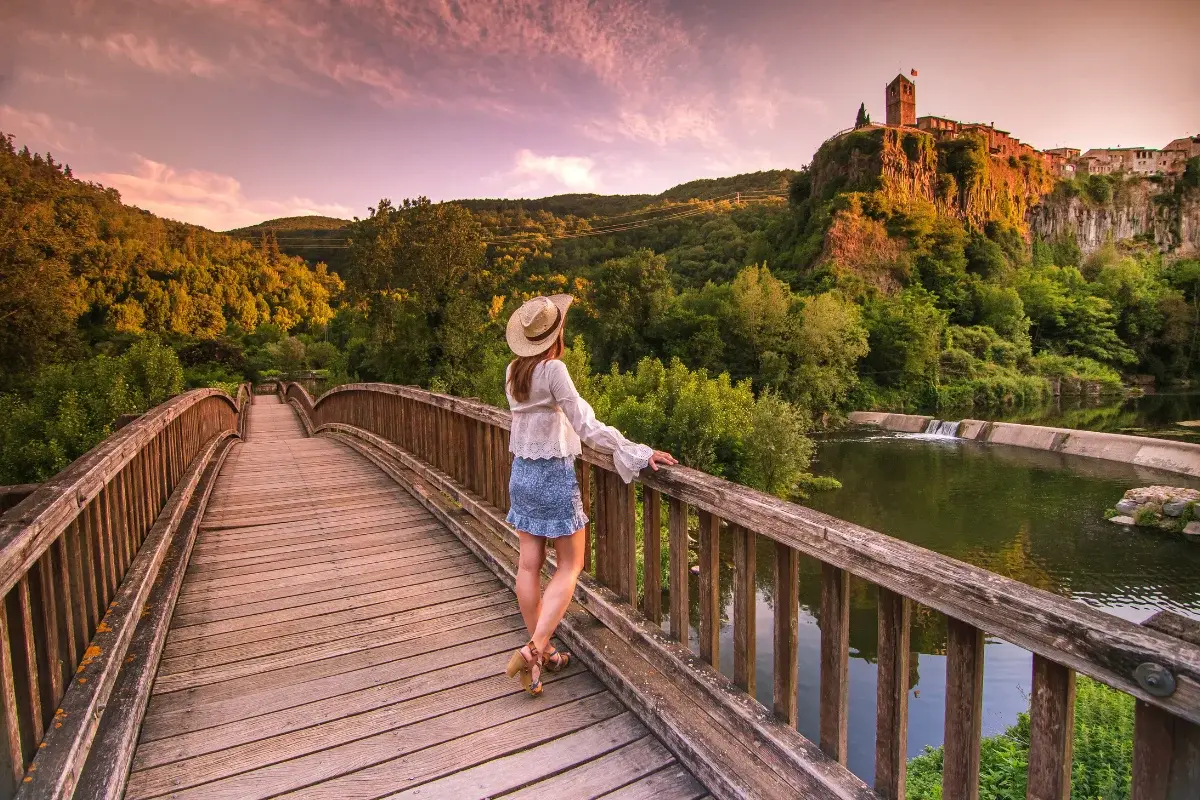

Castellfollit de la Roca is the second smallest municipality in Catalonia at 0.68 km². It sits on the edge of a basalt cliff 50 metres high and nearly a kilometre long — two superimposed lava flows from 217,000 and 192,000 years ago respectively, carved over millennia by the Fluvià and Toronell rivers eating into the base.
The result is one of the most visually improbable silhouettes in Spain: medieval stone houses overhanging a wall of prismatic basalt columns, with nothing below them but the river.
A geological monitoring note before you go: in 2017, 70 tonnes of basalt broke off into the Toronell riverbed. A 17-metre crack beneath the main square is currently tracked by the Institut Cartogràfic i Geològic de Catalunya with precision crack gauges. Geologists don’t indicate imminent collapse risk — but the cliff continues to erode at its base, as it has for 200,000 years.
What is there to see in Castellfollit de la Roca? A basalt cliff village 9 km from Olot in the Garrotxa Volcanic Zone. 50-metre cliff with medieval houses on the edge, the Sant Salvador church at the extreme tip of the rock, the Fluvià river viewpoint from below, the unique Vietnam War Museum, and the only active basalt quarry in Spain — whose stone Gaudí used for Park Güell’s columns. Visit takes 1.5–2 hours.
The photograph everyone misses: why the view is from below
Most visitors drive in, park, walk the old town and leave with photos of the village from street level. The defining image of Castellfollit — the one that explains what the place actually is — requires going down to the river.
Park at the free car park at Hostal Mont-Rock (Ctra. N-260z, km 45.2) and take the Itinerary 13 path down toward the Fluvià. In five minutes you reach the Passera del Fluvià — the wooden footbridge over the river — which is the exact point from which the full geological structure becomes visible: 30 uninterrupted metres of prismatic basalt columns, formed when lava cooled slowly and contracted into vertical geometric prisms, with the medieval construction sitting directly on top.
This is the perspective that appears in every photograph of the village and that nobody warns you requires going down first.
Quick decision: how to organise the visit
- 1 hour only → Mont-Rock car park → Passera del Fluvià (river view) → ascent via Camí Vell → Mirador Josep Pla → old town
- Combining with Itinerary 13 → full 2.2 km loop (45 min, low difficulty) — descend through traditional market gardens, cross the medieval bridge, return via the historic paved path
- With children → old town walk and footbridge are fully accessible; the Sausage Museum (Museu del Embutido) has free entry with included tasting
- Longer walking route → Ruta de les Tres Colades toward Sant Joan les Fonts (8 km) — three lava flow levels from different geological periods
- Combining villages → Besalú 8 km (11th-century medieval bridge, 12th-century Mikvé, one of only two preserved medieval Jewish ritual baths on the peninsula), Olot 9 km (Volcano Museum and Croscat and Santa Margarida craters)
- Geological context before arriving → the basalt of the active quarry here was specifically chosen by Gaudí for the columns of Park Güell — the same rock formation that became UNESCO World Heritage in Barcelona
The old town: what’s actually there
Mirador Josep Pla is the main viewpoint — a terrace at the far end of the cliff where the former cemetery has been converted into a belvedere with benches. Best at late afternoon, when lateral light illuminates the basalt columns from the side. Josep Pla, Catalonia’s most important 20th-century prose writer, described the village from this exact position in his travel chronicles.
Sant Salvador church stands at the extreme tip of the cliff — the furthest point over the drop. The original 13th-century building was destroyed by the 1427–1428 earthquakes (which killed 80–85 people in the comarca), subsequent wars and the Spanish Civil War. What exists now is a late Renaissance reconstruction that functions as a cultural centre and exhibition space. The bell tower can be climbed.
Plaça de Sant Roc and the Clock Tower mark the entrance to the old town. The tower was built in 1925 as the result of a political wager: a monarchist candidate promised to donate a clock to the village if he won the 1919–1920 elections. He won. The clock was inaugurated five years later.
The medieval street grid — narrow lanes, houses in black volcanic stone — has specific details worth looking for: at number 1, Carrer de la Font, remnants of the original town walls; at number 3, arrow slits for archery. The Can Castell house is built directly on the walls of a medieval castle demolished in 1691 during the Nine Years’ War.
The quarry, the museum and the Gaudí connection
Castellfollit is easy to file away as picturesque. Three things sit outside the standard itinerary:
The Vietnam War Museum (Carrer de Sant Josep) is a private collection unique in Europe dedicated entirely to the 1965–1975 conflict. Uniforms, helmets, radio equipment, deactivated weapons, 400+ original photographs, strategic maps and personal documents from soldiers. The owner typically receives visitors personally. There’s no large sign on the facade — finding it is part of the experience.
The active basalt quarry has been operating since the 19th century and is the only active basalt extraction site in Spain. Managed by the Ortiz family. The basalt is used as acid-resistant rock in industrial chimneys, pavements and ornamental elements. Antoni Gaudí specifically selected stone from this quarry for the columns of Park Güell after identifying its combination of structural resistance and natural texture. The rock beneath the village ended up as UNESCO World Heritage in Barcelona.
The Sausage Museum (Ctra. Girona, 10) documents 150+ years of the Sala family, one of the oldest butcher dynasties in Catalonia. Free entry including tasting of fuet, butifarra and artisan cured meats. The prehistoric objects in the collection link to traces of Neanderthal tools found in the area — human presence on these lava flows is documented from between 80,000 and 36,000 years ago.
Itinerary 13: the most direct circular route
The most visited official trail of the Garrotxa Natural Park at Castellfollit is Itinerary 13 (Cingleres de Castellfollit): 2.2 kilometres, loop circuit, low difficulty, 45 minutes.
Sequence: Mont-Rock car park → descent through traditional market gardens → Passera del Fluvià (the river-level view of the cliff) → medieval Romanesque bridge over the river → ascent via the Camí Vell (the historic paved merchants’ path, steep gradient) → Plaça de Sant Roc.
The medieval Romanesque bridge section offers the closest ground-level perspective of the basalt columns. The ascent via the Camí Vell — the same path used by muleteers and merchants for centuries — makes the defensive logic of the settlement clear: nothing moved up without being visible from above.
Comparison: Castellfollit vs nearby Garrotxa destinations
| Destination | Distance from Castellfollit | Type | Time needed |
|---|---|---|---|
| Olot | 9 km | City — Volcano Museum, modernista facade | Half day |
| Besalú | 8 km | Medieval town — bridge, Mikvé, Jewish quarter | 2–3 hours |
| Santa Margarida volcano | 15 km | Romanesque hermitage inside volcanic crater | 1–2 hours |
| Croscat volcano | 14 km | Largest volcanic cone on Iberian Peninsula | 1–2 hours |
| Fageda d’en Jordà | 12 km | Beech forest on lava flow — botanical anomaly | 1–2 hours |
| Sant Joan les Fonts | 6 km | Basalt gorge, medieval bridge, lava flow sequence | 2 hours |
Practical details
- Car required: no direct public transport from Barcelona; from Olot (9 km) there’s a bus connection
- Parking: Mont-Rock (N-260z, km 45.2) is free and the most practical; additional spaces on Carrer Doctor Fleming
- Old town vehicle access: restricted to residents; everything is done on foot from the car park
- Footwear: comfortable shoes with grip for the Camí Vell ascent and the footbridge
- Museums: Sausage Museum in commercial hours, free entry; Vietnam Museum may require calling ahead for a guided visit
- Total visit time: 1.5–2 hours for village + Itinerary 13; 3–4 hours if adding longer hiking routes
- Best combination: Besalú (8 km, 11th-century medieval bridge) + Castellfollit + Olot volcanoes — covers the Garrotxa’s three strongest arguments in one day
The cliff the village sits on belongs to a wider volcanic landscape: the Garrotxa Natural Park protects 40 cones and more than 20 lava flows, with Croscat the most recently active on the Iberian Peninsula, described in the Olot and Garrotxa guide.
Mistakes to avoid
- Entering the old town without going down to the river first — the village from street level gives no sense of what it is geologically; the Passera del Fluvià view is the essential step, and it takes 10 minutes round trip from the car park
- Missing the Vietnam Museum because it’s unmarked — no large signage, easy to walk past; it’s on Carrer de Sant Josep and worth the detour for the specificity of the collection
- Combining Castellfollit with too many stops in one day — the village is genuinely compact; an over-packed itinerary leaves no time to do the full Itinerary 13 loop, which is where the geological experience is
- Going in high summer without the Garrotxa hike context — the volcano routes around Olot are best in spring and autumn; Castellfollit itself works year-round, but if combining with the park, timing matters
The crack geologists are monitoring under the main square, the basalt Gaudí shipped to Barcelona for Park Güell, the 70 tonnes that fell into the river in 2017 — Castellfollit is not just a photogenic village. It’s a settlement that has been negotiating with the rock it’s built on since Neanderthals were knapping tools on these same lava flows 80,000 years ago. The cliff hasn’t stopped moving. It’s just moving slowly enough that people keep building on it.
For the wider Garrotxa context, the Olot and volcanic zone guide covers the full natural park including the Croscat and Santa Margarida volcanoes and the Fageda d’en Jordà. For medieval villages to combine in the same day, the Besalú guide covers the town 8 km east, and the hiking near Barcelona guide includes Garrotxa routes with difficulty and access details.