

In 1964, a Besalú resident broke ground to install a water well and found something unexpected under his floor: a stone-vaulted underground chamber with a staircase of 36 steps descending into the rock. He initially thought it was an old wine cellar. Rabbis Mordoc of Perpignan and Chilli of Paris examined the chamber and certified what it actually was: a mikvé — a Jewish ritual immersion bath — dating to the 12th century. One of only four medieval mikvaot preserved anywhere in Europe. The only one in Spain.
The discovery was accidental, which is often how the best historical finds work. Besalú hadn’t been hiding it deliberately; it had simply been built over, layer by layer, across nine centuries. The mikvé is now the most sought-after visit in the town — and the one that requires advance booking because access is by guided tour only.
This guide covers Besalú as it actually is: a former independent county with its own currency, a bridge that bends for geological reasons, a Benedictine monastery with an architectural solution borrowed from pilgrimage cathedrals, and two museums that have nothing to do with the Middle Ages and serve as a welcome change of pace.
Before Arriving: One Booking You Can’t Skip
The Mikvé is only accessible via guided tour managed by the Tourism Office. Tours run approximately at 13:30 and 17:00. Admission: approximately €2.25. Without advance booking — especially in high season — places fill. This is not a visit you can improvise on arrival.
Everything else in Besalú is walk-in accessible. The bridge is open at all hours. The monastery exterior is free. The Plaça de la Llibertat has no gate. Only the Mikvé requires a managed entry time.
The Pont Vell: Why the Bridge Zigzags
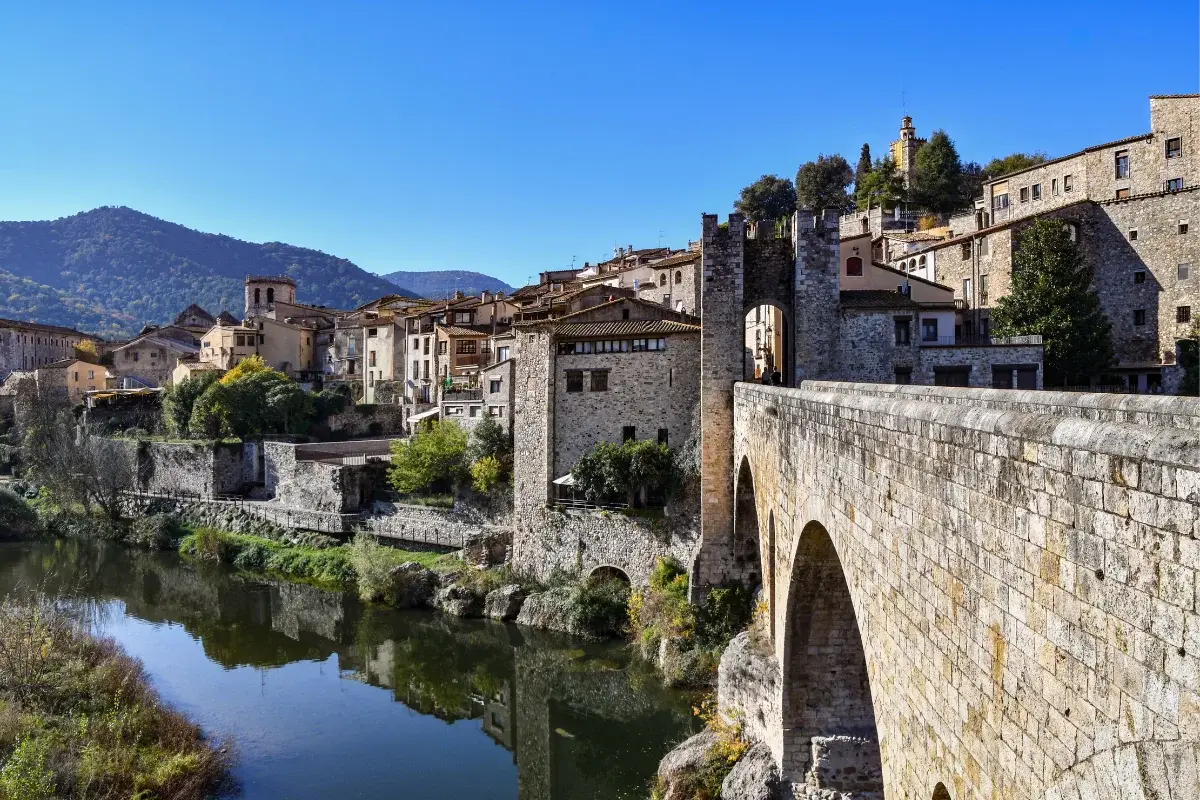
What is the Pont Vell of Besalú? A 135-meter medieval bridge from the 12th century with seven arches of unequal span and a 30-meter hexagonal tower at its center that served as a customs post where traders paid the condal toll (pagus condal) to enter the town. The irregular alignment isn’t aesthetic — the bridge bends to rest on the volcanic basalt outcrops in the Fluvià riverbed, the only points solid enough to anchor the foundations against the river’s seasonal flooding.
The hexagonal tower is worth understanding before crossing it. During the county’s period of independent power (approximately 1002–1111), this tower was the economic choke point of the entire territory. Every merchant traveling between the Garrotxa interior and the coast passed through it. The toll collected here funded both the bridge’s maintenance and the county’s administrative apparatus.
The bridge has two construction traumas documented in the historical record. A catastrophic 1315 flood destroyed several arches, and King Jaume II levied a special tax across the territory to fund reconstruction. In 1939, retreating Republican forces dynamited three arches to slow Franco’s advance toward France. The 1950–1960 restoration rebuilt those arches with fidelity to the original stonework.
Photographically: the best light falls from the east bank before 9:00am, when the low angle catches the bridge without harsh shadows. Evening from the south bank, with the tower in silhouette, is the second-best window.
For context on how Besalú’s bridge connects to the broader medieval infrastructure of Catalonia, the Peratallada medieval village guide covers another village in the same region where the defensive moat is cut directly into bedrock — a parallel story of medieval engineering adapted to local geology.
The hexagonal tower marked the boundary of the call
The hexagonal tower on the Pont Vell had a second function: it served as the visual and administrative landmark from which the call (Jewish quarter) was measured. In medieval Iberian towns, the spatial relationship between the civic crossing point and the Jewish community’s location wasn’t accidental — it reflected the legal and commercial status of the community within the town’s economy.
The Besalú Jewish community was, at its peak in the 14th century, approximately 25% of the town’s total population — around 200 people who specialized in medicine, tailoring and moneylending, protected directly by the count in exchange for high tribute payments. Their spatial integration and economic importance was exceptional for a town of this size.
The other thing to look for: the huecos for the mezuzot (the slots that held the Torah-text parchments identifying Jewish households) are still visible on door jambs throughout the old Jewish quarter — on the Carrer de Tallaferro, Carrer del Portalet and the Baixada de la Mikvé. These are not reconstructed or interpreted; they’re the original 12th and 13th-century stonework with the housing slots intact. Walk with your eyes at door-frame level.
The Mikvé: What the Underground Chamber Actually Was
The mikvé at Besalú was built in the 12th century as a subterranean chamber of Romanesque dressed stone with a barrel vault. The 36 stone steps descend to a chamber where the key ritual requirement was met: mayim hayim — living water, not stagnant. A conduit visible at the third step from the bottom channeled filtrations from the Fluvià river through the rock, ensuring the water was continuously renewed.
The tevilah (full-body immersion) was obligatory for women after menstruation, childbirth and before marriage, and for men before the Sabbath and high holy days. The mikvé was therefore not a peripheral facility — it was essential infrastructure for a practicing Jewish community.
The 12th-century construction date places it in the period of the community’s greatest stability and integration under the protection of the count. The chamber’s Romanesque architectural quality reflects real investment, not minimal provision.
Access: guided tour only, Tourism Office. Approximately €2.25. Tours at approximately 13:30 and 17:00. Book in advance — this is the most in-demand visit in Besalú and fills in high season.
The Monastery of Sant Pere: The Ambulatory Nobody Explains
The Monastery of Sant Pere was founded in 977 and definitively consecrated in 1003. The current church has three naves and one architectural element that’s unusual for Romanesque Catalonia: an ambulatory — a semi-circular corridor behind the main altar that allowed pilgrims to circulate and venerate relics without interrupting the liturgical functions in progress.
In the great pilgrimage cathedrals of France and northern Spain — Santiago de Compostela, Vézelay, Cluny — the ambulatory was standard because continuous streams of pilgrims required continuous access to relics. In Catalonia’s smaller religious houses, it was rarer. Its presence at Sant Pere suggests that the monastery held relics of sufficient importance to generate real pilgrimage traffic — and had the architectural ambition to manage it properly.
The facade carries two rampant stone lions. The interior capitals combine lions (ecclesiastical power and protection), apes and serpents (paganism and evil) in one of the most elaborated Romanesque iconographic programs in the Garrotxa.
Adjacent to the monastery is the Casa Cornellà — a 12th-century three-story civil Romanesque house with a colonnaded central courtyard, stabling on the ground floor, the manor residence on the first floor and a granary at the top. One of the most complete surviving examples of civil Romanesque domestic architecture in Catalonia.
Interior access: guided tour from the Tourism Office only. The exterior and plaza are freely accessible.
The Other Churches: Sant Vicenç and Sant Julià
The Church of Sant Vicenç combines a 12th-century Romanesque structure with later Gothic additions. Three semicircular apses, decorated capitals with winged monsters on the main portal. Inside: a fragment of the True Cross (the original 11th-century relic disappeared; the current one was donated from Rome in the early 20th century to restore the devotional tradition), and the 1413 Gothic tomb of Pere de Rovira.
The Hospital de Sant Julià, founded in the 12th century to shelter pilgrims and the poor, preserves primarily its church facade — a portal with six receding arches whose four supporting capitals show mythological animals on three and Corinthian acanthus leaves on the fourth. Architecturally more interesting than its tourist profile suggests. Today it functions as a social center.
The Plaça de la Llibertat and the Curia Real
The main plaza has medieval arcades — semicircular arches that protected historical commerce and transactions. The Curia Real, a Gothic palace with a hall and twin windows, served as the county’s court of justice and administrative offices. Still standing, still defining the plaza’s character.
Tuesday mornings bring the weekly market with local produce. The Mirador de Besalú on the wall corner above the plaza gives views over the medieval urban plan and the former county territory.
The Two Museums That Break the Medieval Pattern
Besalú has two museums that have nothing to do with the 9th through 14th centuries and serve as deliberate counterpoints to the architectural density of the historic center.
Circusland occupies the former abbot’s palace of Sant Pere monastery with over 60,000 objects documenting 250 years of circus history. It holds the world’s largest miniature circus. The price is approximately €5.90 for adults. Hours: approximately 11:00–19:00. The subject matter is completely unexpected in this context, which is precisely why it works — the contrast between the Romanesque shell and the circus content is jarring in a useful way.
Micromundi displays 2,000+ micro-miniatures at scales down to 1:100,000 — the most extreme being a camel caravan threaded through the eye of a needle, visible only with a high-precision microscope. Approximately €5, hours vary by season. Verify before visiting.
Both provide a useful change of register for children (and adults) after two hours of medieval architecture.
Is It Worth a Day Trip?
Yes — without qualification, for anyone with interest in medieval history, architecture or Jewish heritage.
The combination of the Pont Vell, the accidentally discovered Mikvé, the ambulatory monastery and the intact historic fabric is genuinely unusual. Most medieval towns in Catalonia have one or two of these elements. Besalú has all of them in a walkable circuit.
When it’s not the right choice: if you’re visiting on a Sunday or public holiday during peak season and haven’t booked the Mikvé tour — the tour fills, and the Mikvé is a significant part of what makes Besalú worth the trip.
The ideal scenario: arrive early on a Tuesday (market morning), walk the historic center, attend the 13:30 Mikvé tour, have lunch in the plaza, and continue to the Garrotxa Natural Park in the afternoon.
How to Get There
From Barcelona: TEISA bus from Carrer de Pau Claris 117 or Gran Via 658. Journey approximately 2 hours. From Girona: hourly TEISA service from the train station, 45 minutes.
By car from Barcelona: 130km on the AP-7 and C-66, approximately 1h30. By car from the Costa Brava: 45–60 minutes depending on origin.
Parking: the historic center is restricted to residents. Two free car parks: next to the Tourism Office before the bridge (most convenient), and at the north entrance on the Olot road (direct access to Plaça de Sant Pere and Circusland).
Best timing: May, June and September for the best climate and lowest crowds. Avoid Sundays and public holidays in high season — the historic center changes character significantly. The Medieval Fair on the last weekend of August is the most attended event; the theatrical experience Carrer dels Atrapats (a night-time walk through the dark legends of medieval Catalonia) is the highlight.
The Natural and Cinematic Extensions
The Garrotxa Natural Park is under 20 minutes by car — the best volcanic landscape in the Iberian Peninsula, with 40+ volcanic cones. The Croscat and Santa Margarida volcanoes are the most visited; the Fageda d’en Jordà beech forest growing on a lava flow from the Croscat is the most unexpected landscape.
Castellfollit de la Roca, 10km toward Olot, is built on a 50-meter basalt cliff above the river — the most unusual village location in Catalonia.
On film: Besalú’s Plaça de la Llibertat and bridge area appeared in Westworld (HBO Season 3, transformed into an Italian village under Nazi occupation) and in Perfume: Story of a Murderer. The novel El puente de los judíos by Martí Gironell — a native of Besalú — popularized the Jewish quarter’s history internationally.
Mistakes to Avoid
- Arriving without booking the Mikvé in high season — guided tours fill, and the Mikvé is one of the main reasons to make this specific trip.
- Visiting only the bridge and leaving — the bridge is the most photogenic element but the Mikvé, the monastery ambulatory and the mezuza slots are where the visit becomes genuinely rare.
- Going on a Sunday or public holiday at peak season — the historic center’s character changes completely with tour bus volume. Weekday morning is the correct timing.
- Skipping the interior of Sant Pere — the exterior is impressive; the ambulatory and the capitals are the architectural argument for the monastery visit.
- Conflating the Garrotxa with “nearby hills” — the volcanic landscape is substantive enough to justify a separate half-day. Combining Besalú and the Garrotxa in one day requires early arrival.
Final Insight
Besalú was absorbed by Barcelona’s political orbit in 1111. For the nine centuries since, it has sat in the geographic interior of Catalonia, convenient to neither coast nor capital, and consequently preserved in a way that accessibility tends to prevent. The Mikvé survived because it was buried under floors for 700 years. The bridge survived because it was built on geological formations that made it easier to rebuild than to find an alternative crossing. The mezuza slots survived because nobody bothered to fill them. Accidental preservation is still preservation — and in Besalú’s case, it produced one of the most historically coherent medieval ensembles in Catalonia.
For context on the wider Jewish heritage of Catalonia, the Girona from Barcelona guide covers the Call — one of the best-preserved Jewish quarters in Europe — and the Museum of Jewish History where Nahmanides’ bronze seal is held. And for the full picture of Catalonia’s medieval interior, the Rupit village guide covers the stone village at 822 meters where every house lintel carries its construction date.