
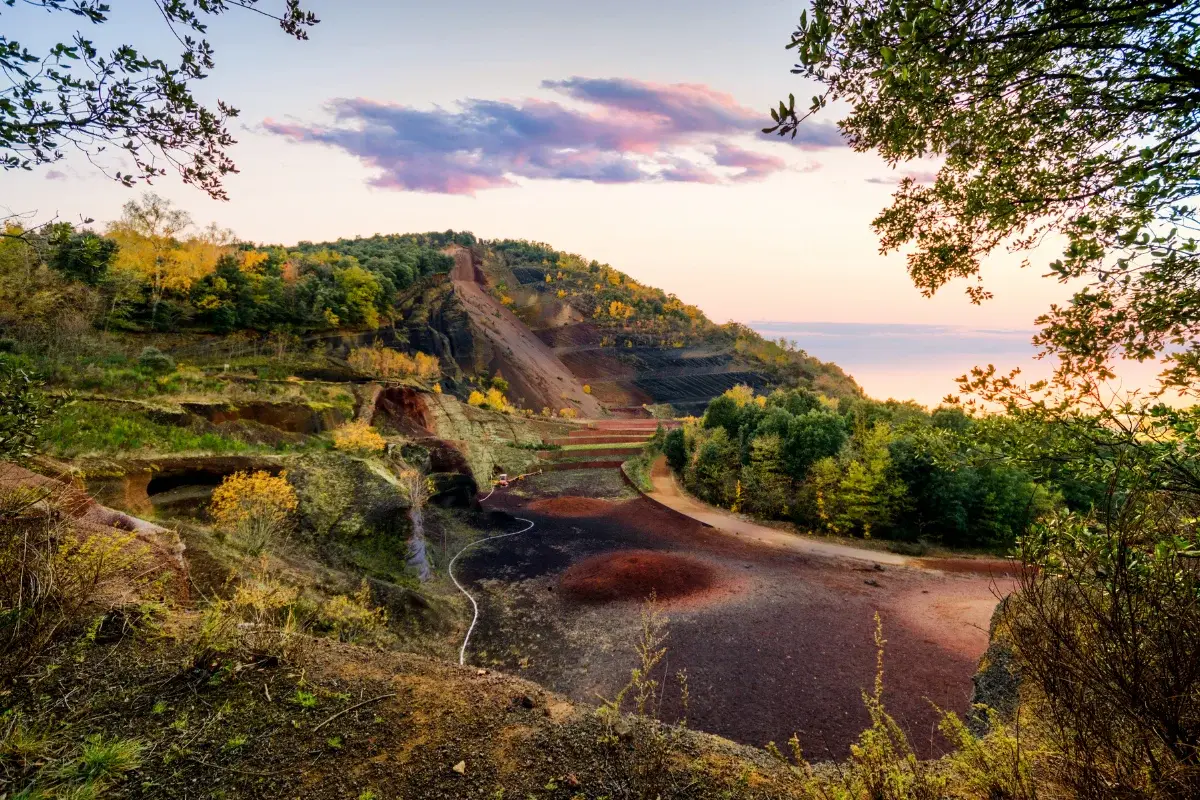

The Garrotxa contains 40 volcanic cones and over 20 lava flows within a 15-kilometre radius of Olot. The Croscat volcano — the most recently active on the Iberian Peninsula, with an eruption approximately 11,000 years ago — has a cross-section where quarrying exposed the internal layers of the cone: red, orange and grey bands showing the sequence of eruptions like a geological notebook left open.
La Fageda d’en Jordà grows on completely flat ground at 550 metres elevation. A beech forest growing flat is botanically anomalous — beeches grow on hillsides, in thin rocky soil. The explanation is entirely geological: the ground is a lava flow from the Croscat, whose uneven surface retains moisture and creates a microclimate that allows the forest to exist somewhere it technically shouldn’t.
The Garrotxa is 110 km from Barcelona by car on the C-17. The combination — volcanoes, medieval villages, volcanic-soil gastronomy — doesn’t exist anywhere else in the western Mediterranean.
The three volcanoes worth planning around
Volcán Santa Margarida: phreatomagmatic — the explosion opened a wide circular crater rather than building material upward. Inside the crater floor: a Romanesque hermitage dedicated to Santa Margarida. The visual effect of walking down into the crater and finding that small church sitting alone on the meadow is one of the most singular contrasts in Catalonia. The descent from the car park takes 20–25 minutes on a clear path.
Volcán del Croscat: the largest volcanic cone on the Iberian Peninsula, 160 metres high. Decades of quarrying for volcanic aggregate left a cut in the flank that’s now the most instructive geological cross-section in the park — visible from the walking path, explained at the Can Passavent interpretation centre at the base. The restoration of the volcano after quarrying ended is part of the guided explanation.
Volcán Montsacopa: Olot’s urban volcano. It’s inside the city — accessible from the centre in 15 minutes on a marked path. The summit has 360° views over Olot, the Natural Park, the Puigsacalm ridge and, on clear days, the Canigou massif in France. The crater is intact because the eruption was effusive rather than explosive — no lateral blast to deform it.
Classic three-volcano circuit: approximately 9 km, 291 metres of positive elevation, 2.5–3 hours. Start at the Can Passavent car park. Best season: March to May.
La Fageda d’en Jordà: the forest that shouldn’t be here
The Fageda d’en Jordà is one of those places that requires explanation before the visual makes sense. Beeches don’t grow at 550 metres on flat ground — that’s simply not where the conditions for a beech forest exist. What happened here is that the Croscat’s lava flow created a relief of mounds and hollows (called tossols) that trap moisture and regulate temperature in a way that mimics high-altitude hillside conditions. The forest is a botanical accident produced by volcanic geology.
The practical result: a forest with moss-covered ground from which beech trunks emerge directly, almost no undergrowth, and a canopy that filters light into the interior. In autumn, the ground turns entirely gold and the filtered light creates an atmosphere unlike anything else in Catalonia.
Access from the Can Serra car park, on flat marked paths. Easily combined with the volcano circuit on the same day.
For visitors who want to calibrate difficulty before coming, the hiking near Barcelona guide covers comparable routes in the region.
Quick decision: how to organise your time in the Garrotxa
- One day from Barcelona → La Fageda d’en Jordà + Volcán Santa Margarida + lunch in Santa Pau — the Rumbus local bus connects Les Preses, Olot and Santa Pau for €2, useful if you leave the car in Olot
- Classic volcano circuit → 9 km loop from Can Passavent (Santa Margarida + Croscat) — 2.5–3 hours, 291m elevation, signed car park
- Focus on volcanic gastronomy → Fesols de Santa Pau DOP (white beans with butifarra) in Santa Pau or Hostal dels Ossos in Olot — restaurants in the Cuina Volcànica network use seasonal local produce
- Most unusual experience in the region → Hot air balloon with Vol de Coloms — company operates near Santa Pau, with European Sustainable Tourism Charter certification; seeing 40 craters from the air has no ground-level equivalent
- Best medieval village → Besalú — 11th-century Romanesque bridge 105 metres long with a hexagonal tower in the middle, 12th-century Mikvé (Jewish ritual bath), one of only two medieval Jewish ritual baths preserved on the Iberian Peninsula
- Families with children → Espai Cràter in Olot + Volcán Montsacopa — the underground volcanology centre has interactive content designed for different age groups; the Montsacopa is a 15-minute walk from the city centre
- Two nights → Olot + volcano circuit + Besalú + full volcanic gastronomy — Saturday in September means the Tura festivities with gegants in the main square; otherwise Olot has the quiet rhythm of a small Pyrenean capital
What to see in Olot beyond the park
Espai Cràter: interactive volcanology centre built underground. Essential for families and for anyone who wants to understand the geological origin of the comarca before going out to walk through it. The underground format is clever — you’re literally inside the mountain learning about what surrounds you.
Casa Solà-Morales: a building facade by Lluís Domènech i Montaner — the same architect behind the Palau de la Música Catalana in Barcelona. The Olot facade carries the same botanical and symbolic Modernista vocabulary, but placed in the context of a small Pyrenean city rather than a Barcelona showcase. The contrast between the building and its surroundings is striking.
Basílica de Sant Esteve: a national heritage building containing an original work by El Greco. Not a detail that appears in most regional tourist guides.
Museu dels Sants: an active religious woodcarving workshop that functions as a museum during visits. On weekdays, the craftspeople are working — the entire process of carving and painting religious figures for international distribution is visible in real time.
The three essential villages
Besalú — best preserved medieval ensemble in the Garrotxa
Besalú is 13 km east of Olot. Entry to the village crosses the 11th-century Romanesque bridge — 105 metres long, with a hexagonal fortified tower at the midpoint. The visual effect of crossing it is immediate: medieval paving, stone houses, the Fluvià river below.
The detail that justifies the stop: the Mikvé — 12th-century Jewish ritual baths, one of only two surviving medieval examples on the Iberian Peninsula (the other is in Girona). A stone building with a Romanesque barrel vault, built at river level for water access. Guided visits only.
Besalú combined with an afternoon in Girona — 25 km east — makes an efficient full-day itinerary connecting the Garrotxa with the Costa Brava gateway.
Castellfollit de la Roca — the village on the edge
Castellfollit de la Roca sits on a basalt cliff 50 metres high and nearly a kilometre long, formed by two superimposed lava flows that the Fluvià and Turonell rivers have sculpted over thousands of years. The houses at the edge of the cliff extend beyond the rock face.
The church of Sant Salvador is at the extreme end of the cliff. From the small square surrounding it, the drop to the river valley below is vertical and unobstructed — one of the most unusual positions for a village in all of Catalonia.
Santa Pau — gateway to the Natural Park
Santa Pau is the most practical entry point to the Natural Park. The old nucleus has a Gothic porticoed square from the 13th century with irregular arches — among the best preserved in Catalonia. The castle of the Baronia, 13th–14th century, anchors the ensemble.
This is where the fesols de Santa Pau are grown — white beans with PDO (Protected Designation of Origin). The volcanic soil gives them a thin skin and buttery texture that distinguishes them from any other bean. In January, the Fira del Fesol celebrates the harvest with tastings in the village.
The Mikvé of Besalú, one of two left in Iberia
The Mikvé in Besalú is one of two surviving medieval Jewish ritual baths on the Iberian Peninsula. The building itself is 12th century — Romanesque vault, stone construction, positioned at river level to guarantee water access as required by halacha. The Jewish community in Besalú was expelled in 1436, nearly six decades before the 1492 expulsion from the whole of Spain.
This context matters: Besalú’s Jewish quarter was not a cosmopolitan urban phenomenon like Barcelona’s El Call, but a small community in a Pyrenean commercial city. The survival of the Mikvé is partly accidental — the building continued to be used as a storage space after the expulsion, which protected it from demolition.
Volcanic gastronomy: what to order and where
Restaurants in the Cuina Volcànica de la Garrotxa network use seasonal local produce. The reference dishes are the fesols de Santa Pau with butifarra (white beans with pork sausage, the most emblematic pairing), Garrotxa goat cheese (mould-rind, creamy texture, specific to the zone), mountain charcuterie (llonganissa, secallona, fuet), mountain-style cannelloni with meat filling and béchamel, and recuit (fresh curd) with honey as dessert.
At the upper end: Les Cols (Olot) holds two Michelin stars, with territory-driven cuisine and avant-garde aesthetics. Ca l’Enric (Vall de Bianya), in a 19th-century roadside inn run by the Juncà siblings, holds one Michelin star. The adjacent hostal has a Bib Gourmand and serves weekday executive lunch menus.
For accessible market-price dining: Bar Club Can Pelaio in Olot serves stews, roast meats, snails and beef with mushrooms at €12–15 average.
Getting there and getting around
By car: Barcelona to Olot via C-17 (Vic) then C-26. Around 110 km, approximately 1 hour 45 minutes without traffic. The scenic alternative via N-260 (Vic–Olot through Collsacabra) is 20–30 minutes longer but considerably more dramatic.
By bus: TEISA operates from Barcelona’s Estació del Nord. The Bracons route is faster; the Amer route passes through more valley villages. Approximately 2 hours.
Inside the comarca: the Rumbus connects Les Preses, Olot and Santa Pau for €2 per trip with unlimited journeys. The sustainable option for visitors who leave the car in Olot and access the Natural Park by public transport.
Season: the comarca works year-round. Autumn (October–November) is the most photogenic period for La Fageda d’en Jordà — the beech canopy turns orange and gold. Spring (March–May) has the best temperature and vegetation for the volcano circuits.
Comparison table: Garrotxa day trip options
| Route | Duration | Key stops | Car needed? | Best for |
|---|---|---|---|---|
| La Fageda + Santa Margarida | 1 day | Fageda, crater, Santa Pau | No (Rumbus) | First visit, families |
| Classic volcano circuit | Half day + | Croscat, Santa Margarida, Can Passavent | Yes | Active visitors |
| Medieval villages | 1 day | Besalú, Castellfollit, Santa Pau | Yes | Architecture, history |
| Full Garrotxa | 2 days | All of above + Olot, gastronomy | Yes | Comprehensive visit |
| Besalú + Girona | 1 day | Besalú, Girona | Yes | Medieval culture |
Mistakes to avoid
- Going only to the Fageda without the volcanic context — the forest makes much more sense once you’ve understood that it exists because of a lava flow, not despite being in a flat area; Espai Cràter or the visitor centre at Can Passavent provides that context
- Arriving in Santa Pau expecting restaurant options without planning — the village is small and restaurants have limited capacity; booking ahead for weekend lunches during peak season (spring, autumn) is practical rather than optional
- Missing Castellfollit de la Roca because it’s not on the standard circuit — it’s 8 km from Olot, 10 minutes by car, and the visual experience of the basalt cliff has no equivalent in the rest of the region
- Skipping the hot air balloon because it seems expensive — the Garrotxa from the air, with 40 visible craters, is a perspective that walking routes cannot replicate; the price (approximately €165–180 per person) needs to be evaluated against what the view actually delivers
Combining the Garrotxa with a stop in Ripoll — 45 minutes by car — adds one of the most important Romanesque monastery portals in Europe to the itinerary. For the broader regional context, the Besalú guide covers the village in more depth, and the Girona day trip guide covers the continuation east toward the Costa Brava.