
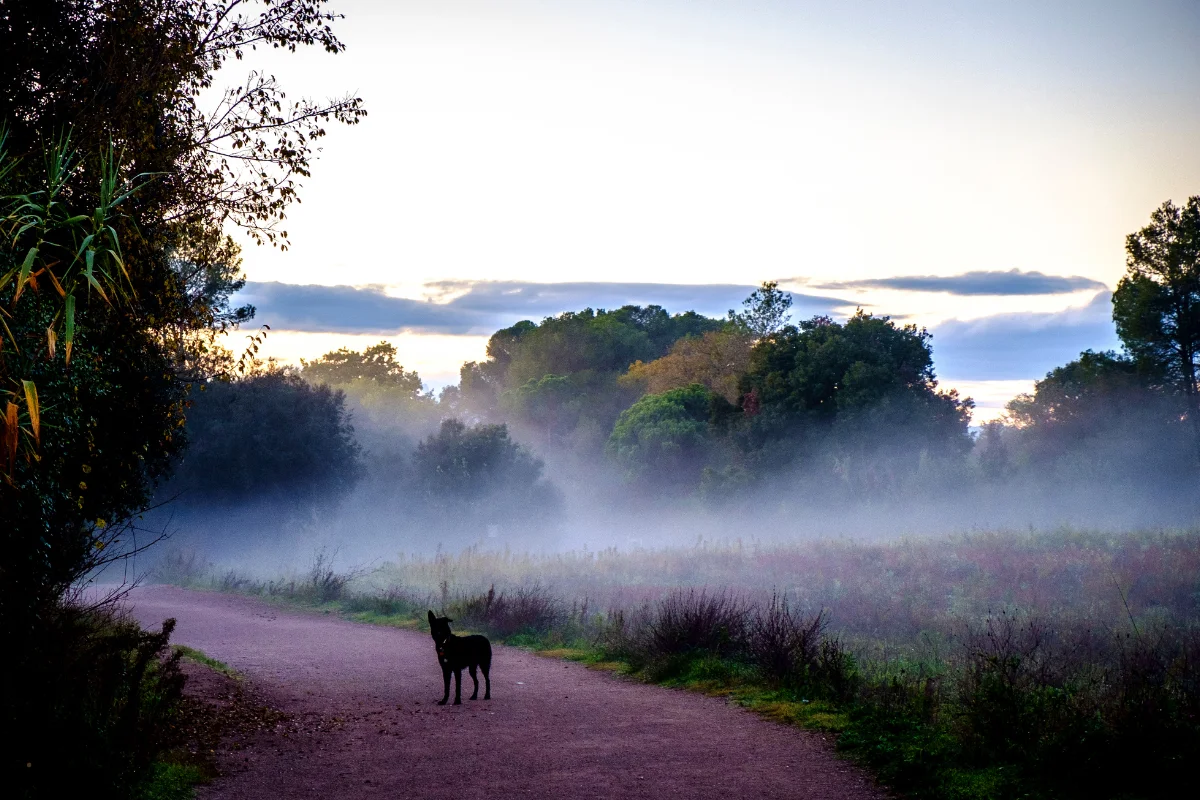

The Collserola Natural Park is 8,259 hectares of protected Mediterranean forest sitting between the city of Barcelona and the Vallès plain. It has 191 catalogued bird species, 28 mammal species including habituated wild boar populations, and a designated protected status under both the Catalan PEIN network and the European Natura 2000 framework. The FGC suburban rail from Plaça Catalunya reaches stations inside the park in 22 minutes, covered by the standard Barcelona transport card with no supplement.
Most international visitors spend their entire trip in Barcelona without knowing it exists. The ones who find it tend to come back.
The hiking near Barcelona guide covers the wider provincial options — Collserola is the one that works on any free afternoon with no planning beyond checking the weather.
Quick Decision: Which Route for Which Visit
- 2 hours, minimal effort, maximum views → Carretera de les Aigües from Vallvidrera funicular — almost flat, Barcelona panorama throughout
- Half day with forest immersion → Sant Medir + Can Borrell loop from Baixador de Vallvidrera (6km, 200m elevation)
- Full day crossing the park → Vallvidrera to Sant Cugat traverse (14.4km, ends at FGC station back to Barcelona)
- Best-rated trail by hikers → Font d’Ermetà – Can Borrell – Can Gordi from Sant Cugat (8.7km, 4.5/5 rating)
- Ridge walk with raptor migration → Torre Baró to Tibidabo ridge (9.5km, September–October for birds)
- Accessible, pushchair-friendly → Camí del Fondal from Baixador de Vallvidrera (2km, adapted for wheelchairs)
- Shortest route to feel you’re in the wild → Pantano de Vallvidrera from Baixador (2-3km, 19th-century industrial reservoir)
The Carretera de les Aigües: What It Actually Is
The most-walked path in Collserola follows the route of a former water pipeline for nearly 10 kilometers with less than 50 meters of total elevation change. It runs along the ridge above the city with continuous open views over the Eixample grid, the Sagrada Família towers, the port and the Mediterranean.
Access: FGC S1 or S2 from Plaça Catalunya → Peu del Funicular station → Vallvidrera funicular → top station. The path starts in both directions from the funicular exit.
Distance: 10km linear. Time: 2–3 hours for the full stretch. 45 minutes to the main viewpoint from the funicular.
How the park absorbs its crowds: the Carretera de les Aigües works as the park’s primary crowd absorption mechanism. By concentrating runners, cyclists, families with prams and casual walkers on this accessible ridge path, it keeps the pressure off the interior forest trails where the actual ecological sensitivity lives. It’s not the wildest thing in Collserola — it’s what allows the wild parts to stay wild.
The views of Barcelona from this path are the clearest you’ll find from any publicly accessible point above the city at this distance. For a comparison of city viewpoints, the secret viewpoints Barcelona guide covers the in-city options.
Trail Guide by Difficulty
Easy — Pantano de Vallvidrera
The Vallvidrera Reservoir was built in 1864 by architect Elies Rogent to supply water to the former municipality of Sarrià — the exposed brickwork structure is 19th-century industrial architecture, not a natural feature. The surrounding area has picnic zones, family-friendly paths, and direct access to the park’s Information Centre.
Access: FGC Baixador de Vallvidrera → 10 minutes on foot. Distance: 2–3km. Time: 45 min–1 hour. Pram-accessible on the initial section.
Easy/Accessible — Camí del Fondal
Runs from Baixador de Vallvidrera to the Vil·la Joana (last residence of the Catalan poet Jacint Verdaguer, now a literary museum run by the MUHBA) and the park Information Centre. The first section is adapted for wheelchairs and visual impairment. Flat with consistent surface throughout.
Distance: 2km. Access: FGC Baixador de Vallvidrera.
Moderate — Sant Medir + Can Borrell Loop
One of the most representative circuits through the Collserola oak forest. The Ermita de Sant Medir — a hermitage documented since 987 AD — is the route’s focal point and the destination of an annual pilgrimage on March 3rd when hundreds of groups walk up from Barcelona before dawn in a tradition that predates most of the city’s current urban fabric.
Access: FGC Baixador de Vallvidrera. Distance: 6km circular. Elevation: ~200m. Time: 2–2.5 hours.
Moderate — Font d’Ermetà – Can Borrell – Can Gordi
Consistently the highest-rated trail in the park by user platforms (4.5/5 from 40+ reviews). Departs from Sant Cugat and covers the Vallès-facing side of the ridge — the more humid, less-visited face of the park where oak replaces pine and stream-side vegetation appears from kilometer 2 onward.
Access: FGC S1/S2 → Sant Cugat. Distance: 8.7km. Elevation: 313m. Time: 2.5–3 hours.
The Font d’Ermetà itself — a semicircular stone structure where water emerges from a single central spout — is one of the park’s more photogenic heritage elements. Architecturally it’s worth the route alone.
Moderate (Linear) — Vallvidrera to Sant Cugat Traverse
The complete cross-park route. Moves through Vil·la Joana, Font del Canet, Sant Medir hermitage and the Pi d’en Xandri — a singular tree that’s among the most well-known individual trees in Catalonia by local reckoning. Ends in Sant Cugat with a 25-minute FGC return to Barcelona.
Access: FGC Baixador de Vallvidrera (start) / FGC Sant Cugat (finish). Distance: 14.4km. Elevation: +248m / -354m. Time: 3h15–3h45. Requires return ticket from Sant Cugat.
Challenging — Torre Baró to Tibidabo Ridge
The route along the main crest of the sierra with simultaneous views over central Barcelona and the Vallès plain. The Turó de la Magarola midpoint is nationally recognized for autumn raptor migration monitoring — honey buzzards, marsh harriers and booted eagles pass through during September and October.
Access: Metro L3 to Canyelles or Vall d’Hebron + 20-minute walk to the start. Distance: 9.5km. Elevation: ~450m accumulated. Time: 3–3.5 hours.
Ends at Tibidabo — the historic amusement park and the Sagrat Cor church with 360° views. The Tibidabo Barcelona guide covers the descent options and what’s worth staying for at the top.
Trail Comparison Table
| Trail | Distance | Elevation | Difficulty | Transport Access |
|---|---|---|---|---|
| Carretera de les Aigües | 10km | Minimal | Very easy | FGC + Vallvidrera funicular |
| Pantano de Vallvidrera | 2–3km | Minimal | Very easy | FGC Baixador de Vallvidrera |
| Camí del Fondal | 2km | None | Accessible | FGC Baixador de Vallvidrera |
| Font d’Ermetà – Can Borrell | 8.7km | 313m | Moderate | FGC Sant Cugat |
| Sant Medir + Can Borrell | 6km | ~200m | Moderate | FGC Baixador de Vallvidrera |
| Vallvidrera – Sant Cugat | 14.4km | +248/−354m | Moderate | FGC (linear, two stations) |
| Torre Baró – Tibidabo | 9.5km | ~450m | Challenging | Metro L3 Canyelles |
| Puig Madrona (El Papiol) | 6.5km | 330m | Moderate-hard | Renfe R4 El Papiol |
The Wildlife: What’s There and How It Behaves
Collserola has been catalogued at 191 bird species, 28 mammals, 17 reptiles and 10 amphibians — numbers that would be unremarkable in a remote reserve but are significant for a space entirely surrounded by a metropolitan area of five million people. The explanation is structural: the ridge functions as a biological corridor between the coast and the interior plateau, allowing species with large territorial requirements to maintain viable populations.
Wild boar (Sus scrofa) is the park’s largest mammal and the one that generates the most management challenges. Habituation to urban food sources — animals that have learned to associate human presence with food — has produced a subset that descends regularly into peripheral neighborhoods. The habituation cycle begins with someone leaving food out and ends with an animal that can no longer function in the wild and becomes a public safety problem. Do not feed them under any circumstances. If you encounter a female with young: don’t run, step back slowly maintaining eye contact.
Raptors: the Turó de la Magarola is a national reference point for migration monitoring. Goshawk, sparrowhawk, peregrine falcon and tawny owl are year-round residents. September–October adds honey buzzard, marsh harrier and booted eagle on passage south.
The invasive species nobody mentions: the Japanese nightingale (Leiothrix lutea), introduced in 1998, has colonized virtually the entire park and competes aggressively with native insectivorous birds for ecological niche. It’s the highest-impact invasive bird species in Collserola and isn’t mentioned in most visitor materials — but it’s responsible for a measurable decline in native forest bird populations since its establishment.
Amphibians: the common salamander (Salamandra salamandra) inhabits the wetter, shadier zones. The Vallvidrera Reservoir is the park’s primary breeding habitat for frogs and toads. The natural springs throughout the park are not treated for drinking — bring water from the city.
Why the biodiversity survives this close to the city
Beyond the trail options, the question worth answering is why the park’s biodiversity has held up this close to a major city.
The answer is the Consorci del Parque — a management body that integrates the Generalitat de Catalunya, the Barcelona Metropolitan Area and nine municipalities — which has maintained continuous ecological monitoring since the 1980s. The Sylvia bird monitoring program, started in 1987, is one of the oldest continuous avian datasets in Catalonia. The Mariposa monitoring program tracks butterfly populations as biodiversity indicators. These programs have identified real-time the arrival and expansion of invasive species, the response of amphibian populations to drought cycles, and the behavioral changes in mammal populations driven by urban habituation.
The park doesn’t look this healthy by accident. It looks this healthy because it’s been actively managed and scientifically monitored for four decades while cities that size normally consume their green edges entirely.
Getting There Without a Car
FGC from Plaça Catalunya (best option for most routes): Lines S1 and S2 run every 6–15 minutes. The stations inside or at the park boundary are:
- Baixador de Vallvidrera (22 min from Plaça Catalunya) → Reservoir, Vil·la Joana, Sant Medir loop, accessible trail
- Les Planes (24 min) → Central sector picnic areas, mid-difficulty routes
- La Floresta (26 min) → Shadier north-facing routes, less-visited zones
- Sant Cugat (32 min) → Font d’Ermetà route, traverse end point
All covered by standard Barcelona transport cards (T-Casual, T-Usual). No airport-style supplements. The Barcelona public transport guide covers the full card options and which works best for a day trip.
Vallvidrera Funicular: from Peu del Funicular station (same FGC line, stop before Baixador) up to Vallvidrera Superior — the most efficient access point for the Carretera de les Aigües, dropping you at ridge level without any uphill walk.
Metro access on foot: Metro L3 at Zona Universitària, Vall d’Hebron, Canyelles or Mundet puts you 15–25 minutes on foot from the park boundary. From the Gràcia, Horta or Sarrià neighborhoods, you can walk directly into the park — forest begins at the urban edge with no transition zone.
Bus: Lines 111, 118, V7 and 128 reach park access points. Line 111 is the most useful for the Tibidabo axis. Check the TMB planner for connections from a specific neighborhood origin.
Who Is This For
You have 2 hours on a clear day → Funicular to Vallvidrera + Carretera de les Aigües eastward to the main Barcelona viewpoint. Return by funicular or walk downhill to Sarrià (30 min) and metro home. The route requires no trail fitness.
You want a proper forest half-day → Sant Medir + Can Borrell loop from Baixador de Vallvidrera. Pack lunch, start before 10:00, back in Barcelona for late afternoon. This route goes through oak forest rather than the pine-dominant ridge and feels more remote than the Carretera.
You want the best all-day experience → Vallvidrera to Sant Cugat traverse. Full cross-park in one linear route, ends with a train back. Bring 2L water minimum. The combination of landscape types — pine ridge, oak interior, stream valley, agricultural clearings — is the park’s full range in one day.
You’re a birder visiting in September or October → Torre Baró to Tibidabo ridge, arriving before 9:00am at the Turó de la Magarola. This is the Catalan raptor migration watchpoint.
You’re visiting with children or pushchairs → Camí del Fondal or Pantano de Vallvidrera from Baixador de Vallvidrera. Both are accessible, both have cultural content, both return to the same station.
Best Strategy by Available Time
Short on time (2 hours): FGC to Peu del Funicular → funicular to top → Carretera de les Aigües 30 minutes in either direction → return same way. Total: 2 hours door-to-door from central Barcelona.
Half day (4 hours): FGC to Baixador de Vallvidrera → Pantano de Vallvidrera → Sant Medir hermitage → Can Borrell → back to Baixador. Pack lunch and water. Return for afternoon plans.
Full day: FGC to Baixador de Vallvidrera → Vallvidrera-to-Sant Cugat traverse (14.4km) → FGC from Sant Cugat back to Barcelona. Combine with Tibidabo visit at the end if energy allows.
Mistakes to Avoid
- Taking bikes on narrow footpaths — the park only permits cycling on tracks wider than 3 meters. The corriols (narrow footpaths) are explicitly banned for bikes. The rule exists because narrow-path cycling is the primary cause of soil erosion on ecologically sensitive sections. Fines are issued.
- Letting dogs off lead — mandatory leash rule throughout the park, no exceptions by zone, breed or time of day. The pressure on ground-nesting bird species from unleashed dogs is documented in the park’s monitoring data.
- Counting on natural springs for water — most park springs are not treated for drinking. Caudal also varies significantly by season. The Font de la Budellera (the park’s most popular spring) was closed for restoration until early 2026; check its current status before planning a stop there.
- Arriving at the Carretera de les Aigües from the wrong direction — most people approach via the Tibidabo tram and funicular (the tourist route). The FGC + Vallvidrera funicular combination is faster, cheaper and deposits you directly on the path.
- Dismissing the park as “just a city park” — it is Natura 2000 protected, has active fire risk management April–September, enforced regulations and 40 years of continuous scientific monitoring. Treating it as a paved urban greenway produces the same category errors as underestimating any protected natural area.
Final Insight
The Collserola ridge has been the geographic limit of Barcelona for most of the city’s history — the barrier that stopped medieval expansion, the water source that fed Sarrià and Sant Cugat, the defensive high ground that every successive government has tried to control. The city grew around it and eventually surrounded it, which is why it now exists as a protected park rather than a suburb. The 191 bird species catalogued there aren’t there despite the five million people below — they’re there because someone decided in 1987 to start counting them, and in 2010 to protect the land that supported them. Collserola is what deliberate conservation inside a metropolitan area actually looks like when it’s taken seriously for four decades.
For extending a Collserola day into the surrounding area, the Tibidabo Barcelona guide covers everything at the summit above the park, and the cycling routes Barcelona guide maps the access corridors from the city to the park’s southern edge.