
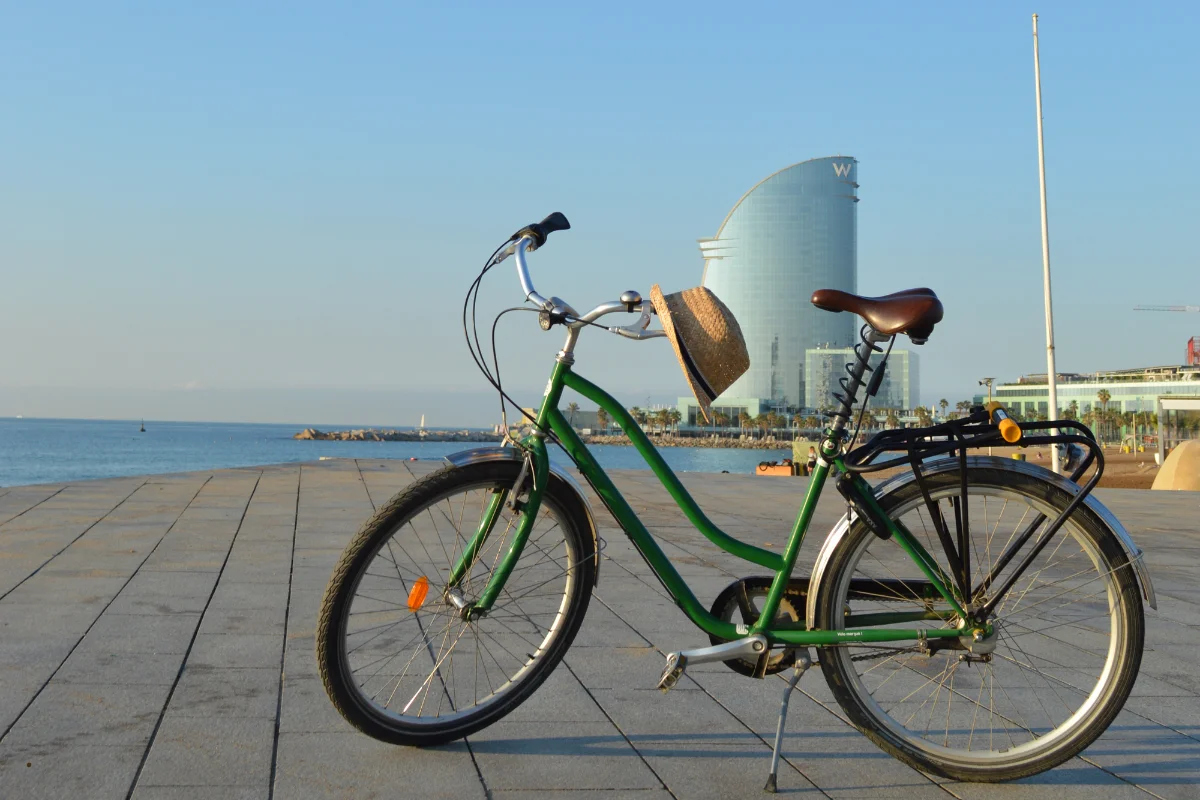

Barcelona has 260km of dedicated bike lanes and around 2,000km of streets with zone 30 where bikes have priority. The network theoretically lets you cross the city end-to-end without touching a major road. In practice, the right route depends on your bike, your level, and what you’re actually trying to experience.
The critical update for 2025: riding on the pavement is prohibited with a €500 fine, no exceptions for width or speed. This changed in February 2025. It catches visitors who’ve ridden here before and assume the old flexibility still applies.
The Carretera de les Aigües — the most photographed cycling route near Barcelona — is compacted earth, not asphalt. A road bike with narrow tyres won’t enjoy it. The Ronda Verda (the circuit that rings the whole city) is 72–81km with 775–900 meters of accumulated elevation. These are the specs that matter before you choose.
Quick Answer: What are the best cycling routes in Barcelona? Easiest: Seafront promenade (10–14km, flat, continuous bike lane). Best views: Carretera de les Aigües in Collserola (10km, compacted earth, 300–450m altitude, 20km/h limit). Most complete: Ronda Verda (72–81km circuit, 775–900m elevation gain). City exploration: Eixample Modernisme loop (13–15km, nearly flat). Nature escape: Besòs River path (10–20km, car-free).
Quick Decision
- Complete beginner, any bike → Seafront promenade (Barceloneta to Fòrum, 10–14km, fully flat, asphalt)
- Want the best views → Carretera de les Aigües (mountain or gravel bike only, compacted earth)
- Want nature, no cars → Besòs River path or Llobregat Delta route south
- Want to combine Gaudí sightseeing with cycling → Eixample Modernisme loop (13–15km, flat)
- Want a serious challenge → Montjuïc climb (13% gradient on final stretch) or Tibidabo ascent
- Want to tour the city perimeter → Ronda Verda (full day, mountain or gravel bike)
- Arriving by train, want to cycle from there → Lavern-Subirats station (R4) for e-bike Penedès routes
Who Is This For?
- Tourists for 2–3 days → Seafront promenade + Eixample loop. Both on rental bikes, no prior Barcelona knowledge needed
- Active travelers who want more than sightseeing → Carretera de les Aigües (needs mountain or gravel bike) combined with the Funicular de Vallvidrera to avoid the climb
- Cyclists who want a proper training ride → Montjuïc circuit or Tibidabo ascent — both have significant gradients
- Multi-day visitors interested in day trips → Llobregat Delta route (40–60km round trip toward Castelldefels and the delta) or Penedès e-bike from Lavern-Subirats
- Residents or long-stay visitors → Bicing annual subscription (€50, residents only) + Ronda Verda as the ultimate local cycling project
The 2025 Rule Change You Need to Know
From February 1, 2025: riding on pavements is prohibited for bikes and e-scooters. Fine: €500. No exceptions for pavement width or cycling speed. The only exceptions are children under 12 (with an adult companion) and under-14s on streets without a segregated bike lane.
Other fines currently enforced:
- No lights (white front, red rear): €100
- Using headphones or phone while cycling: €200
- Locking bike to trees or sensitive street furniture: €100
Maximum speed on road bike lanes: 25km/h. On the Carretera de les Aigües (shared with runners and walkers): 20km/h — enforceable.
Easy Routes: Flat, Any Bike
Seafront Promenade: Barceloneta to the Fòrum (10–14km)
The most-used cycling route in the city. From the Moll de la Fusta near the Columbus monument to the Parc del Fòrum: a continuous, completely flat bike lane separated from traffic for most of the route. Passes Barceloneta beach, the Port Olímpic, Bogatell and Mar Bella beaches, and the Parc de la Ciutadella.
The interesting extension: continue north from the Fòrum to Badalona (~5km additional) along the Parc Fluvial del Besòs. Atmosphere changes completely — less tourist density, more river and trees.
Best time: before 09:00 or after 19:00 in summer. Mid-morning to mid-afternoon, pedestrian density slows cycling to a crawl in the central beach sections.
Bike type: any. 100% asphalt throughout.
Besòs River Path (10–20km)
The Parc Fluvial del Besòs has a segregated cycling track of around 10km along the riverbed from the Fòrum to Montcada i Reixac. No traffic lights, no cars, green surroundings, birds. The most underused good cycling route in Barcelona — and one of the best for uninterrupted riding.
The reverse connection — cycling upstream from the north — allows reaching Santa Coloma de Gramenet and Montcada, completing the northern section of the Ronda Verda.
Distance: 10–20km depending on how far north you go. Difficulty: very easy, flat throughout.
Eixample Modernisme Loop (13–15km circular)
From Plaça de Catalunya: a 13km circular route past Barcelona’s Modernisme highlights. Passeig de Gràcia (Casa Batlló at 3km, La Pedrera at 4km), up to Gràcia, Park Güell, and return via the Sagrada Família to Arc de Triomf.
The Eixample has bike lanes on most main streets. The Passeig de Gràcia section is busiest — avoid it 11:00–14:00 in peak season. For anyone combining cycling with building visits, the Barcelona Modernisme route guide covers the architecture in detail.
Distance: 13–15km. Gradient: minimal — the Eixample is nearly flat except for the approach to Park Güell.
Intermediate Routes: Some Gradient
Montjuïc: The Climb Worth Doing (10–15km)
Montjuïc has an 11km classic route from Plaça Espanya to the castle, with sections reaching 13% gradient in the final 600 meters before the top. Total elevation gain: around 173 meters.
The route passes the 1992 Olympic Ring (Estadio Lluís Companys and Palau Sant Jordi), Poble Espanyol, MNAC, and the Laribal Gardens. The descent via the port side toward Barceloneta has views over the marina and the city that reward the climb.
For those who don’t want to pedal up: the Montjuïc funicular allows bikes to the mid-point and you complete the upper section with gravity advantage on the way down. Combine with Montjuïc Castle for a full morning.
Distance: 10–15km depending on route chosen. Bike type: any with gears. A single-speed urban bike won’t work.
Llobregat Delta Route (40–60km round trip)
South from the Barceloneta toward Castelldefels, the coastal route runs 25–30km one way with moderate gradient. The section between the airport and Castelldefels has 5km of fine-sand beach riding. The Llobregat Delta, south of El Prat, has cycling tracks through rice fields and bird zones — completely different from the urban seafront. Connecting to the Ebro Delta day trip from Barcelona concept for those interested in wetland cycling.
Distance: 20–30km one way (40–60km return). Bike type: gravel or light road bike for comfort.
Advanced Routes: Mountain and Long Distance
Carretera de les Aigües: Best Views in the Area
The Carretera de les Aigües runs along the Tibidabo hillside at 300–450 meters altitude, nearly flat across its 10km, with views over the Eixample, the sea, and the Vallès plain on the other side.
Three things you need to know before going:
- The surface is compacted earth — not asphalt. A road bike with narrow tyres isn’t comfortable here. Mountain bike or gravel.
- Speed is limited to 20km/h because runners and walkers share the path. This is enforced.
- Car access to the Collserola Natural Park may be restricted in certain periods due to African swine fever (ASF) protocols — check the park’s current status before planning.
Getting there: Funicular de Vallvidrera from the FGC station at Peu del Funicular (S1/S2 lines from Plaça Catalunya). Bikes allowed in the funicular — maximum 4 per cabin. You ride up, cycle the route, descend to Sarrià by bike, and return to the center by FGC.
Distance: 10km (the path itself) plus access and descent depending on route variant chosen.
Tibidabo Ascent (15–20km with significant elevation)
From Gràcia to the Tibidabo summit — sustained, demanding climb adequate for those accustomed to mountain riding. The reward is a 360° panorama from the Sacred Heart Temple with the Pyrenees visible to the north on clear days.
Bike type: mountain bike or gravel with strong gearing. Best time: early morning to avoid summer heat.
Ronda Verda: Around Barcelona in One Day
The Ronda Verda is the signposted circuit that rings the city connecting metropolitan municipalities. 72–81km depending on variant, 775–900 meters accumulated elevation gain. A full day to complete it properly.
Surface composition: 34% asphalt, 15% gravel, 9% concrete, remainder forest tracks and pedestrian zones. Requires mountain bike or gravel — not suitable for urban bikes.
The most complex sections are Can Sant Joan in Montcada i Reixac and the Vallbona bridge, where railway and motorway infrastructure density requires close attention to navigation.
| Section | Surface | Points of interest |
|---|---|---|
| Seafront | Asphalt, flat | Fòrum, beaches, port |
| Besòs River | Compacted track | Santa Coloma, Montcada |
| Marina de Badalona | Forest, high gradient | Sant Jeroni monastery |
| Carretera de les Aigües | Compacted earth | City viewpoints |
| Llobregat River | Gravel, flat | Llobregat Delta |
| Montjuïc | Asphalt, gradients | Castle, port views |
Bicing: What It Costs and How It Works
Bicing is exclusively for registered Barcelona residents (empadronats). Two subscription options in 2026:
| Item | Flat Rate | Pay-Per-Use |
|---|---|---|
| Annual subscription | €50 | €35 |
| Mechanical bike 0–30 min | Free | €0.40 |
| Electric bike 0–30 min | +€0.40 | +€0.63 |
| Surcharge over 120 min | €5.75/hour | €5.75/hour |
The flat rate pays off for anyone making more than 43–54 trips per year. Management entirely through the SMOU app.
For visitors without registration: rental shops on the seafront promenade and in El Born charge €10–20/day depending on bike type.
Taking Your Bike on Public Transport
Metro: bikes allowed on weekdays 05:00–06:30, 09:30–16:30, and 20:30 to close. Weekends and holidays: free access all day. Folding bikes count as hand luggage — always permitted.
FGC, Rodalies, and Tram: bikes allowed except on overcrowded trains, with no weekend restrictions. The Funicular de Vallvidrera accepts a maximum of 4 bikes per cabin. The Tibidabo Funicular allows bikes from 11:00.
The practical combination: take the FGC to Vallvidrera, cycle the Carretera de les Aigües, descend to Sarrià by bike, return to center by FGC — the most popular combination among local cyclists, covering the best views without repeating the same section.
Theft Prevention and Bike Registration
Bike theft is a real problem in Barcelona, especially in the historic center. The Biciregistro system costs a one-time €7 and includes high-adhesion sticker kit with unique code and database registration consulted by the Mossos d’Esquadra (regional police).
Lock specifications that matter: Sold Secure Diamond certification for street parking. Models like the LITELOK X1 (angle grinder resistant) or Hiplok D1000 (graphene and ceramic composition) resist the electric tools used in most urban thefts. Gold-level or lower locks don’t withstand those tools.
Locking a bike to a tree or sensitive street furniture: €100 fine. Municipal bike parking is mapped in the SMOU app and on the city mobility map.
The Carretera de les Aigües surface rules out road bikes
The Carretera de les Aigües is not a road-bike route. Described as a mountain road, the detail that matters is that road bikes cannot handle it comfortably. The number of visitors who arrive with a rental city bike or their own road bike and find themselves on compacted earth is significant.
The 2025 pavement prohibition. Guides written before February 2025 (including most content indexed on travel sites) still reflect the old situation where pavement riding was tolerated. The €500 fine is real and is being enforced.
The Funicular de Vallvidrera + FGC combination as the smart way to access the Carretera de les Aigües without the full climb. This approach — widely used by locals — almost never appears in tourist cycling guides.
Mistakes to Avoid
-
Taking a road bike or narrow-tyre rental to the Carretera de les Aigües. Compacted earth with a road bike is technically rideable but uncomfortable and slower than expected. Get a mountain bike or gravel bike for this route.
-
Cycling on the pavement. €500 fine since February 2025. No warnings, no discretion for narrow pavements or slow speeds.
-
Riding the seafront promenade between 11:00 and 16:00 in July or August. Pedestrian concentration makes this section barely faster than walking. Early morning or evening are the only viable times for fluid cycling on that stretch.
-
Not checking the Collserola ASF (African swine fever) restrictions before planning. Car access is sometimes restricted to the park, which affects how you reach certain trailheads. The current status changes — check before you go.
-
Locking to street trees. €100 fine, enforced. Use municipal bike parking (mapped in SMOU app).
Best Strategy
Short on time (2–3 hours): → Seafront promenade from Barceloneta to Fòrum and back (20–28km). Any rental bike, flat, no navigation required.
Half day: → Eixample Modernisme loop (13–15km) + coffee break at one of the best cafés in Barcelona near the route. Combines sightseeing with riding.
Full day (strong cyclists): → FGC to Peu del Funicular → Funicular de Vallvidrera → Carretera de les Aigües (10km) → descend to Sarrià by bike → lunch in Sarrià → FGC back to center. 3–4 hours of cycling, best views in the area.
Multi-day cyclists: → Day 1: Seafront + Besòs River (30km). Day 2: Montjuïc + Llobregat Delta direction (40–50km). Day 3: Ronda Verda attempt (full circuit 72–81km).
1-Day Cycling Plan (Intermediate Level)
- 08:00 → Pick up rental bike near Barceloneta or El Born (pre-book online)
- 08:30 → Seafront promenade east to Fòrum (10km, ~45 min)
- 09:30 → Besòs River path north toward Santa Coloma (optional extension, 10km)
- 11:00 → Return via seafront to Barceloneta area
- 12:00 → Lunch near the Born — best restaurants in Barcelona covers the area
- 14:00 → Eixample Modernisme loop: Passeig de Gràcia → La Pedrera → Park Güell approach → Sagrada Família → Arc de Triomf (13–15km)
- 17:00 → Return bike, evening free in the neighborhood
Riding an electric scooter on the pavement here carries a €500 fine and the machines are banned from all public transport, the two rules the electric scooters guide is built around.
When you arrive, the city offers 46,210 street spaces and 64 covered car parks that take bikes, with theft reports at 1,046 in 2025: the options are compared in parking a bike.
Final Insight
Barcelona’s cycling network connects sea, flat city, and mountain within a 20km radius — a combination that genuinely doesn’t exist at this scale in many European cities of this size. The mistake is treating the seafront promenade as the default and stopping there. The Carretera de les Aigües is 30 minutes from the center by funicular and offers a completely different version of the city. Getting the right bike for the right route is the only planning that actually matters.