
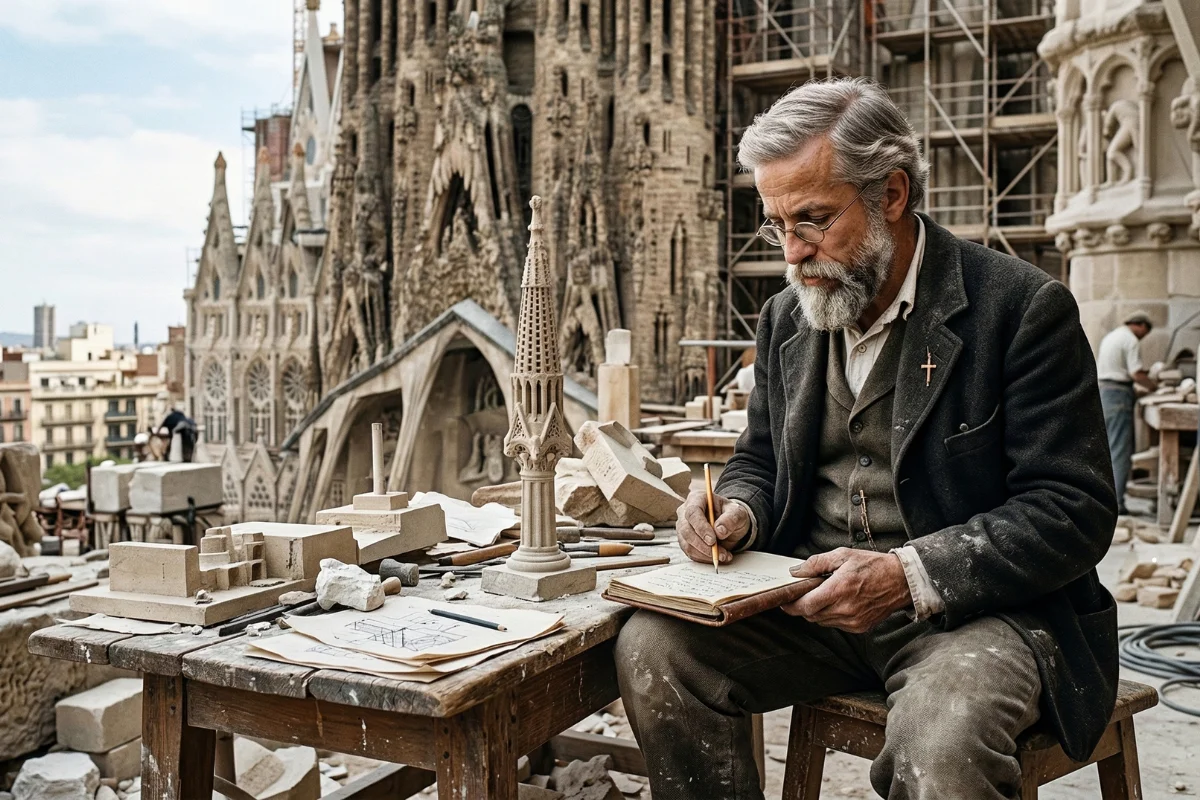

Gaudí left seven UNESCO World Heritage buildings in Barcelona. The problem most visitors face isn’t finding information about each one — it’s knowing the order to visit them, how much real time each one needs, and which ones require advance booking versus which you can approach without prior planning.
Barcelona’s Gaudí scene has changed significantly since each building’s management professionalized: Sagrada Família in June 2026 will see exceptional demand for the centenary of Gaudí’s death. Park Güell now caps the monumental zone at timed entry. Casa Batlló sells out weekends weeks in advance. The planning question is no longer “should I book?” — it’s “how far ahead?”
What follows gives you the itineraries, the booking reality, and the thing that is rarely spelled out: why the order of buildings matters for how you understand what you’re looking at.
Quick Answer: Which Gaudí buildings are in Barcelona and what order should I visit them? 7 UNESCO Heritage works: Sagrada Família, Park Güell, Casa Batlló, La Pedrera, Casa Vicens, Palau Güell, and the Cripta de la Colònia Güell. In 1 day: Casa Batlló and La Pedrera first (Passeig de Gràcia, walking distance apart), Sagrada Família midday, Park Güell late afternoon. In 2 days: add Palau Güell and Casa Vicens. Mandatory advance booking: Sagrada Família and Park Güell. Strongly recommended for all others in peak season.
All 7 UNESCO Works at a Glance
| Building | Built | Type | Advance booking | Price |
|---|---|---|---|---|
| Sagrada Família | 1882–ongoing | Basilica | Required | From €26 |
| Park Güell | 1900–1914 | Urbanization park | Required (monumental zone) | €18 |
| Casa Batlló | 1904–1906 | Residential (remodeled) | Strongly recommended | From €29 |
| La Pedrera (Casa Milà) | 1906–1912 | Residential building | Strongly recommended | From €25 |
| Casa Vicens | 1883–1885 | First residential | Recommended | From €19 |
| Palau Güell | 1886–1890 | Private palace | Recommended | From €12 |
| Cripta Colònia Güell | 1908–1914 | Unfinished crypt | Not required | From €8 |
The Colònia Güell is in Santa Coloma de Cervelló, 20km from Barcelona — a half-day excursion by FGC train from Plaça Espanya.
Quick Decision
- Want to maximize 1 day → Casa Batlló 9:00 + La Pedrera 10:45 + Sagrada Família 14:00 + Park Güell 16:00
- Want the least crowded Gaudí → Palau Güell (€12, almost no queues) or Casa Vicens (opened as museum 2017)
- Want to understand Gaudí chronologically → Casa Vicens (1883) → Palau Güell (1890) → Park Güell (1914) → Sagrada Família (ongoing)
- Want the most spectacular → Casa Batlló (most immersive, AR experience)
- Want the most architecturally significant → La Pedrera (structural innovation, free floor plan)
- On a tight budget → Palau Güell (€12 — cheapest accessible UNESCO Gaudí in Barcelona)
- Centenario visit (June 2026) → Book months ahead for Sagrada Família — it will be the most visited period ever
Who Is This For?
- First-time visitors with 1 day → Sagrada Família + La Pedrera + Casa Batlló. The non-negotiable three. Book all three online before your trip.
- Architecture enthusiasts → Add Palau Güell (structural origin) and Casa Vicens (Oriental influence, pre-Modernisme style). The progression shows how the language developed.
- Families with children → La Pedrera rooftop (warrior chimneys are memorable), Park Güell (outdoor, colourful dragon staircase), Casa Batlló (immersive, shorter concentration needed)
- Budget-focused visitors → Palau Güell (€12) and Casa Vicens (€19) deliver genuine Gaudí without the premium pricing of the Passeig de Gràcia buildings
- Returning visitors who’ve done the main three → Torre Bellesguard (medieval ruins integrated with neo-Gothic, rarely visited) and Casa Calvet (Gaudí’s only city architecture prize, facade viewable free)
Why Visit Order Matters More Than You Think
The most common mistake is planning by building importance instead of geographic logic and time of day.
Light on the Sagrada Família is not consistent. The Nativity facade (east) receives morning light — the stained glass colors are cool, precise, and spectacular at 9:00–11:00. The Passion facade (west) receives afternoon light — warm, dramatic, most powerful at 16:00–18:00. Visiting at the wrong time of day means seeing one facade at its best and the other at its worst.
Park Güell’s monumental zone fills with organized groups between 11:00 and 16:00. The first entry slot (9:30) or the last slot of the day are when the space is most manageable.
Casa Batlló and La Pedrera are 500 meters apart on the same boulevard. Visiting them back to back is the obvious move — except most people don’t do it because they book each separately without seeing the map.
The Passeig de Gràcia pair in the morning + Sagrada Família midday + Park Güell late afternoon is the sequence that works with the geography, the light, and the crowd patterns simultaneously.
1-Day Gaudí Itinerary
Requires advance booking for all interiors. This sequence is optimized for light, geography, and crowd timing.
09:00 → Casa Batlló (Passeig de Gràcia, 43)
First slot of the day has fewest organized groups and best light on the facade. Interior visit with audio guide: 60–90 minutes. The light court inside — graduating from deep blue at the bottom to white at the top to simulate ocean depth — is the element that surprises most visitors who arrive without researching it. The AR-enhanced visit reconstructs the building before Gaudí’s intervention. Evening visitors can see the nocturnal facade projection — a completely different experience.
Full detail: Casa Batlló complete visitor guide.
Price: from €35.
10:45 → La Pedrera (Casa Milà) (Passeig de Gràcia, 92)
5 minutes’ walk north on the same boulevard. Complete visit: piano nobile exhibition + attic with structural catenary model + rooftop with warrior chimneys. The structural revolution here — columns and beams carrying all loads so walls become irrelevant — was so radical that the original owners never fully understood the building they’d commissioned. If you can choose a late afternoon slot for La Pedrera’s rooftop, the light on the chimneys is significantly better.
Price: from €25.
12:30 → Lunch in the Eixample
The neighborhood around Passeig de Gràcia has good options at all price points. The best restaurants in Barcelona guide covers the area.
14:00 → Sagrada Família (Plaça de la Sagrada Família)
Metro L2 (purple) to Sagrada Família — 3 minutes from the Passeig de Gràcia area. Interior visit without towers: 60–90 minutes. With tower access: add 30–45 minutes (book tower specifically). Afternoon is ideal for the Passion facade’s warm stained glass light.
The Nativity facade documents Christ’s childhood with extreme sculptural naturalism — more than 100 real plant species were modeled for the reliefs. The Passion facade by Josep Maria Subirachs uses angular, austere language opposed to Gaudí’s — the tension between the two visual languages is one of the building’s most interesting architectural debates.
Price: from €26 without tower, from €36 with tower.
16:00 → Park Güell (Carrer d’Olot, 7)
From Sagrada Família: metro L5 to Diagonal, transfer to L3 to Lesseps or Vallcarca, plus 15–20 minutes uphill on foot. Or bus 24. The late afternoon slot for the monumental zone is when the crowd thins and the light on the dragon staircase and the mosaic bench is at its best.
The monumental zone — the 86-column Hypostyle Room, the Nature Square with its trencadís bench, and the dragon staircase — requires advance timed booking. The surrounding parkland is free. From the curved bench of the upper square: the widest panoramic view of Barcelona with the sea in the background.
Price: monumental zone €18.
2-Day Gaudí Itinerary: Adding the Less-Visited Works
Day 2 — The Early Gaudí
Palau Güell (Raval)
Gaudí’s first major commission from Eusebi Güell (1886–1890) — built when Gaudí was 34–38 years old. More restrained than Casa Batlló or La Pedrera, but with structural and spatial solutions that anticipate everything that came later.
The central parabolic dome — perforated with holes creating an artificial starfield — is one of the most surprising spaces in Catalan Modernisme. The rooftop has ceramic chimneys similar to La Pedrera’s but earlier, and the basement stabling area with mushroom-shaped columns is photographed constantly. The complete Palau Güell visitor guide covers the dome geometry, the organ that plays every 30 minutes, and the 40cm dome displacement.
5 minutes’ walk from Las Ramblas. Price: from €12. The most affordable UNESCO Gaudí building in the city.
Casa Vicens (Gràcia)
The first significant Gaudí residential work (1883–1885) — before Casa Batlló, before La Pedrera, before the mature Sagrada Família phase. It has Orientalist and Mudéjar influences that appear in no other subsequent Gaudí work: green and white tiles on the facade, wrought iron palm-leaf lattices, a decorative logic completely different from his mature period.
Opened as a museum in 2017 — the most recently accessible Gaudí building. Wait times are minimal compared to the Passeig de Gràcia icons. Price: from €19. 10 minutes’ walk from Park Güell, making the combination natural.
Full context: Casa Vicens complete guide.
Torre Bellesguard (Sant Gervasi) — Optional
Not UNESCO, but one of Gaudí’s most interesting buildings for understanding his evolution. Built 1900–1909 over the ruins of the last castle of King Martí I of Aragon. Gaudí integrated medieval remains into a neo-Gothic building with his own structural solutions. In the upper part of the city, rarely visited by tourists. Guided visit available, from €16.
Casa Calvet (Eixample) — 10-Minute Detour
The only Gaudí building that received the City of Barcelona’s Annual Prize for Artistic Buildings (1900). Private residence — no interior access. Experience limited to the Baroque facade and ground floor, where a specialty café now operates. Worth 10 minutes if you’re in the Eixample.
2-Day Schedule Summary
Day 1 — The Iconic Gaudí
| Time | Location | Duration | Transport |
|---|---|---|---|
| 09:00 | Casa Batlló | 90 min | — |
| 10:45 | La Pedrera | 75 min | 5 min walk |
| 12:30 | Lunch, Eixample | 60 min | — |
| 14:00 | Sagrada Família | 90 min | Metro L2, 10 min |
| 16:00 | Park Güell | 90 min | Metro + 15 min walk |
Day 2 — The Early and Overlooked Gaudí
| Time | Location | Duration | Transport |
|---|---|---|---|
| 09:30 | Palau Güell | 60 min | Metro L3, Drassanes |
| 11:00 | Walk Las Ramblas and Born | Free | 10 min walk |
| 13:00 | Casa Vicens | 75 min | Metro L3, Fontana + 10 min walk |
| 15:00 | Gràcia neighborhood | Free | — |
| 16:30 | Torre Bellesguard (optional) | 75 min | Bus 22 from Gràcia |
Cost Breakdown
Main four icons (1-day itinerary): Casa Batlló from €29 + La Pedrera €25 + Sagrada Família €26 + Park Güell €18 = €98 base.
Full 2-day route including all buildings: add Palau Güell €12 + Casa Vicens €19 + Palau de la Música €20–24 (if included) = €149–153 total.
Ways to reduce the cost:
- Go City Explorer Pass: 20–25% savings on a bundle of 3–7 attractions
- Free first Sunday slots: Palau Güell and Sant Pau are free on the first Sunday of each month
- La Pedrera is free the first Monday of winter months
The Barcelona daily cost guide breaks down how to factor Gaudí admissions into a full trip budget.
The centenary spike, and why booking a week ahead fails
The centenario demand spike. June 2026 marks 100 years since Gaudí’s death. The Sagrada Família and every other Gaudí building will see demand levels without historical precedent. The usual advice of booking a week ahead does not hold for this period. For June 2026 specifically, book months in advance.
The Casa Vicens opening is recent enough that it still gets left out. It only became a museum in 2017, and anything written before that date treats it as not-visitable. It’s the least crowded Gaudí building in the city and the one that shows the starting point of the architectural language most clearly.
The Palau Güell’s €12 price is almost too good to be believed given that it’s UNESCO-listed and arguably the most technically interesting early Gaudí in the city. It persists because the building is in the Raval rather than the Eixample, and most visitors don’t find their way there. That’s a navigational error, not a quality signal.
Mistakes to Avoid
-
Trying to see all six buildings in one day. Physically possible. Intellectually pointless. The Sagrada Família alone needs 90 minutes to do justice to the interior. Six buildings becomes a facade photo collection.
-
Booking Sagrada Família late for June 2026. The centenary of Gaudí’s death will produce exceptional demand. Morning slots will be gone weeks before the date.
-
Going to Park Güell at midday. The monumental zone in high summer midday sun is uncomfortable and photographically poor. Opening (9:30) or late afternoon is the right window.
-
Ignoring Casa Vicens because it’s less famous. The least crowded, most affordable, and most chronologically informative Gaudí building in the city. Skipping it for a sixth look at the Sagrada Família is a misjudgment.
-
Not allocating separate time for each of the two Sagrada Família facades. East (Nativity) and west (Passion) have completely different light, aesthetic, and atmosphere. Planning to see both in a single 45-minute circuit produces surface understanding of each.
Is the Full Gaudí Route Worth It?
Yes for architecture travelers — unambiguously. The concentration of significant work in a walkable area is unique globally. No other city offers a comparable density of completed work by a single architect at this level.
Depends for general visitors. The full route at full price (€149–153/person) is substantial. For a first trip, Sagrada Família + La Pedrera + one Block of Discord building covers the essential range without saturation.
Not worth it if you’re treating it as a checklist. The buildings reward attention — a thorough visit to three produces more understanding than a rushed circuit of six.
Twenty minutes out of the city sits the only built part of a Gaudí church, holding the hanging string model that engineered the Sagrada Família: the Colònia Güell crypt guide covers hours and tickets.
FAQ
How many Gaudí buildings are in Barcelona?
Seven UNESCO World Heritage works: Sagrada Família, Park Güell, Casa Batlló, La Pedrera, Casa Vicens, Palau Güell, and the Cripta de la Colònia Güell. Additional notable buildings include Torre Bellesguard, Casa Calvet (exterior only), and the Portal Miralles.
Which Gaudí building is cheapest in Barcelona?
Palau Güell at €12 is the most affordable UNESCO Gaudí building accessible to the public in the city. The Cripta de la Colònia Güell (outside Barcelona, Santa Coloma de Cervelló) costs from €8. Casa Vicens at €19 is the second most affordable in-city option.
Can you do the Gaudí route without advance booking?
Sagrada Família and Park Güell require mandatory advance booking with timed entry — no booking means no entry regardless of visible queue length. For all other buildings, booking isn’t mandatory but waits of 30–60 minutes in peak season are common without it.
How long does the Sagrada Família take?
Minimum 90 minutes for the interior without towers. With one tower: add 45 minutes. Guided tour: 2–2.5 hours. Include time for the exterior view from Plaça de Gaudí, which is free and often overlooked.
Casa Batlló or La Pedrera — which if you can only visit one?
Casa Batlló for the most immersive visual experience — the light court, main salon, and spiral rooftop chimneys are more dramatic. La Pedrera for the most architecturally significant — the free floor plan and rooftop represent Gaudí’s technical peak. Casa Batlló for spectacle; La Pedrera for depth.
How much does the complete Gaudí route cost?
The four main icons (Casa Batlló from €29, La Pedrera €25, Sagrada Família €26, Park Güell €18) total €98. Adding Palau Güell (€12) and Casa Vicens (€19) brings the total to €129. Combined passes save 20–25%.