

La Mercè is Barcelona’s annual city festival — four or five days around 24 September with over 500 free activities spread across the entire city. The 24th is a public holiday in Barcelona specifically, which means major museums open with free admission and the city operates on a different rhythm than any other point in the year.
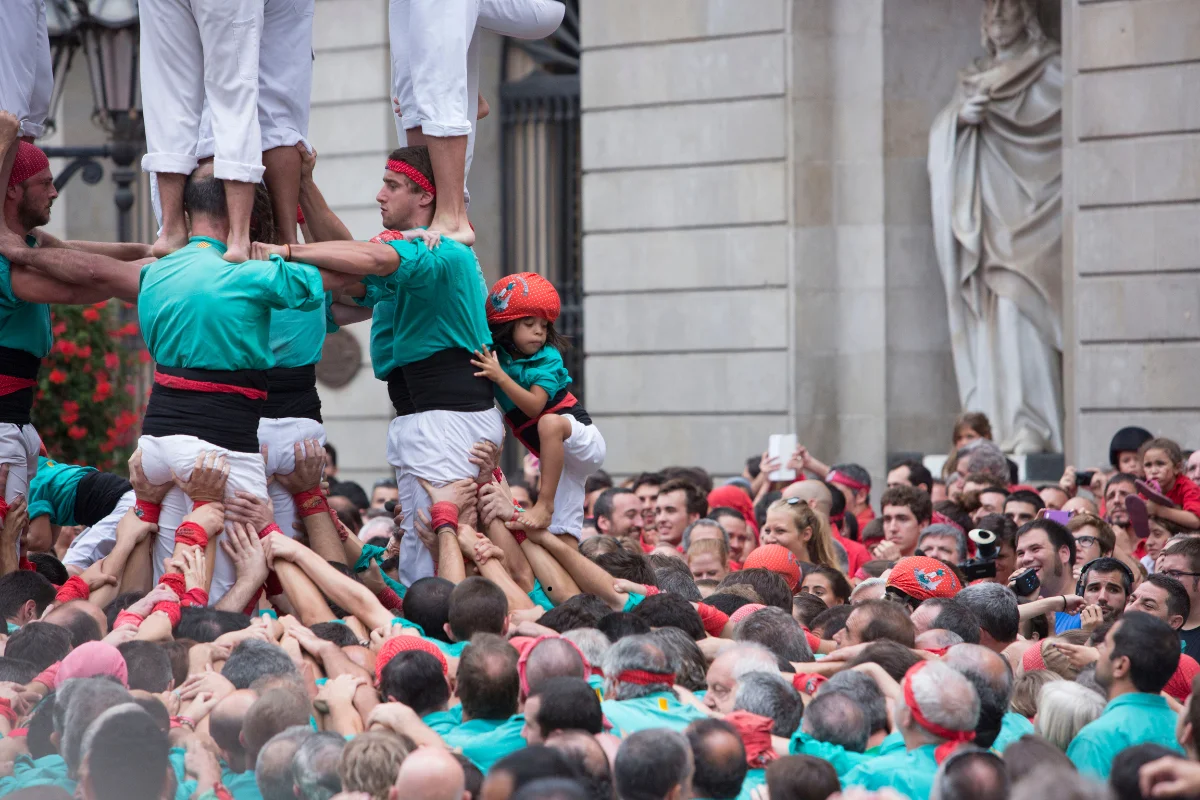
The festival runs 100+ free concerts across 16 stages. The correfoc — where participants walk through 80,000 fireworks launched by costumed devil figures — fills the Via Laietana. Castellers from across Catalonia build human towers up to 10 storeys high in the Plaça de Sant Jaume. The Piromusical at Montjuïc’s Magic Fountain closes everything.
La Mercè 2026 is scheduled for 23–27 September, with 24 September as the central public holiday.
What is La Mercè and when does it happen? La Mercè is Barcelona’s main city festival, dedicated to the city’s patron saint, held annually around 24 September (a local public holiday). 4–5 days of events with 100+ free concerts, castellers (human towers) in Plaça de Sant Jaume, the correfoc fire run, gegants street parade and the Piromusical closing ceremony at Montjuïc’s Magic Fountain. Between 1.5 and 2 million attendees across the festival period. All core programming is free.
Quick decision: which events are worth your time?
- The most intense single experience of the festival → Gran Correfoc (night of 24 September, Via Laietana) — cotton clothing with full arm and leg coverage is mandatory, no water throwing at participants, around 80,000 pyrotechnic devices per edition; arrive 90 minutes early for a good position
- Best for families with children → Correfoc Infantil (afternoon, before the main correfoc) — scaled-down pyrotechnics, slower pace, the official children’s entry point to the fire tradition
- The most technically impressive event → Castellers in Plaça de Sant Jaume, 24 September — top colles from across Catalonia, towers up to 10 storeys (~10 metres), the Historic Diada brings the highest-level teams
- Best free concert experience → Playa del Bogatell (massive capacity, big names) or Moll de la Fusta (more intimate, independent acts) — 100+ concerts across 16 stages citywide
- Free museum access → 24 September: MNAC, Museu Picasso (9am–8pm), CCCB, MACBA and Museu Marítim all open free; Sagrada Família, Poble Espanyol and Palau Güell require advance booking even on the 24th
- Best international street theatre → Mercè Arts de Carrer (MAC) in Parc de la Ciutadella, Parc del Fòrum and Parc de l’Estació del Nord — 70+ companies, circus, dance and emerging performance formats
- Piromusical without the crowd → MNAC steps (Palau Nacional) or Montjuïc Castle — elevated view, no crowd crush, less noise at the base; Hotel Miramar terraces if booked in advance
A locust plague in 1687 and the vow that started it
La Mercè’s origins aren’t purely religious. In 1687, a locust plague devastated Barcelona’s crops. The Consell de Cent (the city council) made a formal vow: if the plague stopped, the city would make the Mare de Déu de la Mercè its patron. The plague stopped. Pope Pius IX didn’t formally validate the patronage until 1868 — nearly two centuries later.
The episode behind the patron saint: during the final days of Barcelona’s 1714 siege, the city’s civil authorities officially named the Virgen de la Mercè “Commander General of the Armies” between 8 and 11 September. It was a symbolic gesture of political resistance rather than military strategy — but it embedded the patron’s image in the city’s identity at its most acute moment of crisis.
The first unified civic festival for the whole city was 1871. The modern protocol of the Seguici Popular — the procession of festive figures with strict choreography and hierarchy — was formalised in 1993, when the city created the official inventory of traditional figures.
The Seguici Popular: Barcelona’s procession of festive figures
The Seguici Popular is the opening parade of La Mercè, and it operates on formal rules that look improvised but aren’t.
The Eagle (Àliga) holds the highest rank and has the most unusual privilege in the festive calendar: it’s the only festive figure in Barcelona with permission to dance inside churches and before civic authorities on the town hall balcony. In the 16th century, the Eagle’s dance was the highest honour the city could offer visiting royalty — performed for Charles I in 1519 and Philip II in 1568.
The Gegants de la Ciutat represent Jaume I and Violant d’Hongria — the two foundational giants of Barcelona’s festive imagination. The current figures are 1991 reproductions of 1921 originals.
The Ox (Bou) has the strangest character arc: it was docile when it belonged to the butchers’ guild in the 15th century, but became aggressive and started charging at crowds after it transferred to the grain merchants’ guild in the 17th century. That disruptive behaviour is now codified into its performance protocol.
The Víbria — a dragon-woman with a woman’s torso, serpent’s tail and bat wings — recovers 1399 iconography. The most elaborately designed figure in the bestiary.
The Toc d’Inici in the Plaça de Sant Jaume is the act where the full Seguici forms a semicircle and each figure performs its specific dance to the Ministrers del Camí Ral musicians. It marks the official start of the festival and typically draws less crowd than the correfoc or castellers — which makes it one of the better experiences to position yourself for without arriving hours early.
The Correfoc: how it started and how to participate safely
The correfoc wasn’t designed. In 1979, during a standard street parade with devil figures, the watching crowd spontaneously started walking into the procession among the diables. No one had planned for public participation — it just happened, and it worked so well it became the defining feature of the tradition. Every subsequent correfoc has built on that accidental first participation.
How it works today: groups of diables and bestiary figures move through the Via Laietana (and sometimes additional streets depending on the edition), launching tens of thousands of fireworks directly into the crowd. Participants enter among the fire at their own choice. Each standard edition burns approximately 80,000 pyrotechnic devices.
What to wear:
- Cotton clothing only — synthetic fabrics melt against skin when sparks hit
- Long sleeves, long trousers, closed shoes (nothing open)
- Cotton hat or bandana for head coverage
- Earplugs and safety glasses (available at pharmacies nearby)
What not to do:
- Do not throw water at the participants — wet ground becomes slippery and water near pyrotechnic materials is a genuine safety risk, not a rule for the sake of it
- Do not bring open bottles or glasses
For residents along the route: lower metal shutters, protect glass with cardboard, take down awnings, disconnect alarm systems (smoke and vibration can trigger them).
The Correfoc Infantil runs in the afternoon before the main event — scaled-down pyrotechnics, slower pace. It’s the standard entry point for children encountering the tradition for the first time, and it’s genuinely distinct from the adult version rather than just a reduced version.
Castellers: human towers up to 10 storeys
The Plaça de Sant Jaume hosts the castellera diada — the most technically demanding act in the festival, with colles from across Catalonia competing in height and difficulty.
The structure: the pinya (hundreds of people forming the base, absorbing falls), the tron (intermediate floors), and the pom de dalt (the crown at the top, formed by children, completed with one hand raised). The most difficult constructions reach 10 storeys and approximately 10 metres.
The Historic Diada brings in top-level colles from outside Barcelona — Minyons de Terrassa, Castellers de Vilafranca — for maximum-difficulty attempts. The Local Diada features the eight Barcelona-based colles.
Castells have been UNESCO Intangible Cultural Heritage since 2010. La Mercè is the moment in the year where the concentration of colles and the technical level of the constructions is highest in the city. The Parc de la Ciutadella also hosts colles rehearsals and performances in the days before the 24th — lower-pressure viewing than the packed Plaça de Sant Jaume.
Positioning: Plaça de Sant Jaume fills early. For the Historic Diada, arriving 2 hours before the start is not excessive. The nearest metro is Jaume I (L4), but it saturates during the event — use Barceloneta station and walk from there.
The Piromusical: where to watch without the crowd
The Piromusical closes the festival with a fireworks display synchronised to a music score chosen by a different artist or band each year, performed at the Magic Fountain of Montjuïc. The central viewing area is the Avinguda de Maria Cristina.
Alternative viewing positions:
- MNAC steps (Palau Nacional): elevated position with a direct frontal view, none of the crowd pressure of the avenue, and the Palau Nacional as a backdrop. Arrive 1.5 hours early.
- Montjuïc Castle: the most distant and quietest option, full panoramic view, no ground-level crowd pressure — ideal for families with small children
- Las Arenas rooftop (former bullring on Plaça Espanya, now a shopping centre): 360° view from the top floor; the side facing the Magic Fountain fills quickly — arrive 45 minutes early
- Hotel Miramar or private Montjuïc terraces: book weeks in advance; options with cocktails and unobstructed views sell out quickly
The post-Piromusical metro problem: Espanya station saturates for 60–90 minutes after the fireworks end. Options: walk to Plaça de Sants (20 minutes) and take the metro from there; wait 45–60 minutes at a nearby bar before attempting Espanya; or walk the 30 minutes to the city centre if you’re staying near the Gothic or Born.
The music programme: BAM vs Música Mercè
Two distinct music circuits run in parallel during La Mercè:
Festival BAM (Barcelona Acció Musical): created in 1993 to platform emerging talent and international acts outside the commercial circuit. Regular venues are Moll de la Fusta, Rambla del Raval and Plaça de Joan Coromines. The BAM operates as a scout programme — artists appearing here tend to move into larger festival billings within 1–2 years. If you see a name you don’t recognise on the BAM programme, that’s often the right reason to go.
Música Mercè: established acts, mainstream pop-rock, jazz and traditional music at large-capacity venues. Playa del Bogatell hosts the biggest shows — audiences over 50,000. Avenida Maria Cristina handles more varied programming with a tendency towards Catalan-language urban pop.
Both circuits are completely free. The full programme is published on the Barcelona city website approximately 3 weeks before the festival opens.
Getting around during La Mercè
The metro runs 67 uninterrupted hours during the festival’s central days — typically from Friday morning through Sunday midnight. This is the most practically important transport fact of the festival, because significant street sections close for events and bus routing changes substantially.
Most useful metro lines by event:
- L3 (green): Liceu for Las Ramblas; Espanya for Montjuïc and Piromusical
- L4 (yellow): Jaume I for Plaça de Sant Jaume — avoid during castellers due to saturation; use Barceloneta instead
- L1 (red): Arc de Triomf for Parc de la Ciutadella
- Tramway: Parc del Fòrum and Playa del Bogatell
The Cursa de la Mercè — a 10 km popular race — takes place the weekend before the 24th to avoid clashing with stage logistics. It causes bus diversions on several routes during the morning of the race.
Free museum access on 24 September
The public holiday means free entry across the major municipal museum network. Confirmed for recent editions:
- MNAC: free all day
- Museu Picasso: free 9am–8pm (book online — the queue is real even with free entry)
- CCCB: free all day
- MACBA: free all day
- Museu Marítim: free all day
- MUHBA (all sites including Plaça del Rei): free all day
Requires advance booking even on the free day: Sagrada Família, Poble Espanyol, Palau Güell. Don’t assume that free entry eliminates the need to book.
The guest city tradition
Since 2007, Barcelona has invited a city from somewhere in the world to participate actively in La Mercè with street theatre companies, musicians and visual artists. The choice of guest city responds to cultural affinity or active cooperation projects.
In the 2025 edition, the guest city was Manchester — the first English city to receive the invitation. The collaboration produced two new festive figures: the Giganta Bee and the Bestia Bee, developed jointly by Catalan craftspeople and Manchester’s Global Grooves company, fusing Barcelona’s fire bestiary with the city’s symbolic bee imagery.
Mistakes to avoid
- Wearing synthetic clothing to the correfoc — polyester and nylon melt when sparks hit; this is genuinely dangerous, not a stylistic preference
- Throwing water at correfoc participants — creates slip hazards and interacts badly with pyrotechnic materials; you will be asked to leave
- Trying to exit Espanya metro station immediately after the Piromusical — wait it out or walk; the saturation lasts 60–90 minutes
- Not booking Museu Picasso in advance for the 24th — free entry still requires an online time slot and they fill up well before the day
- Arriving at Plaça de Sant Jaume 30 minutes before the castellers — for the Historic Diada, 2 hours early is the realistic minimum for a decent position
The city’s other landmark festival works on a different scale: Sónar 2026 runs 18-20 June at Fira Gran Via, covered in the Sónar guide.
Who is this for?
First-time visitors to Barcelona in September → book around the 24th and attend at least the castellers and one concert; the festival gives a compressed version of Catalan civic culture that takes months to encounter otherwise
Families with children → Correfoc Infantil (afternoon, cotton clothing), Seguici Popular (daytime parade), castellers, and the Mercè Arts de Carrer family programming in Parc de la Ciutadella
Music-focused visitors → Festival BAM for discovery, Música Mercè for scale; check the programme as soon as it’s published (3 weeks out)
Culture tourists → Toc d’Inici in Plaça de Sant Jaume to see the Seguici, free museum day on the 24th, MAC street theatre in multiple parks
People who hate crowds → Montjuïc Castle for the Piromusical, MNAC steps for the castellers view, Tuesday or Wednesday programming for the smallest attendance of the week
For the full context of what else is happening in Barcelona in late September, the Barcelona festivals calendar covers the rest of the autumn programme. For accommodation during La Mercè — when hotels in the Gothic and Born book up weeks ahead — the best neighbourhoods to stay in Barcelona guide includes the access trade-offs between central and slightly removed options. And for Montjuïc as a destination beyond the Piromusical, the guide covers the hill’s full range of venues and access routes.