
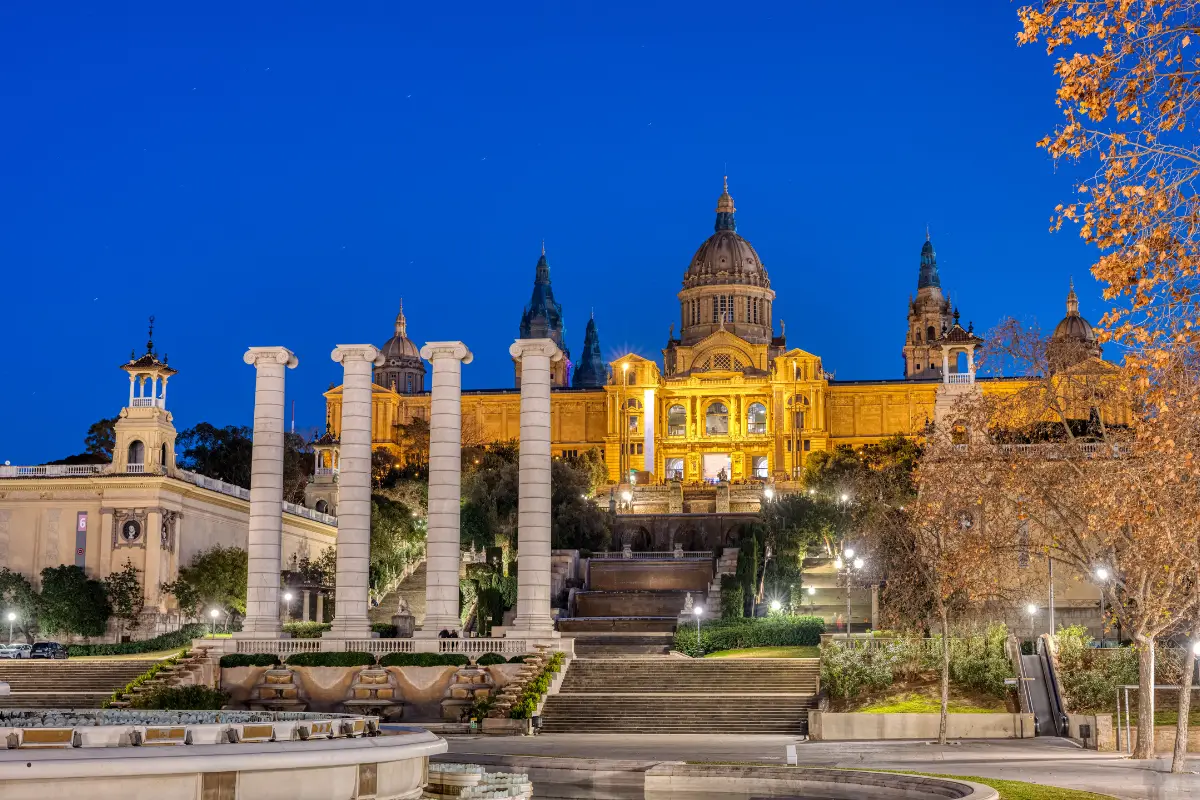

Montjuïc can take two hours or a full day depending on what you want to do. It is not a single monument — it is a 200-hectare hill with world-class museums, a castle with 360° port views, botanical gardens, the 1992 Olympic legacy, and an architectural recreation of all of Spain. The most common mistake is treating it as a single attraction and running out of time and energy before seeing the most interesting parts.
This guide is based on direct visits across all the main sites — including checking current prices, access conditions, and the funicular status that most online guides haven’t updated.
Critical update for 2026: the Montjuïc funicular has been closed since late October 2025 for infrastructure works (Vila i Vilà collector). Expected reopening: mid-April 2026. TMB operates a replacement bus service from Paral·lel metro with the same hours and integrated fare. Plan accordingly.
Quick Answer: What to See at Montjuïc Barcelona Best panoramic views: Montjuïc Castle (€12, free Sundays from 15:00, 360° over the port). Best world-class museum: MNAC (€12, or €2 for terrace-only access, free Saturdays from 15:00). Best art foundation: Fundació Joan Miró (€15, 14,000 works, Sert building). Most unusual: Poble Espanyol (€14.40 online, 117 real-scale buildings from across Spain). Free at any hour: Jardins de Mossèn Costa i Llobera, Font Màgica (show times vary by season). Most hidden: Mirador del Migdia (behind the castle, port and airport view, La Caseta del Migdia bar).
Quick Picks
- Best for first-time visitors → Montjuïc Castle + MNAC terrace (€2) in the same half-day
- Best free experience → Font Màgica show (Thursdays–Sundays, seasonal hours, always free)
- Best views in the city → Castle ramparts over the port (€5, or free Sunday afternoons)
- Best museum → MNAC for Romanesque art (the world’s most important collection) or Fundació Miró for modern art
- Most underrated spot → Mirador del Migdia (south face, port + airport view, almost no visitors)
- Best cheap access to the views → MNAC terrace (€2, no museum entry required)
Quick Decision: How to Plan Montjuïc by Time Available
- Got 2–3 hours → Castle only: ramparts, port views, walk Jardins de Miramar, descend. No museums.
- Got half a day (4–5 hours) → Castle + one museum (MNAC or Fundació Miró) + Jardins walk. Most balanced option.
- Got a full day (7–8 hours) → Castle + MNAC + Fundació Miró + Olympic Ring + Poble Espanyol + Font Màgica at dusk. Requires pace.
- Got two days → Add Jardí Botànic, Jardins de Laribal, Teatre Grec, Mirador del Migdia, Museu d’Arqueologia.
- Want free only → Font Màgica + Jardins de Mossèn Costa i Llobera + Castle Sunday after 15:00 + MNAC Saturday after 15:00.
Practical strategy: start at the top (Castle) in the morning and descend gradually, visiting museums on the way down toward Plaça d’Espanya. Going uphill at the end of the day with tired legs is the most common planning error on Montjuïc.
Who Is This For?
- First-time visitors → Castle for views + MNAC for architecture and Romanesque art + Font Màgica for the evening
- Art-focused travellers → Fundació Joan Miró (14,000 works, Sert building) + MNAC (world’s best Romanesque collection)
- Budget visitors → Free Sunday Castle (from 15:00) + free MNAC Saturday (from 15:00) + Font Màgica + free gardens
- Architecture interested → MNAC Palau Nacional (1929 Exposition) + Palau Sant Jordi (Isozaki) + Calatrava tower + Mies van der Rohe Pavilion
- Families with children → Poble Espanyol (craft workshops, wide open space) + Jardins de Joan Brossa (former amusement park site with play areas)
How to Get to Montjuïc in 2026
The funicular is closed. The Montjuïc funicular (Paral·lel metro to Avinguda Miramar) has been out of service since late October 2025 for the Vila i Vilà collector works. Expected reopening: mid-April 2026. TMB runs a replacement bus with the same schedule and route from Paral·lel metro — same fare, integrated into the T-Casual.
Bus 150 from Plaça d’Espanya — the most practical option for going directly to the Castle. Leaves from Plaça d’Espanya, stops at the MNAC and Olympic Ring, continues to the summit. Integrated into the transport system: €2.90 single or T-Casual (10 trips, €13). Best route if starting from the top and descending.
Montjuïc Cable Car (Telefèric) — 750 metres aerial journey between three stations: Parc (next to the funicular stop), Mirador, and Castell. Adult return: €19 (10% discount online). Child 4–12: €13 return. Under 4: free. Hours: January–February 10:00–18:00; March–May 10:00–19:00; June–September 10:00–21:00; October 10:00–19:00; November–December 10:00–18:00. An attraction in itself — the port and city views during the journey are considerable.
Port Aerial Tramway (Transbordador Aéreo) — connects Torre de Sant Sebastià in Barceloneta with Jardins de Miramar on Montjuïc. Aerial crossing over the port. Adult: €12.50 one way, €19 return. Spectacular for the journey, less practical for moving around the hill afterward.
On foot from Plaça d’Espanya — the escalators along Avinguda Maria Cristina reach the MNAC in approximately 30 minutes. From MNAC to Castle: another 40–50 minutes walking. Recommended in spring or autumn with good weather.
| Option | From | Time | Price |
|---|---|---|---|
| Bus 150 | Plaça d’Espanya | 20–30 min | €2.90 / T-Casual |
| Replacement bus | Metro Paral·lel | 10 min | Same as metro |
| Cable car | Parc de Montjuïc | 7–10 min/section | €19 adult return |
| Port Tramway | Barceloneta | 10 min | €12.50 one way |
| On foot | Plaça d’Espanya | 30–50 min | Free |
The seaward slope has the one visit that costs nothing: Montjuïc Cemetery is open daily from 8:00 to 18:00, with a free hearse museum on weekends and bus 21 from Paral·lel to the gate.
Montjuïc Castle — History, Views, and the Honest Story
The current star-shaped fortress surrounded by rock-cut moats is the result of 18th-century Bourbon reforms directed by engineer Juan Martín Cermeño. The castle’s history is inseparable from Barcelona’s darkest chapters: it functioned as a political prison for centuries and as an execution site, including the shooting of Catalan president Lluís Companys in 1940.
Since 2007, when the city council received the building’s transfer, the space has been transformed into a centre of democratic memory. The Santa Eulàlia moat — where many executions took place — is now a space for reflection.
The ramparts and terraces offer 360° views: the port of Barcelona, the Mediterranean, the Sagrada Família on the horizon, the Llobregat Delta to the south. Among the best elevated views in the city from ground level.
Pricing: €5 general entry, €3 reduced, guided tour €4 more. Free on Sundays from 15:00 and the first Sunday of each month. Winter hours (November–March): 10:00–18:00. Summer hours (April–October): 10:00–20:00. Open every day of the year.
For the full context of Montjuïc’s south face — the Mirador del Migdia and La Caseta del Migdia bar — the Montjuïc Castle guide covers the castle’s history and the surrounding viewpoints in detail.
MNAC — The World’s Most Important Romanesque Art Collection
The Museu Nacional d’Art de Catalunya occupies the Palau Nacional, built for the 1929 International Exposition. It defines Montjuïc’s silhouette as seen from the city.
The Romanesque art collection is the primary reason to visit: mural paintings removed from Pyrenean churches in the early 20th century for preservation, now displayed in rooms that recreate the original apse spaces. It is the most complete collection of this type in the world. The collection continues with Gothic, Renaissance, Baroque, and Catalan Modernisme — Ramon Casas, Santiago Rusiñol.
Pricing: €12 permanent collection. €2 for terrace-only access — entry to the building and the exterior mirador terraces without entering the museum. This is the option for views without the collection, and one of the best-value panoramic experiences in the city. Free Saturdays from 15:00 and the first Sunday of each month. Hours: Tuesday–Saturday 10:00–18:00, Sunday 10:00–15:00. Closed Mondays.
The MNAC terraces are one of the best positions to watch the sunset over the Font Màgica and the Plaça d’Espanya axis — covered in the best sunset spots in Barcelona guide.
Fundació Joan Miró — The Building Is Part of the Experience
The Fundació Joan Miró building was designed by Josep Lluís Sert — Mediterranean rationalism with interior courtyards and skylights that fill the works with natural light. Miró himself wanted the foundation in Barcelona and insisted that the building form part of experiencing his work, not just contain it.
The permanent collection has over 14,000 pieces — paintings, sculptures on the exterior terraces, the large Foundation tapestry, late-period works. Temporary exhibitions bring internationally significant contemporary artists.
Pricing: €15 adult, €18 with temporary exhibition included. Free for under 15s. Hours: Tuesday–Sunday 10:00–19:00 (20:00 in summer). Closed Mondays.
Poble Espanyol — 117 Buildings, All Real Scale
Poble Espanyol was built for the 1929 Exposition as a synthesis of Spanish architecture. Inside, 117 buildings from different regions of the country are reproduced at full scale, recreating streets, squares, and neighbourhoods with original materials and proportions.
In 2026 it functions as a multipurpose cultural centre: live craft workshops (glass, leather, ceramics), the Museu Fran Daurel with works by Picasso, Dalí, and Miró, and evening music programming — the Brunch Electronik electronic music series has its seasonal home here.
Pricing: €14.40 adult online (€15 at the gate), €9 child 4–12. Hours: Monday 10:00–20:00, Tuesday–Sunday 10:00–00:00.
The Olympic Ring — Free to Walk, Worth the Detour
The Anella Olímpica (Olympic Ring) was the centrepiece of the 1992 Barcelona Games. The exterior esplanade is free to access.
Estadi Olímpic Lluís Companys — originally built for the 1929 Exposition, completely rebuilt for 1992 while preserving the neoclassical facade. The seating area can be visited for free on non-event days. Capacity: 55,000.
Palau Sant Jordi — designed by Arata Isozaki, the modular dome was raised using hydraulic jacks. Interior not accessible on non-event days, but the exterior architecture justifies the walk.
Calatrava Telecommunications Tower — 136 metres of steel, also functions as a sundial: its shadow marks the time on the Plaça d’Europa according to the original design.
Font Màgica — When and How to See It
The Font Màgica de Montjuïc faces the Palau Nacional at the base of the MNAC steps. The water, light, and music show is always free. After a period of suspension and restrictions due to drought, current show schedules: Thursdays and Fridays at 20:00, Saturdays at 21:00 in winter hours; extended in spring and summer. Always verify the current schedule at the Barcelona city council website before planning your visit — times change by season and shows are suspended for maintenance or drought conditions.
The Barcelona fountains guide covers the Font Màgica in detail, including the closed-loop water recycling system that makes it more sustainable than it appears.
The Gardens — What Distinguishes Each One
Jardins de Mossèn Costa i Llobera — south-facing on the port cliffs, warm microclimate supporting over 800 species of cacti and succulents from deserts worldwide. Internationally recognised as a botanical reference. Free access.
Jardí Botànic de Barcelona — 14 hectares of flora from Mediterranean-climate regions: Mediterranean basin, Chile, California, South Africa, southern Australia. €5. Free Sundays from 15:00.
Jardins de Laribal — Hispanic-Arab style with cascades, pools, and rose gardens. Influenced by Jean-Claude Nicolas Forestier’s 1929 Exposition design. Calm walking atmosphere. Free access.
Jardins de Joan Brossa — on the site of the former Montjuïc Amusement Park (1966–1998). Combines forest vegetation with children’s play installations. Free access.
Mirador del Migdia — The View Nobody Takes
Behind the Castle, on the south slope, is the Mirador del Migdia. Most Castle visitors don’t find it because it’s on the opposite side from the city. The views from here are not Barcelona’s skyline — they are the Llobregat Delta, the airport, the sea toward Sitges, and the Garraf hills. A completely different perspective from any other viewpoint in the city.
La Caseta del Migdia, directly at this spot, has wooden picnic tables under pine trees and serves grilled food (sausages, chicken, salad) for €20–30. Popular on summer evenings. Free access.
For the full Mirador del Migdia context and how it fits into the sunset orientation logic, the secret viewpoints in Barcelona guide covers it alongside the other less-known elevated points in the city.
Is It Worth It?
Montjuïc Castle: Yes — both for the history and the views. The free Sunday-afternoon window (from 15:00) is the best-value panoramic experience in Barcelona. The €12 full-price entry is reasonable given the open hours and the quality of the port views from the ramparts.
MNAC: Yes — particularly the Romanesque collection, which has no equivalent anywhere. The €2 terrace-only access is a genuine value option for views without committing to the museum. The free Saturday afternoon window is the most useful for budget planning.
Fundació Miró: Yes, if modern art is a priority. The Sert building is itself significant. At €15 it’s priced in line with major European foundations. Skip it if contemporary art isn’t your focus and you’re pressed for time.
Poble Espanyol: Depends. Worth it if you have children (wide space, craft workshops), if you’re staying for an evening event, or if the architectural recreation concept interests you. Less compelling as a standalone daytime visit at €14.40 if the Castle and museums are already on the plan.
Font Màgica: Yes, always — it’s free. Just check the schedule before going, because it doesn’t run every night.
Price and Free Access Summary
| Site | Price | Free access |
|---|---|---|
| Montjuïc Castle | €12 | Sundays from 15:00, 1st Sunday/month |
| MNAC (full collection) | €12 | Saturdays from 15:00, 1st Sunday/month |
| MNAC (terraces only) | €2 | Same as collection |
| Fundació Joan Miró | €18 | Under 15s free |
| Poble Espanyol | €14.40 online | — |
| Jardí Botànic | €5 | Sundays from 15:00 |
| Mies van der Rohe Pavilion | €7 | — |
| Jardins Mossèn Costa i Llobera | Free | Always |
| Font Màgica | Free | Always (seasonal hours) |
| Olympic Ring esplanade | Free | Always |
Mistakes to Avoid
- Planning uphill for the end of the day. After 4–5 hours on Montjuïc, the walk back up to the Castle is exhausting. Start at the top and descend — Bus 150 takes you to the summit, the rest is downhill.
- Going to see the Font Màgica without checking the schedule. It doesn’t run every night. In winter it operates Thursday–Saturday only, and hours shift by season. Shows also suspend for drought restrictions and maintenance without advance notice.
- Trying to do Castle + MNAC + Miró + Poble Espanyol + Olympic Ring in one morning. The distances between these sites are larger than they look on a map. That programme realistically takes a full day — attempting it in half a day means rushing through everything.
- Paying €5 for the Castle on a Sunday after 15:00. Free entry every Sunday from 15:00 and the first Sunday of each month. If your schedule allows flexibility, this is a significant saving.
- Missing the MNAC terrace-only option. Most visitors don’t know the €2 terrace access exists. If the Romanesque collection isn’t a priority, the building exterior and the panoramic terraces cost €2, not €12.
- Going to La Caseta del Migdia on a Monday or Tuesday. It’s closed those days. The Mirador del Migdia itself is always accessible, but the bar is Wednesday–Sunday only in the summer season.
The MNAC terrace costs €2 on its own
The MNAC terrace can be accessed on its own for €2. It is one of the most useful facts for a budget visit and rarely appears in a standard guide. The terrace view is excellent. The entry cost is €2.
They don’t update the funicular status. The Montjuïc funicular has been closed since October 2025. Guides that recommend “take the funicular” without this caveat are sending visitors to a closed station.
They treat Montjuïc as a morning activity. The Font Màgica runs at dusk. The Castle free entry starts at 15:00 on Sundays. The Mirador del Migdia sunset is the best in the city for port views. Montjuïc is as much an evening destination as a morning one — guides that structure it only as a daytime activity miss half the experience.
Best Strategy by Time Available
Got 2 hours: Bus 150 to the Castle summit → ramparts and port views → Jardins de Miramar walk → descend. Focus on the view, skip the museums.
Half-day: Bus 150 to Castle (morning, best light) → descend on foot to MNAC (1.5 hours inside or €2 terrace only) → escalators down to Plaça d’Espanya. Clean, efficient, best of both.
Full day: Morning: Castle + Olympic Ring walk. Lunch: Poble Sec neighbourhood at the base (the best tapas in Barcelona guide covers Carrer Blai, 5 minutes from Plaça d’Espanya). Afternoon: Fundació Miró + MNAC. Evening: Font Màgica (check schedule) from the MNAC terrace.
1-Day Montjuïc Plan:
- 9:30: Bus 150 from Plaça d’Espanya → Montjuïc Castle summit. Ramparts and port views (1.5 hours).
- 11:30: Walk or cable car to Fundació Joan Miró (1.5 hours inside).
- 13:30: Descend to MNAC. Terrace access (€2) or full collection (€12). 45 min–2 hours.
- 16:00: Walk through Jardins de Mossèn Costa i Llobera (free, south-facing cactus gardens).
- 18:00: Plaça d’Espanya — dinner in Poble Sec before the Font Màgica show.
- 20:00+: Font Màgica (free, check current schedule) from the MNAC steps.
Frequently Asked Questions
Is the Montjuïc funicular running in 2026?
No — it has been closed since late October 2025 for the Vila i Vilà collector infrastructure works. Expected reopening: mid-April 2026. TMB operates a replacement bus from Paral·lel metro with the same schedule and integrated fares. The cable car and Bus 150 are both operational.
How much does Montjuïc Castle cost?
€5 general entry, €3 reduced. Free on Sundays from 15:00 and on the first Sunday of each month. Open every day: 10:00–18:00 in winter (November–March), 10:00–20:00 in summer (April–October).
How much does the Montjuïc cable car cost?
€19 adult return (10% discount online). €13 child 4–12 return. Under 4: free. Three stations: Parc de Montjuïc, Mirador, Castell. Hours vary by season — 10:00–18:00 in winter to 10:00–21:00 in summer.
Is the Font Màgica free?
Yes — the water, light and music show is always free. Hours change by season and shows suspend for drought conditions or maintenance. In winter: Thursdays and Fridays 20:00, Saturdays 21:00. Always verify at the Barcelona city council website before planning around it.
How long does Montjuïc take to visit?
Minimum 2–3 hours for the Castle and views only. Half a day (4–5 hours) for Castle plus one museum. A full day (7–8 hours) for Castle, MNAC or Miró, Olympic Ring, Poble Espanyol, and Font Màgica. Gardens and Jardí Botànic require additional time.
Can you visit the MNAC just for the views?
Yes. There is a €2 entry that gives access to the building and the exterior mirador terraces only, without entering the collection. The MNAC terraces are one of the best sunset viewpoints in the city — overlooking the Font Màgica and the Plaça d’Espanya axis.
Final Insight
Montjuïc has more layers than any single visit can cover. The practical decision is not which sites to include but which ones to genuinely experience versus which ones to note for a return visit. The Castle and the MNAC terrace (at €2) are the irreducible minimum. Everything else depends on your interest, your time, and whether you’re willing to stay until the Font Màgica starts after dark.
Continue the Route
For the full Montjuïc context — including the castle’s history, the military heritage, and the transformation into a cultural space — the Montjuïc Castle guide covers it in depth.
For finding the city’s less-known elevated viewpoints beyond Montjuïc, the secret viewpoints in Barcelona guide covers the Pont de Mühlberg, Turó del Putxet, and Mirador del Migdia in the context of the full city panorama landscape.
And for planning what comes before or after Montjuïc in a full Barcelona day, the Barcelona complete travel guide has the routing logic that connects Montjuïc to the Eixample, the old city, and Poble Sec without backtracking.