
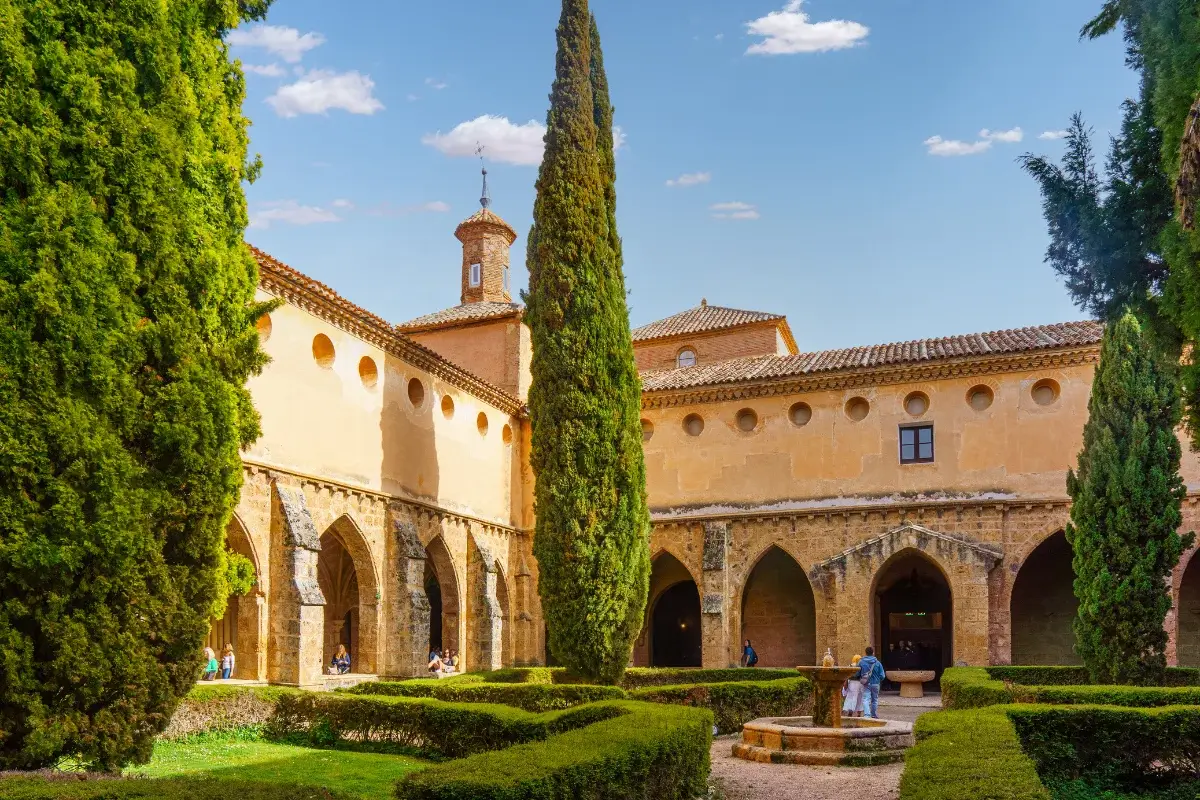

The name comes from Petras Albas — white stones — because the site was a limestone quarry with pale-toned rock. A medieval chronicle says Queen Elisenda chose the location by hanging meat at different points on the hillside: Pedralbes was where it took longest to decompose, indicating a dry, well-ventilated microclimate suitable for a cloistered community. Founded in 1327, the monastery preserves the largest Gothic cloister in the world, the earliest Trecento-influenced painting on the Iberian Peninsula, and one of the most singular medieval tombs in Catalonia.
In February 2025, the last three resident nuns transferred to a convent in Girona. A community that had been here continuously since 1327 — nearly 700 years without interruption — is no longer. The building is now fully a museum. The 700th anniversary year is 2026.
A Monastery Built in Twelve Months
The construction took just over a year — unusual speed for the period. The reason was the king’s health: papal authorization arrived February 1, 1325; the first stone was laid March 26, 1326; the church was consecrated May 3, 1327. Six months after inauguration, Jaime II was dead. The urgency is self-explanatory.
Elisenda de Montcada was Jaime II’s fourth wife, from one of the most influential noble families in the Crown of Aragon. The foundation was not purely a pious act — it was a political maneuver that bound the royal house to the Montcada family and created a space of female power on the axis between Sarrià and Barcelona. The first community comprised 14 nuns and 15 novices from the Convent of Sant Antoni in Barcelona. After widowing, Elisenda did not return to court life. She installed herself in an annexe palace, where she lived for 37 years until her death in 1364 — never professing as a nun, but never fully returning to conventional aristocratic life either. Her will ordered the palace demolished after her death. Archaeological excavations in the 1970s found the remains.
Is Pedralbes Monastery worth visiting in Barcelona? Yes, particularly for three elements found nowhere else: the world’s largest Gothic cloister in a single intact complex; Ferrer Bassa’s 1346 murals — the first Giotto-influenced painting in the Iberian Peninsula; and a bifrontal tomb where the same queen appears crowned from the church side and in nun’s habit from the cloister side. Entry €5. Free Sundays from 15:00 and first Sunday of the month.
The Three Spaces That Require Attention
The Cloister — Three Levels, 700 Years
The cloister organizes into three tiers: the two lower levels from the 14th-century foundation period; the third added in 1532 in a style that harmonizes with but doesn’t replicate the original. The columns of the lower levels are carved in Girona nummulitic limestone — a calite with visible fossil remains that gives it a singular texture. Each wing has 26 columns with capitals decorated with the shields of the Royal House of Aragon and the Montcada family.
The cloister was not only a transit space. The small daylight cells where nuns read and did needlework were distributed along its galleries. The interior garden includes a medicinal herb garden — recreated on archaeological and botanical evidence — that was the monastery’s living pharmacy.
The Tomb of Elisenda de Montcada — One Alabaster Block, Two Identities
The funerary monument of Elisenda de Montcada sits in the dividing wall between the church and the cloister, with two faces showing two entirely different versions of the same person. From inside the church: the queen appears with crown, sumptuous robes, and dynastic attributes of the Crown of Aragon — her public image for the faithful and posterity. From the cloister: she appears in a Poor Clare’s habit, with a more individualized face and an expression of humility.
Recent restoration work revealed that the arcosolium background was originally painted in deep blue scattered with gold stars. The tomb rests on three golden lions.
It is the only known Gothic tomb in Catalonia with this deliberate bifrontal design — two identities carved in a single alabaster volume.
The Chapel of Sant Miquel — The Oldest Italian-Style Painting in Iberia
In the northeast corner of the cloister is a prayer cell containing the most important murals of the Late Middle Ages in the Iberian Peninsula. Ferrer Bassa painted them between 1343 and 1346, commissioned by Abbess Francesca de Saportella, Elisenda’s niece. The commission went to a court painter who had seen Giotto’s work directly in Italy.
The technique combines fresco with dry-touch retouching. The scenes depict the Joys of the Virgin and the Passion of Christ, with figures showing an emotional expressiveness and a grasp of volume and spatiality that simply did not exist in Catalan painting of the period. Bassa died that same year — almost certainly of the Black Death sweeping Europe at the time. These murals are his only preserved work.
Following a comprehensive restoration completed between 2014 and 2018, the chapel now includes an augmented reality experience called Tocar l’Ànima (“Touching the Soul”) that reveals details of the painting impossible to perceive at normal viewing distance.
Quick Decision
- 90 minutes → Full cloister + Chapel of Sant Miquel + Elisenda’s tomb — the core artistic and historical circuit
- Richest experience of the murals → Book the augmented reality Tocar l’Ànima experience — limited access, confirm availability in advance
- Cost-free Sunday visit → Free entry from 15:00 every Sunday, or all day on the first Sunday of the month
- With children → The cloister, medicinal garden, and medieval kitchen are the most intuitively accessible spaces; the dormitory and infirmary read without prior context
- Minimum crowds → Tuesday or Wednesday at 10:00 — the cloister is practically empty
- For the 700th anniversary → The commemoration runs from March 26, 2026 (first stone anniversary) to May 3, 2027 (first mass anniversary)
The Monastic Rooms — How the Community Actually Lived
The least photographed part of the monastery is the one that best explains cloistered life.
The Kitchen: in continuous use from the 14th century until 1983. The layers are visible — 16th-century stone sinks coexist with a refrigerating chamber and stoves from later periods. It’s one of the most direct testimonies of historical continuity in the complex.
The Refectory: where the community ate in silence while a nun read aloud from the stone pulpit. The 16th-century murals by Francesc Granell cover the walls. The Angel’s Fountain in the cloister facing the entrance is where the ritual hand-washing before meals took place.
The Infirmary: Renaissance architecture separated from the main nucleus to prevent contagion. It operated autonomously with its own kitchen and rest areas. Below it, the procures — large vaulted spaces — stored harvests, grain, oil, and contained stables and a wine cellar.
The Dormitory: the largest-scale room in the complex, with an architectural perspective that the exhibition Tresor del Monestir has restored to its full extent.
Why Ferrer Bassa’s murals matter technically
The largest Gothic cloister is the headline. The part worth understanding is why Ferrer Bassa’s murals are technically significant beyond their date.
In 1346, Catalan painting was still operating within a flattened Byzantine-influenced visual language: gold backgrounds, frontal figures, hierarchical sizing. Giotto had been working in Florence and Padua since the early 1300s with a radically different approach — three-dimensional figure modeling, emotional expressiveness, spatial recession. These ideas had not reached Catalonia.
Ferrer Bassa had seen Giotto’s Arena Chapel frescos directly. What he brought back — the turned bodies, the grief visible in individual faces, the sense of depth in the drapery — was, for Catalonia in 1346, a 30-year technical leap forward executed in a small prayer cell for a nun’s devotional use. The significance is not the date but the gap it represents.
The End of the Community — What Changed in 2025
In February 2025, the last three Poor Clare nuns residing in the adjacent building transferred to the Convent of Vilobí d’Onyar in Girona. The community had maintained continuous presence since 1327. The decision was the community’s own, due to the advanced age of the remaining sisters and the impossibility of maintaining contemplative life below the five-member minimum required by their rule.
The monastery now operates fully as a museum under Barcelona City Council management through the Institut de Cultura. A 75-year agreement guarantees that the community’s artistic assets remain displayed at the site in exchange for municipal rent.
Practical Information
| Season | Days | Hours |
|---|---|---|
| Winter (Oct 1–Mar 31) | Tue–Fri | 10:00–14:00 |
| Winter | Sat–Sun | 10:00–17:00 |
| Summer (Apr 1–Sep 30) | Tue–Fri | 10:00–17:00 |
| Summer | Sat | 10:00–19:00 |
| Summer | Sun | 10:00–20:00 |
| All year | Mon | Closed |
Entry: General €5; Reduced €3.50 (over 65, students under 30, unemployed, large families). Free under 16, Barcelona Card holders, Targeta Rosa. Accepts Spain’s Bono Cultural Joven.
Summer free afternoons: free entry Tuesday and Friday afternoons from June 6 to September 15.
Address: Baixada del Monestir, 9, 08034 Barcelona.
Transport: FGC line L12, Reina Elisenda stop (closest, a few minutes’ walk). Metro L3, Maria Cristina or Palau Reial stops (15 minutes on foot or bus transfer). Buses H4, V5, 63, 68, 75, 78.
FAQ
How long does a visit to Pedralbes take?
Between 90 minutes and two hours for a self-guided visit covering the cloister, Sant Miquel Chapel, tomb, and monastic rooms. The guided visit runs 1 hour 15 minutes. Add 30 minutes for the augmented reality experience in the chapel.
Why is the cloister the largest Gothic cloister in the world?
Pedralbes is the largest Gothic cloister by dimensions and integrity. It has three levels — the two lower from the 14th century, a third added in 1532. Its columns of Girona nummulitic limestone have a distinctive texture from the visible fossils in the stone. The Poor Clare community maintained it in continuous use for nearly 700 years.
What makes Elisenda’s tomb unusual?
It has two completely different faces representing the same person. From the church, she appears as queen with crown and dynastic attributes. From the cloister, she appears in the humble habit of a Poor Clare. This allowed her to be simultaneously present in the priests’ altar prayers and the nuns’ cloister prayers. It is the only bifrontal tomb of this type in Catalan Gothic architecture.
Do the nuns still live at Pedralbes?
No. The last three nuns transferred to Vilobí d’Onyar in Girona in February 2025. The community had been continuously present since 1327. The monastery now operates fully as a museum under a 75-year agreement with Barcelona City Council.
Pedralbes doesn’t compete with the Sagrada Família or the Palau de la Música for visitor attention — and that is its primary advantage. The 700-year cloister, the only bifrontal Gothic tomb in Catalonia, and the only Giotto-influenced painting in 14th-century Iberian art can be seen with time and in silence. That combination doesn’t exist anywhere else in Barcelona.
For the broader architectural context in the area: the Gaudí Pavilions (Pavellons Güell) are 10 minutes on foot. For the Gothic architecture comparison in the city center, the Gothic Quarter guide covers the Cathedral, Santa Maria del Mar, and the medieval streets at the opposite scale of Pedralbes. And for planning the full northwest Barcelona area visit, hidden places in Barcelona includes other undervisited spaces in the same district.