
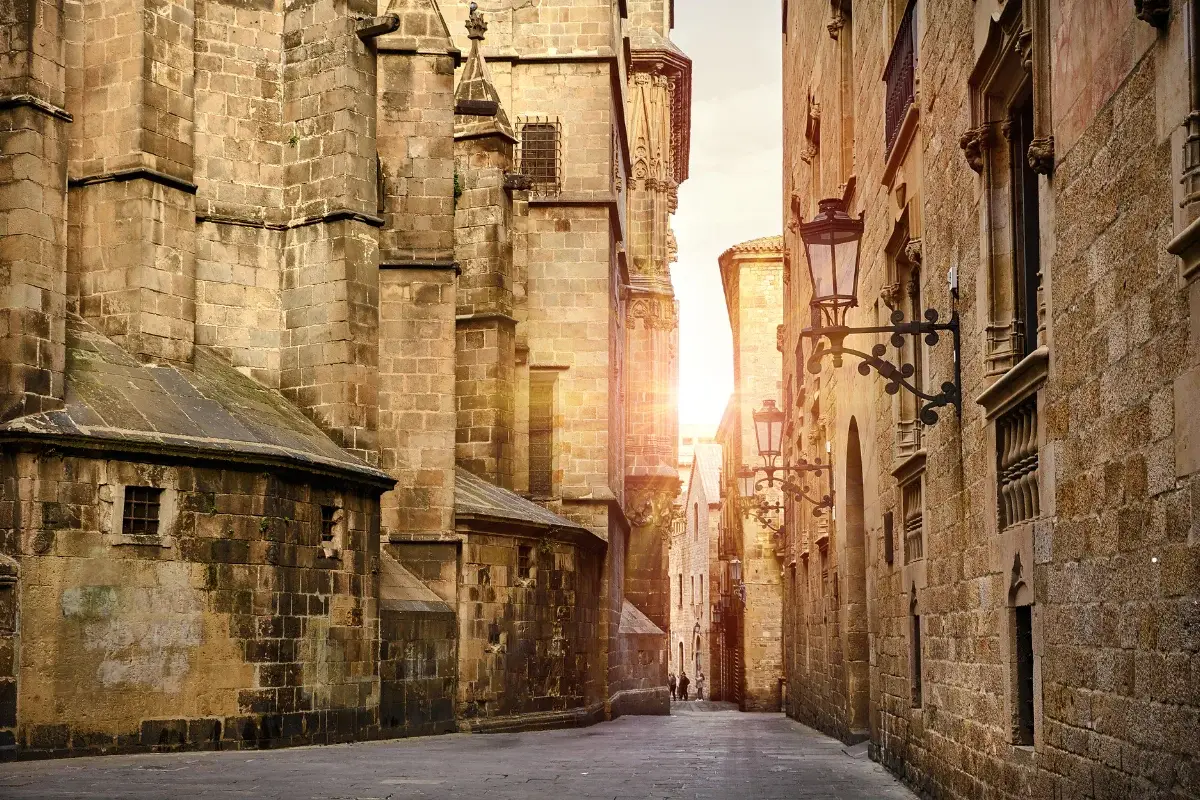

There is a version of the Gothic Quarter that Barcelona invented in the early 20th century — narrow stone streets, neo-Gothic bridges, a cathedral façade completed in 1913. And there is the version that has been there for two thousand years: Roman columns hidden inside a medieval courtyard, shrapnel craters on a church wall that nobody explains, and the ghost of a Jewish quarter destroyed in 1391. Both versions coexist within a few hundred metres of each other. Most visitors only see the first.
This guide makes both legible.
The Quarter That Built Its Own Past
What is the Gothic Quarter and is it really medieval?
Partly. The Gothic Quarter contains genuine 14th–15th century structures, but much of what looks medieval was built or heavily reconstructed between 1900 and 1930 as part of a deliberate urban branding operation. The Cathedral façade was finished in 1913. The Pont del Bisbe — the neighbourhood’s most photographed bridge — dates to 1928. Several buildings were relocated stone by stone to complete the “medieval” ensemble. Understanding this doesn’t diminish the visit — it makes everything you see more interesting.
Quick Decision
- Want the most authentic medieval space → The MUHBA underground Roman city beneath Plaça del Rei
- Want the best free hidden gem → Temple of Augustus — Roman columns inside a courtyard, free, no queue
- Want to understand what actually happened here → Plaça de Sant Felip Neri — the shrapnel craters explain more about Barcelona than most paid museums
- Want the most photographed shot → Pont del Bisbe, before 8:30am or after 8pm
- Want to see what the neighbourhood was before tourism → El Call, the medieval Jewish quarter — Carrer de Marlet, 9th-century Hebrew inscription
- Best paid visit → MUHBA underground city — Roman Barcelona beneath your feet, free on Sunday from 3pm
What the Opening of Via Laietana Actually Did
In 1901, the city of Barcelona began demolishing a dense working-class neighbourhood to drive a new boulevard — Via Laietana — through the old city. Around 10,000 residents were displaced. The rubble created space for what urban planners would later “medievalise” into the Gothic Quarter.
The Casa Padellàs, now home to the MUHBA, was moved stone by stone from Carrer dels Mercaders to Plaça del Rei to complete the monumental ensemble — and during its reconstruction, any elements that didn’t fit the Gothic aesthetic were quietly removed.
This is not a scandal. Cities rebuild their identities constantly. But knowing it changes how you read every façade in the neighbourhood. The Gothic Quarter is as much a 20th-century construction as a medieval survival.
The most honest way to visit it: treat the 1900–1930 layer as interesting in its own right, and the genuinely ancient layers — Roman Barcino, the Jewish Call, the 14th-century churches — as the reward for going deeper.
The Cathedral: What’s Gothic, What’s Not, and What to Actually Look At
Barcelona’s Cathedral was built primarily between the 14th and 15th centuries — the body of the building is genuine Gothic. The main façade you photograph from the square was completed in 1913, following medieval plans that had remained unexecuted for centuries. Both facts are true simultaneously.
The cloister is the reason to spend time here rather than pass through. Thirteen white geese live in the garden — one for each year of Santa Eulàlia’s life, the city’s patron martyr. The contrast between the noise of the surrounding streets and the enclosed silence of the cloister is one of the most effective architectural transitions in the city. It works whether or not you know the history.
The choir stalls inside the nave contain painted shields from the Order of the Golden Fleece, installed for the 1519 chapter meeting presided over by Charles V. It’s the most detailed visual record of imperial power in Barcelona, in a location nobody directs visitors towards.
The rooftop terrace has views across the neighbourhood’s rooflines and is worth the separate entry fee on a clear day. The best time to visit Barcelona’s monuments affects this specifically — the Cathedral rooftop in October afternoon light is a different experience from August midday.
Practical: Free until 12:30pm. €9 after that. The cloister has its own entrance and is accessible during the free period.
Plaça del Rei and the Roman City Below Your Feet
The Plaça del Rei is the neighbourhood’s most architecturally coherent medieval space — the Palau Reial Major, the Chapel of Santa Ágata, and the surrounding buildings have changed little since the 15th century. The square was also where Columbus reportedly reported to the Catholic Monarchs after returning from the Americas.
But the most important thing here is underground.
The MUHBA (Barcelona History Museum) has its main entrance on the square, with access to an excavated Roman city beneath current street level. The underground circuit covers 4,000 square metres of Barcino — the Roman colony founded in the 1st century BC. The route passes through garum factories (the fermented fish sauce that was the Roman equivalent of ketchup), dye works, laundries, and drainage systems from the 1st century AD.
The city is buried 4–7 metres below current street level, which makes physically visible exactly how medieval Barcelona was built on top of Roman Barcelona. No other site in the city demonstrates urban stratigraphy with this clarity.
Prices: Check the MUHBA website for current entry. Free Sundays from 3pm and first Sunday of every month all day. Advance booking recommended in high season. The hidden places in Barcelona guide covers the Temple of Augustus — also part of the same Roman circuit, 200 metres away, free.
Temple of Augustus: Roman Columns Nobody Expects
At Carrer del Paradís 10, inside the headquarters of the Centre Excursionista de Catalunya, four Corinthian columns stand 9 metres tall. They’ve been standing since the 1st century BC — the remains of the temple dedicated to Emperor Augustus at the highest point of the Roman forum.
The columns were hidden inside a medieval building for centuries. They were rediscovered and restored by Puig i Cadafalch in the early 20th century. The surrounding walls are Gothic — the visual collision between classical columns and medieval stone is the image the visit is built around.
The detail that changes the context: the Temple of Augustus stands on the Monte Taber, a barely 16-metre hill that was the geographic and symbolic centre of Roman Barcino. Walk across the square outside and you’re walking across what was once the heart of a Roman colony. The asphalt gives nothing away.
Access: Free. Variable opening hours — verify before visiting. The entrance looks private but is open to the public during visiting hours.
Plaça de Sant Felip Neri: What Those Holes in the Wall Actually Are
This small, photogenic square hidden between alleyways is one of the most-photographed corners of the Gothic Quarter. The irregular holes pockmarking the church façade and surrounding buildings are almost always described, when they’re described at all, as “marks from the Civil War.” That framing undersells what happened.
On the 30th of January 1938, two bombs dropped by Italian fascist aviation hit the square while civilians were sheltering there. Forty-two people were killed, the majority of them children from a nearby school. The craters are not decorative history — they’re the specific physical record of aerial bombing of a civilian population during the Spanish Civil War.
Knowing this before you stand in the square is the difference between a pleasant photograph and an encounter with what the city actually lived through.
The square is also architecturally interesting — the church is one of the few Baroque buildings in Barcelona, built between 1721 and 1752. Regular sacred music concerts use the space with historical instruments appropriate to the period.
El Call: The Jewish Quarter That Was Erased in 1391
El Call was for centuries one of the most important Jewish communities in the Crown of Aragon. Its streets — Carrer del Call, Banys Nous, Carrer de Marlet, Sant Domènec del Call — preserve the medieval street plan and some Hebrew inscriptions embedded in façades.
On Carrer de Marlet, a 9th-century Hebrew inscription is the oldest written evidence of Jewish presence in Barcelona. It’s mounted on a wall in a street most tourists walk through without slowing down.
The Major Synagogue on the same street was rediscovered in 1987. It has foundations from the 4th century and is considered one of the oldest synagogues in Europe. Access is by guided visit only.
In 1391, pogroms destroyed the community. The neighbourhood was partially demolished and its residents expelled or forcibly converted. What remains today is a fraction of what existed — which is why the MUHBA El Call interpretation centre, with original objects and documentation from the medieval period, is worth the visit for anyone who wants to understand the scale of what was lost.
The Call connects naturally to the rest of the old city. The El Raval neighbourhood guide covers what lies immediately to the west, across Las Ramblas — a different social history in a different architectural register.
Pont del Bisbe: The Most Photographed Lie in the Neighbourhood
The neo-Gothic bridge connecting the Palau de la Generalitat with the Casa dels Canonges is on more Instagram accounts than almost any other structure in Barcelona. It was built in 1928 by Joan Rubió i Bellver, a disciple of Gaudí.
Its Gothic detailing is Northern European in character — it references Flemish Gothic rather than anything in the local architectural tradition. This was a deliberate aesthetic choice by the architect, not a restoration. The bridge has no historical precedent on that site.
The keystone carries a small skull. Local legend holds that if it falls, the Palau de la Generalitat will be cursed. The legend was invented at roughly the same time as the bridge.
For photography without crowds: before 8:30am or after 8pm. Every other window of the day involves navigating around tour groups.
Plaça Reial and Its Gaudí Lamp Posts
The Plaça Reial is not medieval. It’s a 19th-century arcaded square designed in 1848 by Francesc Daniel Molina — a bourgeois public space at the edge of the historic district, next to Las Ramblas. It has a completely different character from the rest of the Gothic Quarter: lively, nocturnal, tourist-facing.
The central lamp posts were designed by a 26-year-old Antoni Gaudí in 1879 — one of his first public commissions. They have serpent and caduceus forms referencing Hermes, god of commerce. They’re easy to miss in context.
Basílica de Santa Maria del Pi: The Gothic That Works on Its Own Terms
Built in the 14th century, Santa Maria del Pi is a textbook example of Catalan Gothic — a distinct regional style that prioritises wide interior space, decorative austerity, and the manipulation of light over the vertical drama of French or German Gothic.
The 8-metre rose window is one of the largest in the world for a single-nave church. The octagonal bell tower was for centuries the highest point in the city.
The squares surrounding the church — Plaça del Pi and Plaça de Sant Josep Oriol — are two of the neighbourhood’s most comfortable places to sit and observe. The Carrer de Petritxol, running adjacent, has the city’s oldest operating chocolate shops: Dulcinea and La Pallaresa have served thick drinking chocolate with melindros (long biscuits for dipping) for decades without changing the formula.
Three things the standard Gothic Quarter account gets wrong
Three failures turn up in almost every account of the quarter:
They treat the medieval and the invented as equivalent. The Pont del Bisbe and the Cathedral nave are not the same kind of history. One is a 20th-century aesthetic pastiche; the other is a 600-year-old structural achievement. Presenting both as “medieval” flattens the neighbourhood’s actual complexity.
They describe Plaça de Sant Felip Neri as picturesque without explaining the craters. The shrapnel holes appear in thousands of photographs with captions like “charming hidden square.” The story of January 1938 is not a footnote — it’s the reason the square matters.
They ignore El Call entirely. The Jewish quarter is mentioned as a neighbourhood to walk through. The Major Synagogue, the 9th-century inscription, and the MUHBA El Call centre — which tells the story of one of the most complete destructions of a community in medieval Cataluña — are treated as optional extras. They’re not.
Mistakes to Avoid
- Paying Cathedral entry when you arrive after 12:30pm on a tight schedule — the free morning window (until 12:30pm) covers everything worth seeing for most visitors: the nave, the cloister, the geese. The rooftop needs separate entry regardless.
- Skipping the MUHBA underground because it has an entry fee — the free Sunday window (from 3pm, or all day first Sunday of month) makes this one of the best free experiences in the city. Worth reorganising a full day around.
- Going to see the Pont del Bisbe at 11am on a Saturday — the photograph is impossible to take without a crowd. Before 8:30am is the only reliable window.
- Treating El Call as a walking neighbourhood without stopping — the 9th-century inscription on Carrer de Marlet and the Major Synagogue are specific destinations, not atmosphere. Find them on a map before you arrive.
- Conflating the Gothic Quarter with El Born — they’re adjacent but distinct. The Gothic Quarter is denser, more tourist-facing, with heavier medieval history. El Born has a different social character, better gastronomy, and Santa Maria del Mar. The best streets walking guide covers both in a single logical circuit.
Best Strategy
-
2 hours (essentials only) → Catedral (cloister free until 12:30pm) → Temple of Augustus (free, 5 min) → Plaça del Rei exterior → Pont del Bisbe → El Call (Carrer de Marlet inscription). Everything on foot, no entry fees.
-
Half day → Add MUHBA underground city (book in advance or go Sunday from 3pm) + Plaça de Sant Felip Neri + Santa Maria del Pi. Finish with chocolate at Dulcinea on Carrer de Petritxol.
-
Full day → Everything above + MUHBA El Call + Plaça Reial at dusk + dinner in El Born. The El Born guide covers the second half of this circuit in the same depth.
Practical Information
| Place | Entry | Free option | Hours |
|---|---|---|---|
| Barcelona Cathedral | Free until 12:30pm / €9 after | Morning visit | Variable |
| MUHBA underground | Paid (check website) | Sun 3pm+ / 1st Sun all day | Tue–Sun |
| Temple of Augustus | Free | Always free | Variable hours |
| MUHBA El Call | Paid | Sun 3pm+ / 1st Sun all day | Tue–Sun |
| Major Synagogue (Call) | Guided visit fee | — | By guided visit |
| Plaça Sant Felip Neri | Free | Always | Outdoor |
| Pont del Bisbe | Free | Always | Outdoor |
Getting there: Metro L4 Jaume I (direct access to Plaça de Sant Jaume and the Cathedral) or L3 Liceu (approach via Las Ramblas). From Barceloneta, 10 minutes on foot through the Port Vell.
The Gothic Quarter connects directly west to El Raval across Las Ramblas, and east to El Born across Via Laietana — the same boulevard whose construction in 1901 displaced 10,000 residents to make space for the neighbourhood you’re visiting.
One ticket covers 4,000 m² of Roman city beneath these streets plus around 15 other MUHBA sites, and almost nobody uses more than one — the calculation the MUHBA Roman Barcelona guide makes.
Frequently Asked Questions
Is the Gothic Quarter actually medieval?
Partly. Genuine 14th–15th century structures exist throughout the neighbourhood. But much of what looks medieval was built or reconstructed between 1900 and 1930 as part of a deliberate urban rebranding. The Cathedral façade finished in 1913, the Pont del Bisbe dates to 1928, and at least one building was moved stone by stone to complete the “medieval” ensemble.
How long does the Gothic Quarter take to visit?
Two hours for the essentials (Cathedral cloister, Temple of Augustus, Plaça del Rei, El Call, Pont del Bisbe). A full day if you include the MUHBA underground city, Santa Maria del Pi, MUHBA El Call, and the Plaça Reial at dusk.
Is the MUHBA underground free?
Yes, Sundays from 3pm and the first Sunday of every month all day. The rest of the time it has an entry fee. Online booking recommended in high season — the timed slots fill up.
What are the holes in the walls of Plaça de Sant Felip Neri?
Shrapnel craters from the Spanish Civil War. On 30 January 1938, two bombs dropped by Italian fascist aviation hit the square while civilians sheltered there. Forty-two people were killed, most of them children. They are not decorative.
Can you visit the Major Synagogue in El Call?
Yes, by guided visit. It’s on Carrer de Marlet. It has foundations from the 4th century and is one of the oldest synagogues in Europe. The street also has a 9th-century Hebrew inscription that is the oldest written evidence of Jewish presence in Barcelona.
When is the best time to photograph the Pont del Bisbe?
Before 8:30am or after 8pm. Every other time slot involves navigating around tour groups. The bridge faces south, so morning light is flattest — late afternoon gives the best side lighting on the Gothic stonework.