
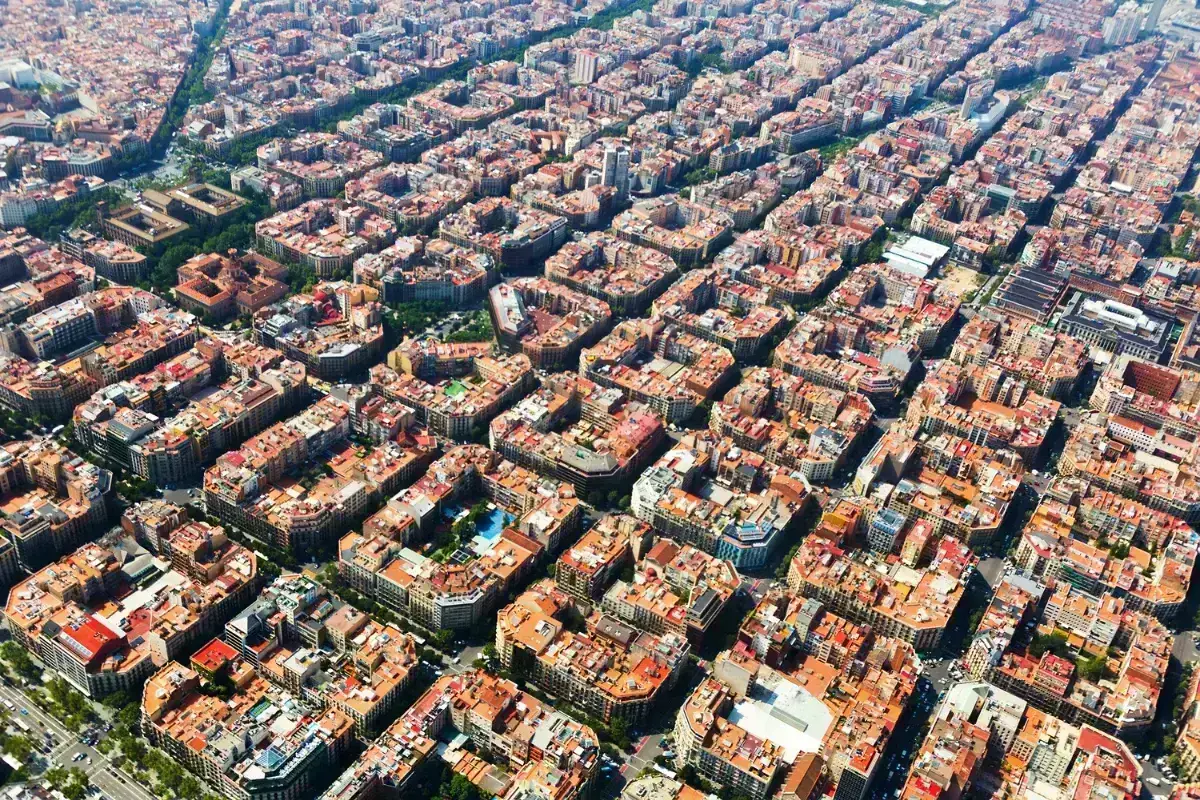

The street grid of Sants is the most honest historical document in the neighborhood. It doesn’t follow the Eixample’s orthogonal logic because Sants wasn’t part of Barcelona when Ildefons Cerdà designed his plan. It was an independent municipality — Santa Maria de Sants — with its own roads, its own textile factories and its own organized working class. Barcelona annexed it in 1897 without asking. The irregular streets, the small plazas, the passages between blocks — all of that is the physical record of a village that existed before the district did.
The annexation is still visible in every block. And that resistance to the Eixample’s uniformity is exactly what gives Sants its character today.
What the Industrial History Left Behind
The Carrer de Sants — the main commercial axis — was already a functioning road in 1790, when it was part of the Barcelona-Madrid highway. Two centuries before the Eixample existed, Sants had commercial infrastructure. When industrialization arrived in the mid-19th century, the village already had the bones.
The Vapor Vell — founded in 1846 by Joan Güell, father of Gaudí’s patron — was the first large steam-powered factory in Catalonia. The chimney is still standing: 54 meters of prismatic brick visible from anywhere in the lower part of the neighborhood. When textile production moved to the Colònia Güell, the building was left empty for decades. A 2000 rehabilitation by Josep Maria Julià preserved the original wooden roof trusses in the upper floor and converted the complex into a library, school and cultural center.
It’s one of the most successfully rehabilitated industrial buildings in Barcelona. It receives a fraction of the visitors of anything with Gaudí’s name attached.
Also here: in 1919, workers at La Canadenca — the electricity plant whose three chimneys still stand as the Jardí de les Tres Xemeneies — went on strike and cut all power to Barcelona. The conflict forced the Spanish government to legislate an eight-hour maximum working day. One of the first such laws in the world. It happened in Sants, not in a parliament.
The Park That Doesn’t Look Like a Park
The Parc de l’Espanya Industrial occupies the site of the Vapor Nou, the second major textile factory in the neighborhood. When the factory closed, the city commissioned architect Luis Peña Ganchegui, who delivered something in 1985 that nobody had predicted: an artificial lake, nine white lighting towers that reference industrial chimneys, and a metal dragon sculpture that functions as a water slide.
The dragon is the central piece and one of the most photographed structures in the neighborhood. Children queue for it. Adults queue for photographs of children queueing.
The white towers are the most unsettling element — they carry the visual language of surveillance infrastructure converted into public lighting. Peña Ganchegui played deliberately with the tension between industrial control space and neighborhood leisure space. The park sits three minutes on foot from the main Sants train station, which means it’s one of the most accessible unusual parks in the city for anyone passing through.
What the park is not: a relaxing green space. The geometry is aggressive, the materials are hard, and the lake reflects light in ways that feel more architectural than natural. Go expecting a landscape experiment, not a picnic ground.
The Elevated Garden Nobody Knows About
For decades, the railway tracks entering Barcelona from the west physically cut Sants in two. A concrete and rail barrier that blocked movement between the blocks to the north and south.
In 2016 that barrier became a park. The Jardins de la Rambla de Sants is an 800-meter elevated green platform built over the train tracks — Barcelona’s version of the New York High Line, without the marketing budget. Mediterranean vegetation, rest areas, and rooftop views of the neighborhood that are available from no other point at ground level.
The best time to visit is late afternoon, when the low light cuts across the rooftops and satellite dishes that define this part of the city. The access points are along the Carrer de Sants; they’re not marked on most tourist maps, which guarantees the company of neighbors rather than visitors.
For anyone combining hiking near Barcelona with urban exploration, the Rambla de Sants is a genuinely unusual elevated walkway that merits the detour. The view at the northern end, looking back toward the Eixample, shows the urban transition that happened when Sants was absorbed into the grid.
The Market That’s Actually a Market
Architect Pere Falqués designed the Mercat de Sants in 1913 — exposed brick, ceramic details, the same Falqués who designed the ornate lamp posts of Passeig de Gràcia, but here working for a working-class neighborhood rather than for the bourgeoisie. The building was rehabilitated in 2014 with the original facade intact.
Inside: approximately 50 stalls of fresh produce, with the actual function of a neighborhood market rather than the tourist-facing food hall format that has colonized several of Barcelona’s more famous markets. The architecture works better from the inside than from the street — the proportions of the columns and the roof become clear once you’re in.
Worth entering even without buying anything.
Can Batlló: The Industrial Complex Residents Occupied
In the La Bordeta sub-neighborhood, Can Batlló is an industrial complex comparable in scale to Camp Nou that had been promised as green space and neighborhood infrastructure in the 1976 Metropolitan General Plan. In 2011, after decades of non-delivery, the neighborhood occupied it.
Today it functions as a community-managed space: a popular library specializing in labor history, carpentry and circus workshops, and Coòpolis — a cooperative atheneum that is a European reference in social economy. The space is operational, functional and unfinished simultaneously.
The tension with the city over the rehabilitation of the remaining warehouses is ongoing. Can Batlló is an experiment in progress, not a museum. Visit it as such — the library is open to the public, the workshops run on schedules, and the atheneum hosts public events. It’s the most genuinely radical community project accessible to visitors in Barcelona.
The Plaça d’Osca: The Untouristed Square
The Plaça d’Osca is a small pedestrianized square two blocks from the train station that appears in zero tourist guides and in every local conversation about the neighborhood. Bar terraces, independent retail, the Sunday vermouth ritual.
It’s the type of square that was normal in Barcelona before mass tourism redesigned the city for external consumption. The Bodega Bartolí, open since 1939, serves the esmorzar de forquilla — the Catalan mid-morning meal of egg, charcuterie and bread with tomato — at a bar counter that hasn’t changed era. It’s the most local food experience in the neighborhood and one of the least known in the Barcelona breakfast guide.
The Carrer de Sants: A 4-Kilometer Commercial Axis
The Carrer de Sants, continuing as Carrer de la Creu Coberta, adds up to approximately 4 kilometers of continuous commercial street. Local associations claim it as the longest commercial axis in Europe — a statistic that matters less than what it implies: a scale of neighborhood commerce that has been disappearing from most European cities for decades, surviving here because the neighborhood has enough residential density to support it.
Walking the full length — from Plaça de Sants to Plaça d’Espanya — gives a precise picture of what Barcelona looks like when it isn’t performing for visitors. Shoe repair shops, fabric stores, traditional ironmongers and pharmacies alongside newer restaurants and cafés. The commercial mix of a functioning neighborhood, not a curated visitor zone.
The 1919 strike that won the eight-hour day
The most important thing that happened in Sants rarely makes an itinerary: the 1919 La Canadenca strike that established the eight-hour working day. The connection between Sants’ industrial history and a global labor milestone is rarely made explicit in neighborhood guides, which tend to focus on parks and markets rather than the social movements that gave the neighborhood its political identity.
The Jardines de les Tres Xemeneies — where the chimneys of La Canadenca still stand — is the most direct physical memorial to that history. It’s also the largest legal graffiti wall in the city, managed by the Wallspot platform, with murals that change regularly. Skaters, visual artists and neighborhood residents coexist in a space that’s equal parts industrial archaeology and contemporary urban culture.
Is Sants Worth a Visit?
Yes — but as part of a specific itinerary rather than as a primary destination. Sants doesn’t have a single iconic attraction. It has a collection of things that individually are interesting and collectively are revealing: an elevated garden that nobody marketed, an occupied industrial complex that became a social economy laboratory, a park built from factory ruins, a market that functions as a market.
For a visitor interested in Barcelona beyond the Eixample and the Gothic Quarter, Sants gives a more accurate picture of how the city actually works than most neighborhood guides suggest.
When it doesn’t work: if you need Instagram-ready landmarks with clear opening hours and organized queues. Sants’ most interesting elements — the Rambla de Sants, Can Batlló, the Jardí de les Tres Xemeneies — are open spaces without visitor infrastructure. The neighborhood rewards curiosity rather than checklists.
How to Organize the Visit
Half day (3 hours): Exit Sants station toward the Parc de l’Espanya Industrial (3 minutes). Find an access to the Jardins de la Rambla de Sants on Carrer de Sants and walk the 800-meter elevated garden. Descend to the Mercat de Sants. End with vermouth at Plaça d’Osca or the esmorzar at Bodega Bartolí.
Full day: Add the Vapor Vell and Can Batlló in the afternoon. Connect at the end to Plaça d’Espanya for the Montjuïc ascent — the Montjuïc complete guide covers everything above the mountain from the MNAC to the castle.
Connections
Sants borders Poble Sec to the east and has direct access to Montjuïc via Plaça d’Espanya. The Sants train station is the largest rail hub in Catalonia — 10 minutes by metro from Passeig de Gràcia (L3), with Rodalies, long-distance and international connections.
The neighborhood makes most sense as the morning half of a day that ends on Montjuïc. The Barcelona first-time visitor guide gives the framework for understanding where Sants sits geographically relative to the rest of the city.
Final Insight
Sants was absorbed into Barcelona’s administrative body 128 years ago. Its street grid still hasn’t fully accepted the logic of the Eixample. The elevated garden is built over train tracks that used to divide it. The occupied industrial complex runs community services that the municipality promised and didn’t deliver. The neighborhood’s whole character is defined by what it resisted — which makes it one of the more honest places to understand what Barcelona actually is beneath the tourism infrastructure.
For the Festa Major, it’s the last week of August around August 24. The street installations built by neighborhood associations over months of work, the castellers, the correfocs and the open-air chess tournament (the largest in Spain) make it the most genuinely local festival in any Barcelona neighborhood.