
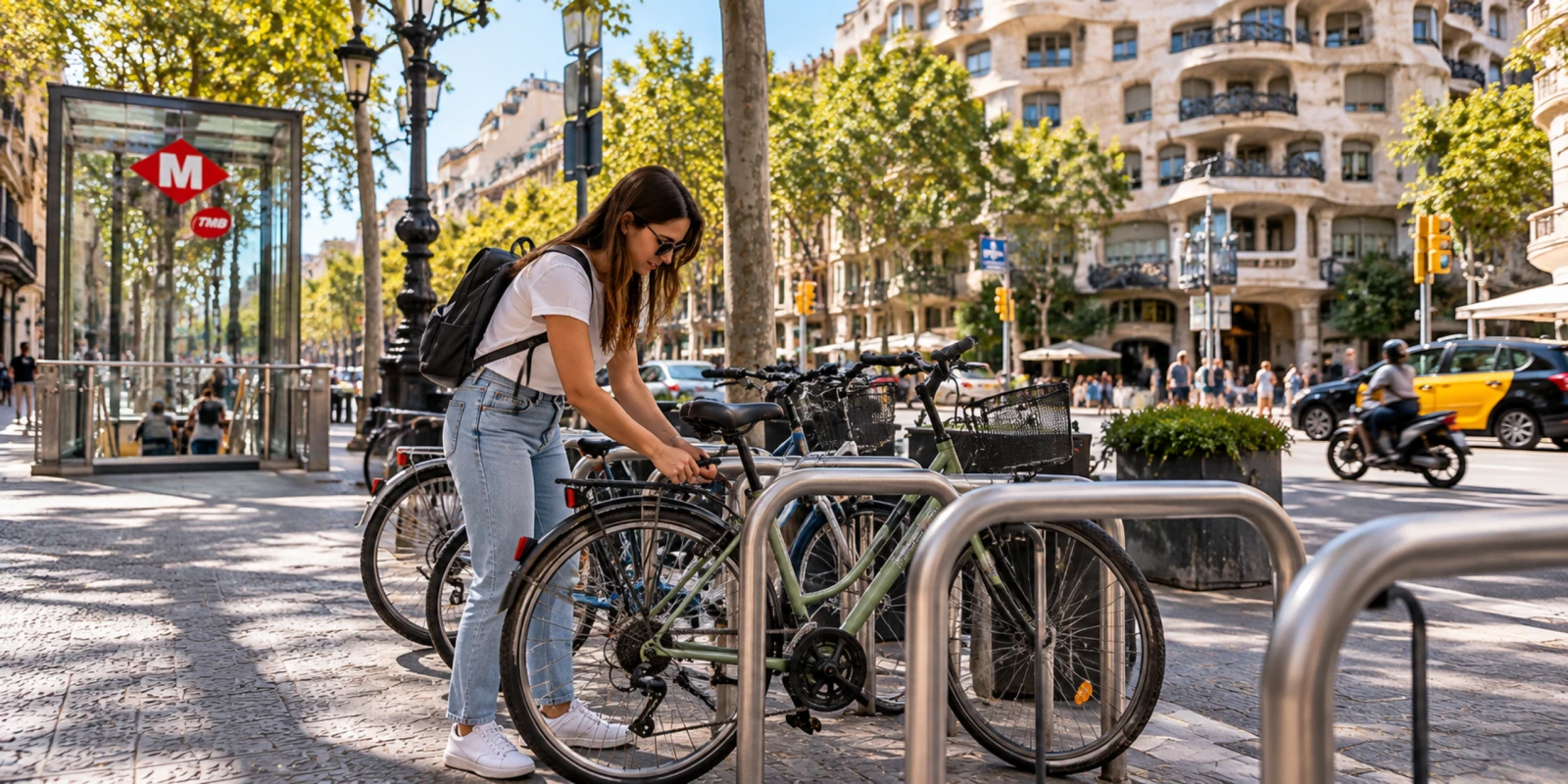

Bike theft in Barcelona is measured, and the numbers are the reason this decision matters: reports rose from 921 in 2024 to 1,046 in 2025, more than half of thefts are never reported, and around 20 per cent of victims stop cycling afterwards. Against that the city offers three very different answers. The street gives 46,210 spaces across 4,407 anchor points, free and with no time limit. Under cover, 64 car parks take bikes and 61 of them never close. And the metropolitan Bicibox locker starts at 0 euros a year, with insurance while the bike sits inside the module.
Where should you leave a bike in Barcelona? For half an hour, the street: 46,210 spaces in 4,407 points, free and untimed. For a working day or a night, one of the 64 car parks with bike spaces, 61 of them open midnight to midnight. The Bicibox adds annual tiers of 0, 20 and 40 euros with insurance included.
How often bikes are stolen here
The theft figures come from a named study, not from impressions, which is rarer than it sounds.
The Bicicleta Club de Catalunya publishes, with the ICTA-UAB and using data from the Mossos d’Esquadra, the Guàrdia Urbana and the Àrea Metropolitana, a report recording 921 reports in 2024 and 1,046 in 2025. It also puts numbers on two things cyclists already sensed: more than half of thefts go unreported and around 20 per cent of victims stop using the bike to get around.
Thefts concentrate in the Eixample, Ciutat Vella, Gràcia and Sant Martí, which are also the districts with the most anchor points. That is not a coincidence: it is where more bikes are locked up for more hours.
The report’s own proposal is to deploy GPS decoy bikes to find out where stolen bikes end up.
What the frame number does for you
This is the detail that separates a useful report from one that leads nowhere.
Of the 1,046 reports filed in 2025, the study warns that a good share carry neither the frame number nor photographs, and without both the bike is effectively impossible to identify if it surfaces. Photograph the frame number today rather than on the day it disappears.
It is worth doing before anything else on this page, because none of the parking options below removes the risk entirely.
The Bicibox and its three tiers
The least known of the three options, largely because the entry tier costs nothing.
| Tier | Annual fee | Maximum stay |
|---|---|---|
| Daily use | 0 euros | 24 hours |
| Very frequent use | 20 euros | 72 hours |
| Full, at a reserved station | 40 euros | no limit |
Bicibox charges these three fees as the secure parking service of the Àrea Metropolitana de Barcelona. It works with closed modules and includes insurance for the bike, the scooter or the personal mobility vehicle while it sits inside. Registration is through its app and the vehicle has to be registered.
The difference against a street anchor is not the price, which at entry level is zero, but that the bike ends up locked inside and covered.
The 64 covered car parks
This is the option most people do not know exists, and it is the one that changes an overnight stay.
Of the city’s 555 car parks, 64 have spaces reserved for bicycles. Sixty-one open every day from midnight to midnight, so they cover both a working day and a full night. The two exceptions are the les Corts funeral home, 8 am to 10 pm, and the SABA Gràcia I, closed on Sundays.
The spread favours the centre again: 13 in the Eixample and 12 in Ciutat Vella, which is 25 of the 64, against 2 in Nou Barris, 2 in Sant Andreu and 2 in Horta-Guinardó.
One thing to know before going: the register publishes no rate for the bike space. The price is asked at the car park before driving in, the same as the stay at an EV charging point.
Pavement or roadway, and why it matters less than you think
There are two kinds of anchor point and the difference is not the obvious one.
On the pavement there are 3,123 points with 33,645 spaces, three in every four. On the roadway, inside the strip where cars used to park, there are 1,284 points with 12,565 spaces.
Taking a car space does not make them bigger: the median roadway point holds 8 spaces and the median pavement point 10. The largest in the city is a roadway one with 62 spaces, and the largest pavement one has 60. What actually changes is where the bike ends up, at a doorway or between cars.
How many spaces each district has
The spread is very uneven and worth knowing before counting on finding a space.
The Eixample holds 11,549 spaces across 1,190 points and Sant Martí 9,953 across 956. In the middle sit Ciutat Vella with 4,758, Sants-Montjuïc with 4,637, les Corts with 3,910, Gràcia with 2,880, Sant Andreu with 2,780 and Sarrià-Sant Gervasi with 2,723. At the far end, Horta-Guinardó has 1,429 across 139 points and Nou Barris 1,591 across 148, which is eight times fewer than the leader.
The median point holds 10 spaces, so the typical rack is a short row. And the street anchor is free with no time limit, which is not the case for a car.
If you are weighing the switch, routes and what Bicing costs are in the cycling routes guide, and for the days the bike will not do, the public transport guide and the metro ticket worth buying put the fares side by side. General street-crime advice for the city is in the safety guide.
For half an hour, the street. For a night, find a roof.
Frequently asked questions about parking a bike in Barcelona
How likely is a bike to be stolen in Barcelona?
Reports reached 1,046 in 2025 and 921 in 2024, but the Bicicleta Club de Catalunya says more than half of thefts are never reported, so the real figure is higher. Around 20 per cent of victims stop cycling afterwards.
Where can you park a bike in Barcelona?
On the street there are 46,210 spaces across 4,407 anchor points, free and with no time limit. Under cover, 64 of the city’s 555 car parks have spaces reserved for bikes, and 61 of those are open around the clock.
How much does Bicibox cost?
It has three annual tiers. Daily use is 0 euros a year with stays up to 24 hours, very frequent use is 20 euros a year with stays up to 72 hours, and the full tier is 40 euros a year with no stay limit at a reserved station.
Do Barcelona car parks charge for a bike space?
The open register publishes no rate for the bike space, so the price is asked at the car park before going in. What it does publish is the hours: 61 of the 64 are open every day from midnight to midnight.
Which Barcelona district has the fewest bike parking spaces?
Horta-Guinardó with 1,429 spaces across 139 points, and Nou Barris with 1,591 across 148. At the other end the Eixample has 11,549 across 1,190 points, eight times more than Horta-Guinardó.
What should you do if your bike is stolen in Barcelona?
File the report with the frame number and photographs, which is what allows the bike to be identified if it turns up. The Bicicleta Club de Catalunya warns that a good share of reports carry neither of the two.