
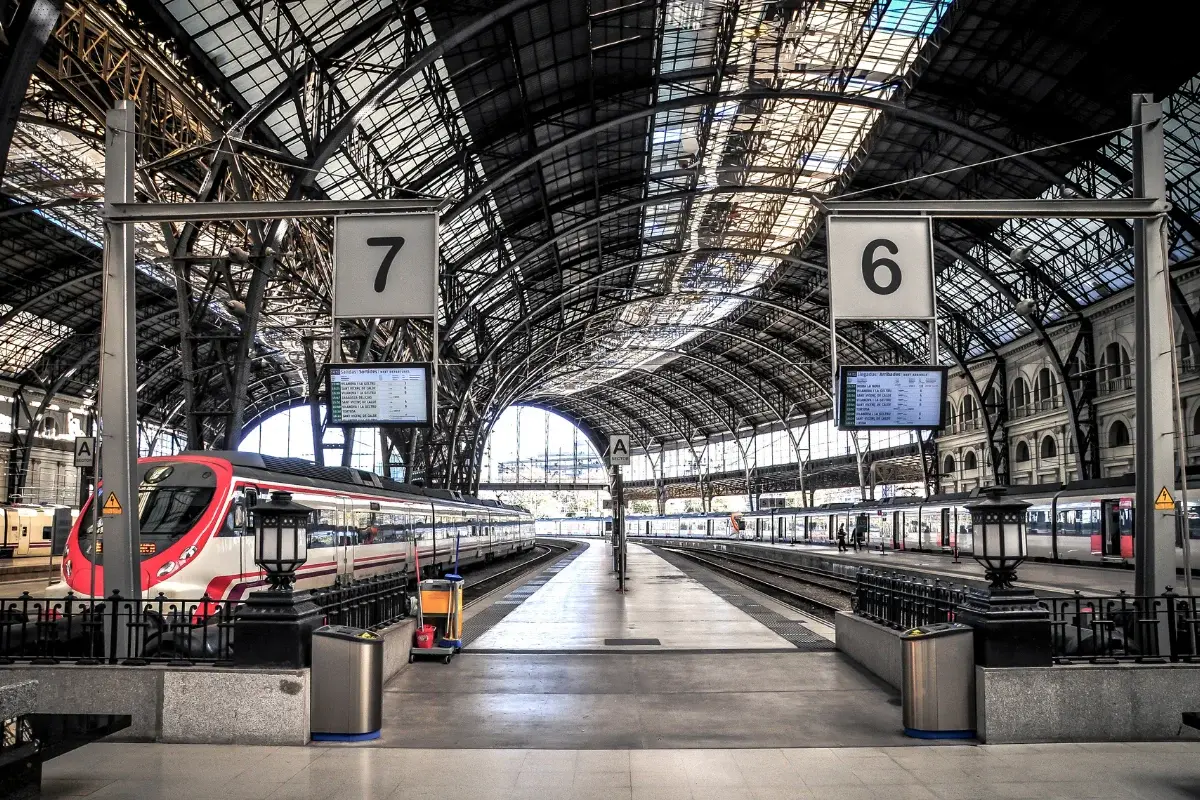

The curved iron canopy of Estació de França describes an arc for a specific reason: the tracks couldn’t run straight because an 18th-century Bourbon military fortress occupied the adjacent land. The engineers had to curve the approach. That defensive restriction — a relic of a military installation that no longer exists — produced the most distinctive railway interior in Spain: 29 meters of height, 195 meters of length, twelve tracks under a single curved steel vault.
The station opened June 2, 1929, two weeks after the Universal Exhibition. Alfonso XIII cut the ribbon. It’s still a working station today, free to enter, and one of the most genuinely undervisited landmarks in Barcelona.
What the Building Actually Is
França Station was built on a site with railway history going back to 1854, when the first Barcelona–Granollers line terminated here. The name “França” (France) consolidated after 1878, when the network extended to the French border — making this the departure point for the first direct Barcelona–Paris connection.
The 1929 building was commissioned by the MZA railway company as a monumental gateway for international visitors arriving for the Exhibition. Four architects and engineers divided the work: Andreu Montaner i Serra and Pedro de Muguruza handled the structural engineering; Raimon Duran i Reynals and Pelayo Martínez designed the public spaces and ornamentation.
The result splits into two distinct architectural registers that exist within the same building.
Is Estació de França worth visiting in Barcelona? Yes, and it costs nothing. It’s a working station — no ticket needed to enter. The main hall is a 17×73m Novecentist space with three domed skylights, marble floors, and bronze fittings comparable to the Gare d’Orsay in Paris. The curved iron canopy over the platforms is unique in Spain. Total visit time: 20–30 minutes. Metro: L1, Arc de Triomf stop.
The Iron Canopy — What the Curve Actually Means
The platform canopy is the industrial heart of the station and the space that produces the strongest first impression. Two twin vaults cover twelve tracks across a surface equivalent to three football pitches. The 29-meter height and the deliberate curve create a perspective that no other Spanish station can replicate: railway lines that appear to dissolve into an infinite arc of steel and light.
The 2022–2025 rehabilitation replaced deteriorated cladding with 10,900 m² of white cellular polycarbonate panels that transmit 48% of solar light. The work was carried out at 30 meters height with the station in continuous operation — over 2.3 million annual passengers moving under a 20,200 m² safety net for two years. Investment: €5.5 million.
The material choice matters: polycarbonate over glass maintains the original diffused-light quality of the Victorian railway hall while reducing thermal load on the structure below.
The Main Hall — The Space Most Visitors Never Reach
If the canopy is the industrial space, the main concourse is the ceremonial one. Designed primarily by Duran i Reynals, it measures 17 by 73 meters and is topped by three large domed skylights that flood the granite floor with zenithal light. Marble in multiple tones, polished bronze, classical proportions.
The Gare d’Orsay comparison is inevitable and accurate: same era, same concept of the railway palace as bourgeois representation, same dialogue between industrial engineering and civic grandeur. The functional difference is significant: the Gare d’Orsay closed to rail traffic in 1939 and reopened as a museum in 1986. França is still a station. That operational authenticity is something the Orsay no longer has.
| Attribute | Estació de França | Gare d’Orsay |
|---|---|---|
| Opened | 1929 | 1900 |
| Vault height | 29m | ~32m |
| Style | Novecentism / Eclecticism | Beaux-Arts / Eclecticism |
| Current use | Working station | Art Museum |
| Light transmission | 48% (polycarbonate, 2025) | Lateral + zenithal glazing |
Quick Decision — How to Use the Visit
- 15 minutes → enter from the passenger side, walk to the far end of the platforms to see the full curvature of the canopy, then cross through the concourse
- 30 minutes → add time in the main hall to read the bronze station map that shows the original 1929 track configuration — the changes visible today are historically significant
- Half day → combine with Ciutadella Park (5 minutes on foot), El Born neighborhood, and Santa Maria del Mar — all within a 10-minute radius
- Photography → the canopy reads best in mid-morning light from the south end of the platforms; the concourse is most empty on weekday mornings before 10:00
- Architecture focus → arrive from Arc de Triomf station on foot — the 1929 temporal and spatial sequence (arch → boulevard → park → station) is one of the most coherent urban routes in Barcelona
The owl sculptures embedded in the structure
Beyond the curved canopy, the detail worth looking for is the set of owl sculptures embedded throughout the structure.
Dozens of small stone owls are distributed across cornices, capitals, and elevated points in the concourse and platforms. Their origin is entirely functional: pigeon droppings are highly corrosive to iron and marble. The station managers installed owl figures — natural predators — to deter pigeons from nesting in the canopy structure.
The system failed. Barcelona’s pigeons learned that the statues posed no real threat. Today it’s routine to see pigeons roosting directly on top of the owl heads. Despite the technical failure, the owls have become an informal heritage detail — locating them has turned into a minor visitor game, and they appear in more Instagram posts about the station than the architecture itself. No mainstream guide mentions them as a point of interest.
The Station on Screen and in Literature
França Station is the most-requested Adif facility for film production in Catalonia. Its curved platforms, natural light, and monumental scale allow historical period evocation without sets.
Woody Allen used it in Vicky Cristina Barcelona (2008) as an arrival symbol. Alejandro González Iñárritu chose the concourse scale in Biutiful (2010) for its ability to amplify isolation. Almodóvar used the surrounding area in All About My Mother (1999). Carlos Ruiz Zafón placed it in the Shadow of the Wind universe as a temporal portal to post-war Barcelona.
The verifiable historical footnote: on February 22, 1923, Albert Einstein arrived at this station by train from Toulon, returning from a Japan lecture tour. It was the beginning of an academic visit to Barcelona that included lectures at the University of Barcelona. He descended from the train onto these platforms.
Practical Information
| Detail | Information |
|---|---|
| Entry | Free, no ticket required |
| Interior access | Concourse and platforms accessible to all |
| Metro | L1, Arc de Triomf — 8 minutes on foot |
| Best time | Weekday mornings, before 10:00 for empty concourse |
| Visit duration | 20–30 minutes standalone; 2 hours with Born + Ciutadella |
| Trains operating | Rodalies R2 Sud (Sitges, Vilanova, Tarragona) + regional lines |
Mistakes to Avoid
- Going only to the platforms: the main concourse — through the passenger entrance — is the architecturally richer space. Most transit passengers never see it.
- Missing the bronze station map: displayed in the concourse, it shows the original 1929 track layout. The differences from today’s configuration are a readable history of Barcelona’s rail network evolution.
- Expecting a museum: it’s a working station with real trains. The experience is closer to the Orsay before conversion than after — which is precisely what makes it valuable.
- Coming only by night: the curved canopy is only readable in natural light. After dark, the architectural argument disappears.
The debate about converting França into a cultural venue — following the Orsay model — reappears periodically in Barcelona’s urban planning discussions. Current infrastructure plans maintain its railway function as non-negotiable: without it, any failure in the central tunnels under Plaça Catalunya or Passeig de Gràcia would leave the network without capacity to maneuver. A monument that is also essential infrastructure is rarer than it looks.
For the broader architectural context of 1929 in Barcelona: the Mies van der Rohe Pavilion and the Palau Nacional were inaugurated the same year — three buildings from a single exhibition that took completely different trajectories in the following century. For the neighborhood around the station, the El Born Barcelona guide covers the medieval streets, markets, and waterfront within walking distance.